📑 Table of Contents
Imagine writing something so beautiful that the greatest composer in history transcribes it by hand—yet no one remembers your name. For nearly three hundred years, one of the most heart-wrenching melodies in Baroque music floated through concert halls as an orphan, attributed first to Vivaldi, then to another composer entirely. Only in the twentieth century did scholars finally discover the truth: this masterpiece belonged to a Venetian nobleman who never sought fame at all.
The Adagio from Alessandro Marcello’s Oboe Concerto in D minor is the kind of music that stops time. From the very first breath of the oboe, you feel something ancient stirring—a sorrow that transcends language, a tenderness that needs no explanation. It’s no wonder this single movement has appeared in films from The Hunger to The Firm, and most famously in the 1970 Italian classic Anonimo Veneziano (The Anonymous Venetian)—a title that eerily mirrors the composer’s own forgotten legacy.
The Nobleman Who Composed in Shadows
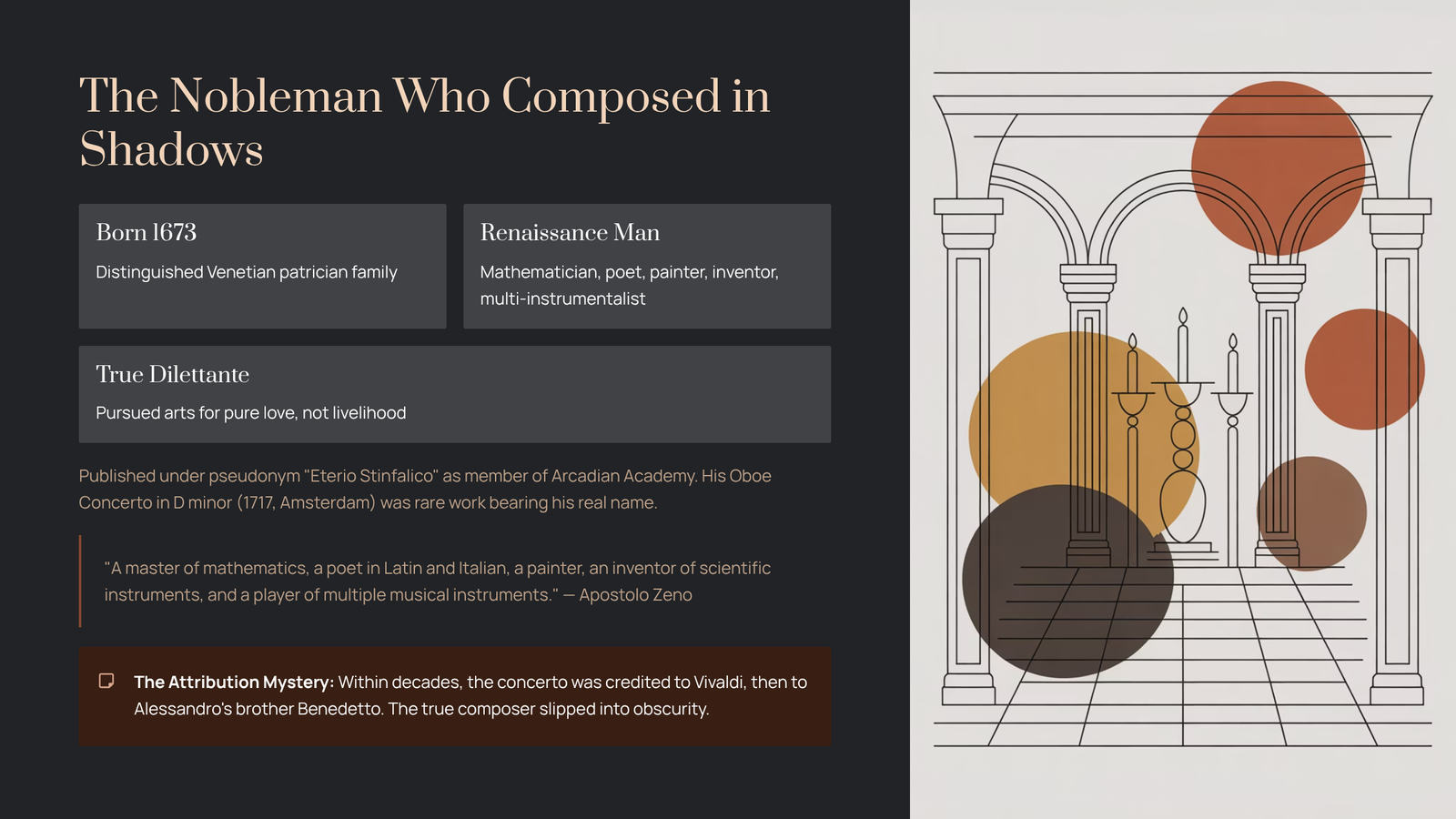
Alessandro Marcello was born in 1673 into one of Venice’s most distinguished patrician families. Unlike professional musicians who scraped by on church salaries and aristocratic patronage, Marcello lived a life of extraordinary privilege and intellectual breadth. His contemporary Apostolo Zeno described him as a master of mathematics, a poet in Latin and Italian, a painter, an inventor of scientific instruments, and a player of multiple musical instruments.
Yet Marcello published most of his works under the pseudonym “Eterio Stinfalico,” a reference to his membership in the Arcadian Academy. He was what the Italians called a dilettante—not in the dismissive modern sense, but meaning a gentleman who pursued the arts for pure love rather than livelihood. His Oboe Concerto in D minor, published in Amsterdam in 1717, was one of the rare works to bear his real name.
Unfortunately, that attribution didn’t stick. Within decades, the concerto was being credited to Antonio Vivaldi. Later, it became associated with Alessandro’s more famous younger brother, Benedetto Marcello. The true composer slipped quietly into obscurity, his single greatest achievement carrying someone else’s name.
When Bach Fell in Love
Around 1715, a young Johann Sebastian Bach encountered this concerto in Weimar and was immediately captivated. Bach had been systematically transcribing Italian concertos for solo keyboard—works by Vivaldi, Telemann, and others—transforming orchestral textures into music for harpsichord. But Marcello’s Adagio seems to have touched him differently.
Bach’s keyboard transcription (BWV 974) preserves the heartbreaking melody while adding elaborate ornamentation to the slow movement—trills, mordents, and grace notes that baroque performers would have improvised but rarely wrote down. In doing so, Bach created something like a love letter in musical notation, showing future generations exactly how he heard this music in his mind’s ear.
Today, oboists often perform Marcello’s original concerto using Bach’s ornamentations, creating a fascinating dialogue across three centuries between a forgotten Venetian nobleman and the greatest musical mind in German history.
What Makes This Adagio Unforgettable
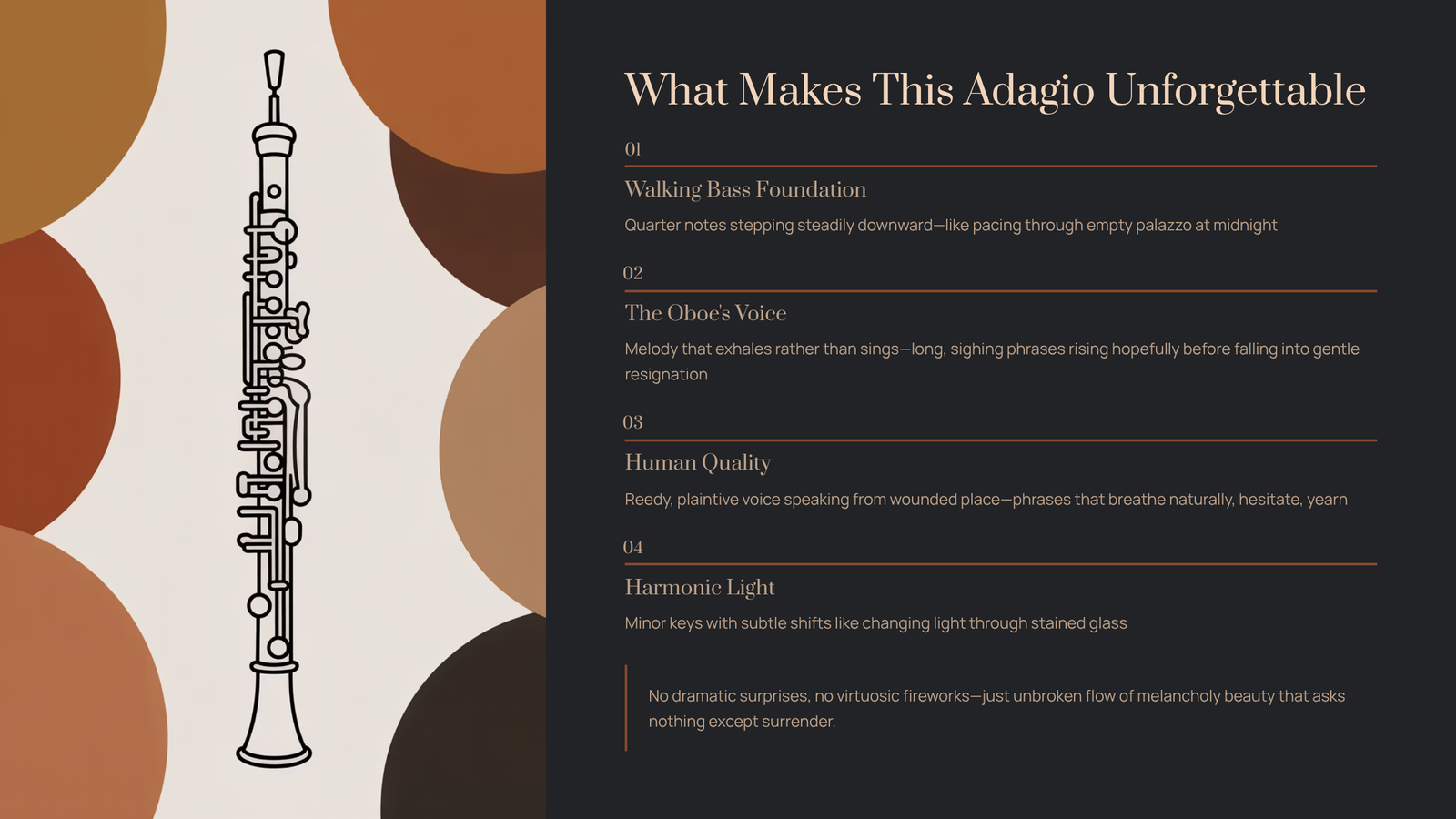
The movement opens with a simple, walking bass line—quarter notes stepping steadily downward like someone pacing through an empty palazzo at midnight. Above this measured foundation, the oboe enters with a melody that seems to exhale rather than sing. The phrases are long and sighing, rising hopefully before falling back into gentle resignation.
What strikes listeners immediately is the oboe’s almost human quality. Unlike the brilliant trumpet or the ethereal flute, the oboe carries a reedy, plaintive voice that seems to speak directly from some wounded place. Marcello understood this perfectly. He gives the soloist phrases that breathe naturally, that seem to hesitate and yearn, that tell a story without words.
The harmony moves through minor keys with subtle shifts that feel like changing light through stained glass. There are no dramatic surprises here, no virtuosic fireworks—just an unbroken flow of melancholy beauty that asks nothing of you except surrender.
How to Listen: Three Pathways
First Listen: Pure Emotion
Find a quiet space, close your eyes, and let the music wash over you without analysis. Don’t try to follow the structure or identify techniques. Simply notice where the melody makes you breathe deeper, where it tightens your chest, where it offers release. This Adagio rewards passive listening like few other pieces in the repertoire.
Second Listen: The Conversation
Now pay attention to the dialogue between the oboe and the strings. Notice how the orchestra provides a constant, gentle heartbeat while the soloist floats above with increasing freedom. Listen for the moments when the strings seem to answer the oboe’s questions, and the moments when they simply hold space for its grief.
Third Listen: Historical Imagination
Picture Venice in the early 1700s—the canals, the masks, the crumbling grandeur. Imagine a nobleman composing at night in a palazzo lit by candlelight, writing music he never expected would outlive him. Then imagine Bach in provincial Weimar, hundreds of miles away, copying this melody by hand and falling in love with a stranger’s sorrow. This Adagio is a message in a bottle that took centuries to deliver.
Recommended Recordings
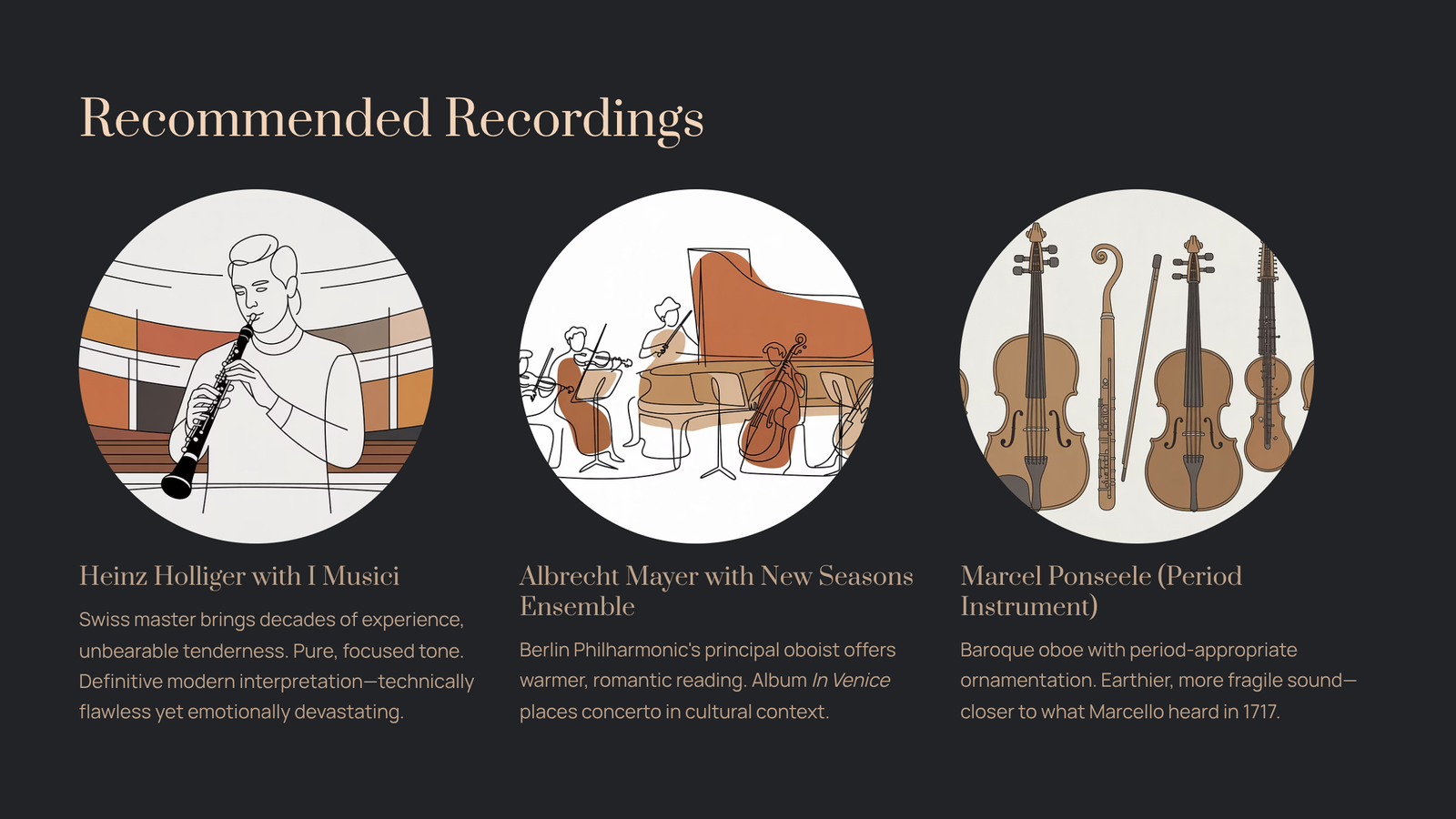
Heinz Holliger with I Musici
The Swiss master brings decades of experience and an almost unbearable tenderness to this recording. His tone is pure and focused, his phrasing utterly natural. This is perhaps the definitive modern interpretation—technically flawless yet emotionally devastating.
Albrecht Mayer with the New Seasons Ensemble
The Berlin Philharmonic’s principal oboist offers a slightly warmer, more romantic reading. His album In Venice places the concerto in its cultural context alongside other Venetian baroque works.
Marcel Ponseele (Period Instrument Performance)
For those curious about historical authenticity, Ponseele performs on a baroque oboe with period-appropriate ornamentation. The sound is earthier, more fragile—closer to what Marcello himself might have heard in 1717.
A Personal Reflection
There’s something deeply consoling about music that has survived this long without fanfare. Alessandro Marcello never knew that his Adagio would soundtrack Hollywood films or appear on meditation playlists three centuries later. He wrote it for its own sake, published it without much promotion, and died in 1747 having no idea that Bach had already immortalized it.
Perhaps that’s why this music feels so honest. It wasn’t composed to impress critics or win competitions. It emerged from a wealthy amateur who simply loved beautiful things—mathematics and poetry, painting and music, all equally worth pursuing for their own rewards.
When I listen to this Adagio, I hear someone who understood that the deepest emotions can’t be rushed or forced. The melody unfolds at its own pace, asking only that we slow down and listen. In our age of infinite distraction, that invitation feels more precious than ever.
Let the oboe sing its ancient song. Let the strings keep their gentle vigil. And let yourself, for just four minutes, inhabit a sorrow so beautiful it becomes a kind of peace.