📑 Table of Contents
There’s a particular kind of morning that arrives after a long, grey stretch—when you open the window and the air has changed overnight. You can’t name what’s different, but your shoulders drop. Something has loosened.
That’s the exact feeling Beethoven hands you in the first ten seconds of this piece. The violin slips in with a melody so open and unhurried that it doesn’t feel composed so much as exhaled. No grand announcement, no thunder. Just a tune that seems to have always existed, finally allowed to be heard.
People nicknamed it the “Spring” Sonata, and for once the nickname is honest. Beethoven didn’t give it that name himself, but whoever did was listening closely.

A Composer You Think You Know
Most people meet Beethoven through his stormiest work—the pounding fate motif of the Fifth Symphony, the brooding “Moonlight” Sonata, the image of a scowling man shaking his fist at the heavens. He’s been cast as music’s great sufferer.
That picture isn’t wrong, but it’s badly incomplete. Beethoven was also funny, tender, and capable of writing music that simply glows with contentment. In 1801, when he composed this sonata, he was around thirty, living in Vienna, and at the height of his early fame. His playing dazzled audiences. Commissions poured in.
And here’s the detail that makes the cheerfulness almost unbearable to think about: he had already begun to notice his hearing slipping away. The ringing in his ears, the conversations he couldn’t quite follow—it was starting. Within a year he would write a desperate letter confessing his terror of going deaf. Yet the music from this exact period brims with light. He poured the brightness somewhere, even as his own world was beginning to dim.
What “Sonata” Even Means Here
If the word “sonata” feels intimidating, here’s the only thing you need: this is a conversation between two instruments—violin and piano—who are genuine equals.
That equality was a real shift. In a lot of earlier music, the keyboard was background furniture while the violin sang. Beethoven refused to let that happen. Listen and you’ll hear the melody passed back and forth like a story two friends are telling together, each finishing the other’s sentence. The piano isn’t accompanying the violin. They’re in dialogue.
The movement we’re focused on is the first one, marked Allegro—Italian for “lively” or “cheerful,” which doubles as a perfect mood description.
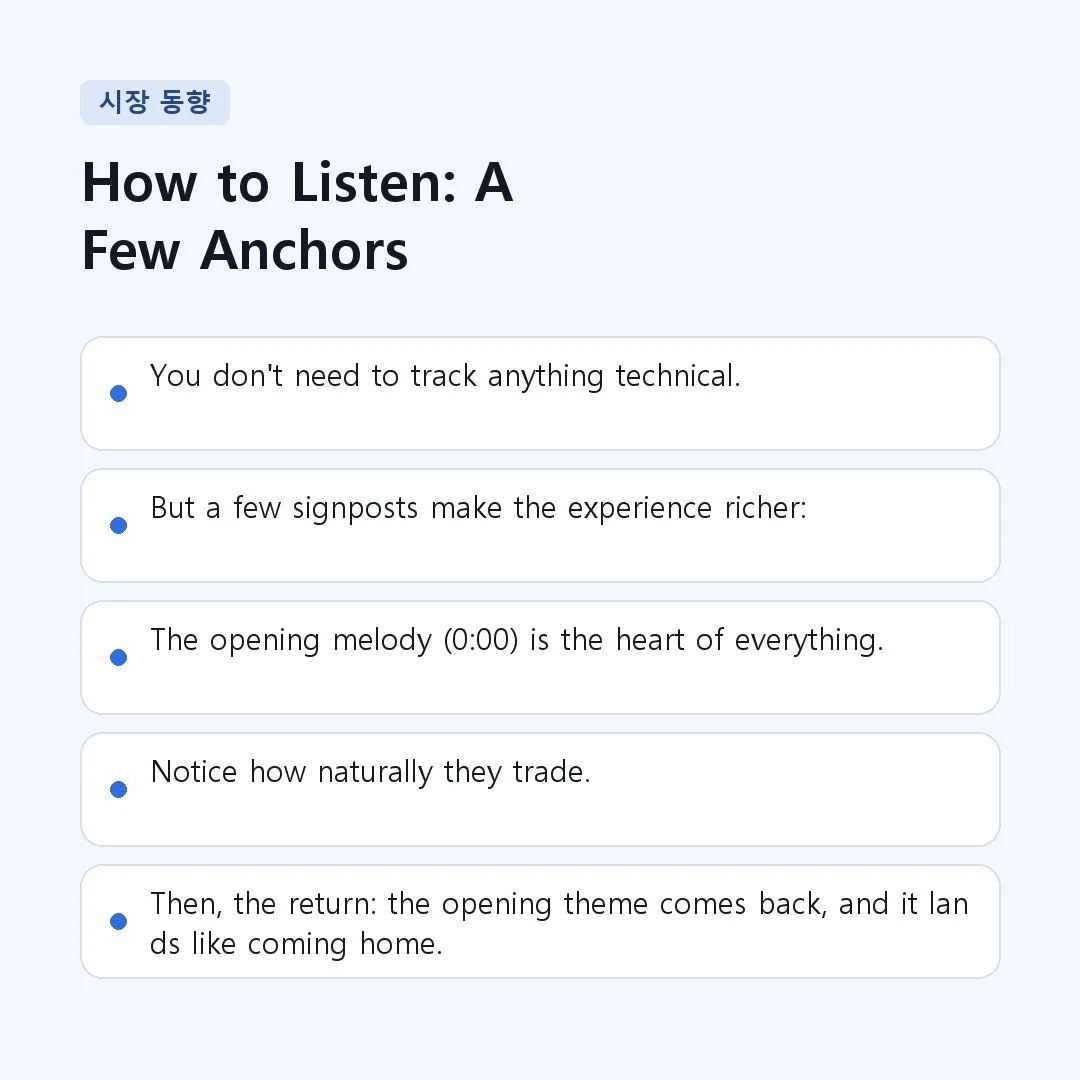
How to Listen: A Few Anchors
You don’t need to track anything technical. But a few signposts make the experience richer:
The opening melody (0:00) is the heart of everything. The violin sings it first; then the piano answers, taking the same tune and turning it over like someone admiring a stone in the light. Notice how naturally they trade.
Around the one-minute mark, the music gathers a little urgency—a brief shadow, some faster running notes, a sense of forward motion. This is the “development,” where Beethoven plays with the melody, tugging it into new keys, almost teasing it.
Then, the return: the opening theme comes back, and it lands like coming home. That sensation of recognition—oh, this again, but I’m happier to hear it now—is the entire emotional engine of the form. Composers spend the whole movement earning that homecoming.
The whole thing runs about ten minutes, and it never asks anything difficult of you. It just unfolds.

Where to Start Listening
A few recordings worth your time, depending on what you’re after:
Itzhak Perlman and Vladimir Ashkenazy give you the warm, generous, golden-toned reading—if you want the “Spring” to actually feel like spring, start here. Perlman’s tone is sunlight made audible.
Anne-Sophie Mutter with Lambert Orkis offer something more sculpted and dramatic, with a wider emotional range. Choose this if you like a performance with more edges and surprises.
For a lighter, more transparent and historically curious sound, Isabelle Faust brings a quicksilver agility that makes the dialogue between the instruments crackle.
Any of these is a wonderful door in. If you’re undecided, Perlman is the easy, embraceable first listen.
Let It Do Its Work
Some music demands your full attention. This piece doesn’t insist—but it rewards it.
Put it on when you need a reset. The morning of a fresh start, the moment after you finally finish something heavy, the quiet first coffee of a day you’re hoping will go better than the last one. Beethoven wrote brightness in a season when his own future was darkening, which means this music isn’t naïve. It knows what it’s holding back. It chooses warmth anyway.
That might be the most generous thing a piece of music can offer: not a denial of difficulty, but a deliberate, clear-eyed reach toward the light. Press play and let it reach for you too.