Handel’s eyesight failed gradually near the end of his life, but the exact cause of his blindness is uncertain. A note in his manuscript of Jephtha shows that trouble with his left eye was already interrupting his work in 1751; within a few years, he had lost most or all of his sight.
That timeline tells us more than a confident diagnosis would. It lets us follow what Handel was making as his vision worsened, and what he could still do when reading a score became difficult or impossible.
📑 Table of Contents
Handel and Jephtha: The Evidence in His Own Manuscript
Jephtha was Handel’s last major oratorio, a large work for solo singers, chorus, and orchestra. While composing it, he paused and wrote a note in the manuscript explaining that the weakening sight of his left eye prevented him from continuing. The note is unusually direct evidence: this is Handel recording a practical obstacle to composition as it happened.
He returned to the work and completed it. That matters because the familiar shorthand—“Handel went blind while writing Jephtha”—can make the change sound sudden and absolute. His note identifies a problem in one eye at a particular point. It does not tell us that he could no longer see at all, or identify the disease behind the problem.
The distinction also helps us hear Jephtha on its own terms. Its story concerns a father’s vow and its consequences, and its grave music belongs to that drama. The chorus “How dark, O Lord, are Thy decrees” may feel especially poignant beside the manuscript note, but its words are part of the oratorio’s story, not a statement by Handel about his eyes. Start with that chorus and notice how the voices move together before drawing apart; the musical uncertainty serves the text without needing a biographical explanation.
What Caused Handel’s Blindness?
Cataracts are often given as the answer. They are a plausible explanation for worsening vision in an older person, and biographical accounts describe attempts to treat Handel’s eyes. Yet the surviving evidence does not support a certain modern diagnosis. Reports of symptoms and treatments are not the same as the detailed examination an eye specialist would make today.
The safest conclusion is therefore a limited one: Handel experienced serious, progressive loss of sight, sought treatment, and eventually became blind. Saying precisely what happened inside his eyes goes beyond what we can establish. Even the failure of a treatment cannot, by itself, prove the original cause.
It is also easy to compress several years into one dramatic event. The interruption noted in Jephtha belongs to 1751; accounts of Handel’s near-total or total blindness describe the years that followed. His ability to finish the oratorio fits a gradual decline better than the idea that one moment ended his working life.
That uncertainty need not make the story less compelling. We have something firmer than a retrospective medical guess: a surviving score that shows a composer stopping because he could not see well enough, then continuing his work.
How Handel Performed After Losing His Sight
Handel did not produce another work on the scale of Jephtha after his vision failed. “He kept composing” needs that qualification. He could still work with music already in his repertory, and accounts of his later years describe him continuing to play the organ and take part in performances.
An organist who knows his music can do much without looking at a printed page. Handel had spent decades playing, conducting, and revisiting his own works. Memory and practiced hands could support a performance even when reading notes was no longer possible. That explains continued musical activity without suggesting that blindness made composition effortless.
His oratorios were living performance works, too. They could return to the stage with changes in singers and circumstances, rather than existing only as scores completed once and set aside. Handel’s later years included such performances, especially of Messiah. His loss of sight narrowed the ways he could work; it did not remove him from musical life.
The difference between writing a new large score and performing familiar music is central to this chapter of his life. Jephtha shows the strain that failing sight placed on composition. The later performances show the resources he had built over a long career: knowledge of his music, experience at the keyboard, and people who could help bring the works before an audience.
Hearing the Career That Came Before His Blindness
Handel had already written the works through which many listeners meet him today before the eye trouble documented in Jephtha. Hearing a few of them in order of musical purpose gives a better sense of that career than treating everything he wrote as a prelude to blindness.
Begin with “Zadok the Priest,” the first of his coronation anthems. Start at its quiet orchestral opening and wait for the chorus to enter. Handel builds expectation through repeated motion, then answers it with a sudden, full sound. It is public, ceremonial music shaped for a decisive moment.
For a different kind of spectacle, try “La Réjouissance” from Music for the Royal Fireworks. Start with its opening rhythmic burst and listen to how the short phrases keep renewing the celebration. Our guide to Handel’s “La Réjouissance” takes a closer look at that festive sound.
Then turn to “Where’er You Walk” from Semele. Start when the singer enters and follow the gentle rise and fall of the melody. Its even pace and long vocal lines show Handel writing for an intimate dramatic moment rather than a crowd.
In “Hallelujah” from Messiah, start at the opening choral declaration and listen for the contrast between the whole chorus singing together and the voices taking separate lines. The guide to the “Hallelujah” chorus follows that shared sense of triumph. Messiah remained part of Handel’s performing life after his sight failed, but the chorus was written well before then.
Finally, return to the chorus “How dark, O Lord, are Thy decrees” in Jephtha. Start with its first choral phrase and hear how Handel gives weight to each change in the words. Taken together, these works span ceremony, celebration, drama, and reflection. Jephtha adds a documented human circumstance to that range, while remaining a work about its own characters and story.
Frequently Asked Questions
Did Handel go blind while composing Jephtha?
His sight was failing while he composed it, and he noted that weakness in his left eye had stopped him from working at one point. He later completed the oratorio. His blindness developed over the following years, so the manuscript note should not be read as proof that he became completely blind that day.
Was Handel’s blindness caused by cataracts?
Cataracts are a common explanation, but the surviving records do not establish an exact diagnosis. We can be confident about his serious loss of sight and more cautious about its medical cause.
How did Handel perform after losing his sight?
He continued to play and participate in performances of music he knew. Long experience as an organist and familiarity with his own works made that possible, even though failing sight had disrupted the task of writing a new score.
Sources
- George Frideric Handel — Encyclopaedia Britannica
- George Frideric Handel — Wikipedia
- Jephtha (Handel) — Wikipedia
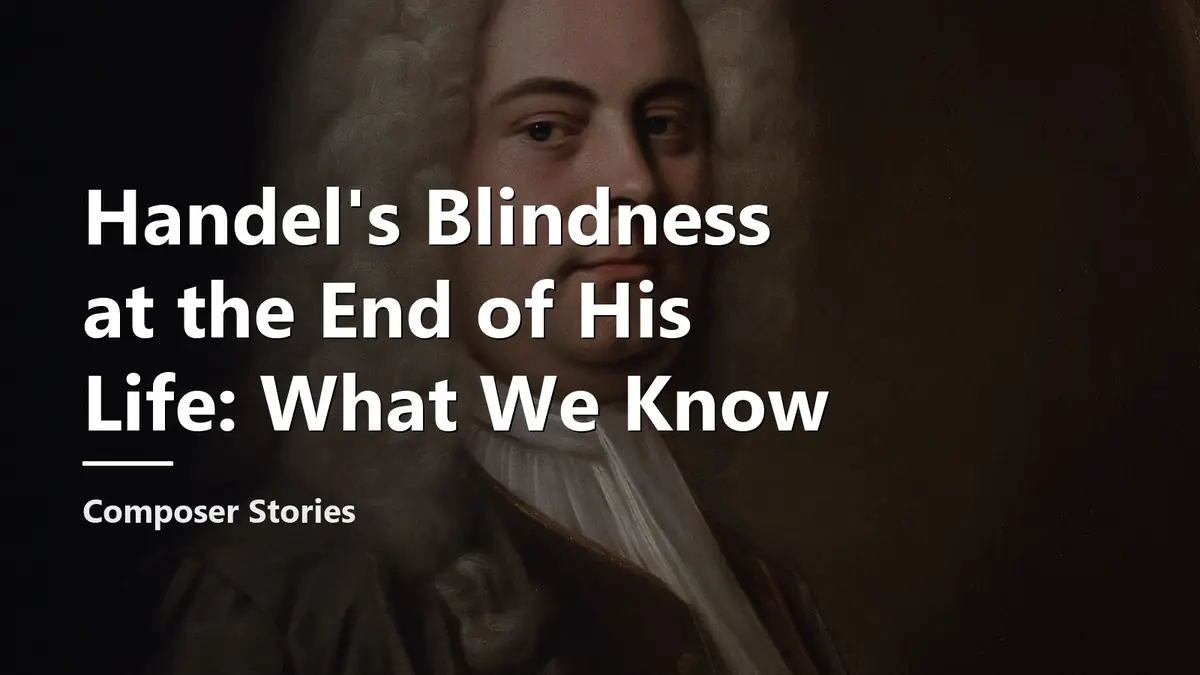
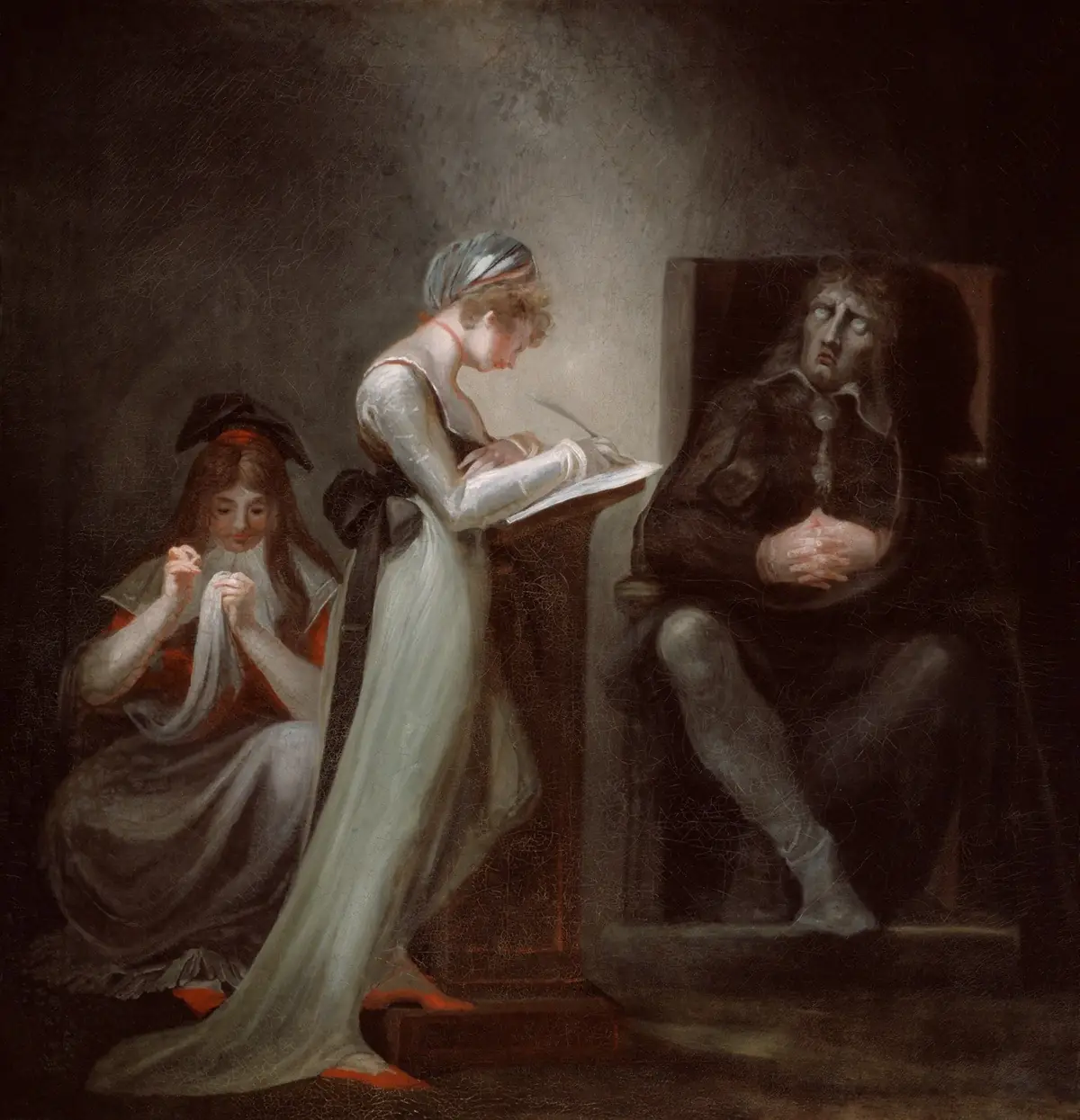
Cover art: George Frideric Handel by Balthasar Denner, Attributed to Balthasar Denner, between circa 1726 and circa 1728date QS:P,+1726-00-00T00:00:00Z/8,P1319,+1726-00-00T00:00:00Z/9,P1326,+1728-00-00T00:00:00Z/9,P1480,Q5727902. Wikimedia Commons (public domain). Image: Milton Dictating to His Daughter, Henry Fuseli, 1794. Art Institute of Chicago (public domain).