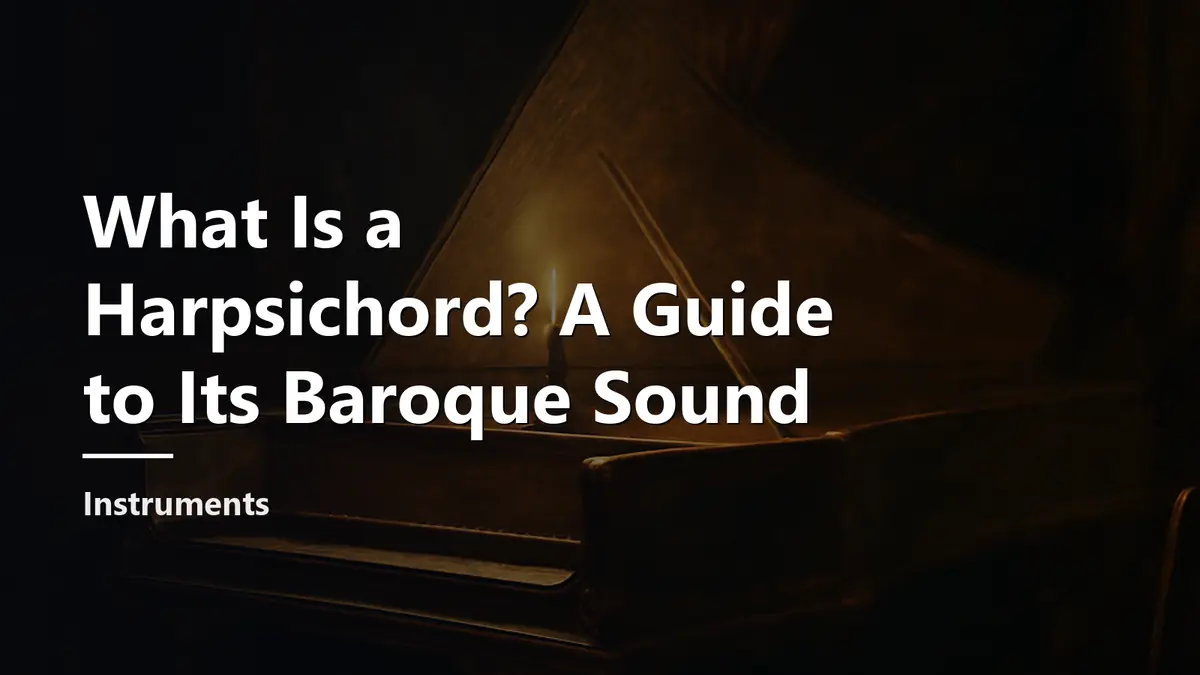
A harpsichord is a keyboard instrument that makes sound by plucking strings when you press its keys. That bright, quick-fading sound sets it apart from the piano and helps explain the lively detail you hear in much Baroque music.
If you have heard one without knowing its name, you may have noticed a crisp shimmer behind an ensemble or a stream of notes that seems to sparkle without growing louder. Once you know how the instrument works, both sounds become easier to follow.
📑 Table of Contents
How a Harpsichord Works
Press a harpsichord key and a small mechanism called a jack rises toward a string. A tiny plectrum on the jack plucks the string; when the key is released, a damper stops the vibration. The sound begins sharply, then fades on its own. Holding down the key does not keep the note sounding at full strength.
That short life gives each note a clear edge. In a fast passage, you can often hear individual notes even when several musical lines are moving together. In a slower passage, the player can make the gaps between notes feel expressive: a brief space may give a phrase a breath, while connected notes keep it flowing.
Some harpsichords have more than one set of strings that the player can select, changing the color or fullness of the sound. Some also have two keyboards, called manuals. These choices let a player set up contrasts between passages, although the details depend on the instrument.
The basic sound remains a pluck rather than a sustained tone. That is why a harpsichord can sound so alert at the start of a note and so delicate immediately afterward. Try listening past the initial sparkle. The way a player groups and releases the notes is where much of the expression lies.
Harpsichord vs Piano: What Changes When You Press a Key?
A piano strikes its strings with felt-covered hammers. Press a piano key harder and the hammer generally hits harder, giving you a louder sound. A harpsichord plucks its strings instead, so pressing a key with more force does not give the player the same direct control over volume.
This does not make harpsichord playing flat or mechanical. Players shape a phrase through timing, articulation, ornamentation, and their choice of registration—the sets of strings they use. A tiny delay before an important note can draw your ear to it. A clean break between phrases can make the next entrance feel fresh.
The piano also has a sustain pedal that can let notes ring after the keys are released. A harpsichord has no equivalent way to wash a whole passage in lingering sound. Its clarity invites composers and players to build momentum through moving lines, repeated patterns, and changes in texture.
You can hear the difference especially well in music performed on both instruments, including Bach’s keyboard works. A piano performance may use a rising and falling volume to shape a long phrase. On a harpsichord, the same phrase may come into focus through where the player leaves space, connects notes, or brings one line forward. Neither approach requires you to know the score: follow the shape of one musical idea and notice how it changes as it returns.
The Harpsichord in Baroque Music
During the Baroque era, roughly 1600 to 1750, the harpsichord served more than one purpose. It could take the spotlight as a solo instrument, carrying several musical lines at once. It could also play within an ensemble, supplying chords above a bass line as part of the continuo, the harmonic foundation that supports much Baroque music.
In an ensemble, you might not immediately pick out every harpsichord note. Listen for a light, percussive pattern near the bass instruments, especially when the melody pauses. Its chords help show where the harmony is going and give other players a firm rhythmic partner.
As a solo instrument, it rewards a different kind of attention. Instead of waiting for a huge swell, notice how one line passes an idea to another. Bach often lets several lines remain active at once. The harpsichord’s distinct attacks can help you hear their entrances, even when the music grows intricate.
Baroque music does not always feature a harpsichord. Handel’s Music for the Royal Fireworks, for example, was originally written for outdoor performance with winds and percussion. Its bold sound is a useful reminder that “Baroque” names a broad musical era, not a single instrumental color. The harpsichord is one of that era’s most recognizable voices, but the wider sound world includes everything from intimate keyboard pieces to ceremonial music built to carry across open air.
Four Works That Show What to Listen For
Start with the opening movement of Bach’s Italian Concerto, BWV 971. Listen for the exchange between full, emphatic passages and lighter ones. Bach uses a solo keyboard to suggest the contrast between an orchestra and a soloist, and the shifts in sound are especially vivid on a harpsichord with two manuals. If that opening catches your ear, our guide to the Italian Concerto’s first movement follows its forward motion.
For a smaller musical gesture, start at the Gavotte in Bach’s French Suite No. 5, BWV 816. Its dance rhythm gives you something easy to hold onto: listen for how the tune moves in neat phrases and how the crisp ends of the notes keep it buoyant. A harpsichord player does not need to force the beat; the instrument’s quick attack helps the dance find its step. Our closer look at the Gavotte offers another way into that rhythm.
Next, try the Ricercar a 6 from Bach’s The Musical Offering. Start at the opening and listen for a musical idea entering in one line, then appearing in others. “Six” refers to the six parts in the musical writing, not six players you need to count by ear. In a harpsichord performance, the challenge and pleasure are hearing those independent lines form a connected whole. You can simply follow one entrance, lose it, and catch it again later.
Finally, start at “La Réjouissance” in Handel’s Music for the Royal Fireworks. Here the point is contrast: listen to the brilliant ensemble sound, then return to one of the Bach keyboard pieces. Both can be energetic and unmistakably Baroque, yet the sources of that energy differ. Handel projects with a large group of instruments; in the harpsichord pieces, rhythm and interlocking lines can create excitement from a single keyboard.
Frequently Asked Questions
Is a harpsichord an early piano?
No. Both are keyboard instruments with strings, but a harpsichord plucks them while a piano strikes them with hammers. The modern piano did not simply give the harpsichord a louder version of its sound; its mechanism gave players a different way to shape volume.
Why does a harpsichord sound so bright?
Each note begins with a small pluck, giving it a clear, sharp attack. The sound then fades fairly quickly, so a sequence of notes can feel crisp and sparkling rather than smoothly sustained.
Can you play Bach on a piano instead of a harpsichord?
Yes. Many of Bach’s keyboard works are performed on both instruments. Try hearing the same passage each way: the piano can shape volume directly, while the harpsichord draws your attention to the spacing, overlap, and movement of the lines.
Sources
- Harpsichord — Encyclopaedia Britannica
- Piano — Encyclopaedia Britannica
- Italian Concerto (Bach) — Wikipedia
- The Musical Offering — Wikipedia
- Music for the Royal Fireworks — Wikipedia
Cover art: Cover illustration generated with AI image tools; contains no real person.