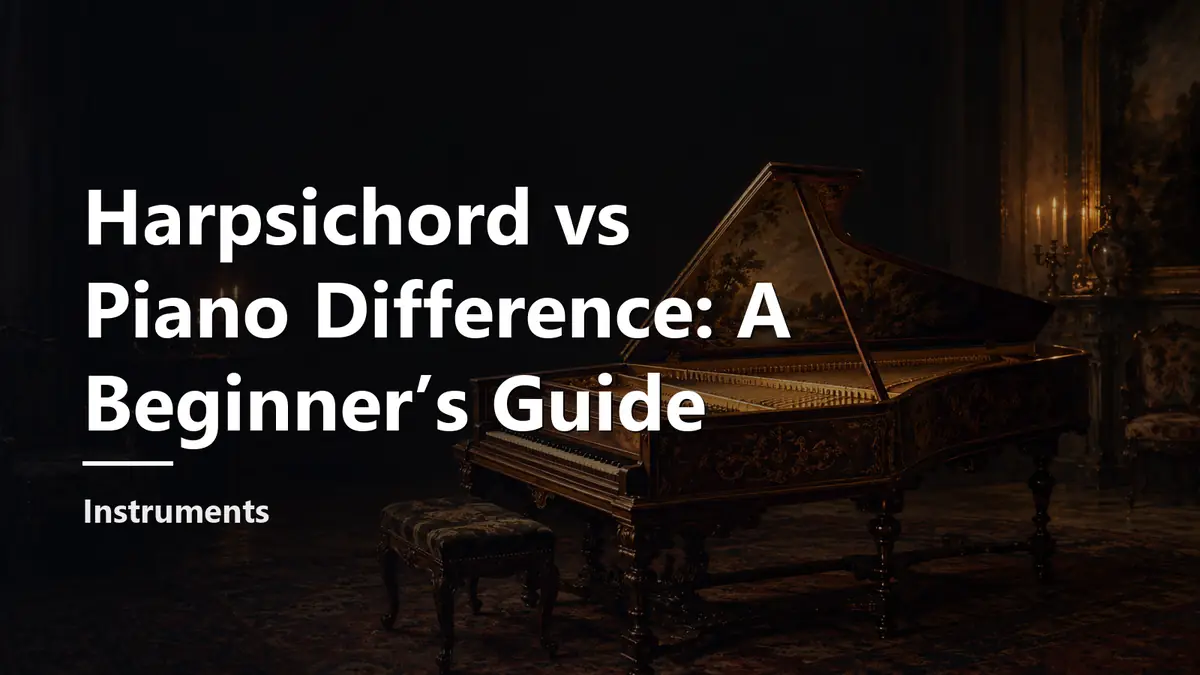
The main harpsichord vs piano difference is how they make a string sound: a harpsichord plucks it, while a piano strikes it with a hammer. That gives the harpsichord a bright, crisp tone and lets the pianist shape a note’s volume much more directly through touch.
Both instruments have keyboards and strings, so the confusion is understandable. Once you know what happens behind the keys, though, their sounds become easier to tell apart—and Baroque keyboard music opens up in a new way.
📑 Table of Contents
How Does a Harpsichord Work?
Press a harpsichord key and a small upright piece called a jack rises. Its plectrum plucks a string, much as a pick plucks a guitar string. When you release the key, a damper stops the vibration. Older plectrums were commonly made from quill; modern ones are often made from plastic.
A piano takes a different route. Press its key and a felt-covered hammer strikes a string, then moves away so the string can vibrate. Pressing the key harder generally makes the hammer strike harder, producing a louder sound. A pianist can therefore bring a melody forward or let it recede simply by changing the touch.
Pressing a harpsichord key harder does not give you that same range of volume. Once the plectrum plucks the string, extra force at the key makes little difference to the note’s loudness. The player can still be expressive, but much of that expression comes from when notes begin and end, how they overlap, and which notes receive a little more time.
You may also see a harpsichord with two keyboards, called manuals, or stops that change which sets of strings sound. These offer different tone colors and levels of fullness. They do not turn the instrument into a piano: the individual strings are still plucked.
What to Listen for in the Harpsichord’s Sound
A harpsichord note has a clear beginning and then fades. You hear the pluck distinctly, especially in quick passages, where each note can seem neatly outlined. A piano can make a similarly crisp sound, but it can also produce a much wider sweep from quiet to loud and sustain a rounded tone with its pedal.
The harpsichord’s clarity is particularly useful when several musical lines move at once. Try following the lowest notes for a few seconds, then shift your attention to a higher line. You may notice that the instrument does not blend everything into one sound; it lets you hear how the parts fit together.
Harpsichord players create contrast in other ways, too. A phrase can feel more urgent when its notes are closely connected, or more playful when tiny gaps separate them. An ornament—a quick turn or cluster of notes around the melody—can draw your ear to a particular moment without a sudden increase in volume.
Recordings can make the distinction less obvious at first. A close microphone may make a harpsichord sound larger than you expect, and a pianist can play Baroque music with a light touch. Listen for the note itself: does it begin with a pointed pluck and fade quickly, or can the player make its attack and volume change noticeably from one note to the next?
Harpsichord Music for Beginners: Six Places to Start
Bach’s Goldberg Variations offer a way to hear how much variety a harpsichord can produce. Start with the opening Aria and listen to the calm melody above the bass line; then try the first variation to hear those lines become more active. The work was written for a harpsichord with two manuals, and some variations make lively use of that arrangement. Our guide to the Goldberg Variations’ Aria can help you get acquainted with its opening.
For a bolder sound, try Bach’s Italian Concerto. Start at the beginning of the first movement, where fuller passages alternate with lighter ones. Bach uses the keyboard to suggest the contrast between a larger group and a soloist in a concerto. The changes in sound come from the instrument’s available colors and from the writing, rather than from piano-style changes of touch. Our guide to the Italian Concerto’s opening movement follows that energy.
Domenico Scarlatti’s Keyboard Sonata in D minor, K. 141 puts the harpsichord’s sharp outlines to work. Start at the opening and listen for the rapid repeated notes. Notice how clearly the rhythm comes through even when the music moves fast. If you know the piece from a piano performance, comparing the two instruments is especially revealing.
Handel’s The Harmonious Blacksmith is the nickname for the final movement of his Keyboard Suite in E major. Start with the simple opening theme, then listen to how the variations give it increasingly busy patterns. You do not need to track every note: keep the theme in mind and hear how the harpsichord makes each new pattern sparkle.
François Couperin’s Les Barricades Mystérieuses shows a gentler side of the instrument. Start at the beginning and listen to the way its flowing lines overlap. The plucked notes remain distinct, yet the repeated patterns can create a remarkably smooth impression. Give your ear time to settle into the pulse before trying to pick out each line.
Jean-Philippe Rameau’s Les Indes galantes is a stage work, so it is different from the solo keyboard pieces above. Try a harpsichord performance of a dance arranged from it, beginning with the dance’s first statement. Listen for the firm rhythm and decorative detail, while keeping in mind that an arrangement is one way of bringing this stage music to the keyboard.
Hearing the Difference When Both Play Baroque Music
The simplest comparison is to hear the same piece played first on harpsichord and then on piano. Bach’s Goldberg Variations or a Scarlatti sonata will do. Keep your attention on one short passage: the beginning of a melody, a quick run, or a note held at the end of a phrase.
On the harpsichord, ask how the player separates or connects the notes. On the piano, notice whether the melody rises above its accompaniment through changes in volume. Neither instrument needs to imitate the other. Each gives the performer a different set of choices, and hearing those choices is part of the pleasure.
You can also use this comparison when you encounter an unfamiliar recording. If its quick notes sound sharply defined but its loudness stays fairly even, a harpsichord may be playing. If individual notes swell in prominence through the performer’s touch and longer tones linger, you may be hearing a piano. Let those clues guide you, then check the recording’s instrument credit.
Frequently Asked Questions
Can a harpsichord play softly and loudly?
Yes, it can offer quieter and fuller sounds through its stops, sets of strings, or manuals, depending on the instrument. But pressing an individual key harder does not give a player the piano’s direct control over that note’s volume.
Is a harpsichord an early piano?
No. Both are keyboard instruments with strings, but their plucking and striking mechanisms make them distinct instruments. The harpsichord was central to much Baroque keyboard music; the piano later offered players a broader range of touch and volume.
Can you play piano music on a harpsichord?
Some music can be adapted, but passages that depend on strong crescendos, sustained pedal, or a melody made louder through touch will work differently. Trying a familiar piece on both instruments can help you hear which effects come from the notes and which come from the instrument.
Sources
Cover art: Cover illustration generated with AI image tools; contains no real person.