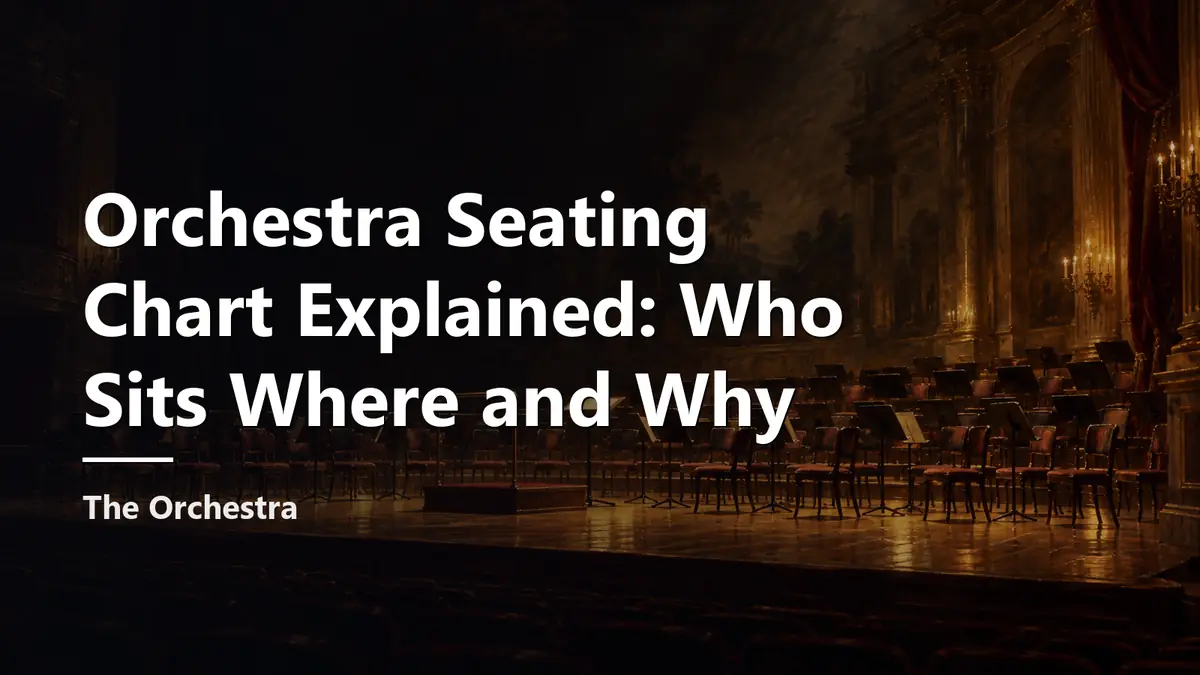
An orchestra usually seats strings across the front, woodwinds in the middle, and brass and percussion toward the back. This layout helps musicians hear and see one another while giving instruments with very different volumes room to balance.
If you have wondered why the violins seem to fill one side of the stage, or why a trumpet player has to look past several rows to see the conductor, the seating chart offers a useful map. Learn its basic shape, and you can start following a piece with your eyes as well as your ears.
📑 Table of Contents
Where Do Orchestra Sections Sit?
Picture the stage from an audience seat. First violins are commonly at the front on your left, with second violins beside them. Violas and cellos usually occupy the rest of the front arc, while double basses stand or sit near an outer edge, often toward the back of the strings. Exact positions vary.
Behind the strings, woodwinds typically sit in compact rows near the center. Flutes, oboes, clarinets, and bassoons may each have only a few players, so a close grouping helps them hear one another. Brass players sit farther back, often with horns nearer the center and trumpets, trombones, and tuba beyond them. Timpani and other percussion instruments generally occupy the rear, where there is space for larger equipment and for players to move safely.
The conductor stands at the front, facing the musicians. From the audience, you mostly see the conductor’s back. The player nearest the conductor on the first-violin side is the concertmaster, who leads the first violins and helps coordinate the string players.
Think of this as a common arrangement, not a fixed diagram. An orchestra may move a harp, keyboard instrument, extra percussion, or entire section to suit the music and the stage. A work with a chorus needs room for singers too; in Beethoven’s Symphony No. 9, the chorus is commonly placed behind the orchestra.
Why Are Brass Instruments at the Back?
The first reason is balance. A full string section consists of many players, but one brass instrument can project strongly through it. Placing brass behind the other sections gives the sound more distance to mix before it reaches the audience. It also lets quieter passages from strings and woodwinds come through more clearly.
That does not mean brass should always sound distant. In the opening of Richard Strauss’s Also sprach Zarathustra, the trumpet call needs to stand out. Its position at the rear does not stop it from reaching the hall; the players and conductor shape how forcefully it does so. Our guide to the opening of Also sprach Zarathustra offers a closer look at that sound.
Woodwinds sit near the center partly because they often exchange short musical ideas with the strings and brass. From there, they can hear neighboring players and watch the conductor without being spread across the stage. In the slow movement of Dvořák’s Symphony No. 9, listen for the English horn melody emerging from this central area. It gives you a clear example of a single wind voice carrying a tune over a quieter orchestra.
Practical needs matter as well. Timpani, bass drum, cymbals, and other percussion require space, and some players switch instruments during a performance. Double basses also take up more room than violins. Seating is a compromise among sound, sightlines, movement, and the size of the stage.
Why Do the Strings Sometimes Change Places?
A seating chart can look different even when the orchestra is playing the same symphony. One especially noticeable choice concerns the second violins. Many orchestras place them beside the first violins on the audience’s left. Others put the second violins opposite the firsts, on the right.
The opposite-side arrangement can make a musical exchange easy to hear. When a composer passes a phrase between the two violin groups, the sound appears to travel across the stage. It can also change where the violas and cellos sit. Neither arrangement is the single correct one for every work: conductors and orchestras choose according to musical preference, performing tradition, and the room.
You can test this with the finale of Dvořák’s Symphony No. 9. Start at its forceful opening, then watch how melodies and answering figures move among sections. The seating helps you locate each response, even when the whole orchestra is busy. For more on the movement itself, see our guide to the New World Symphony finale.
A chart is most useful as a guide to groups, rather than a promise about every chair. If the cellos are where you expected the violas, your ears can still find them: the cellos generally speak in a lower range, while the violas sit between the violin and cello ranges.
What Does an Orchestra Conductor Do?
The conductor gives players a shared sense of pulse, entrances, and musical direction. A hand movement can show when a section begins; a smaller gesture may invite a gentler sound. The conductor also makes decisions in rehearsal about tempo, phrasing, and balance, so much of the coordination you hear at a concert was prepared before the performance.
Musicians do not simply follow every motion in isolation. They listen closely to colleagues, know their parts, and use the conductor’s gestures as a common reference. This matters when a tune moves rapidly from one part of the stage to another, or when a large group must enter together after a pause.
Watch the opening of Beethoven’s Symphony No. 9 for that shared timing. The music gathers before its first strong statements, and the players need a common sense of when the sound should grow and arrive. In Elgar’s Enigma Variations, try the variation called “Nimrod”: follow how the conductor guides the gradual rise in intensity without making the music feel hurried.
Famous orchestras such as the Berlin Philharmonic, Vienna Philharmonic, New York Philharmonic, and Chicago Symphony Orchestra each have their own performing histories. Conductors including Leonard Bernstein, Herbert von Karajan, and Marin Alsop have also become familiar names beyond the concert hall. Their work can shape a performance, but the sound you hear comes from decisions made with the musicians in front of them.
How Can You Follow the Seating During a Concert?
Pick one section at a time. At the start of a piece, find the first violins, then locate the cellos, woodwinds, brass, and percussion. Once you know where they are, notice who starts a phrase and who takes it over. You do not need to identify every instrument to enjoy that conversation.
Mahler’s Symphony No. 2 offers a particularly broad view of orchestral space. Alongside its large forces, it calls for musicians to play from offstage. When those sounds appear, the usual seating chart suddenly feels like only part of the musical picture: distance itself becomes something you can hear.
For a smaller exercise, return to the English horn melody in Dvořák’s Ninth or the growing sound of Elgar’s “Nimrod.” Look toward the section you think you hear, then check whether another group joins it. The chart gives you a starting point; the pleasure is noticing how often the music crosses it.
Frequently Asked Questions
Is orchestra seating always the same?
No. The broad pattern of strings in front, woodwinds near the center, and brass and percussion behind them is common, but orchestras adjust it for the music, the hall, and their own preferences. The placement of the second violins is one change you may spot immediately.
Why are violins usually on the left?
First violins commonly sit at the front on the audience’s left as part of a long-established orchestral layout. It puts the concertmaster close to the conductor, but it does not require all violins to stay on that side: second violins may sit across the stage.
Can musicians see the conductor from the back row?
They generally have a sightline to the conductor, though stage layouts differ. Players also rely on listening, rehearsal, and cues from colleagues, especially when their attention must move between the conductor and the music in front of them.
Sources
Cover art: Cover illustration generated with AI image tools; contains no real person.