📑 Table of Contents
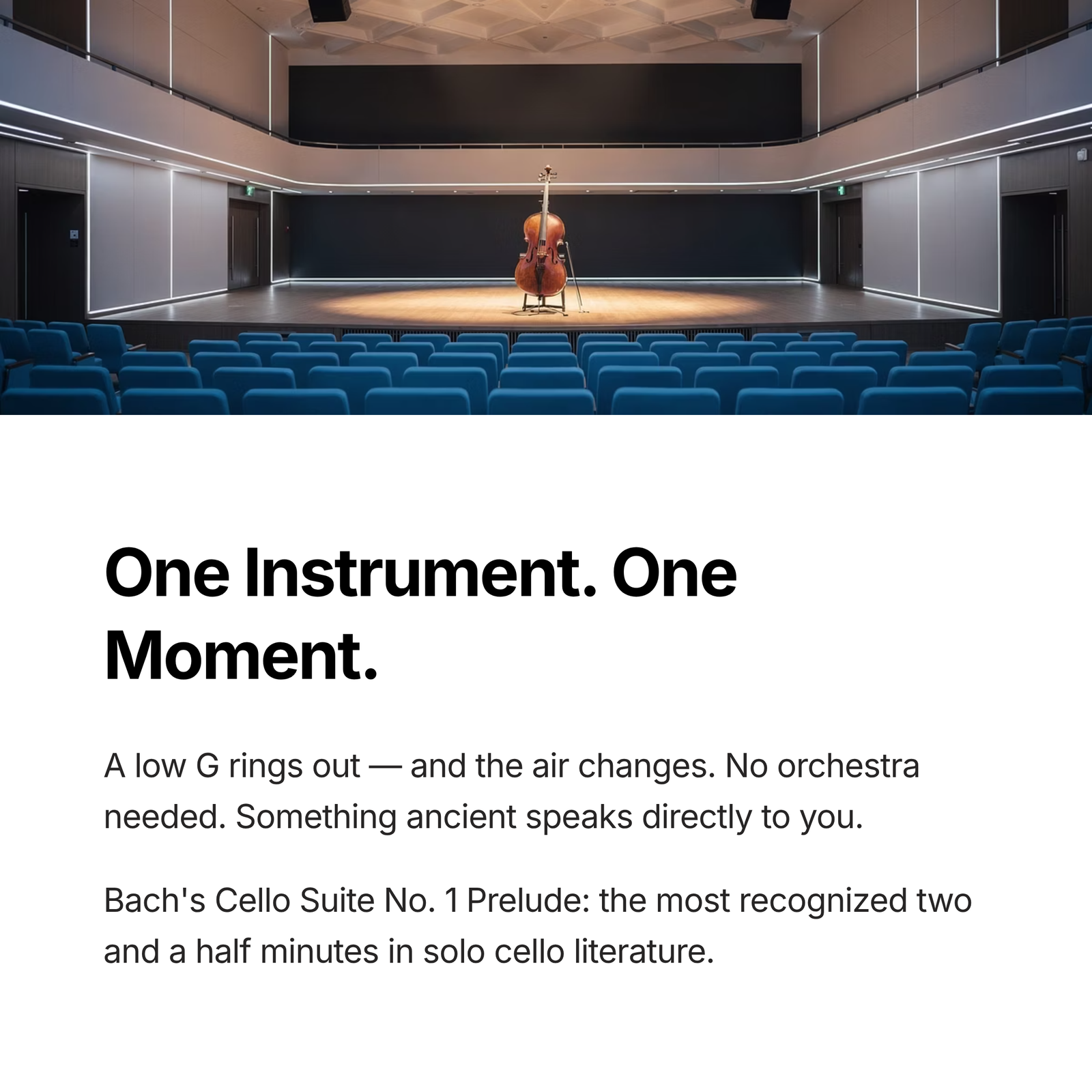
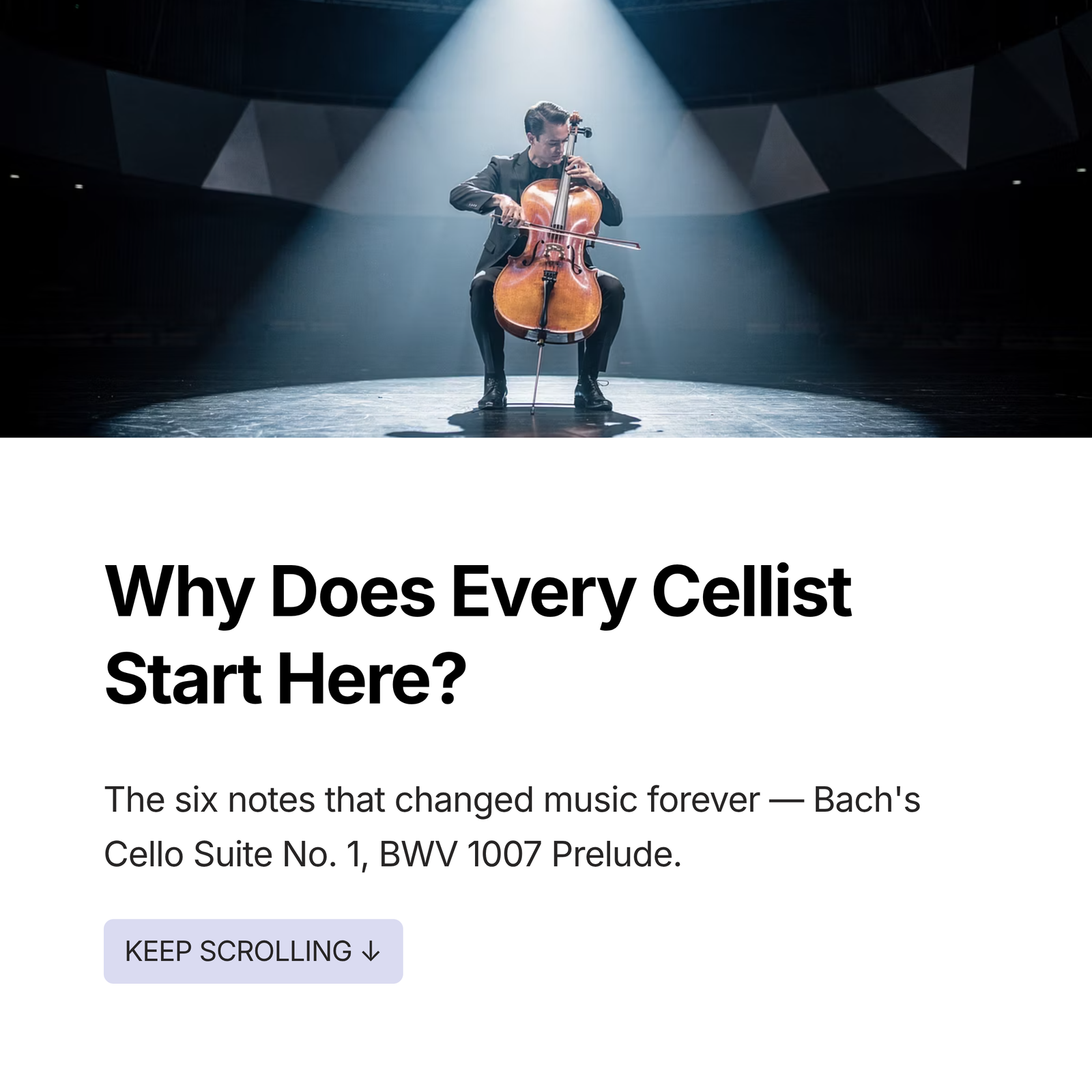
Imagine a dimly lit concert hall. No orchestra, no conductor, no grand piano. Just one person, one cello, and a bow drawn slowly across a string. The first note rings out — a low, resonant G — and suddenly, the air in the room changes. You don’t need to know a thing about classical music to feel it. Something ancient and deeply human is speaking directly to you.
That sound is the opening of Johann Sebastian Bach’s Cello Suite No. 1 in G Major, BWV 1007 — specifically, its Prelude. It may be the most recognized two and a half minutes in all of solo cello literature. You’ve heard it in films, in coffee shops, in moments of stillness you didn’t plan for. But have you ever really listened to it?
The Man Behind the Notes: Bach in Köthen
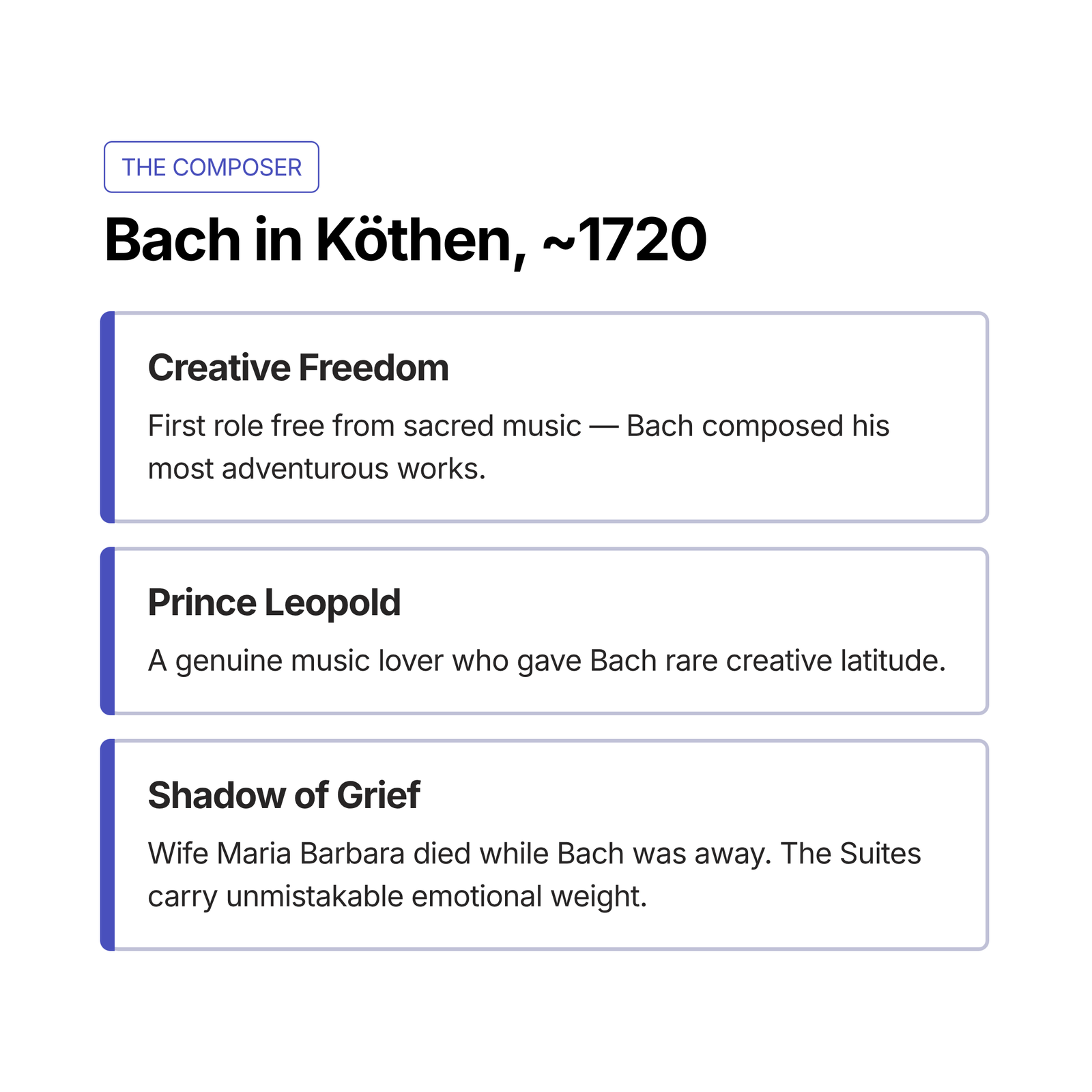
To understand this piece, it helps to know where Bach was in his life when he wrote it. Around 1720, Bach was serving as Kapellmeister — essentially the music director — at the court of Prince Leopold in Köthen, a small German town. Unlike his previous positions in churches, this role freed him from writing sacred music. For the first time, Bach could focus entirely on instrumental works.
This period produced some of his most adventurous compositions: the Brandenburg Concertos, the Well-Tempered Clavier, and the six Cello Suites. Prince Leopold was a genuine music lover who played the viola da gamba himself, and he gave Bach the creative freedom that many composers only dream of.
But this wasn’t an entirely happy time. In 1720, Bach returned from a trip to find that his wife, Maria Barbara, had died and been buried in his absence. The Cello Suites may have been composed in the shadow of that grief — though scholars debate the exact timeline, the emotional weight of these pieces is unmistakable.
Why This Prelude Matters: Architecture Disguised as Simplicity
Here’s the paradox that makes this Prelude extraordinary: it sounds effortless, almost inevitable, as though the music is simply happening — like water flowing downhill. But beneath that natural ease lies one of the most sophisticated pieces of musical engineering ever written.
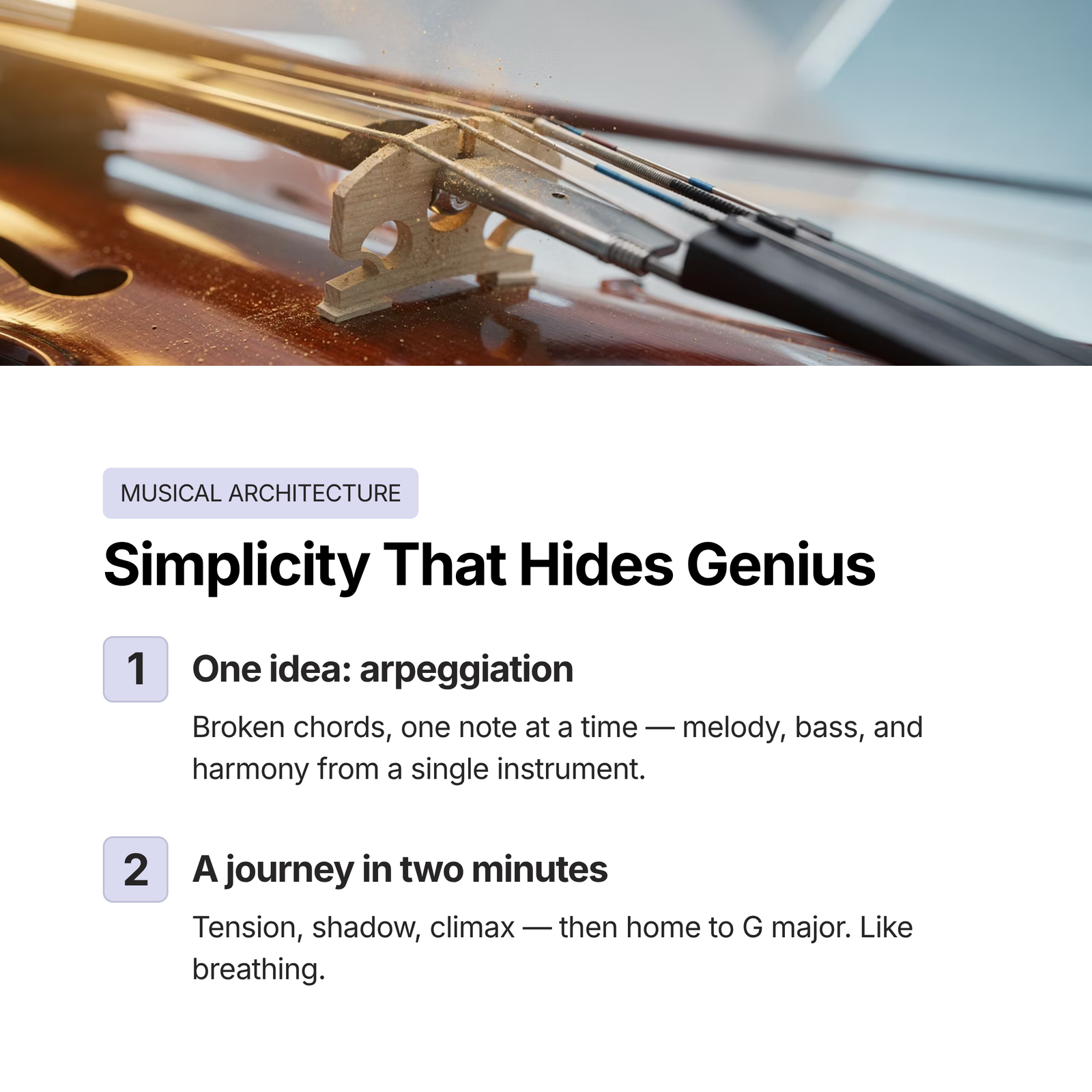
Bach builds the entire Prelude from a single idea: broken chords, played one note at a time. This technique, called arpeggiation, means the cello is essentially outlining harmonies without any accompaniment. There’s no second instrument filling in the gaps. The cello is simultaneously the melody, the bass line, and the harmonic foundation. One instrument doing the work of three.
What makes this more remarkable is the journey Bach takes you on. The piece begins in a warm, stable G major — think of it as standing on solid ground. Over the course of roughly two minutes, he guides you through a series of harmonic shifts: moments of gentle tension, brief shadows of minor keys, and small climaxes that build and release like breathing. Then, near the end, a dramatic ascending scale sweeps upward before the piece settles back into that comforting G major, like arriving home after a long walk.
How to Listen: Three Doorways into the Prelude
If you’re new to classical music, here are three ways to engage with this piece that go beyond simply pressing play.
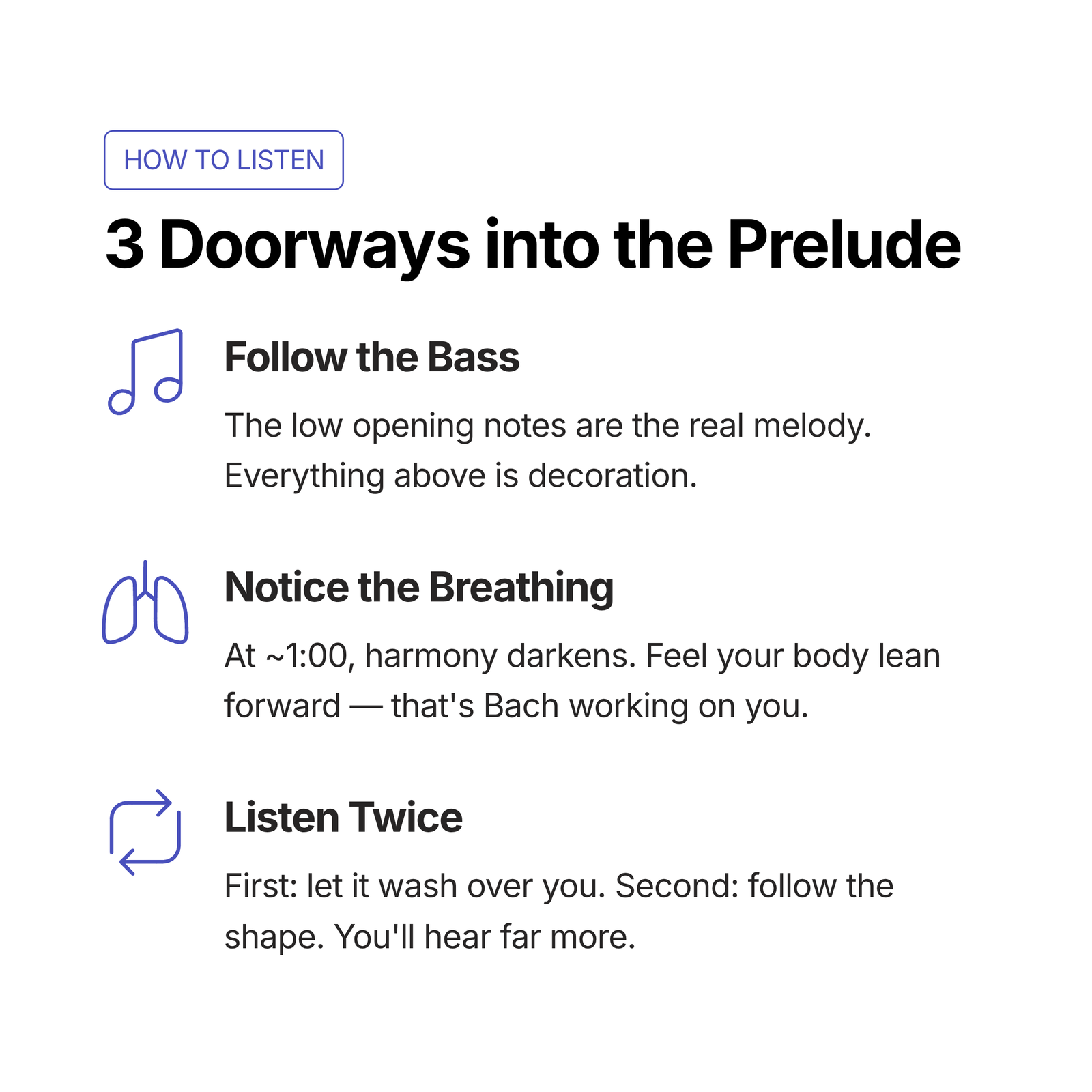
Listen for the bass notes. Each measure begins with a low note that anchors everything above it. Try following just those bottom notes — they trace a slow, deliberate path that is the real melody of the piece. The dancing notes above are decoration; the bass is the backbone.
Notice the breathing. Around the 1:00 mark in most recordings, you’ll hear the harmony darken slightly. The music moves into territory that feels less certain, more questioning. This is Bach creating tension — and if you pay attention to your own body, you might notice yourself leaning forward, waiting for resolution. That’s not an accident. That’s compositional genius working on you physically.
Listen to it twice. The first time, just let it wash over you. Don’t analyze, don’t think. The second time, try to follow the shape — the way the piece rises, falls, tenses, and releases. You’ll be surprised how much more you hear when your ear knows what’s coming.
Recordings Worth Your Time
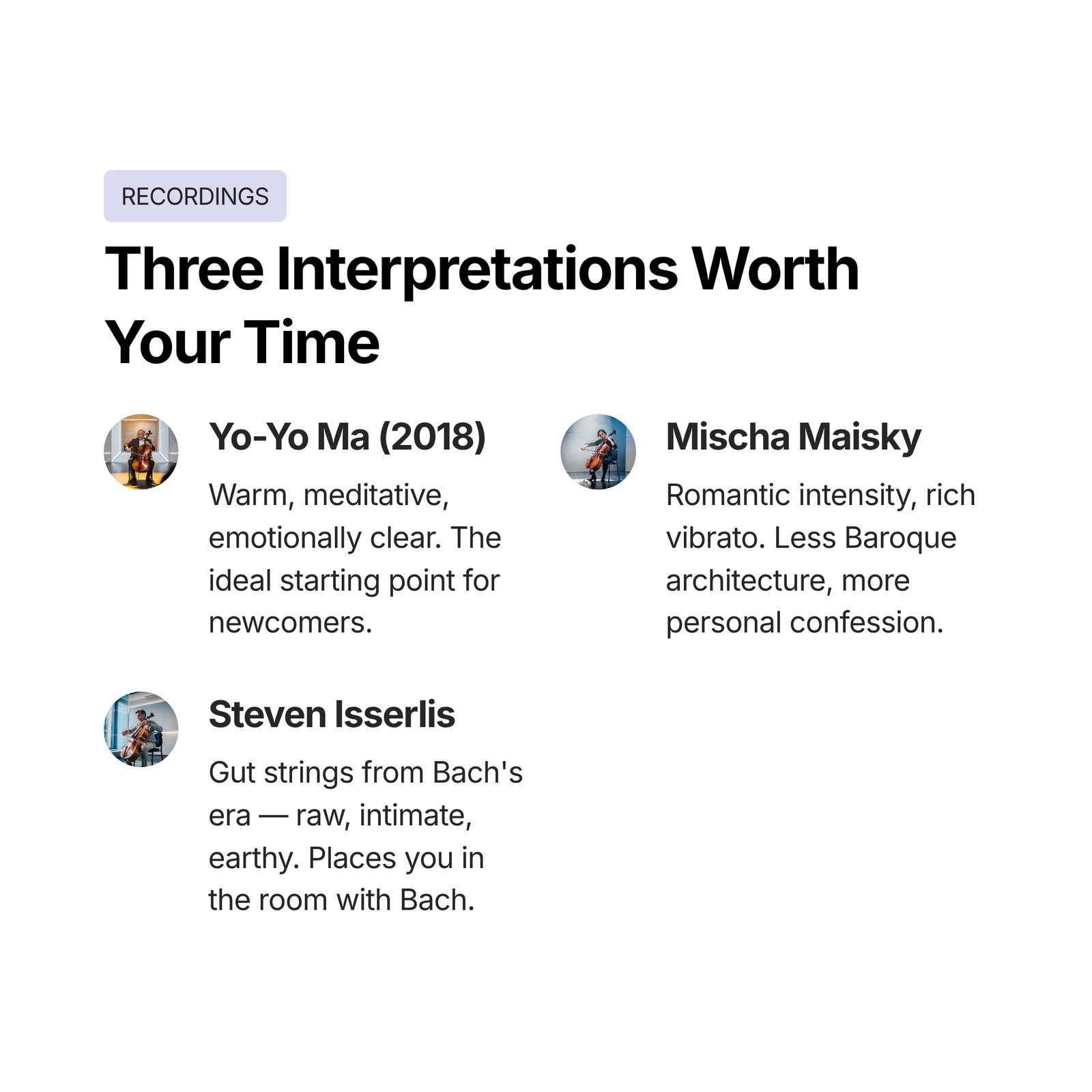
This Prelude has been recorded hundreds of times, and each cellist brings something different. Here are three interpretations that offer genuinely distinct experiences.
Yo-Yo Ma has recorded the complete Cello Suites twice — once in 1983 and again in 2018. His later recording, part of the album Six Evolutions, is warmer and more meditative, shaped by decades of living with this music. It’s an ideal starting point for newcomers because of its openness and emotional clarity.
Mischa Maisky brings a Romantic intensity that some purists resist but many listeners adore. His phrasing is generous, his vibrato rich, and he treats the Prelude less like Baroque architecture and more like a personal confession. If you want to feel this piece in your chest, start here.
Steven Isserlis, by contrast, plays on gut strings — the type of string used in Bach’s era — and his interpretation has a rawness and intimacy that modern steel strings can’t replicate. The sound is earthier, more fragile, and it places you in the room with Bach himself.
For a completely different perspective, search for transcriptions played on guitar, marimba, or even accordion. This Prelude’s architecture is so robust that it survives — and thrives — in almost any instrumental voice.
The Piece That Almost Disappeared
Here’s a detail that should give you chills: we almost lost this music entirely. Bach never published the Cello Suites during his lifetime. The manuscript passed through various hands after his death in 1750, and for over a century, the suites were considered little more than technical exercises — useful for practice, not worthy of the concert stage.
That changed in the early 1900s when a thirteen-year-old Catalan boy named Pablo Casals stumbled upon a weathered copy of the suites in a secondhand music shop in Barcelona. He spent the next twelve years studying them privately before performing them in public. Casals would go on to become the greatest cellist of the twentieth century, and his championing of the Bach Suites transformed them from forgotten études into pillars of the Western musical canon.
Every time you hear this Prelude today — in a concert hall, in a film soundtrack, through your earbuds on a quiet morning — you’re hearing the echo of that teenager’s discovery in a dusty Spanish shop.
Why This Music Still Finds Us
There’s a reason this Prelude resonates so deeply across centuries and cultures. It doesn’t try to impress you. It doesn’t demand your attention with dramatic crashes or virtuosic fireworks. Instead, it simply speaks — in a voice that is calm, honest, and unhurried.
In a world that constantly shouts for your attention, there is something radical about a piece of music that quietly sits beside you and says nothing more than what needs to be said. Bach wrote thousands of pages of music in his lifetime. But these two minutes for solo cello — this unadorned conversation between a wooden instrument and the silence around it — may be the most human thing he ever composed.
Press play. Close your eyes. And let six notes, written three hundred years ago by a man you’ll never meet, remind you what it feels like to simply be.