📑 Table of Contents
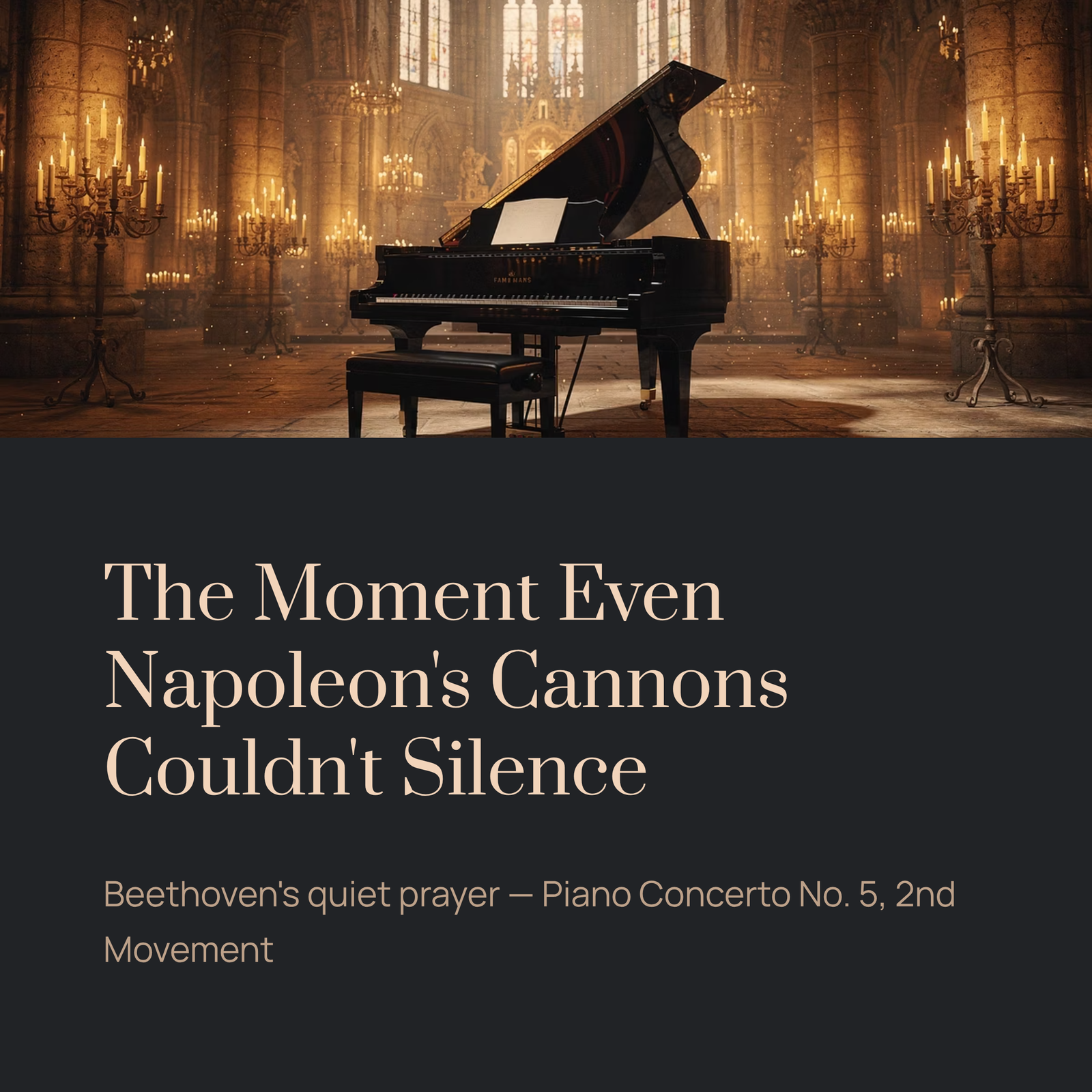
In the spring of 1809, Napoleon’s army surrounded Vienna. Cannonballs shook the buildings, and Ludwig van Beethoven — already losing his hearing, already losing his grip on the world of sound he loved most — hid in the basement of his brother’s house, pressing pillows against his ears to protect what little remained. It was during this impossible time that he completed his Piano Concerto No. 5 in E-flat major, a work the world would come to call the “Emperor.”
And right at its center, he placed something no one expected: silence. Not the dramatic, fist-shaking silence of defiance. Something far more vulnerable. A hymn. A prayer whispered so softly that you have to lean in just to hear it. The second movement, marked Adagio un poco mosso, is barely seven minutes long, yet it contains a kind of peace that the entire first movement, with all its grandeur, never even attempts.
I want to talk about those seven minutes, because they changed the way I listen to music.
Who Was Beethoven in 1809?
By the time he sat down to write the Emperor Concerto, Beethoven was thirty-eight years old. He was not the young rebel who had stormed into Vienna’s salons two decades earlier. He was not the fiery genius who had once dedicated a symphony to Napoleon and then furiously scratched out the dedication. He was, instead, a man running out of time — at least in the way that mattered most to him.
His hearing had been deteriorating since his late twenties, and by 1809, conversation was becoming a struggle. The irony was almost too cruel: the greatest musical mind of his generation was slowly being locked out of music itself. Yet he kept composing. The Emperor Concerto was actually the last piano concerto he would ever write. Not because inspiration failed him, but because he could no longer hear well enough to perform as the soloist himself — and the idea of someone else premiering his concerto was, for a long time, unbearable.
Understanding this context matters, because the second movement is not simply “slow and pretty.” It is the sound of a man who has accepted something enormous and frightening, and found — somehow, impossibly — serenity on the other side.
Listening to the Adagio: What to Notice
The movement opens with muted strings playing a chorale-like theme in B major — a key that feels distant and warm after the bright E-flat of the first movement. This key change is one of the most beautiful surprises in all of Beethoven’s music. It is as though you have been standing in a grand, sunlit hall and suddenly stepped through a door into a candlelit chapel.
Here is what I would invite you to pay attention to:
The first thing you will hear is the orchestra alone — the strings, hushed and reverent, laying out a melody that feels more like a hymn than a concerto theme. It moves in simple, stepwise motion, as if it is trying not to disturb the silence around it. There is no drama here, no tension to be resolved. Just a quiet declaration of something the composer seems to know is true but cannot quite put into words.
Then the piano enters. And this is where many listeners feel something shift in their chest. The piano does not argue with the orchestra. It does not compete. It takes the same melody and decorates it — gently, the way morning light filters through curtains. The right hand floats high above the staff in crystalline arpeggios, while the left hand anchors everything with a steady, breathing pulse. Beethoven marks this cantabile — “in a singing style” — and that is exactly what it sounds like: a voice singing in a room where it thinks no one is listening.
What makes this movement truly extraordinary is its restraint. Beethoven, the man known for his volcanic temper and his titanic musical gestures, here writes music that barely rises above a whisper. There are no sudden fortissimos, no crashing chords. The dynamic range stays within the softest end of the spectrum for almost the entire movement. It is as if Beethoven is showing us a side of himself he rarely reveals — not the hero, but the man at prayer.
Near the end, the piano plays a series of descending phrases that grow quieter and quieter, almost dissolving into air. And then, without any pause, a single low B-flat in the piano drops like a stone into water — and we are suddenly, breathlessly, in the opening of the third movement. That transition is one of the most stunning moments in the concerto literature. But we will stop here, at the threshold, and stay in the chapel a moment longer.
What This Movement Means to Me
I first heard this Adagio on a winter evening when I was not looking for profundity. I was tired, a little defeated by the ordinary cruelties of a long week, and I put on a recording almost by accident. Within thirty seconds, I stopped what I was doing. The music was not asking anything of me. It was not trying to impress me or challenge me or teach me a lesson. It simply existed — luminous and unhurried — like a hand placed gently on a shoulder.
That, I think, is the secret of this movement. It does not perform vulnerability; it is vulnerable. In a concerto that bears the nickname “Emperor,” the second movement reminds us that the truest strength is not in conquest but in the willingness to be still, to be soft, to be open. For a man who was losing his hearing in the middle of a war, that was perhaps the bravest thing he ever wrote.
How to Listen: A Few Practical Suggestions
If you are new to this piece, I would suggest starting with the second movement on its own before listening to the full concerto. It stands beautifully in isolation and only lasts about seven minutes — a manageable window that rewards complete attention.
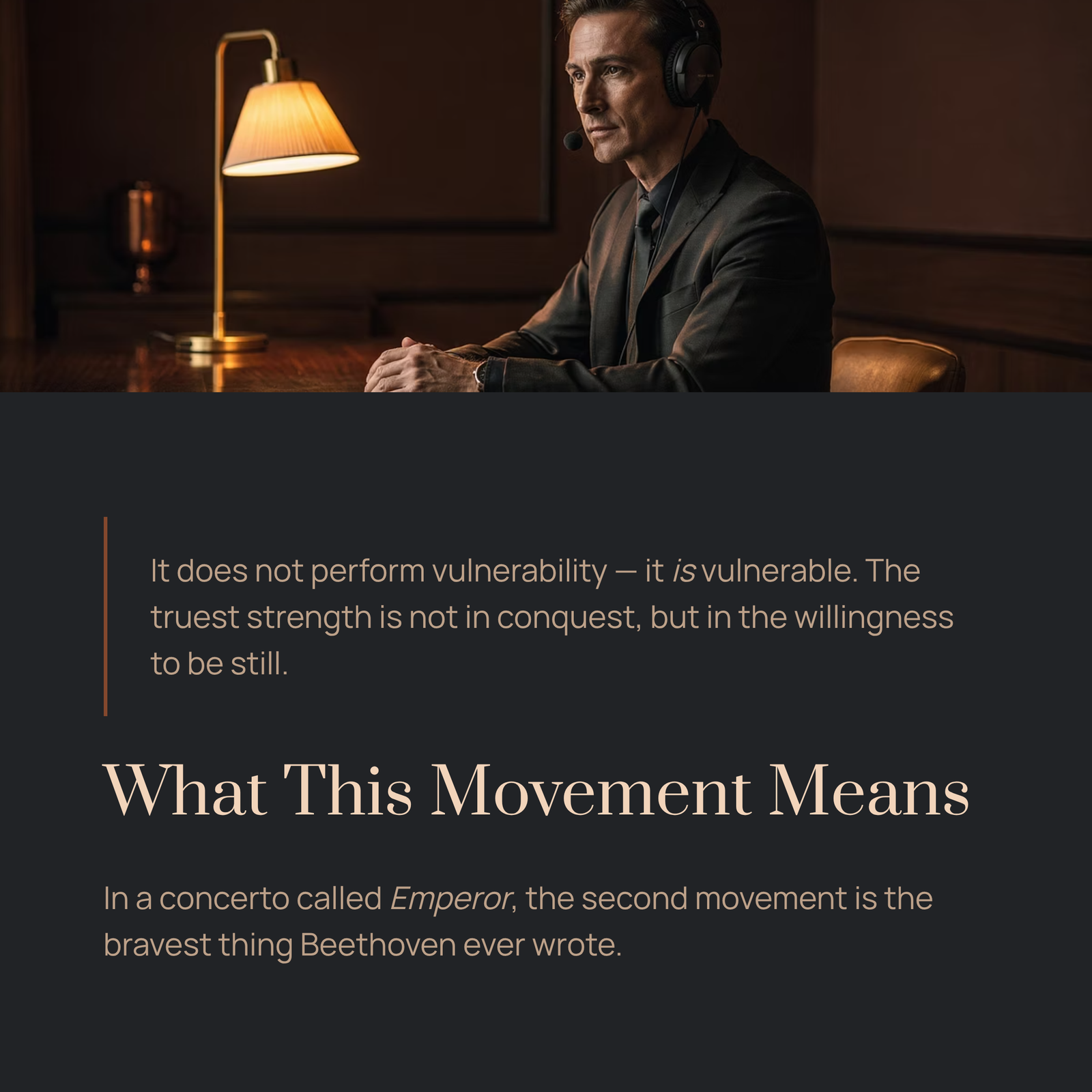
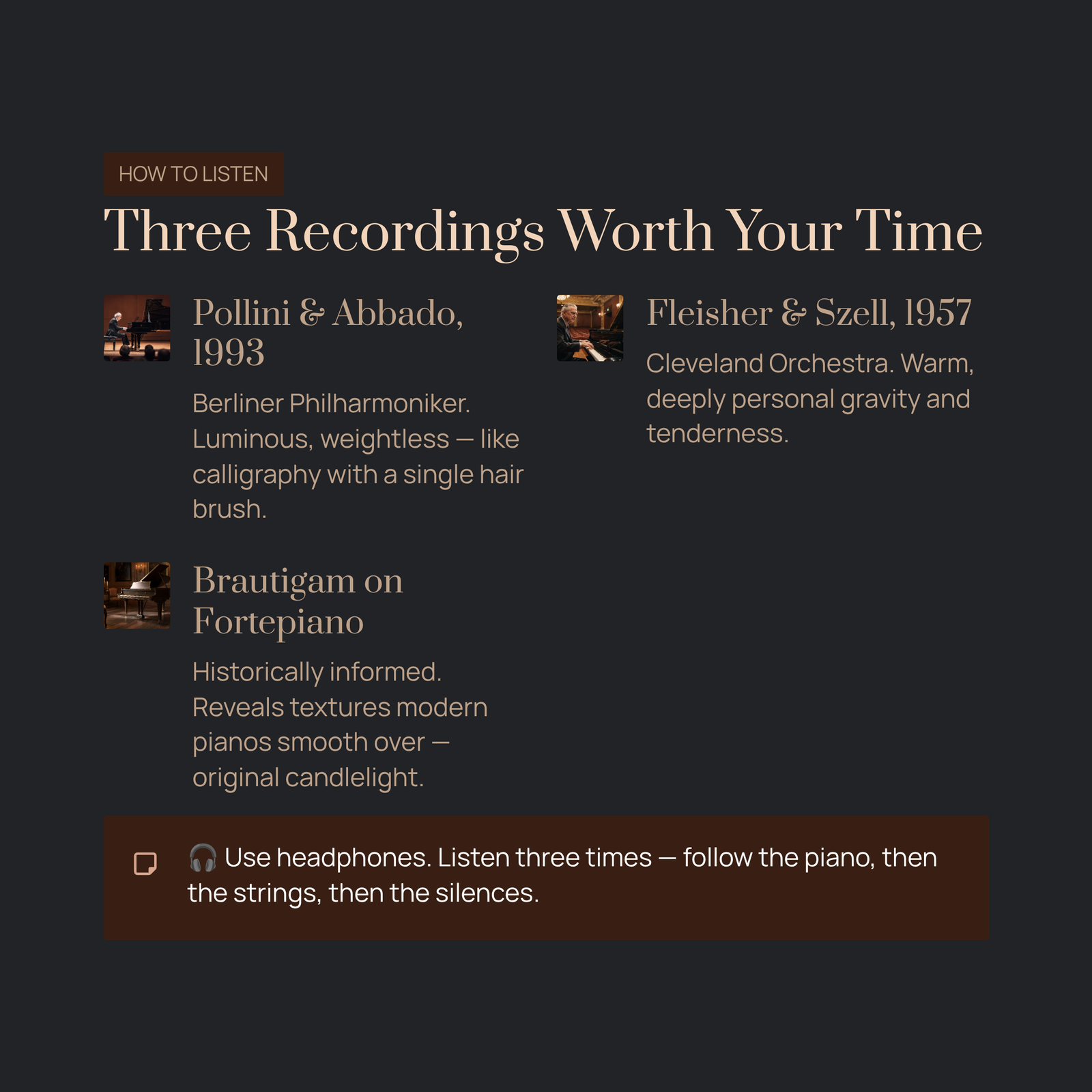
Listen with headphones if you can. This is music that lives in the quiet details: the way the strings breathe together, the delicate ornamentation of the piano, the almost imperceptible shifts in harmony. In a noisy room, you will miss the very things that make it remarkable.
As for recordings, there are several I return to often. Maurizio Pollini’s 1993 recording with the Berliner Philharmoniker under Claudio Abbado is one of the most refined — Pollini’s touch in the Adagio is luminous and weightless, like watching someone write calligraphy with a single hair brush. For something warmer and more Romantic, try the 1957 recording with Leon Fleisher and George Szell conducting the Cleveland Orchestra; there is a gravity and tenderness there that feels deeply personal. And if you want a historically informed perspective, Ronald Brautigam’s recording on fortepiano reveals textures that modern pianos sometimes smooth over — it is like hearing the movement in its original candlelight.
If you listen more than once — and I hope you will — try paying attention to a different element each time. The first time, follow the piano. The second time, listen only to the strings. The third time, close your eyes and just notice how the silences between phrases feel. Each listening reveals a new layer, like peeling back translucent sheets of paper to find another drawing underneath.
Stillness as an Act of Courage
We live in a world that rewards loudness. Volume is confidence; speed is intelligence; more is always better. Beethoven knew that world too — his first and third movements are full of it, and magnificent for it. But in this second movement, he chose something else. He chose to be quiet in the middle of the noise, gentle in the middle of the violence, open in the middle of loss.
That choice, I believe, is what makes the Adagio un poco mosso not just a great piece of music, but a kind of moral statement. It tells us that the spaces between the notes matter as much as the notes themselves. That the willingness to slow down, to listen, to let something fragile and beautiful simply exist without rushing to the next thing — that is not weakness. It is one of the most difficult, most necessary things a human being can do.
Seven minutes. A hymn in B major. A man going deaf, writing music he could barely hear, in a city under siege. And somehow, out of all of that, this: a stillness so complete it feels like the whole world is holding its breath.
Press play. Lean in. Let it find you.