📑 Table of Contents
There’s a single timpani roll, followed by a cascade of piano chords tumbling downward like a waterfall plunging off a cliff — and just like that, you’re gone. You’re no longer sitting in your chair. You’re standing at the edge of a Norwegian fjord, the wind sharp against your skin, the horizon impossibly wide.
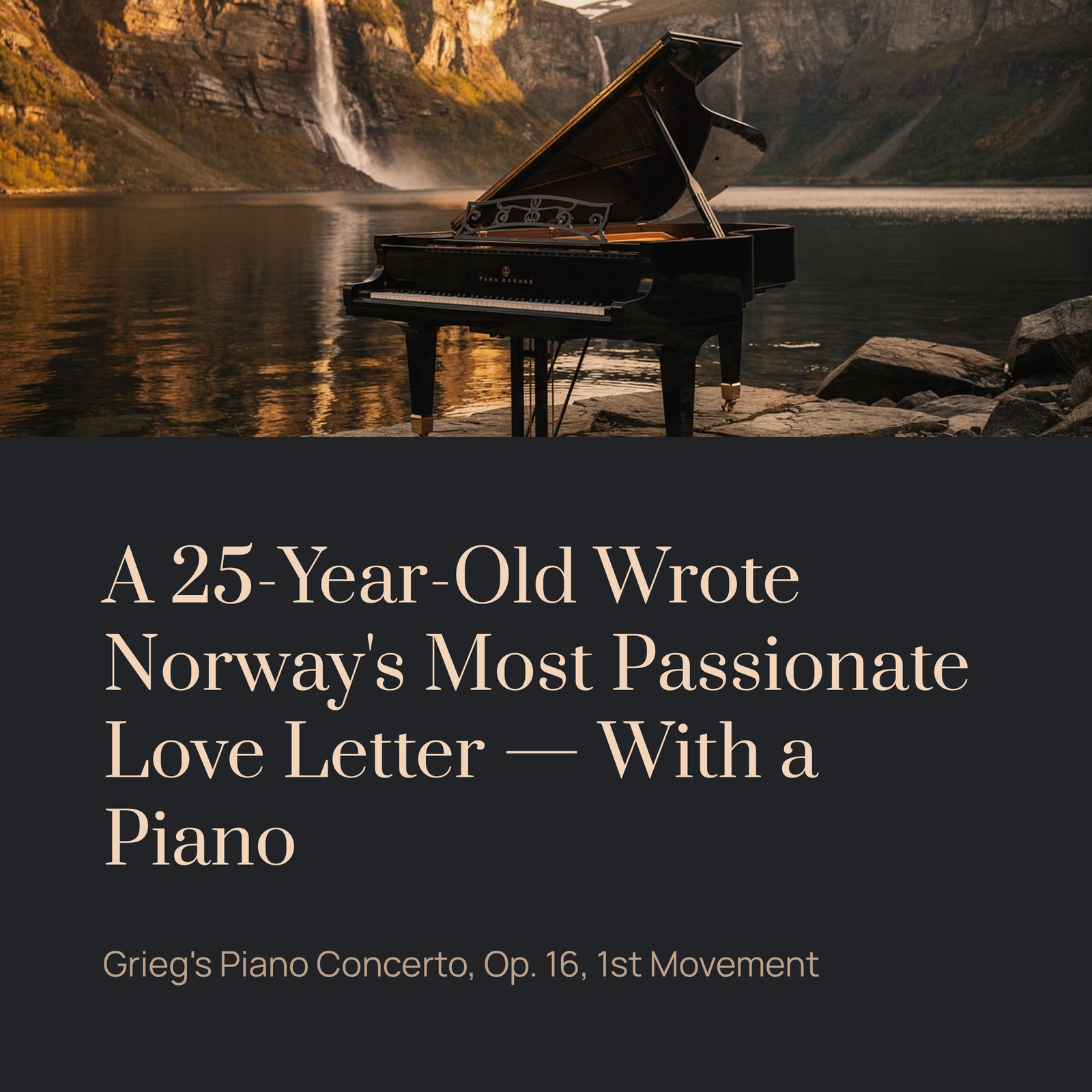
That opening is Edvard Grieg’s Piano Concerto in A minor, Op. 16, first movement — and once you hear it, you never quite unhear it. It stays lodged somewhere between your ribs and your memory, the kind of musical moment that makes even people who claim they “don’t get classical music” stop and listen.
I still remember the first time those descending chords hit me. It wasn’t a concert hall. It wasn’t a carefully curated playlist. It was a random click on a video thumbnail, and within ten seconds I thought: Who wrote this, and what were they feeling?
The answer, it turns out, is a 25-year-old from Bergen who was desperately in love — with a woman, with his homeland, and with the terrifying possibility that he might actually be good enough to say something that mattered.
A Young Man With Something to Prove
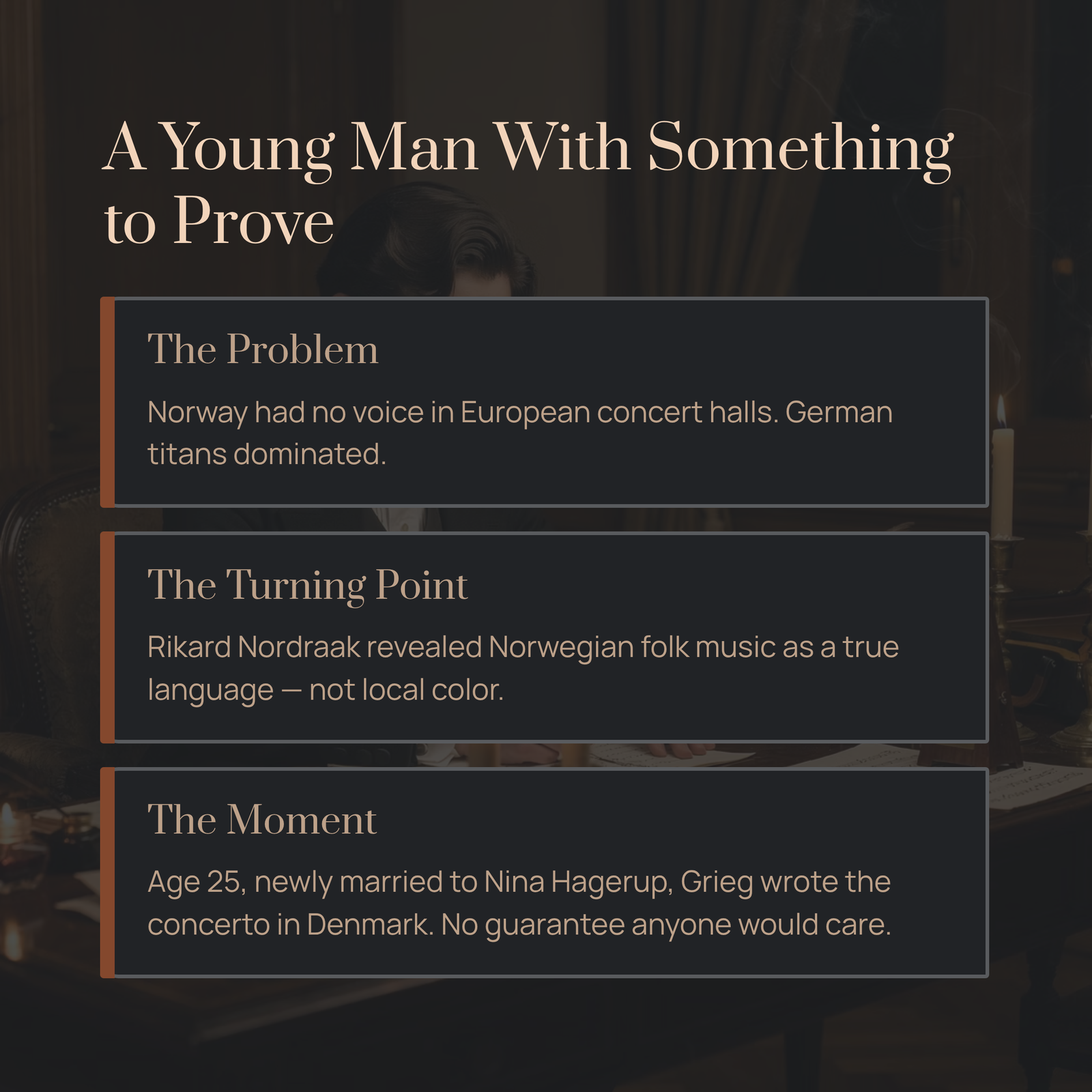
Edvard Grieg was not supposed to be Norway’s voice. In the 1860s, Norway didn’t really have a voice — at least not in the concert halls of Europe. Scandinavian composers were overshadowed by the German titans: Beethoven, Brahms, Schumann. If you wanted to be taken seriously, you went to Leipzig, studied the German way, and wrote music that sounded, well, German.
Grieg did go to Leipzig. He studied at the conservatory there. But something didn’t sit right. The music he was being taught to admire felt like someone else’s clothes — beautifully tailored, but not quite his size.
It was after meeting Rikard Nordraak, a fiercely nationalistic young composer, that Grieg found his direction. Nordraak convinced him that Norwegian folk music — those haunting melodies carried by hardingfele fiddles across mountain valleys — wasn’t just quaint local color. It was a language. And Grieg could speak it.
In 1868, freshly married to his cousin Nina Hagerup (a gifted soprano who would become his greatest musical partner), Grieg sat down in Denmark and poured everything he had into a piano concerto. He was 25. He had no guarantee anyone would care. He wrote it anyway.
What You’re Actually Hearing
Let me walk you through the first movement — not with a music theory textbook, but with your ears.
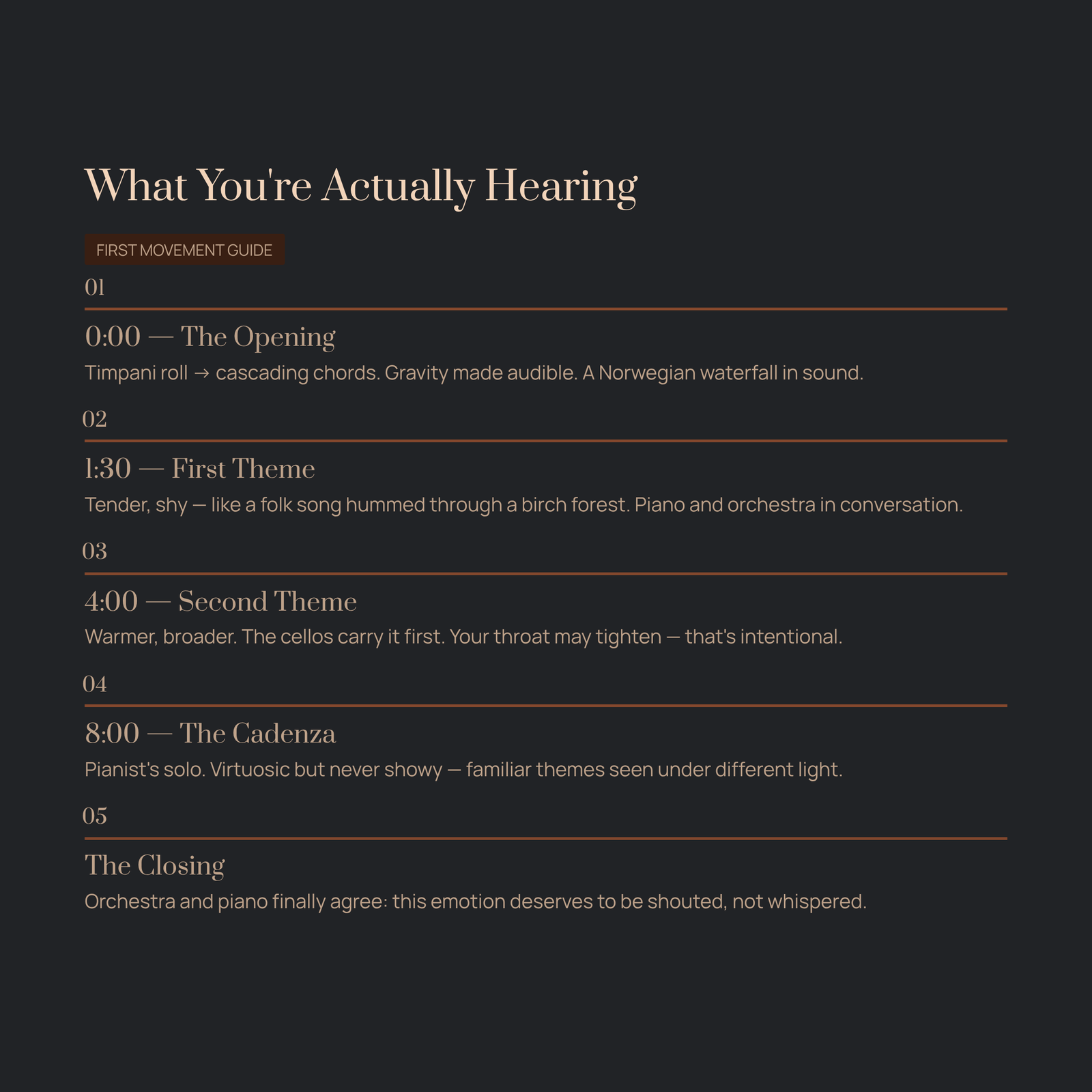
The Opening (0:00–1:30): That famous timpani roll into the descending piano chords isn’t just dramatic for drama’s sake. Listen to the shape of it — it falls. It cascades. Grieg is literally painting a landscape in sound. If you’ve ever seen photographs of Norwegian waterfalls dropping hundreds of meters into narrow fjords, that’s what this sounds like. It’s gravity made audible.
The First Theme (1:30–3:00): After the orchestra picks up the energy, the piano enters with a melody that’s achingly tender. This is where Grieg’s folk music roots show. The melody doesn’t move in the grand, sweeping gestures of German Romanticism. It steps carefully, almost shyly, like a folk song someone might hum while walking through a birch forest. Pay attention to how the piano and orchestra hand the melody back and forth — it’s a conversation, not a monologue.
The Second Theme (around 4:00): Here Grieg shifts to something warmer, broader, more openly emotional. If the first theme is a private thought, the second theme is what happens when you finally say the thing out loud. The cellos often carry this melody first, and it’s one of those passages that can make your throat tighten without you entirely understanding why.
The Cadenza (around 8:00–10:00): This is the pianist’s solo moment, and Grieg makes it count. It’s virtuosic, yes — your fingers would need to be made of something other than flesh to play it casually — but it’s never showing off for its own sake. The cadenza revisits the themes you’ve already heard, transforming them, intensifying them, like seeing a familiar landscape under completely different light.
The Closing: The movement ends with a blaze of energy, the orchestra and piano finally agreeing on something together — that whatever this emotion is, it deserves to be shouted, not whispered.
Why This Concerto Hits Different
There’s a reason this piece has survived over 150 years of changing tastes, wars, cultural upheavals, and the entire invention of recorded music. It’s not because it’s technically perfect (Grieg himself revised it obsessively throughout his life, never quite satisfied). It’s because it’s emotionally honest in a way that feels almost uncomfortably personal.
Grieg wasn’t trying to build a cathedral like Brahms. He wasn’t wrestling with God like Beethoven. He was doing something simpler and, in some ways, harder: he was trying to capture what it felt like to stand in a specific place, love a specific person, and belong to a specific people. The concerto is homesickness turned into sound. It’s the ache of knowing that the place you come from is beautiful and small and largely ignored by the wider world — and deciding to make the world listen anyway.
That’s why it connects with people who’ve never been to Norway, who couldn’t find Bergen on a map. Homesickness is universal. The longing to be understood is universal. Grieg just happened to express it with a piano and an orchestra.
Recordings Worth Your Time
Choosing a recording of this concerto is like choosing a favorite photograph of someone you love — every angle reveals something different.
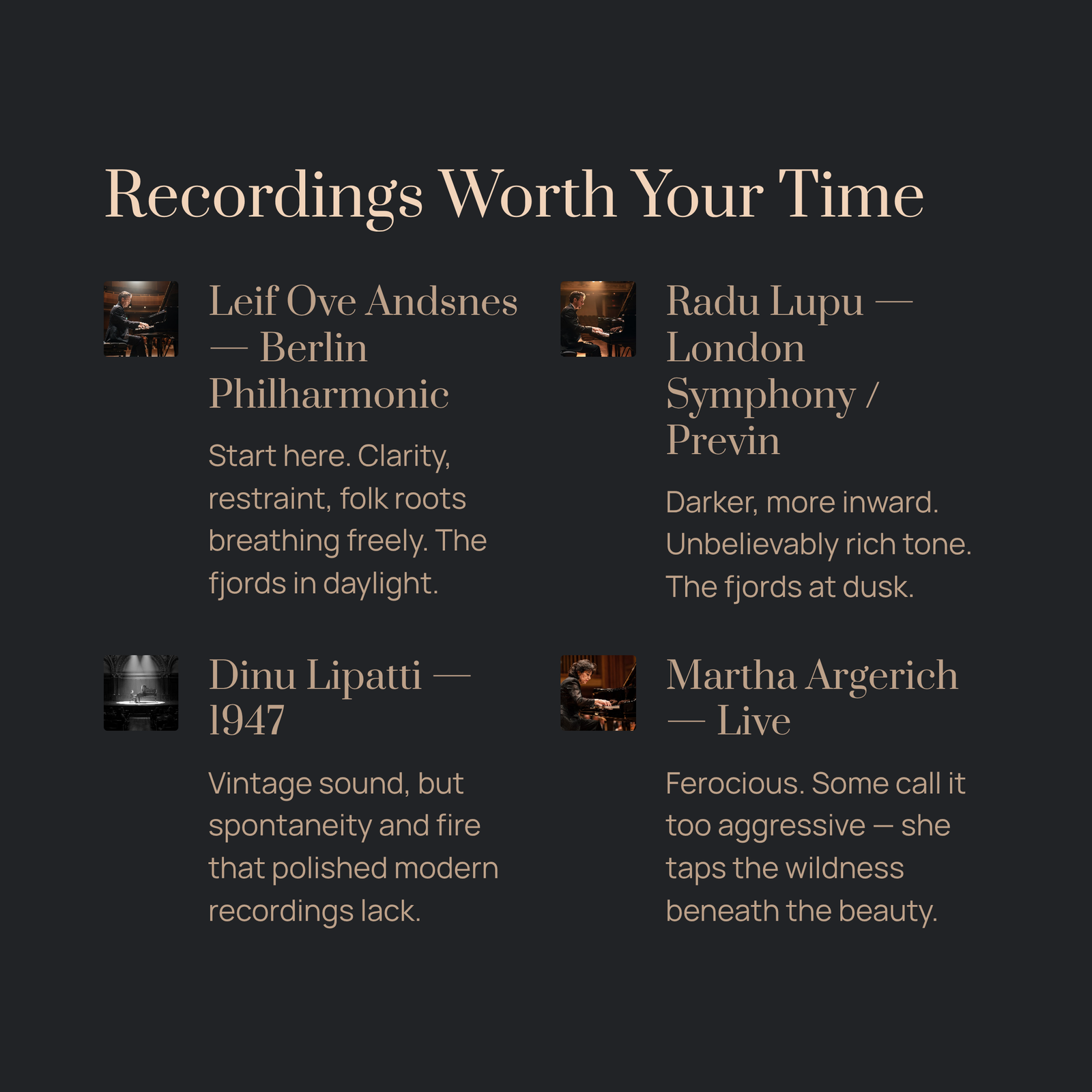
Leif Ove Andsnes with the Berlin Philharmonic is the recording I’d hand to someone who’s never heard this piece. Andsnes is Norwegian himself, and you can feel it. His playing has a clarity and restraint that lets the folk-music roots breathe without ever becoming overly sentimental. It sounds like the landscape it was written about.
Radu Lupu’s recording with the London Symphony Orchestra under André Previn is something else entirely — darker, more inward, almost secretive. Where Andsnes gives you the fjords in daylight, Lupu gives you the fjords at dusk. The piano tone is unbelievably rich, and Lupu has a way of holding back just slightly before emotional peaks that makes them hit harder when they arrive.
For a historic perspective, try Dinu Lipatti’s 1947 recording. The sound quality is vintage, naturally, but Lipatti’s playing has a spontaneity and fire that studio-polished modern recordings sometimes lack. It sounds like someone discovering the piece in real time.
And if you want sheer pianistic excitement, Martha Argerich’s live performances of this concerto are legendary. She brings a ferocity that some purists find too aggressive for Grieg, but I think she taps into something genuine — the wildness underneath the beauty, the storm behind the postcard.
How to Listen (Especially If This Is Your First Time)
If you’ve got twelve minutes and a pair of decent headphones, here’s what I’d suggest:
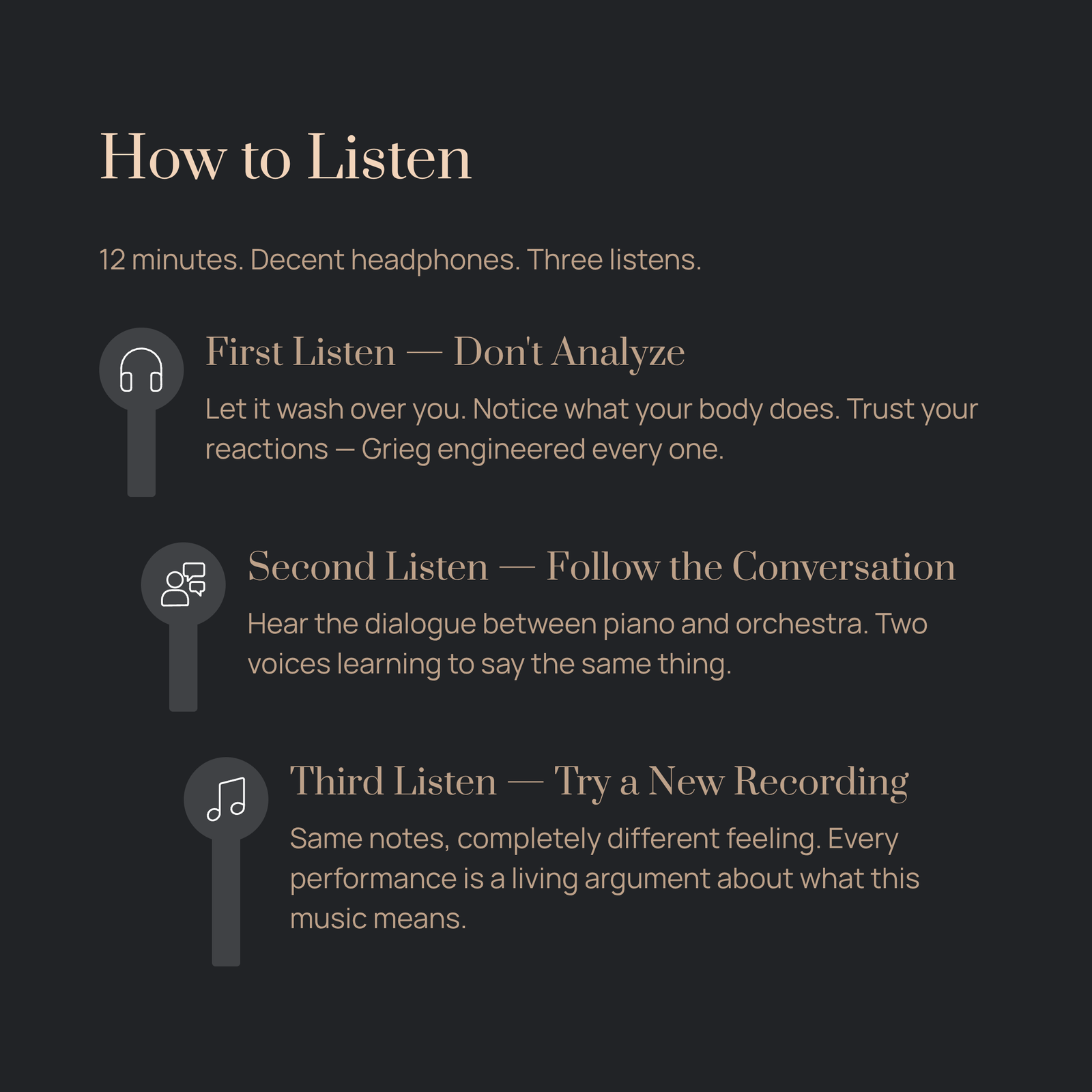
First listen — don’t analyze. Don’t try to follow what I’ve described above. Just press play and let it wash over you. Notice what your body does. Does your breathing change during the opening? Do you lean forward during the cadenza? Do you feel something tighten in your chest during the second theme? Trust those reactions. They’re not accidents — Grieg engineered every one of them.
Second listen — follow the conversation. Now try to hear the dialogue between piano and orchestra. Notice how they sometimes agree, sometimes argue, sometimes one falls silent while the other speaks. This movement is essentially a story about two voices learning to say the same thing.
Third listen — pick a recording you haven’t tried yet. You’ll be amazed how different the same notes can feel in different hands. That’s not a flaw in classical music; that’s its greatest feature. Every performance is an interpretation, a living argument about what this music means.
The Sound of Belonging
Grieg lived another 39 years after writing this concerto. He composed beautiful things — the Peer Gynt suites, the Holberg Suite, countless songs and piano miniatures. But he never wrote another piano concerto. Not because he couldn’t, but because, in some sense, he’d already said what he needed to say.
That first movement is a young man’s declaration: This is where I’m from. This is what it sounds like. This is who I am. And the extraordinary thing is that more than a century and a half later, listeners around the world hear that declaration and feel it as if it were their own.
Maybe that’s what the best music does. It starts in one person’s specific, irreplaceable experience — a fjord, a folk song, a love that’s hard to put into words — and somehow arrives at something we all recognize.
So put on your headphones. Press play. Let the timpani roll. Let the piano fall.
You might just find something that sounds a lot like home.