📑 Table of Contents
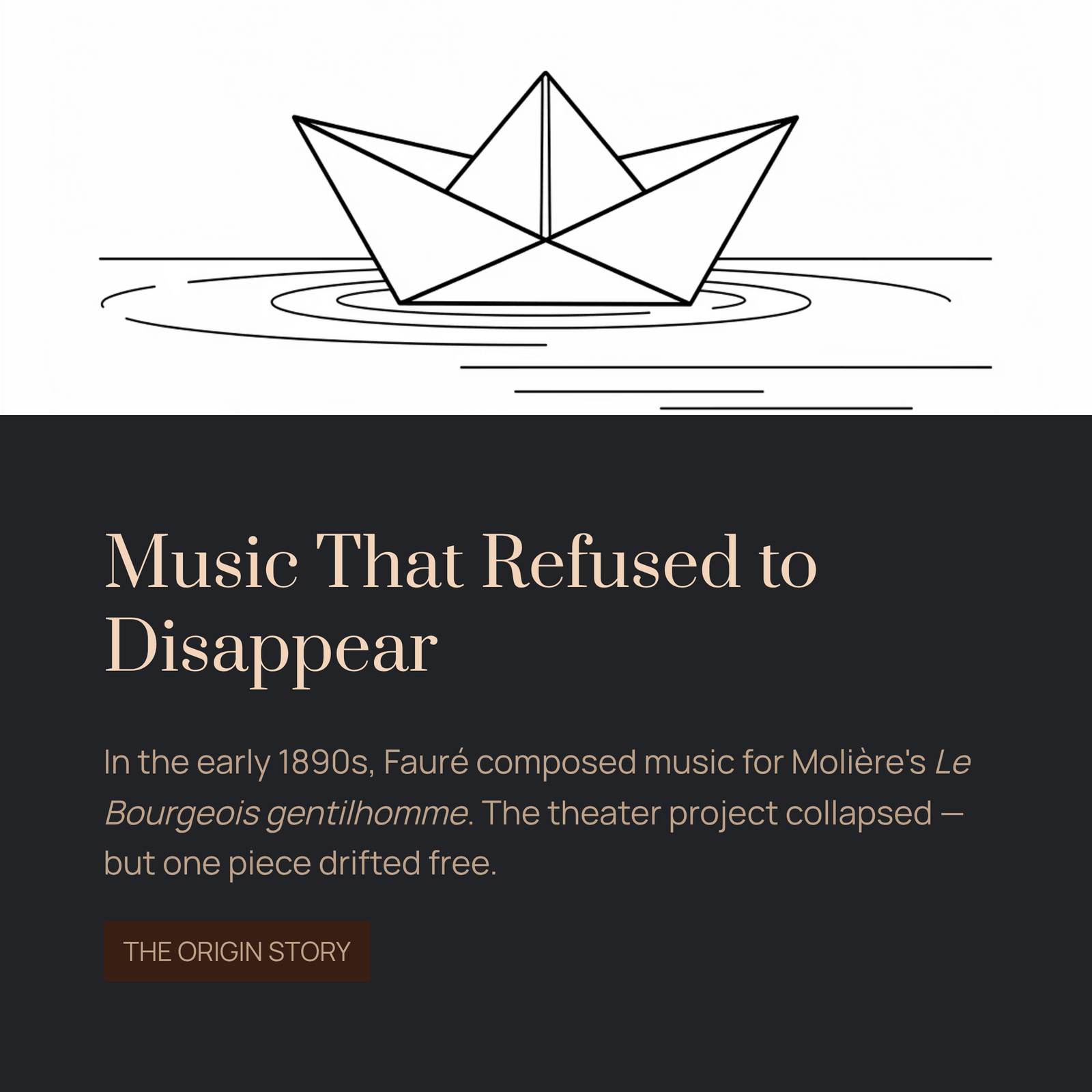
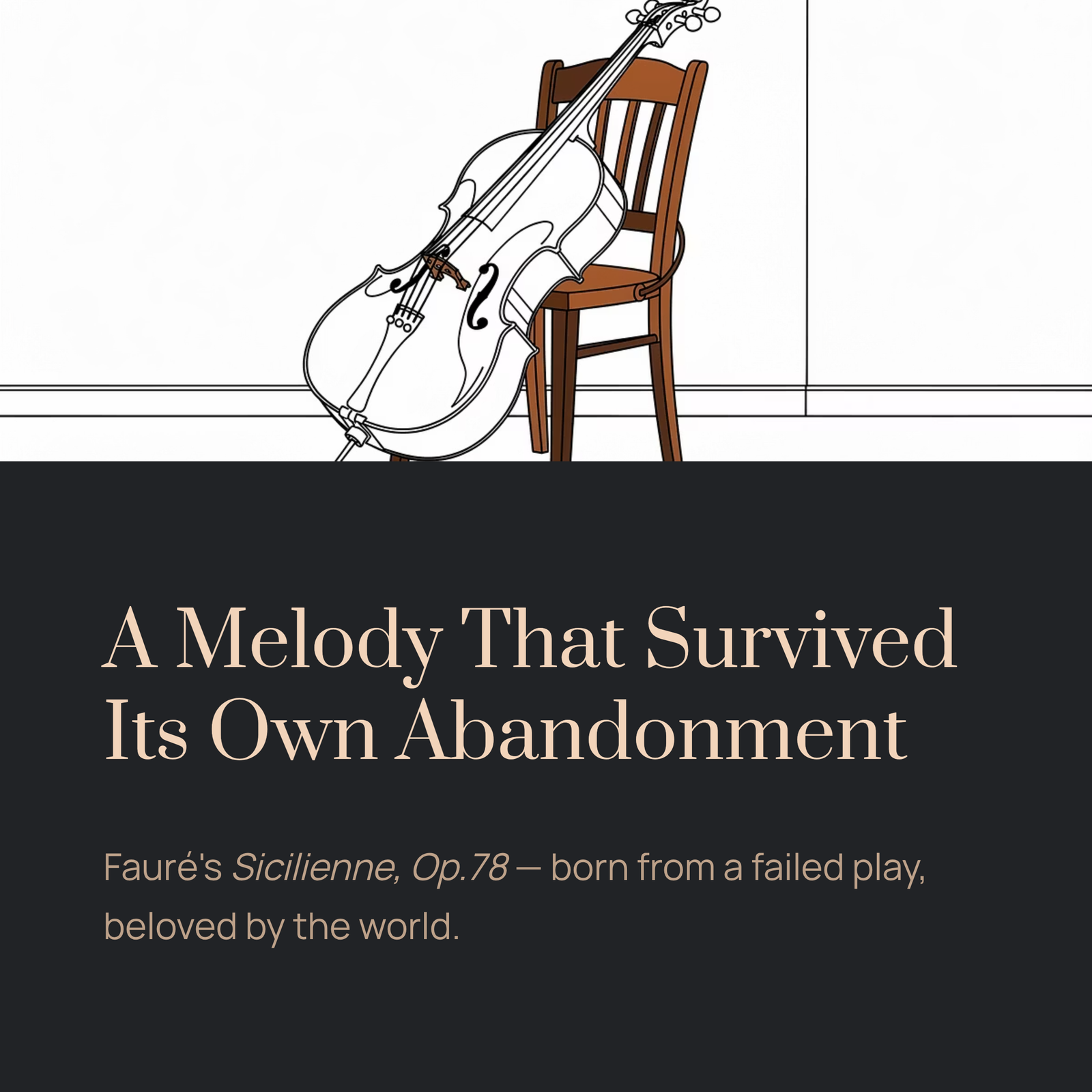
There is something quietly miraculous about music that survives its own abandonment. In the early 1890s, Gabriel Fauré sat down to compose incidental music for a production of Molière’s Le Bourgeois gentilhomme. The theater project fell apart — plans dissolved, curtains never rose, the stage stayed dark. But one piece from that unfinished effort refused to disappear. It drifted out of the wreckage like a paper boat on still water, and eventually found its way into concert halls around the world.
That piece is the Sicilienne, Op.78 — and once you hear it, you will understand why it could not stay buried.
Who Was Gabriel Fauré?
If classical music were a dinner party, Fauré would be the person sitting in the corner having the most interesting conversation — the one you’d have to lean in to hear, but once you did, you wouldn’t want to leave. Born in the south of France in 1845, Fauré spent decades in relative obscurity compared to his louder contemporaries. While Wagner was building sonic cathedrals and Tchaikovsky was flooding concert halls with drama, Fauré was doing something far more intimate. He was whispering.
He served as organist at the Madeleine church in Paris, taught at the Paris Conservatoire (where he eventually became director), and composed music that valued subtlety above spectacle. His harmonies shift like light through stained glass — you can feel them changing even when you can’t quite name what’s happening. Debussy and Ravel, those two giants of French music who came after him, both studied under Fauré’s influence. Without him, the sound of twentieth-century France might have been entirely different.
Yet for all his importance, Fauré remains underappreciated outside of France. The Sicilienne is one of the best doors through which to enter his world.
The Story Behind the Sicilienne
The word “sicilienne” refers to an old dance form originating from Sicily, typically written in a lilting 6/8 time signature. Picture the gentle rocking of a small boat on the Mediterranean — that’s the rhythm at the heart of every sicilienne. Composers from Handel to Bach had used the form centuries before Fauré, but none quite like this.
Fauré originally scored the piece for cello and piano around 1893, intended for that ill-fated Bourgeois gentilhomme production. When the theater project collapsed, the music simply waited. A few years later, Fauré found the perfect second home for it: his incidental music for Maurice Maeterlinck’s Pelléas et Mélisande, a symbolist play dripping with atmosphere and unspoken longing. The Sicilienne became the orchestral suite’s most beloved movement, now reimagined for a full ensemble.
It’s a small irony worth savoring — a piece composed for a comedy by Molière ended up becoming the emotional heart of a symbolist tragedy. Music has its own sense of direction.
How to Listen: What Makes This Piece So Special
The Sicilienne opens with a figure you will recognize instantly, even if you’ve never heard the piece before. The cello (or, in orchestral versions, a solo woodwind) plays a descending melody in G minor — tender, unhurried, slightly melancholic. Underneath, the accompaniment sways in that characteristic 6/8 pulse, like a lullaby that knows it can’t quite put you to sleep because the thoughts it carries are too beautiful to let go of.
Here are a few things to listen for on your first few hearings.
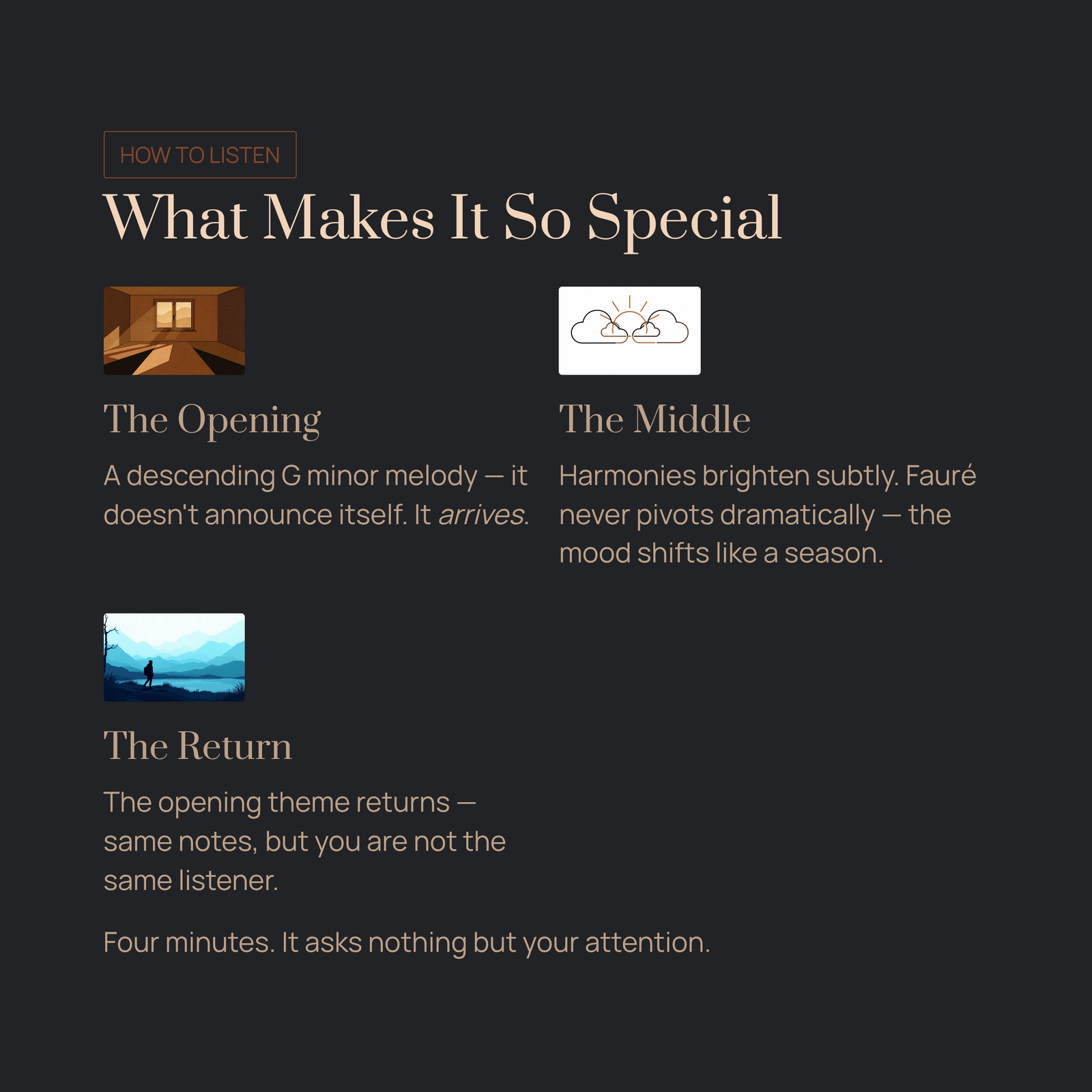
The opening melody has a quality that’s hard to describe in words. It doesn’t announce itself — it arrives, the way evening light enters a room. Pay attention to the way it falls, note by note, almost like someone slowly exhaling after holding their breath for a long time. There is no urgency here. Fauré trusts silence almost as much as he trusts sound.
Around the middle section, the mood shifts gently. The harmonies brighten just slightly, as if the clouds have thinned enough to let a little warmth through. This is classic Fauré — he never makes a dramatic pivot. Instead, the emotional color changes the way a season does: gradually, and only noticeable when you suddenly realize things feel different.
Then the opening melody returns, but it feels changed by what came between. This is perhaps the deepest magic of the Sicilienne. Structurally, it’s a simple ABA form, yet the return of the first theme carries a weight the opening didn’t have. You’ve traveled somewhere in those few minutes. You come back to the same notes, but you are not the same listener.
The whole piece lasts barely four minutes. It asks nothing of you except your attention.
Recommended Performances to Start With
One of the joys of the Sicilienne is that it exists in multiple voices — cello and piano, orchestra, flute arrangements, even guitar transcriptions. Each version reveals a different facet.
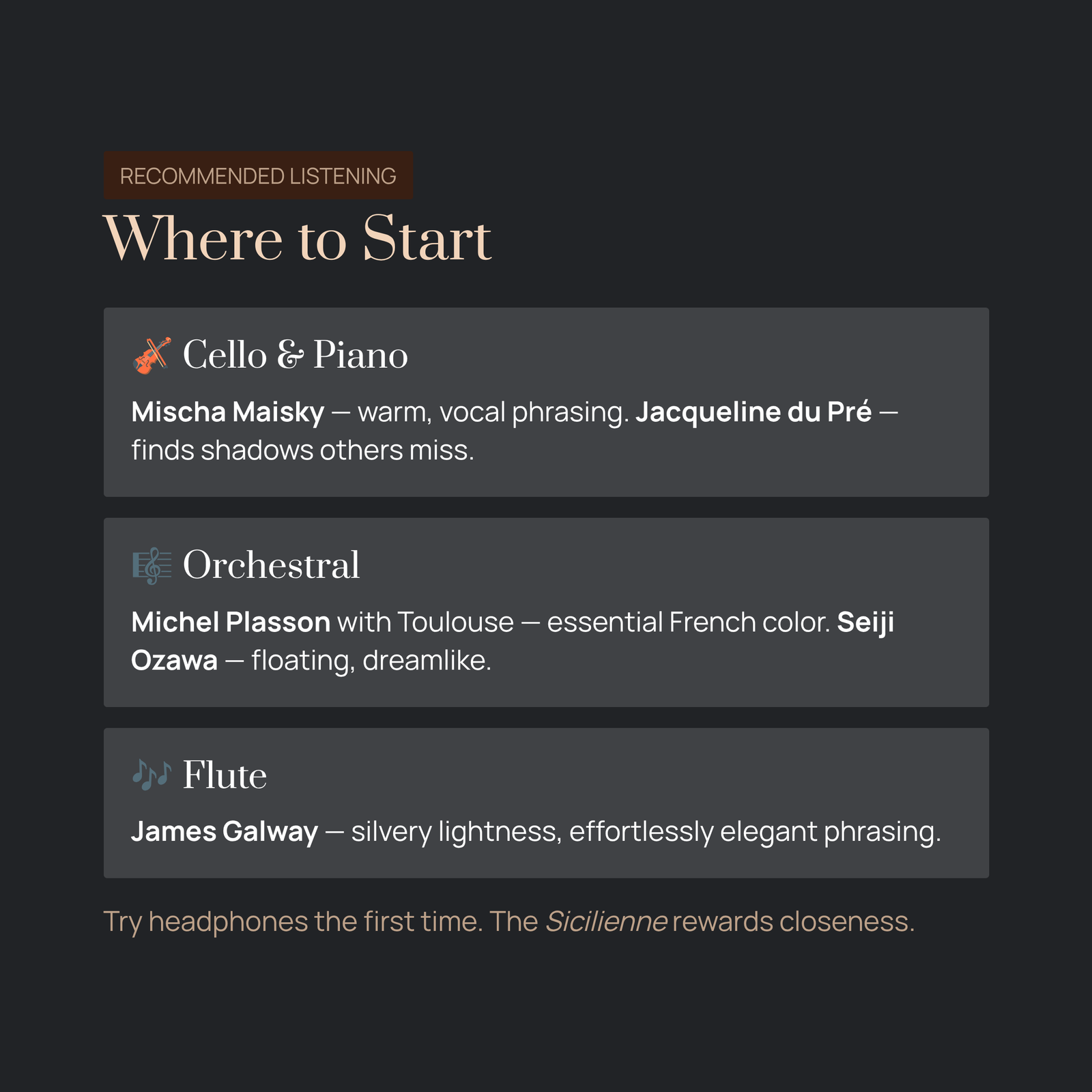
For the original cello and piano version, the recording by Mischa Maisky with pianist Daria Hovora is a beautiful place to start. Maisky’s tone is warm and vocal, and he brings a natural breathing quality to the phrasing that makes the melody feel like it’s being spoken rather than played. Another outstanding version is by Jacqueline du Pré, whose intensity lends the piece a surprising emotional depth — she finds shadows in this music that others glide past.
For the orchestral version from the Pelléas et Mélisande suite, look for the recording conducted by Michel Plasson with the Orchestre du Capitole de Toulouse. The French orchestral colors are essential here — the particular way French wind players shape a phrase, the translucent string sound. Seiji Ozawa’s recording with the Boston Symphony also captures the piece’s floating, dreamlike quality.
If you enjoy flute, the arrangement performed by James Galway has introduced countless listeners to this piece. The flute’s silvery timbre adds yet another dimension of lightness, and Galway’s phrasing is effortlessly elegant.
Whichever version you choose, try listening with headphones the first time. The Sicilienne rewards closeness.
Why This Piece Matters Now
We live in a world of noise — constant, relentless, overlapping. Notifications ping, headlines shout, algorithms compete for the next fraction of your attention. Against this backdrop, Fauré’s Sicilienne does something almost radical: it asks you to slow down. Not in a preachy, self-help-book kind of way. It simply creates a space where slowness is the natural rhythm, where gentleness is not weakness but a kind of courage.
There’s a reason this piece has survived over 130 years. It speaks to something permanent in us — the part that needs rest but not emptiness, the part that craves beauty but not spectacle. Fauré understood that the quietest voice in the room is sometimes the one worth listening to most carefully.
The Sicilienne is proof that a piece of music doesn’t need to be loud, or long, or complicated to change the texture of your afternoon. Four minutes. A descending melody. A gentle rocking rhythm. And somewhere in those four minutes, a small door opens — into stillness, into memory, into a version of yourself that has time to simply feel.
Let it play. Close your eyes if you like. And notice what surfaces when you give yourself permission to do nothing but listen.