📑 Table of Contents
There are moments in music where you don’t just hear the sound — you feel it hit you in the chest.
The third movement of Vivaldi’s Summer from The Four Seasons is one of those moments. From the very first measure, the entire string ensemble erupts in a unified, almost violent downpour of notes. There is no gentle introduction, no polite warm-up. The storm has already arrived before you’ve had time to brace yourself.
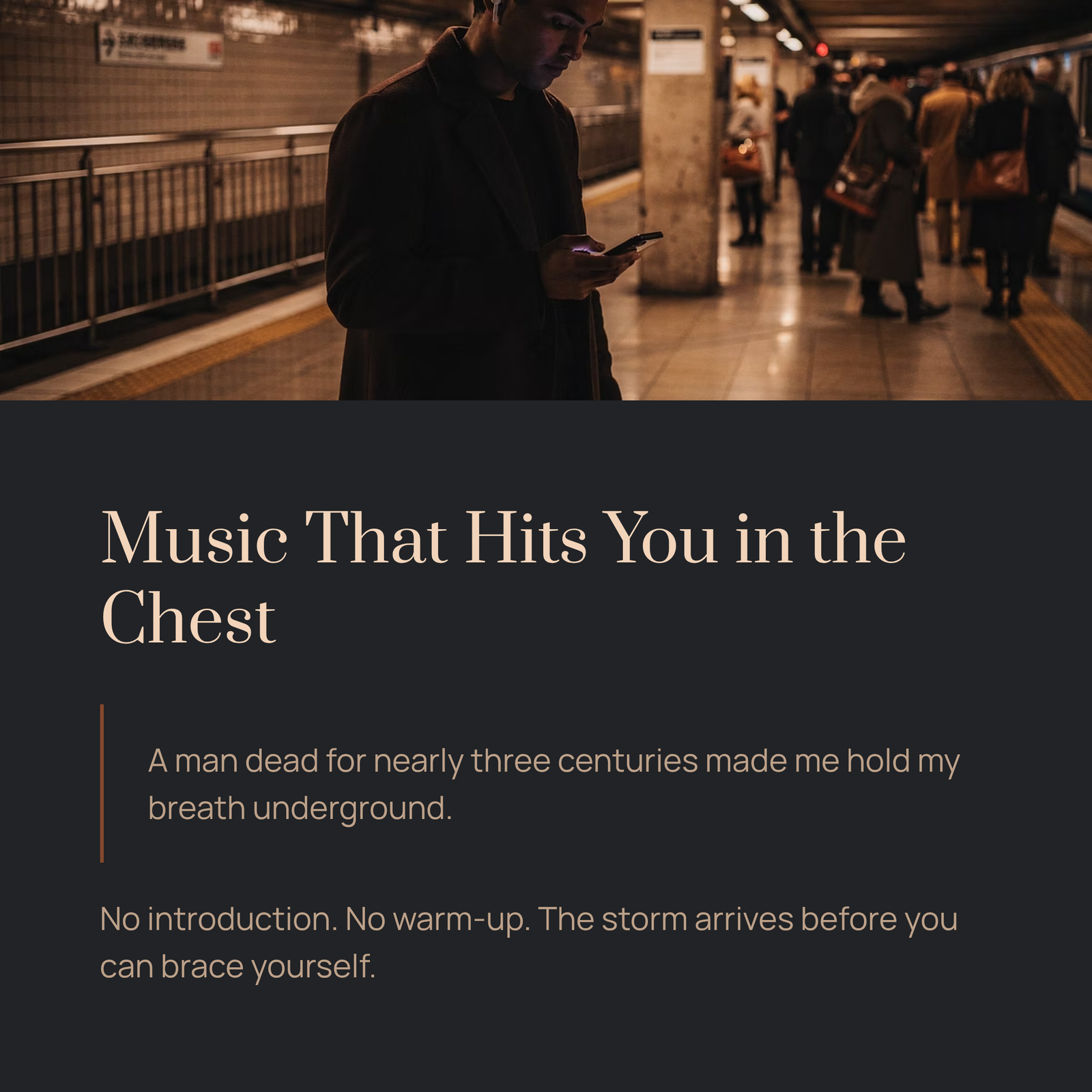
I remember the first time I heard this Presto — not in a concert hall, but through cheap earbuds on a crowded subway. Even in that unlikely setting, surrounded by noise and fluorescent light, those opening bars sliced through everything. I pulled my phone out of my pocket to check what was playing. It was Vivaldi. A man who had been dead for nearly three centuries had just made me hold my breath underground.
That’s the strange, almost unsettling power of this piece: it was written in the early eighteenth century, yet it sounds like something ripped from the future.
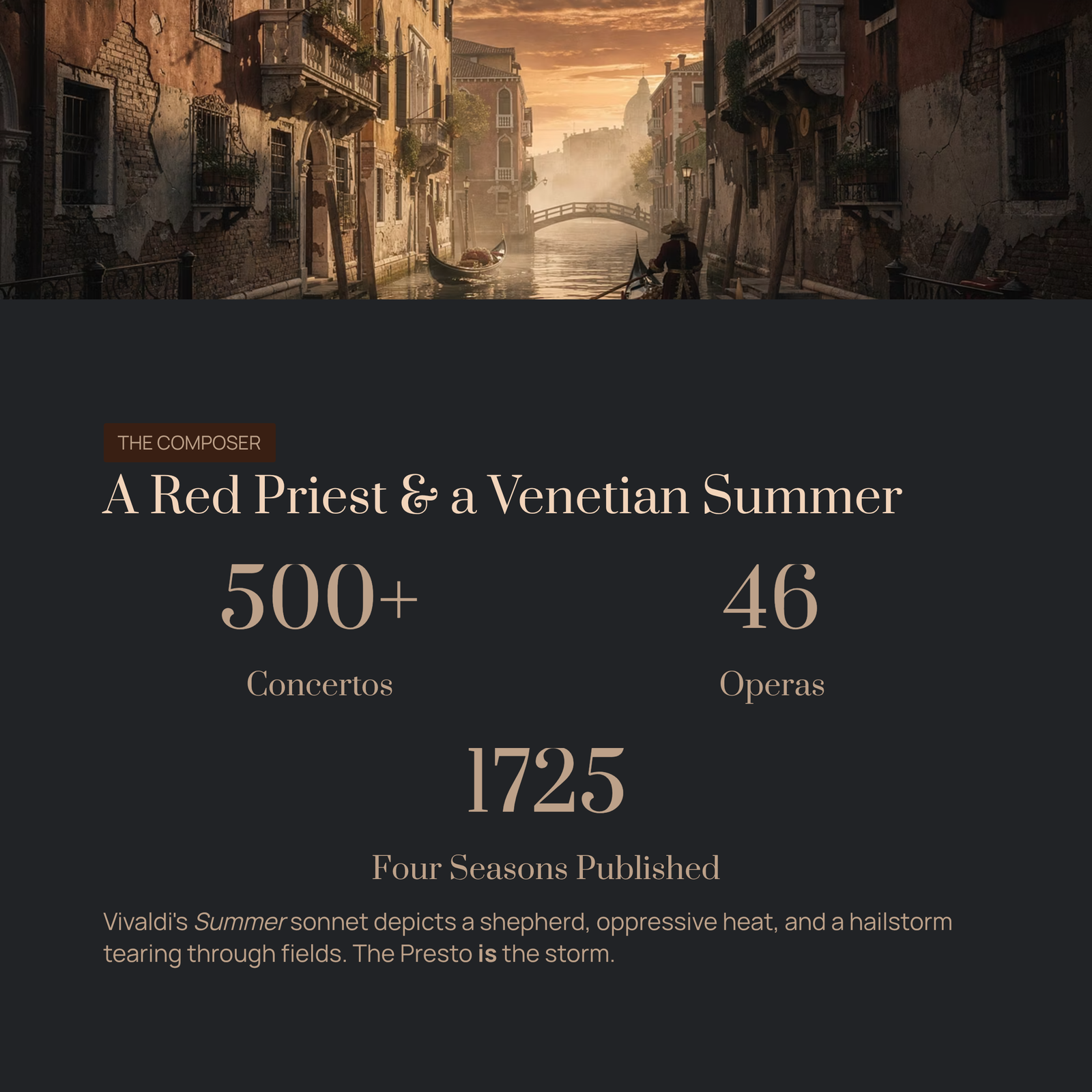
A Red Priest, a Venetian Summer, and a Sonnet No One Reads
Antonio Vivaldi was born in Venice in 1678 and ordained as a priest — though his flaming red hair earned him the nickname Il Prete Rosso, “The Red Priest.” He was excused from saying Mass due to chronic chest ailments (likely asthma), which freed him to pour his energy into something arguably more enduring: music. Over the course of his life, Vivaldi composed over 500 concertos, 46 operas, and countless sacred works.
The Four Seasons (Le quattro stagioni), published around 1725 as part of a larger collection titled Il cimento dell’armonia e dell’inventione (“The Contest Between Harmony and Invention”), remains his most celebrated work. Each of the four violin concertos is accompanied by a sonnet — likely written by Vivaldi himself — that describes the programmatic content of the music.
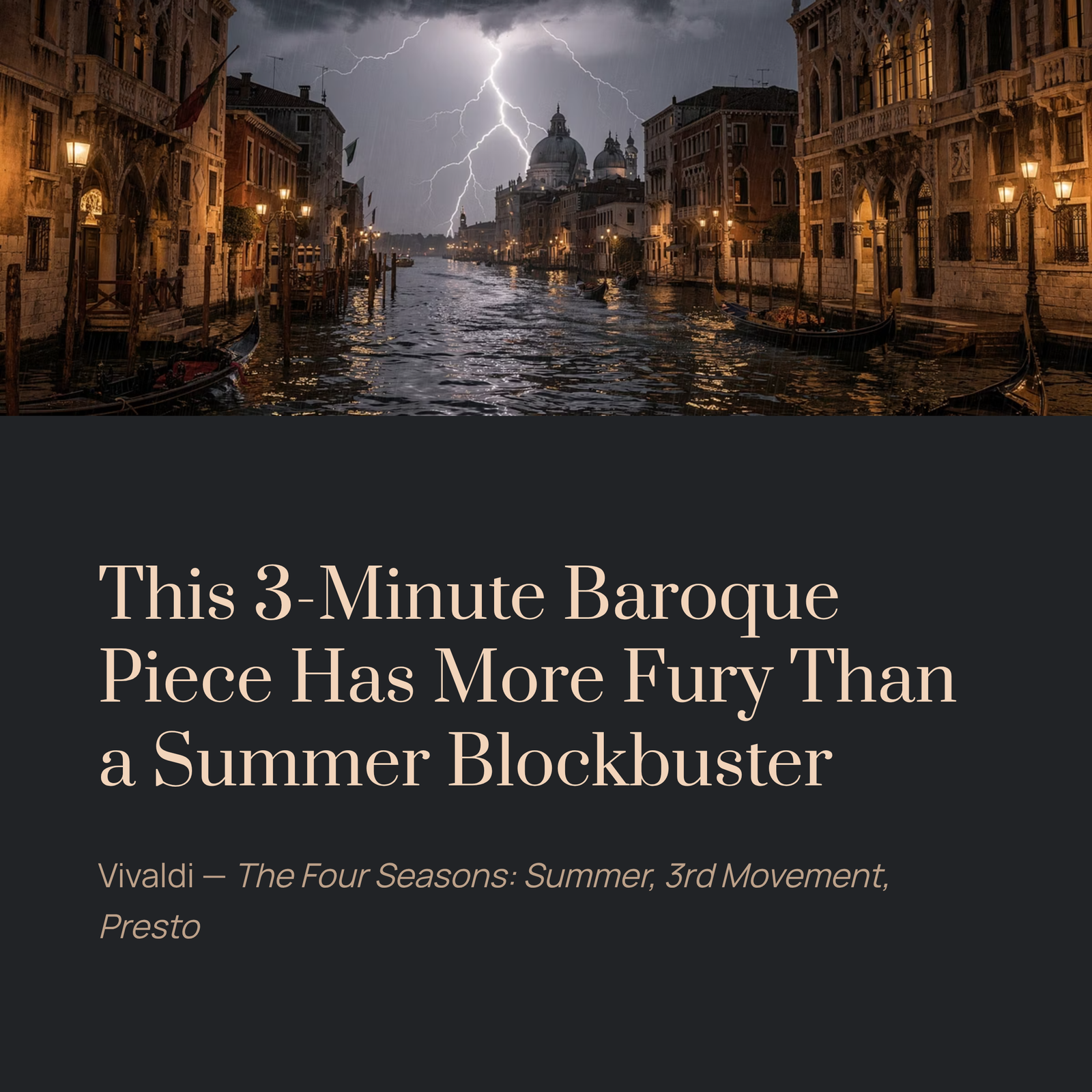
The sonnet for Summer paints a scene that anyone who has endured a Mediterranean July would recognize: oppressive heat, a young shepherd trembling at the sound of distant thunder, and finally, the full fury of a hailstorm tearing through crops and fields. The third movement — the Presto — is the storm itself.
What makes Vivaldi’s approach remarkable is how literal and vivid it is. This isn’t abstract emotion set to notes. This is weather set to strings. And it works with a ferocity that three hundred years of musical evolution have not diminished.
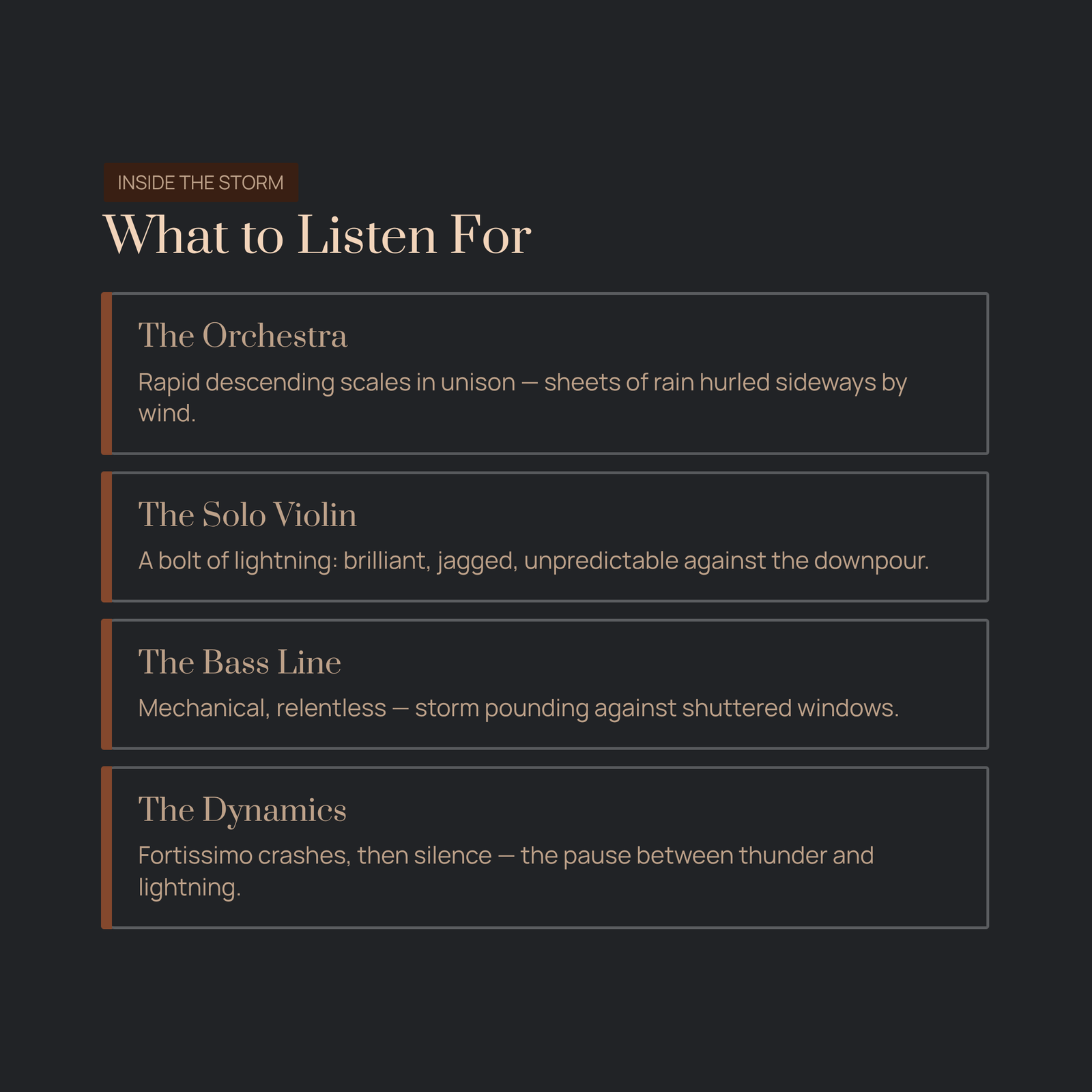
Inside the Storm: What to Listen For
At first listen, the Presto can feel like a wall of sound — relentless, almost overwhelming. But once you know what to listen for, the architecture of the chaos becomes breathtakingly clear.
The movement opens with the full string ensemble playing rapid, descending scales in unison. Picture rain — not a drizzle, but sheets of water being hurled sideways by wind. These aren’t melodic phrases in the traditional sense; they are textures, forces of nature translated into gut strings and horsehair bows. The effect is startlingly cinematic, centuries before cinema existed.
Against this torrent, the solo violin enters — not as a hero rising above the storm, but as another voice within it. The soloist’s passages are virtuosic and furious, filled with rapid-fire sixteenth notes and leaping intervals that demand extraordinary precision. Think of the solo violin as a bolt of lightning: brilliant, jagged, and unpredictable against the steady downpour of the orchestra.
One of the most striking features of this movement is its rhythmic relentlessness. Vivaldi barely allows the listener a moment to breathe. The bass line drives forward with almost mechanical insistence, like the inescapable pounding of a storm against shuttered windows. There is no development section, no contrasting lyrical theme to offer respite. It is three minutes of pure, unbroken intensity — and that is precisely the point.
Listen also for the dynamic contrasts. Vivaldi alternates between moments where the full ensemble crashes in fortissimo and brief passages where the texture thins, as though the storm is catching its breath before the next assault. These aren’t pauses for relief; they are the silence between thunder and the next crack of lightning.
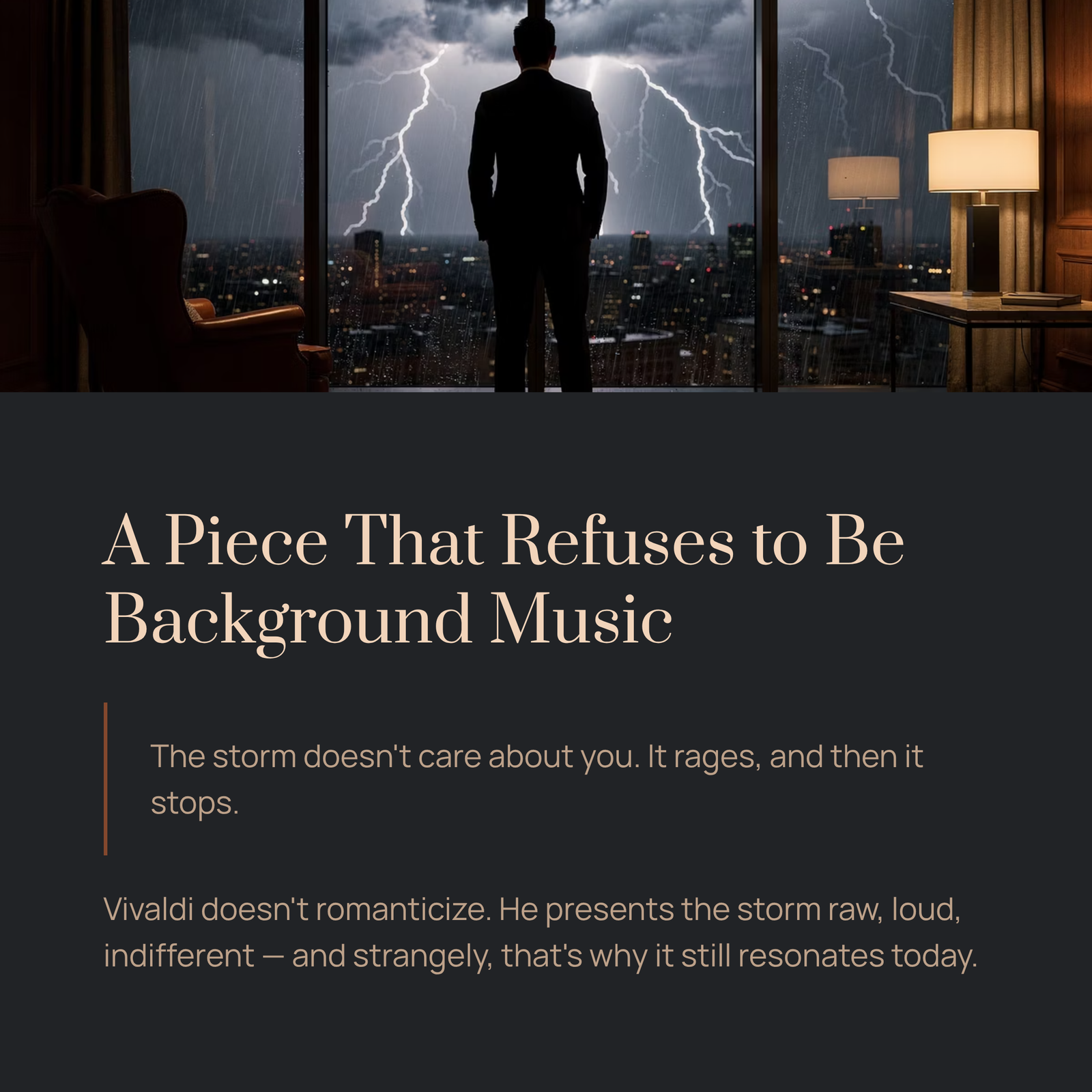
A Piece That Refuses to Be Background Music
I’ve listened to this Presto dozens of times across years, in different rooms and different moods, and it has never once faded into the background. That is a remarkable quality for any piece of music, but especially for one written in the Baroque era, a period often stereotyped as elegant and restrained.
What strikes me most about this movement is its honesty. Vivaldi doesn’t romanticize the storm. He doesn’t frame it as a metaphor for inner turmoil or spiritual struggle — at least not explicitly. He simply presents it: raw, loud, and indifferent. There is something almost modern about this directness. The storm doesn’t care about you. It doesn’t resolve neatly into a major key. It rages, and then it stops.
And maybe that’s why this piece resonates so deeply even today. In an age saturated with manipulative soundtracks designed to tell us exactly what to feel, Vivaldi’s Presto simply throws you into the middle of something real. You either stand in the rain or you don’t.
There is also a strange exhilaration in its intensity. Like watching a thunderstorm from a safe window, there is a pleasure in being engulfed by sound that cannot actually harm you. The Presto gives you permission to feel overwhelmed — and to enjoy it.
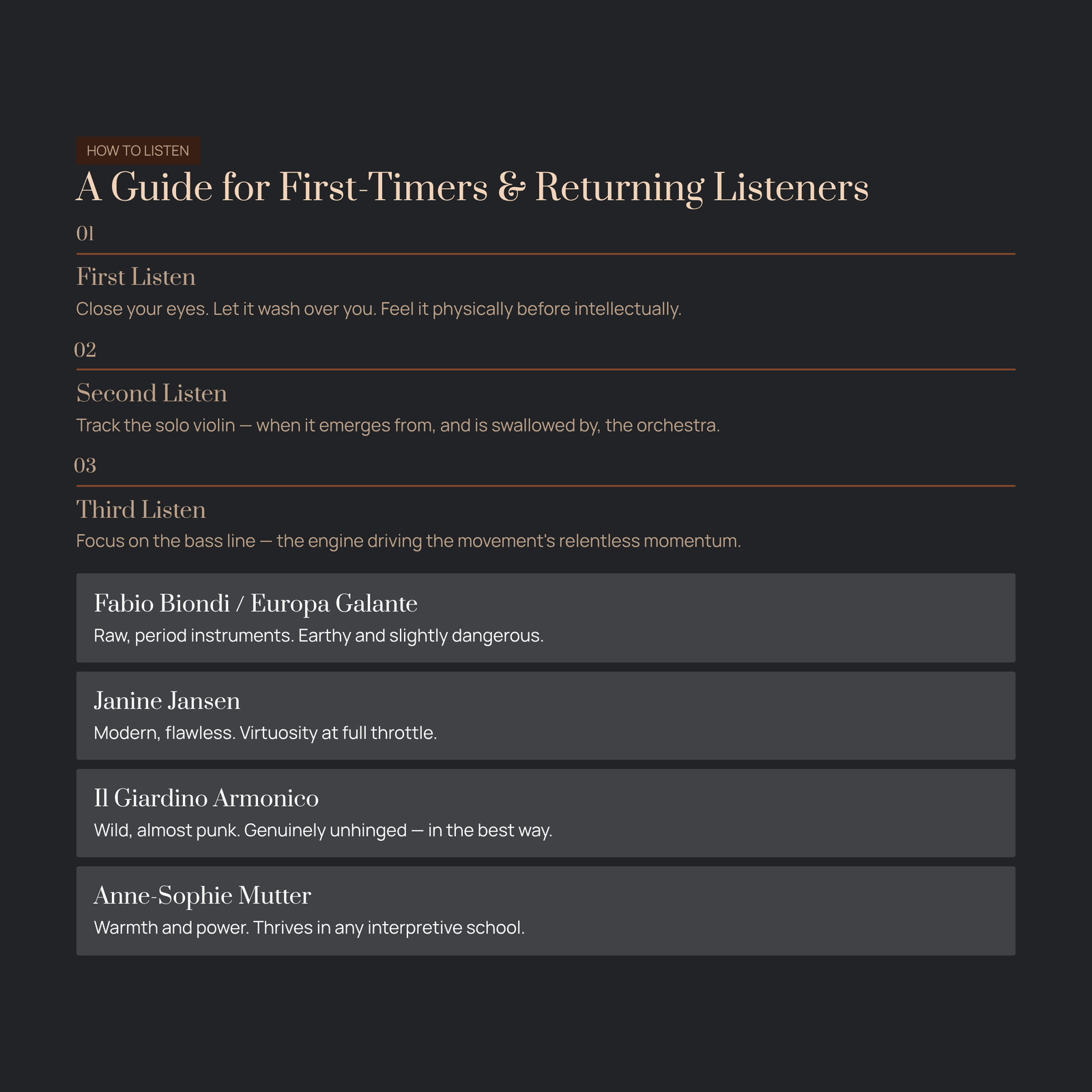
How to Listen: Practical Guidance for First-Timers and Returning Listeners
If this is your first time with this movement, I would suggest the following approach.
On your first listen, don’t try to analyze anything. Just press play, close your eyes, and let the sound wash over you. Notice where your body tenses up, where your breathing changes. This piece is physical before it is intellectual — let it be.
On your second listen, focus on the relationship between the solo violin and the orchestra. Try to track when the soloist emerges from the texture and when they are swallowed back into it. You’ll begin to hear the storm not as a monolith but as a conversation — albeit a violent one — between individual voices and collective force.
On your third listen, pay attention to the bass line. It is the engine of the entire movement, the thing that makes it feel like it is hurtling forward. Once you hear it, you can’t unhear it, and you’ll understand how Vivaldi generates such extraordinary momentum with such relatively simple means.
For recommended performances, consider these recordings, each offering a distinct perspective on the same storm:
The Europa Galante recording led by Fabio Biondi is fierce and historically informed, played on period instruments with gut strings that give the sound an earthy, almost aggressive quality. This is the version I return to most often — it sounds the way I imagine Vivaldi intended it: raw, immediate, and slightly dangerous.
Janine Jansen’s live recording brings a more modern, polished intensity. Her technique is flawless and the sheer velocity of her playing is astonishing. If you want to hear what world-class virtuosity sounds like at full throttle, this is the version.
Il Giardino Armonico under Giovanni Antonini takes the period-instrument approach to its most radical extreme. Their interpretation is wild, almost punk in its energy — tempos are pushed, dynamics are exaggerated, and the result is a performance that sounds genuinely unhinged in the best possible way.
For a more traditional orchestral sound, the classic Anne-Sophie Mutter recording with the Trondheim Soloists offers warmth and power in equal measure, proving that this piece thrives regardless of interpretive school.
After the Storm
The final notes of the Presto do not fade away. They stop — abruptly, decisively, as if the storm has simply moved on to devastate the next valley. There is no coda, no gentle resolution. Just silence where chaos was.
It is one of the most effective endings in all of Baroque music, and perhaps in all of music, period. Vivaldi understood something that many composers after him forgot: sometimes the most powerful thing a piece of music can do is simply stop.
Three centuries later, this three-minute storm still catches listeners off guard. It still makes people pull out their phones on the subway to check what’s playing. It still refuses to be polite, or predictable, or safe.
And in a world that often feels like it’s demanding we stay calm, stay measured, stay composed — there is something deeply necessary about a piece of music that says: No. Feel this. All of it. Right now.