📑 Table of Contents
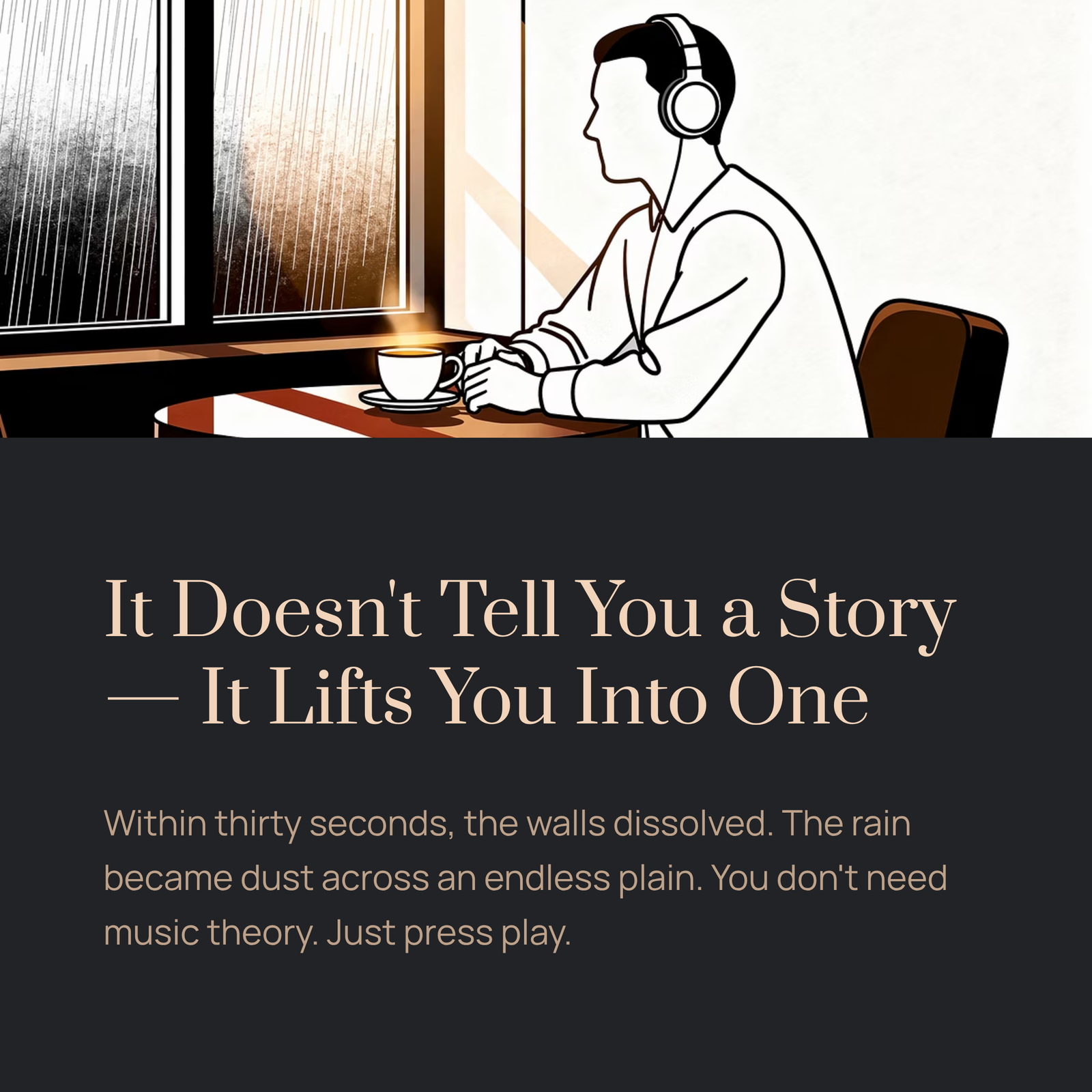
There are pieces of music that don’t ask for your attention — they simply take it. Hans Zimmer’s Cornfield Chase, from Christopher Nolan’s 2014 film Interstellar, is one of those rare compositions. The first time I heard it outside of the movie theater, I was sitting in a café on a rainy afternoon, headphones in, staring at nothing in particular. Within thirty seconds, the walls around me dissolved. The rain outside the window was no longer rain — it was dust sweeping across an endless plain, and I was running through it, not away from something, but toward something I couldn’t name.
That’s what this piece does. It doesn’t tell you a story so much as it lifts you into one. And the remarkable thing is, you don’t need to know a single thing about music theory, orchestration, or film scoring to feel it in your chest. You just need to press play.
The Man Who Scores the Universe
Hans Zimmer hardly needs an introduction, yet the arc of his career makes the existence of Cornfield Chase all the more fascinating. Born in Frankfurt, Germany, in 1957, Zimmer grew up straddling the worlds of classical European composition and pop music — he played in bands before he ever scored a film. His breakthrough came with Rain Man (1988), and from there he built an empire of sound: The Lion King, Gladiator, The Dark Knight, Inception. Each score pushed the boundaries of what film music could be, layering electronic textures with massive orchestral forces.
But Interstellar was different. When Nolan approached Zimmer about the project, he didn’t hand him a script. Instead, he gave him a single page — a short letter about a father’s relationship with his child — and asked him to write something based on that alone. No mention of space. No mention of black holes or wormholes. Just fatherhood. Just love and distance.
Zimmer sat at his piano and composed the emotional core of the entire score in a single day. That decision — to root a cosmic epic in the smallest, most intimate human feeling — is what gives Cornfield Chase its devastating simplicity.
Inside the Music: Dust, Light, and Liftoff
Cornfield Chase opens with a delicate, almost tentative piano figure — a pattern of rising notes that feels like a question being asked over and over. It’s quiet. Unhurried. The kind of melody a child might pick out on a keyboard, not because it’s childish, but because it carries that same quality of pure, unguarded wonder.
Then the organ enters.
This is the moment everything changes. Zimmer chose to build the Interstellar score around a pipe organ — specifically, the Harrison & Harrison organ at Temple Church in London, an instrument dating back to the 1920s. The choice was deliberate and brilliant. A pipe organ doesn’t just produce sound; it breathes. Air moves through its pipes the same way wind moves through a wheat field, and in Cornfield Chase, you can feel that breath expanding. The organ swells beneath the piano like the ground falling away beneath your feet.
As the piece builds, strings join in — not with a sweeping Hollywood melody, but with sustained, overlapping tones that create a sense of vast, open space. Imagine standing in the middle of a cornfield at dawn, the sky cracking open with light in every direction. That’s the texture Zimmer achieves. There’s no percussion, no rhythmic drive pushing you forward. Instead, the music floats. It accumulates emotion the way clouds gather before a storm — gradually, inevitably, until suddenly you realize you’re holding your breath.
The climax arrives not with a crash but with a radiant expansion, as if the music itself has broken through the atmosphere. And then it recedes, gently, leaving you back on the ground but somehow changed.
What This Piece Means to Me
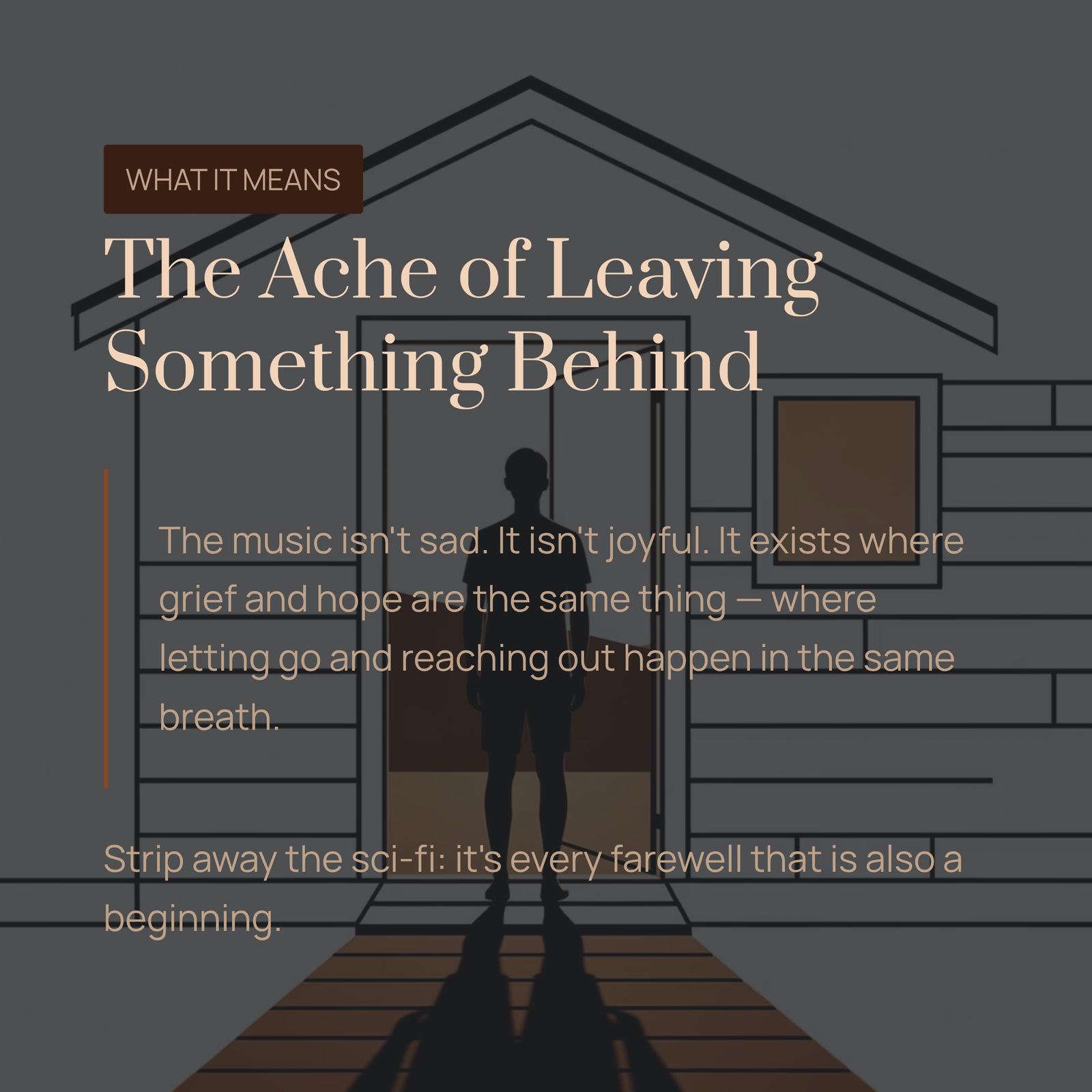
I think the reason Cornfield Chase resonates so deeply with so many people — far beyond the audience that saw Interstellar in theaters — is that it captures a feeling most of us carry but rarely articulate: the ache of knowing you have to leave something behind in order to become who you’re supposed to be.
The film frames this as a father leaving his daughter to save humanity. But strip away the science fiction, and the emotion is universal. It’s the feeling of standing in the doorway of your childhood home for the last time. It’s the moment before you board a flight to a country where you know no one. It’s every farewell that is also a beginning.
What Zimmer does so masterfully is refuse to tell you how to feel about this. The music isn’t sad, exactly. It isn’t joyful. It exists in that luminous space between the two — a space where grief and hope are the same thing, where letting go and reaching out happen in the same breath. That ambiguity is what makes it endlessly listenable. Each time I return to it, I hear something different, because each time, I bring a different version of myself.
How to Listen: A Practical Guide
If you’re coming to Cornfield Chase for the first time — or even if you’ve heard it dozens of times — here are a few ways to deepen the experience.
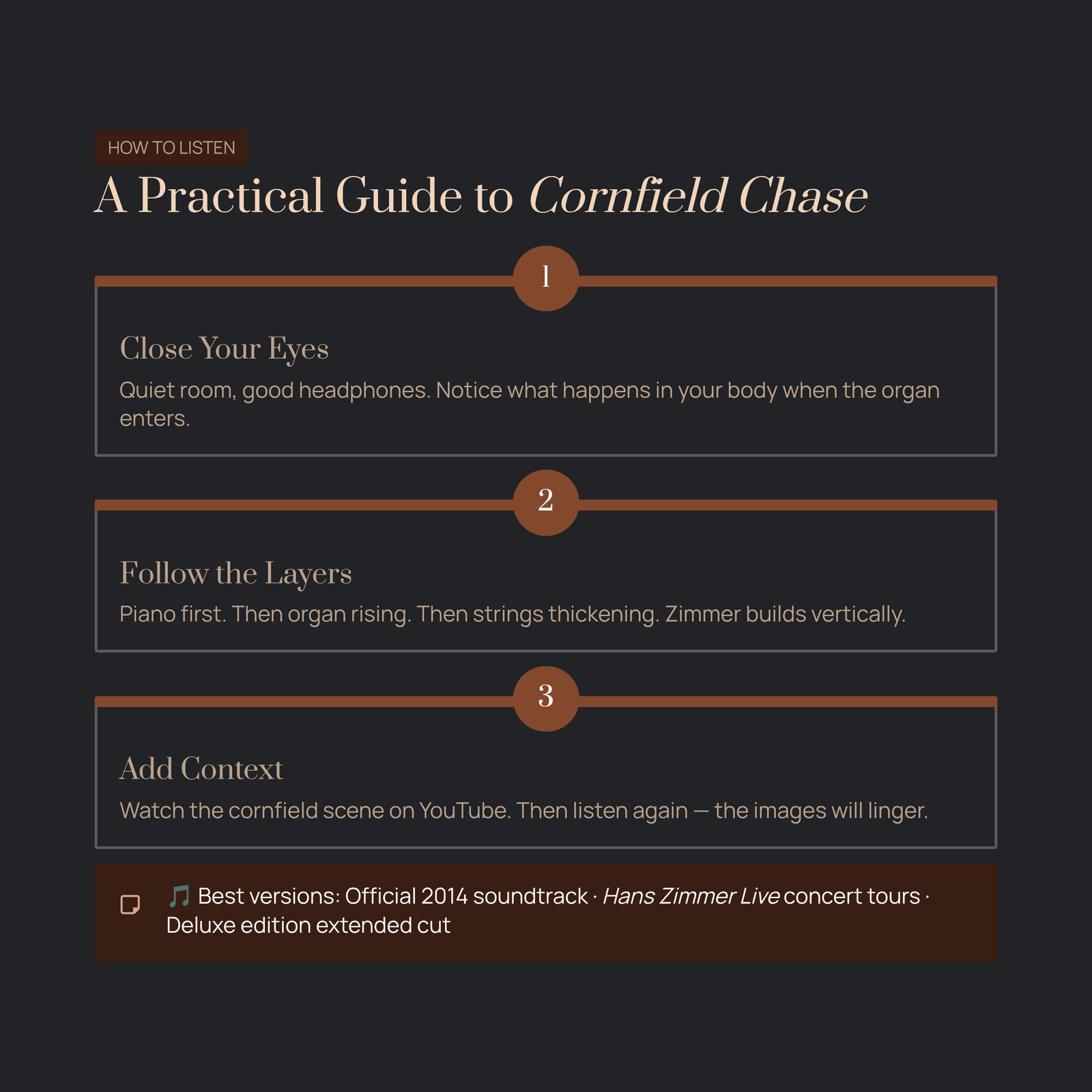
First listen: Close your eyes. Don’t read about it. Don’t watch the film scene. Just let the sound wash over you in a quiet room, preferably with good headphones. Pay attention to the moment the organ enters. Notice what happens in your body — your breathing, your posture, the tension in your shoulders. This piece is physical before it’s intellectual.
Second listen: Follow the layers. Now that you know the emotional shape, listen for the architecture. Start with the piano at the bottom. Then track the organ as it rises. Notice how the strings don’t introduce a new melody but rather thicken and elevate what’s already there. Zimmer builds vertically — stacking frequencies like geological layers — rather than horizontally with changing melodies.
Third listen: Context. Watch the cornfield chase scene from Interstellar on YouTube. See how the music transforms what could have been a simple truck-driving sequence into something mythic. Then listen to the track again on its own and notice how the images linger in your mind.
Recommended recordings and versions: The definitive version is on the official Interstellar soundtrack album (2014), but I also recommend searching for live performances from Zimmer’s Hans Zimmer Live concert tours. Hearing a real pipe organ fill a concert hall changes the experience entirely — the low frequencies move through your body in a way no headphone can replicate. For a different flavor, look for the extended version on the Interstellar deluxe edition, which gives the piece more room to breathe.
Dust Settles, But the Sound Doesn’t
There’s a line in Interstellar that has stayed with me: “We used to look up at the sky and wonder at our place in the stars. Now we just look down and worry about our place in the dirt.” Cornfield Chase is the musical answer to that lament. It doesn’t argue or persuade. It simply lifts your gaze.
What I find most profound about this piece — and about Zimmer’s work on Interstellar as a whole — is that it proves something many of us sense but struggle to articulate: that the deepest emotions aren’t complicated. They’re elemental. A father’s love. The pull of the unknown. The terrifying beauty of letting go. You don’t need a symphony of a hundred instruments to express these things. You need a piano, an organ, and the courage to let the silence between the notes speak.
If you’ve never explored film music as something worth listening to on its own — outside the theater, outside the context of moving images — let Cornfield Chase be your invitation. Put it on when you’re driving alone at night. Play it when the weight of a decision sits heavy on your chest. Let it fill the room when you need to be reminded that leaving the ground is not the same as losing it.
The dust will settle. The music won’t.