📑 Table of Contents
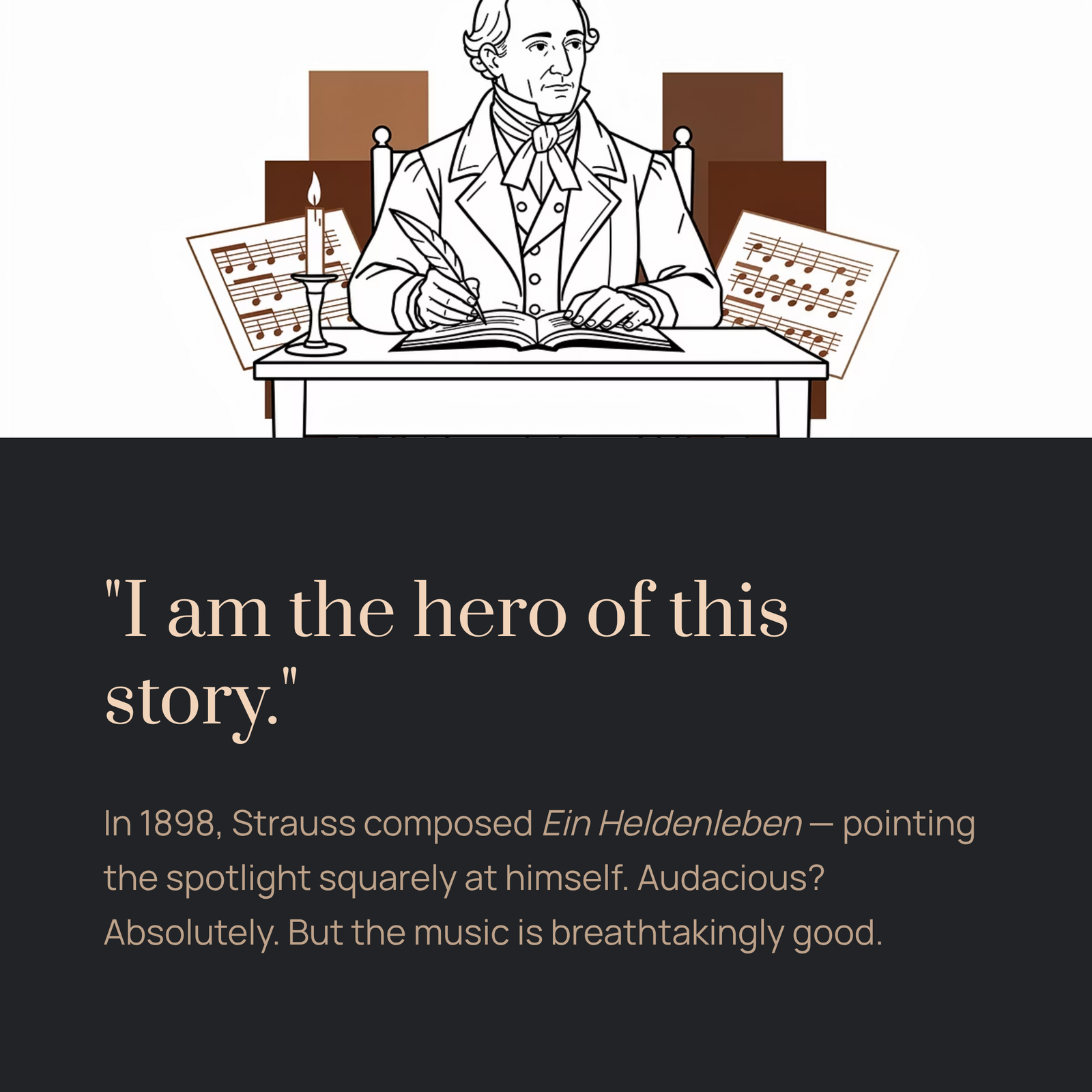
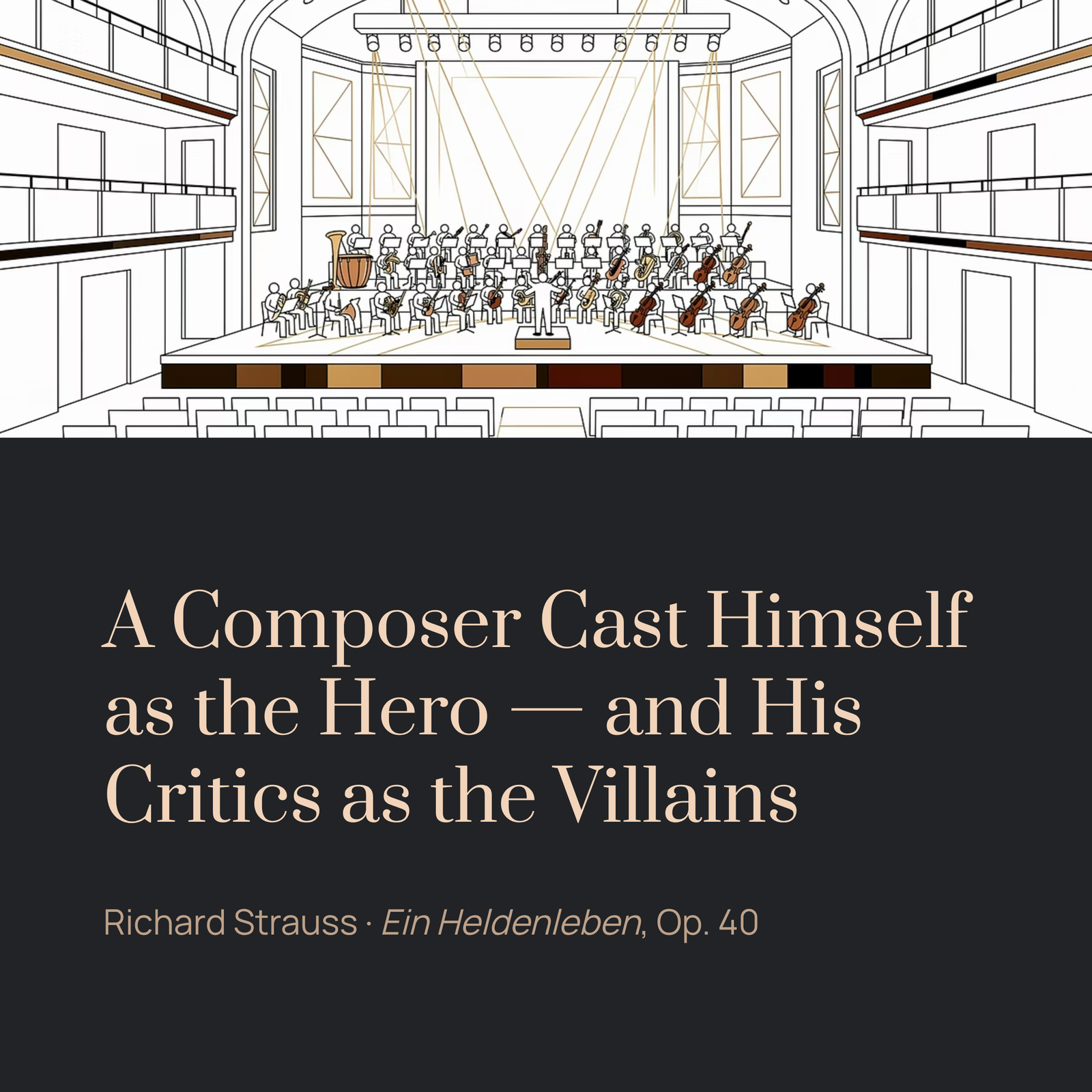
Imagine walking into a concert hall and hearing a composer declare, through a hundred-piece orchestra, “I am the hero of this story.” No allegory, no hiding behind mythology. Just a thirty-four-year-old man from Munich telling the world, in sweeping orchestral sound, that his life was an epic worth telling.
That is exactly what Richard Strauss did in 1898 when he composed Ein Heldenleben — “A Hero’s Life.” While other composers reached for Greek legends or Shakespearean drama to frame their orchestral narratives, Strauss pointed the spotlight squarely at himself. His heroism, his enemies, his lover, his battlefield, his legacy — all painted in some of the most dazzling orchestral writing the late nineteenth century ever produced.
Was it arrogance? Possibly. Was it audacious? Absolutely. But here is the thing: the music is so breathtakingly good that the audacity becomes part of the thrill. And today, we step into the most visceral chapter of this self-portrait — “The Hero’s Battlefield.”
The Man Behind the Music: Richard Strauss in the 1890s
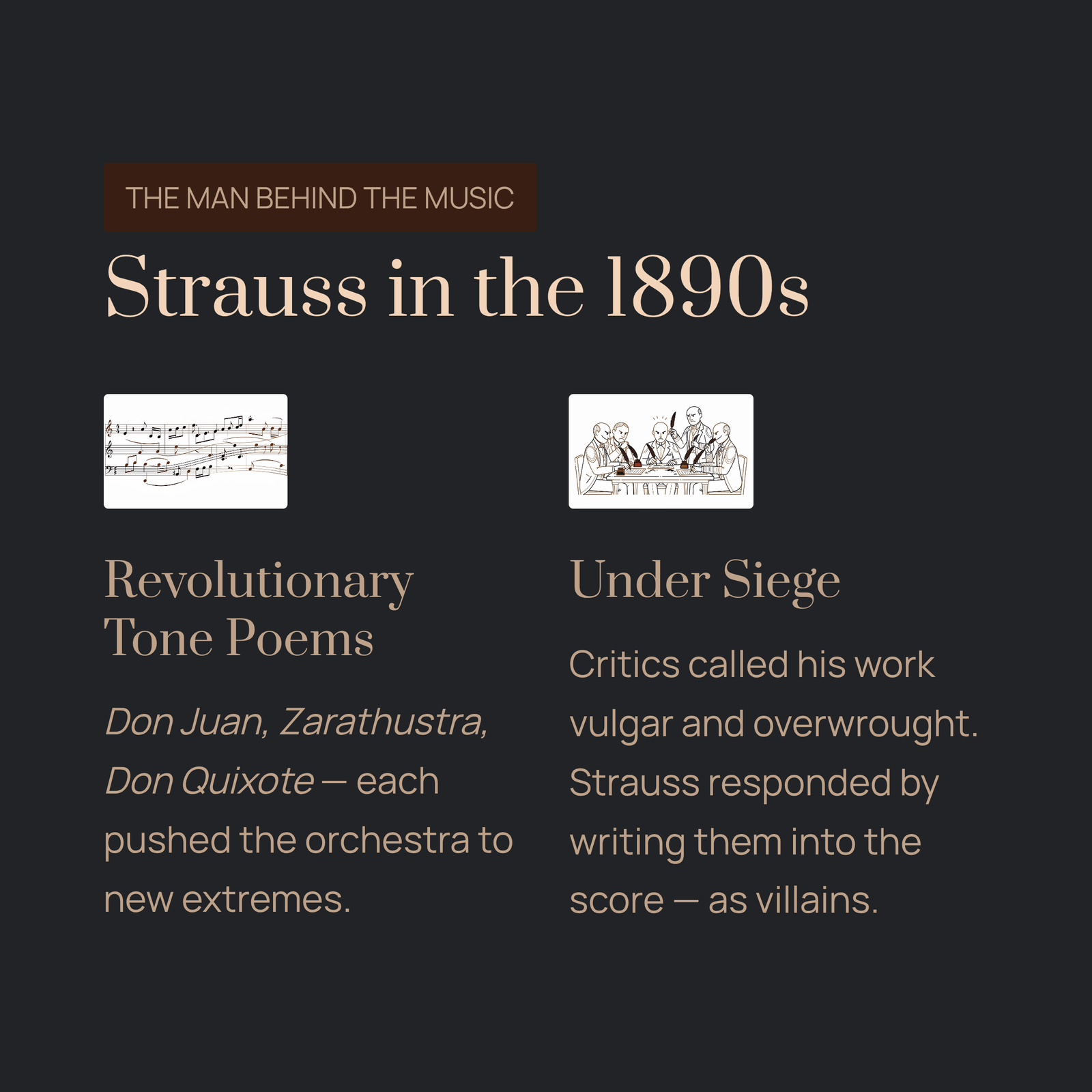
Before we charge into battle, it helps to know who this “hero” was. By the time Strauss sat down to write Ein Heldenleben, he had already shaken the classical music world with a string of revolutionary tone poems: Don Juan, Till Eulenspiegel, Also sprach Zarathustra, and Don Quixote. Each one pushed the orchestra to new extremes of color, virtuosity, and narrative ambition.
But Strauss was also a man under siege — or at least, he felt that way. Music critics of the day attacked him relentlessly. They called his compositions vulgar, overwrought, and shamelessly self-promotional. Strauss, never one to take criticism quietly, decided to respond in the most Strauss way imaginable: he wrote an entire orchestral work casting himself as a misunderstood hero, and his critics as a bleating, sneering mob of adversaries.
Ein Heldenleben unfolds in six continuous sections, each depicting a chapter of the hero’s journey. “The Hero” introduces our protagonist with a bold, striding theme in the horns and strings. “The Hero’s Adversaries” portrays the critics through biting, dissonant woodwind passages — deliberately ugly music meant to mock them. “The Hero’s Companion” is a radiant, volatile violin solo representing his wife, the soprano Pauline de Ahna, whose temperament was famously unpredictable.
And then comes the fourth section: “The Hero’s Battlefield.”
The Battlefield: Organized Chaos on a Monumental Scale
“The Hero’s Battlefield” is one of the most extraordinary passages in all of orchestral literature. It is not a literal depiction of trench warfare or cavalry charges — Strauss’s battlefield is metaphorical, a struggle of the artist against a hostile world. But the music sounds every bit as explosive as any physical combat.
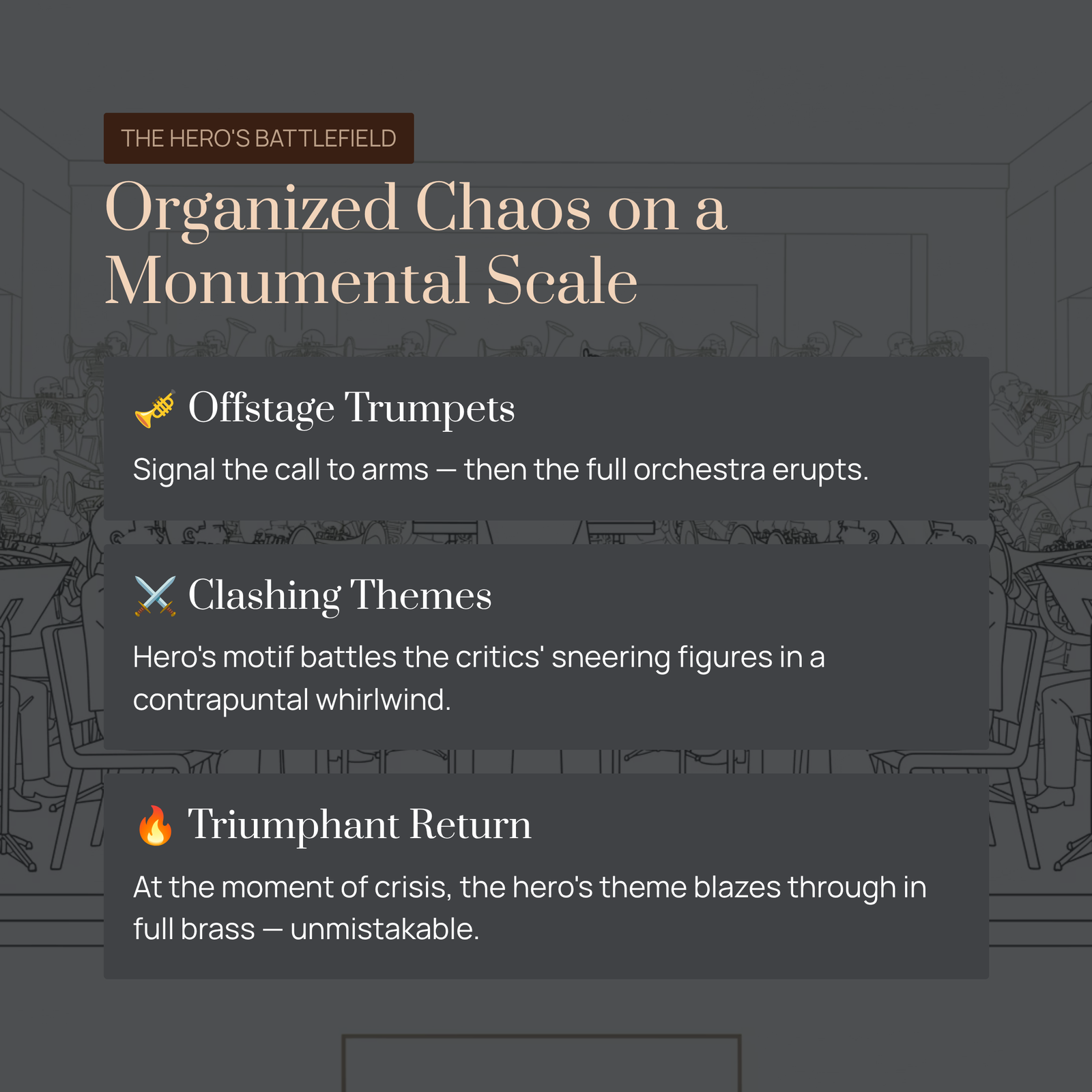
The section erupts without warning. Offstage trumpets signal the call to arms, and within seconds the full orchestra is unleashed in a torrent of sound that feels almost uncontrollable. Strauss layers theme upon theme — the hero’s bold motif clashing against the adversaries’ sneering figures — in a contrapuntal whirlwind that demands every ounce of technical skill from the orchestra.
Think of it as a cinematic battle scene composed decades before cinema existed. Brass fanfares punch through surging string tremolo. Percussion cracks like cannon fire. Woodwinds swirl in frantic, almost panicked patterns. And through it all, the hero’s theme keeps returning, battered but unbroken, each reappearance slightly transformed by the struggle.
What makes this passage so thrilling is how Strauss controls the chaos. Every seemingly random collision of sound is meticulously scored. The cacophony is not noise — it is architecture. Strauss builds tension through accumulation, layering more and more instruments into the fray, until the sound reaches an almost unbearable density. And then, at the moment of crisis, the hero’s theme blazes through in the full brass, triumphant and unmistakable.
The emotional effect is overwhelming. You feel the exhaustion, the defiance, and ultimately the exhilaration of victory — not through words or images, but through pure orchestral storytelling.
What This Battlefield Means: Art as Struggle
It would be easy to dismiss Strauss’s self-mythology as mere ego. But listen more carefully, and something universal emerges from the noise of battle.
Every artist knows this battlefield. The doubt that creeps in at three in the morning. The criticism that cuts deeper than it should. The relentless pressure to prove that your vision has value. Strauss took those invisible struggles and made them thunder.
There is also something deeply moving about the way the hero’s companion — that soaring solo violin — reappears during the battle. In the midst of all that orchestral violence, a single violin voice threads through the texture, fragile yet persistent. It is as if Strauss is saying that even in the darkest moments of conflict, love and intimacy survive. The battlefield does not erase tenderness; it reveals how essential tenderness is.
This interplay between the monumental and the intimate is what elevates Ein Heldenleben beyond spectacle. Strauss was not simply showing off his orchestral technique — though it is staggeringly brilliant. He was mapping the emotional topography of a creative life: the ambition, the vulnerability, the rage, and the quiet moments of grace that make the fight worthwhile.
How to Listen: A Practical Guide for First-Time Listeners
If you have never listened to Ein Heldenleben before, the battlefield section can feel overwhelming. Here are a few ways to make the experience more rewarding.
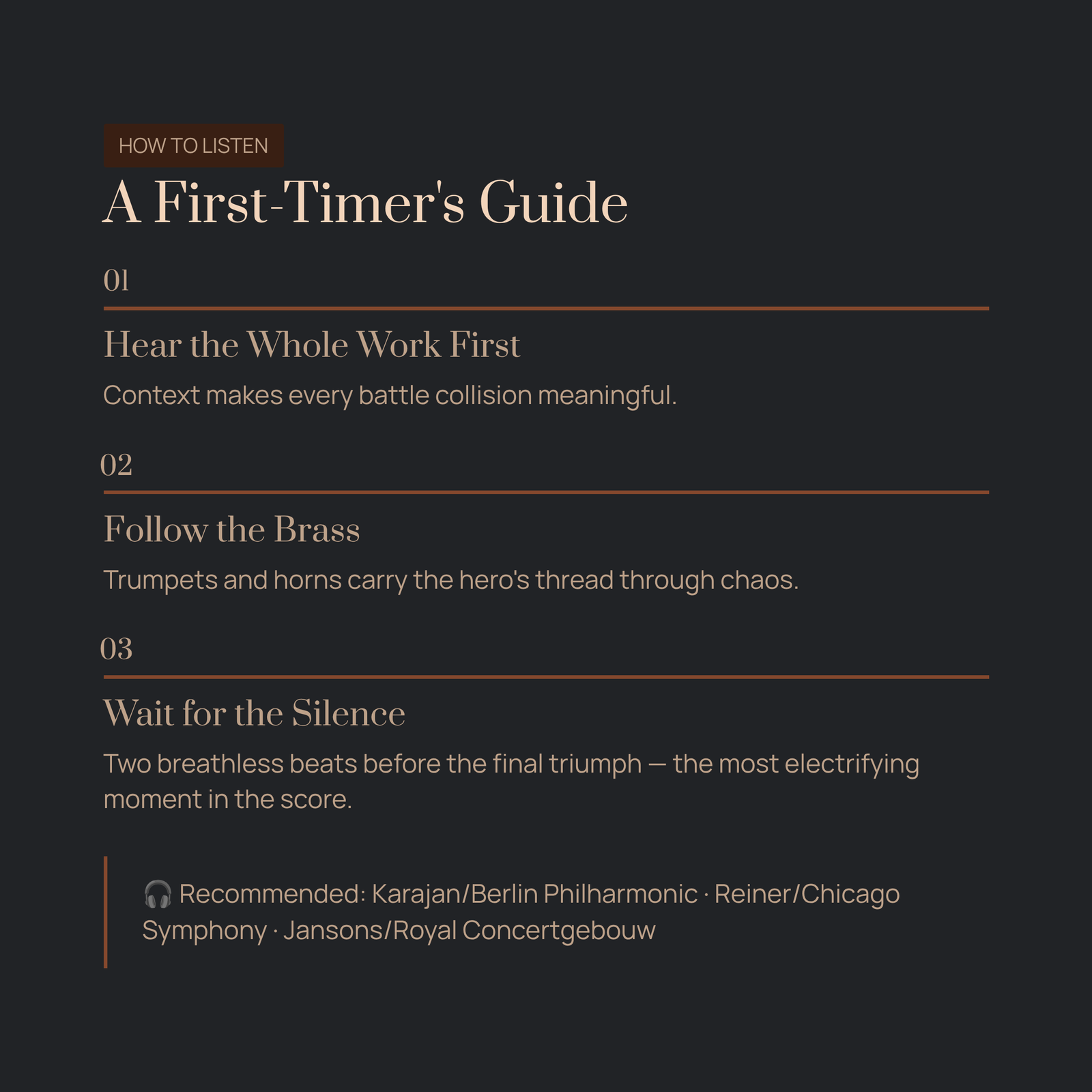
First, listen to the entire work at least once before focusing on the battlefield. The emotional impact of the battle depends on knowing the hero’s theme, hearing the critics’ mockery, and falling under the spell of the violin solo that represents his companion. Without that context, the battlefield is just loud. With it, every collision of themes carries meaning.
Second, follow the brass. In the chaos of the battle, the trumpets and horns carry the hero’s narrative thread. When you hear those bold, ascending phrases pushing through the orchestral storm, that is the hero fighting forward. Track that line, and the structure of the battle becomes clear.
Third, listen for the moment of silence just before the final triumph. Strauss creates a brief, breathless pause — barely two beats — before the hero’s theme returns in full glory. That pause is one of the most electrifying moments in all of orchestral music. Once you know it is coming, the anticipation is almost unbearable.
For recommended recordings, Herbert von Karajan’s reading with the Berlin Philharmonic is a landmark — massive in scale, with an almost cinematic sense of drama. Fritz Reiner and the Chicago Symphony offer a leaner, more transparent approach that reveals Strauss’s intricate orchestration with surgical precision. For a more recent interpretation, Mariss Jansons with the Royal Concertgebouw Orchestra brings warmth and narrative clarity that makes the piece feel like a great novel unfolding in real time. And if you want to witness the solo violin part at its most seductive, look for recordings featuring concertmasters who treat the companion’s music as a character study — not just a technical display.
The Courage to Say “This Is My Story”
There is something radical about what Strauss did with Ein Heldenleben, and the battlefield section crystallizes it. In an era when composers were expected to speak through the safe distance of myth and abstraction, Strauss said: this is me. This is my fight. These are my enemies, and this is the woman I love, and this is what it feels like to push forward when the world pushes back.
You do not have to agree with his self-assessment. You do not have to believe he was truly a hero. But sitting in the middle of that orchestral storm, hearing the hero’s theme rise again and again through waves of opposition — it is hard not to feel something stir. Because the battlefield Strauss composed is not really about one man’s career in late-nineteenth-century Munich. It is about every moment you have ever had to fight for something you believed in, knowing the outcome was uncertain, knowing the critics were watching, and choosing to charge forward anyway.
That is the gift of Ein Heldenleben. It does not ask you to admire Richard Strauss. It asks you to recognize the hero in yourself.