📑 Table of Contents
Imagine pouring every ounce of your soul into a piece of music — months of sleepless nights, scribbled drafts, and relentless revision — only to have someone you deeply respect sit down, listen in silence, and then tear it apart without mercy.
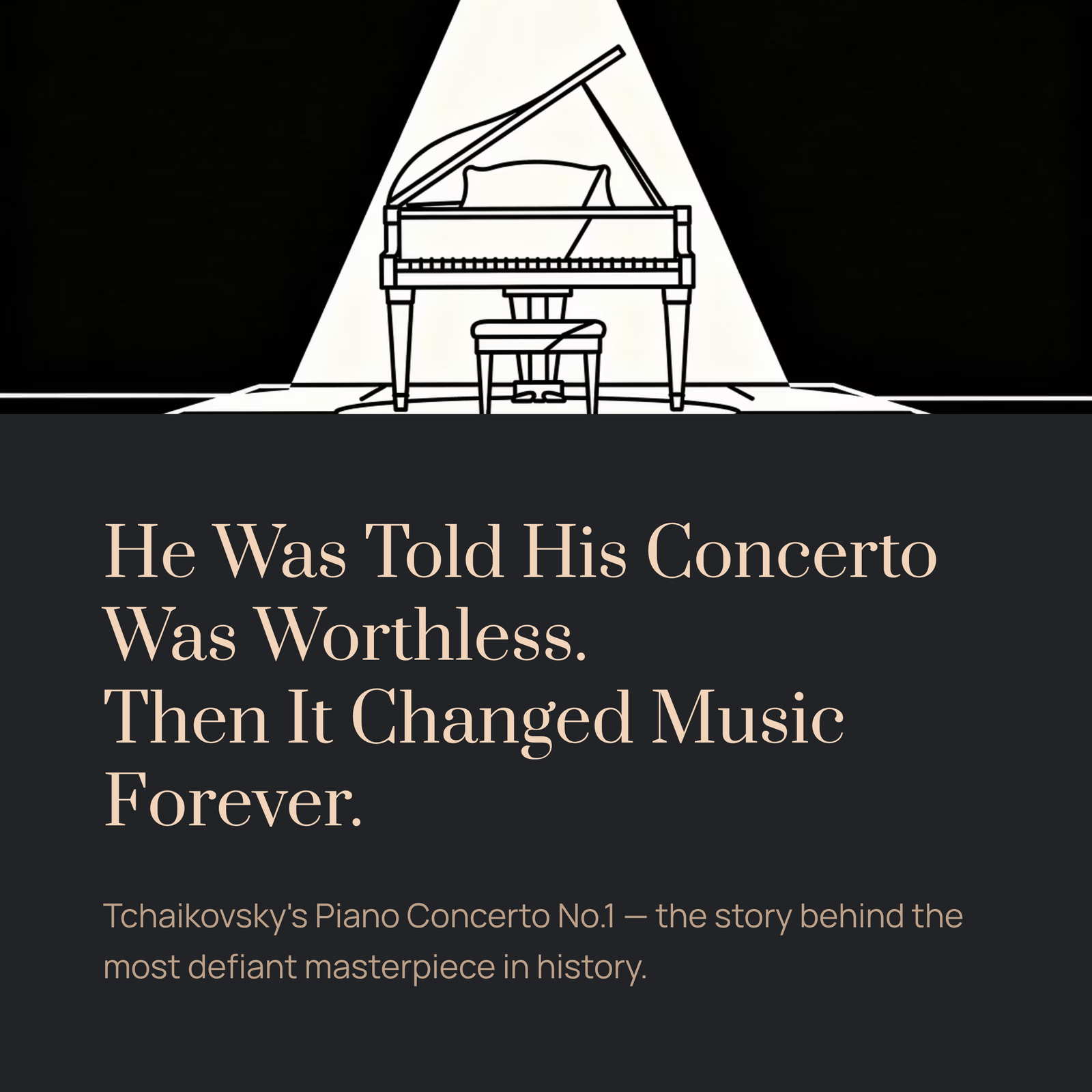
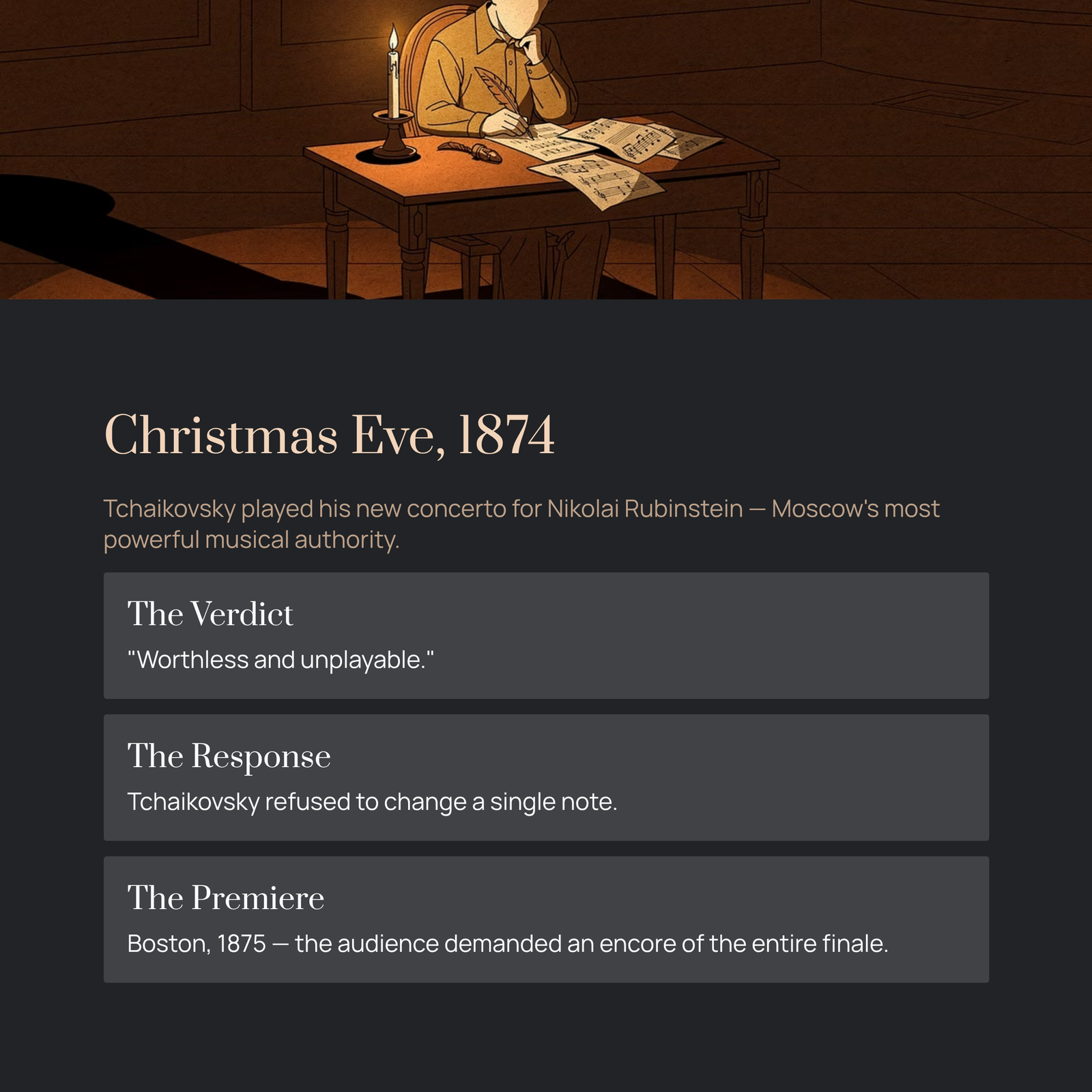
That is exactly what happened to Pyotr Ilyich Tchaikovsky on Christmas Eve, 1874.
He had just finished his Piano Concerto No.1 in B-flat minor, Op.23, and he was nervous. He brought it to Nikolai Rubinstein, the most powerful pianist and musical authority in Moscow at the time — a man Tchaikovsky considered not just a colleague, but a mentor. He played through the entire first movement at the piano, waiting for a nod of approval, a word of encouragement, anything.
What he got instead was devastation. Rubinstein declared the concerto “worthless and unplayable.” He called it clumsy, poorly written, and beyond salvation. Tchaikovsky later described the experience in a letter: he sat in stunned silence, unable to speak, while Rubinstein’s words fell on him like a hammer.
But here’s the thing about rejection — sometimes it is the very thing that sharpens a masterpiece into permanence. Tchaikovsky refused to change a single note. He dedicated the concerto to Hans von Bülow instead, and its premiere in Boston in October 1875 was a triumph. The audience demanded an encore of the entire finale. From that night forward, the concerto never left the stage.
Today, that opening — those thunderous chords crashing over a sweeping melody — is arguably the most recognizable moment in all of piano concerto literature. And it almost never existed.
Tchaikovsky: The Composer Who Wore His Heart on Every Bar Line
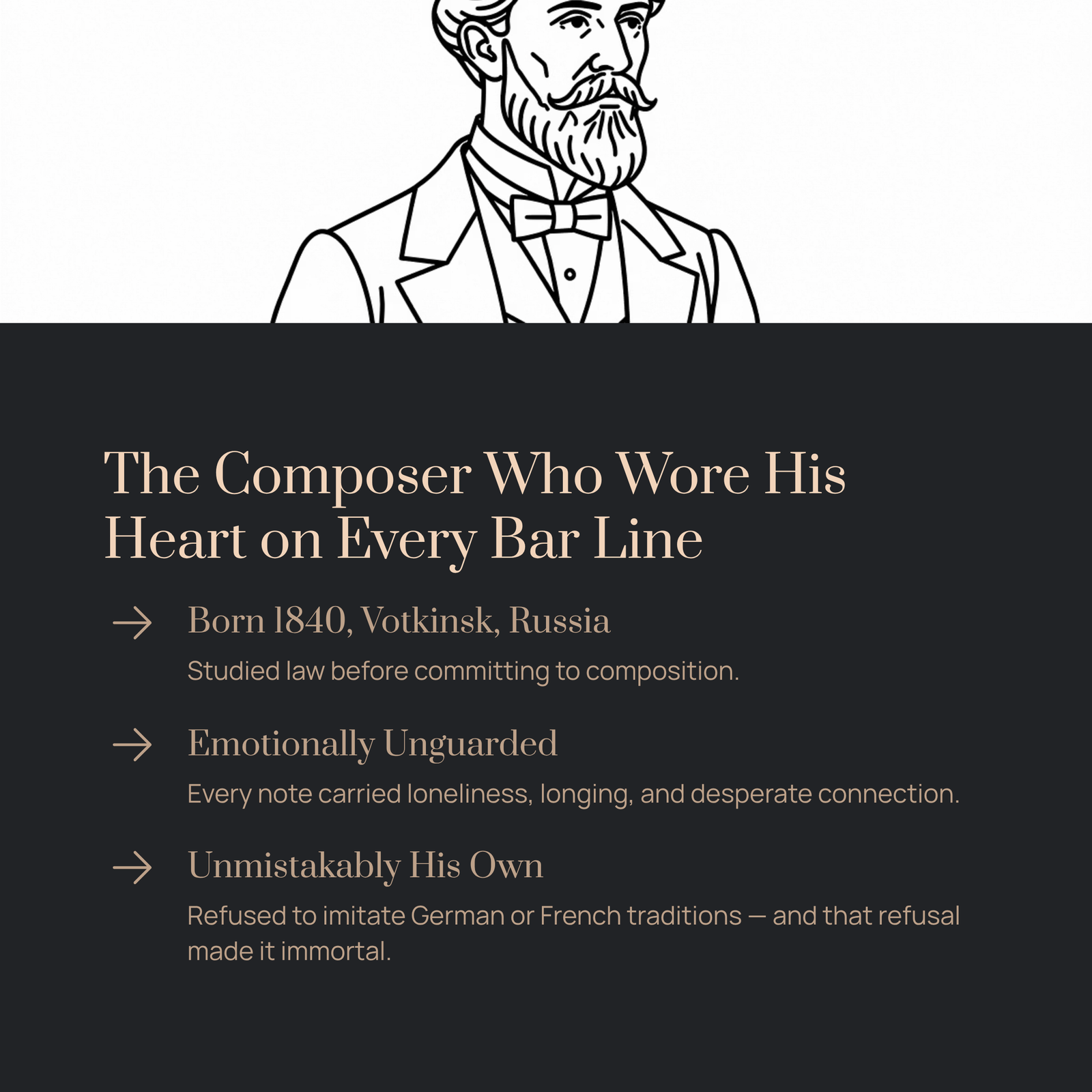
To understand why this concerto sounds the way it does, you need to understand Tchaikovsky himself. He was not a composer who hid behind structure or abstraction. Everything he wrote carried the weight of lived emotion — loneliness, longing, fleeting joy, and an almost desperate need to connect.
Born in 1840 in Votkinsk, Russia, Tchaikovsky came to music relatively late compared to prodigies like Mozart. He studied law before finally committing to composition at the St. Petersburg Conservatory. But once he committed, there was no turning back. Music became the only language through which he could fully express what words could not.
By the time he sat down to write the Piano Concerto No.1 in the autumn of 1874, he was thirty-four years old and still searching for his voice on the international stage. Russian composers at the time were often dismissed by Western European critics as provincial or unsophisticated. Tchaikovsky wanted to prove them wrong — not by imitating the German or French traditions, but by writing something unmistakably his own.
The result was a concerto that refused to follow the rules. And that refusal is precisely what makes it immortal.
Inside the First Movement: A Storm That Never Fully Settles
The first movement, marked Allegro non troppo e molto maestoso, is one of the most ambitious opening statements in the Romantic concerto repertoire. Let me walk you through what to listen for, even if you have never studied a note of music theory in your life.
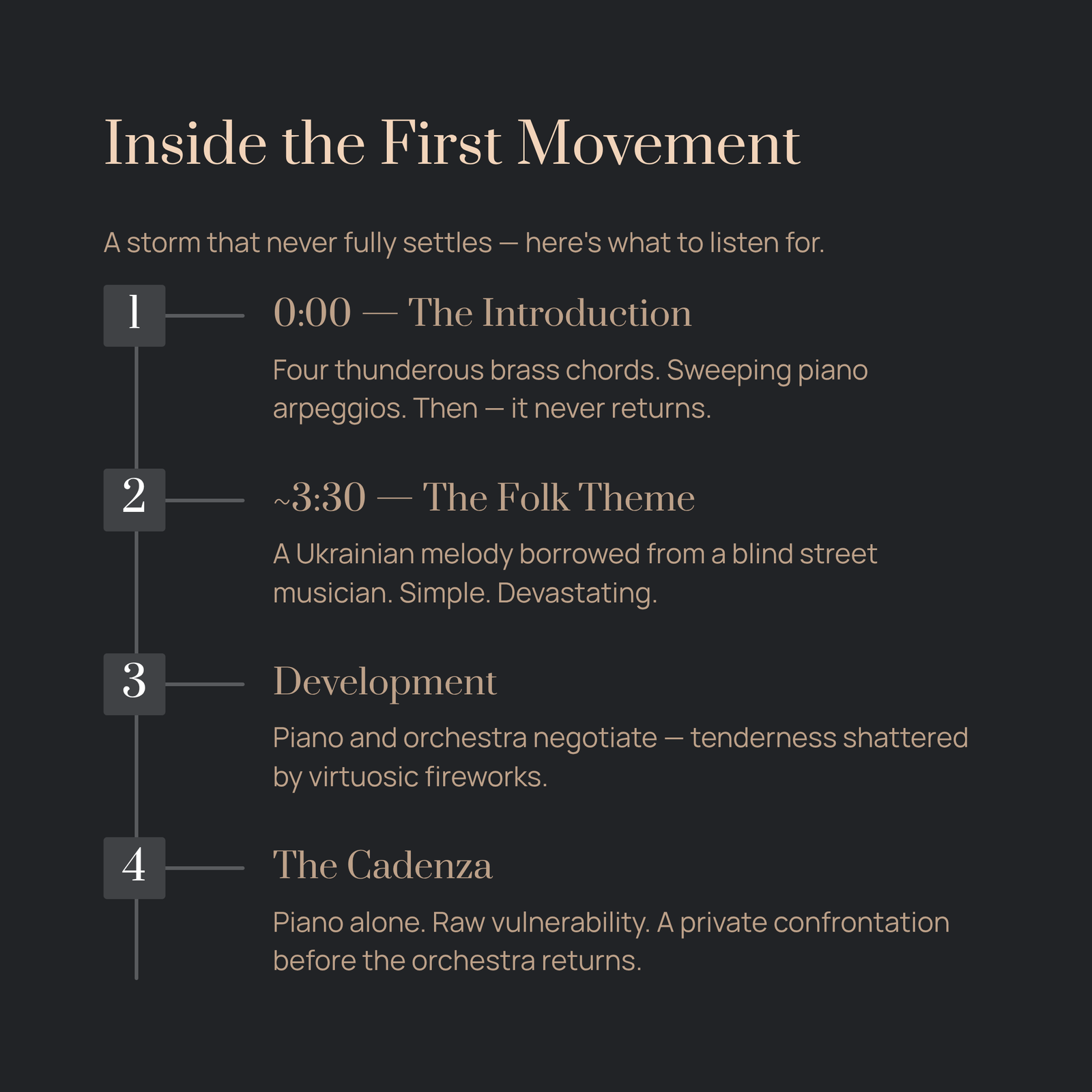
The Introduction (0:00–3:30 approximately)
You will know it the instant you hear it. Four massive orchestral chords — played by the full brass and strings — crash open like the gates of some grand, inevitable ceremony. Over these chords, the piano enters not with a delicate melody, but with enormous, sweeping arpeggios that seem to fill every corner of the room.
Here is something that surprises many first-time listeners: this famous introduction never comes back. Tchaikovsky builds one of the most unforgettable openings in music history and then simply walks away from it. Think of it as the prologue to a novel — it sets the emotional temperature, but the story itself goes somewhere entirely different.
The First Theme (around 3:30 onward)
After the introduction fades, the mood shifts. A Ukrainian folk melody appears — light, almost playful, first introduced quietly by the flute and then picked up by the piano. This is the real main theme of the movement. If the introduction was a thunderstorm, this melody is the first tentative sunlight breaking through.
What makes this theme so effective is its simplicity. Tchaikovsky borrowed it from a blind street musician he once heard singing in Ukraine. There is something profoundly moving about that — a melody born on a roadside, carried by an anonymous voice, finding its way into one of the greatest concertos ever written.
The Development and Cadenza
As the movement progresses, Tchaikovsky does what he does best: he takes that simple folk theme and puts it through an emotional gauntlet. The piano and orchestra engage in what feels less like a dialogue and more like a negotiation — moments of tenderness interrupted by orchestral surges, quiet passages shattered by virtuosic piano fireworks.
The cadenza — the section where the piano plays alone — is a particular highlight. It is not merely a display of technical brilliance, though it certainly demands extraordinary skill. It is a moment of raw vulnerability, as if the pianist has been left alone on stage to confront something deeply personal before the orchestra returns.
Why This Movement Still Stops People in Their Tracks
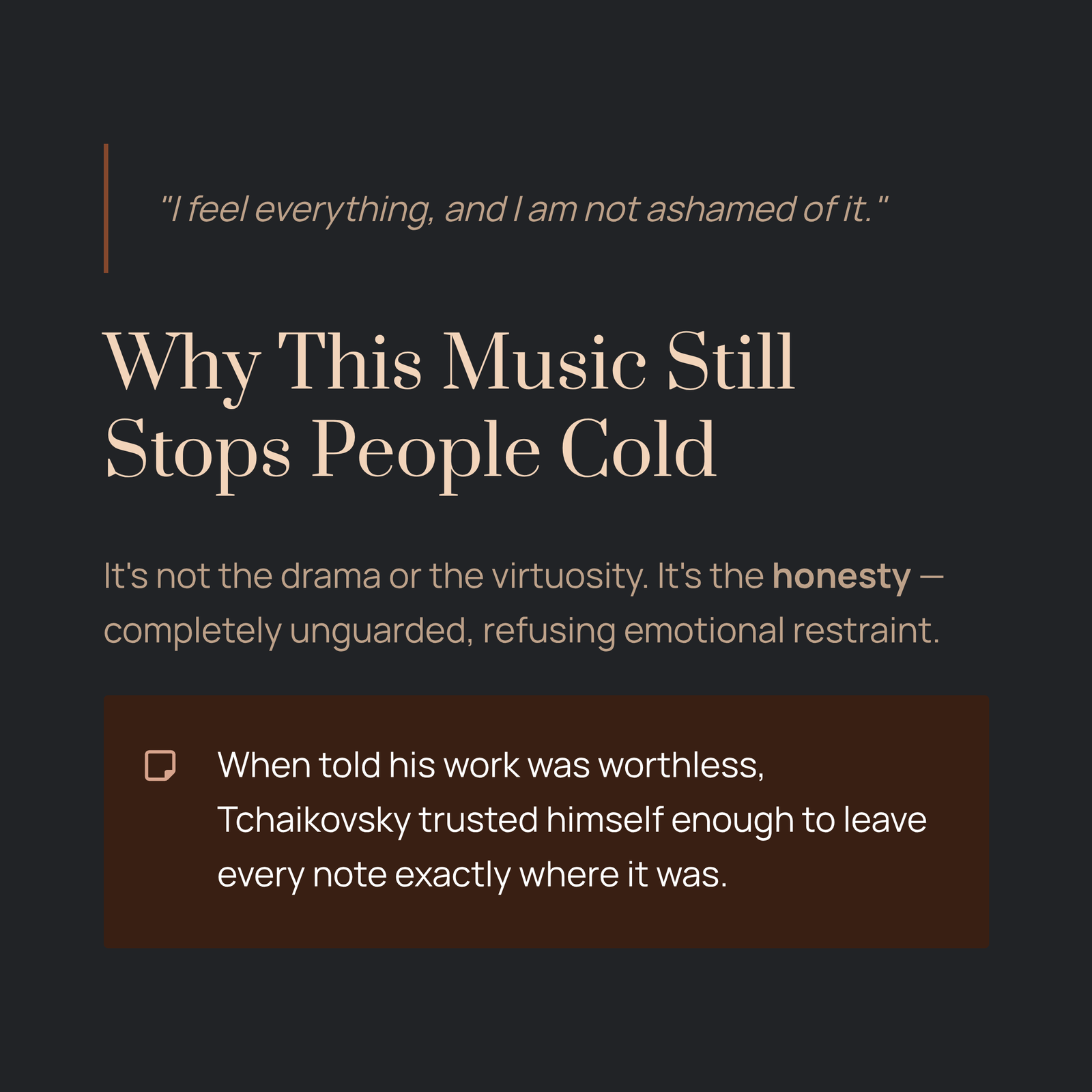
I have a theory about why Tchaikovsky’s first concerto continues to move people who have never listened to classical music before. It is not just the drama or the virtuosity. It is the honesty.
There is a quality in this music that feels completely unguarded. Tchaikovsky does not hold back. He does not hedge his emotional bets or maintain a safe, intellectual distance from the listener. When the music surges, it surges with abandon. When it retreats into quietness, it does so with a fragility that feels almost too private to witness.
In a world that increasingly rewards emotional restraint and cool detachment, there is something radical about a piece of music that says: I feel everything, and I am not ashamed of it.
That is what I hear in the first movement of this concerto. Not just notes arranged brilliantly on a page, but a human being who refused to apologize for the depth of his own feeling — and who, when told his work was worthless, trusted himself enough to leave every note exactly where it was.
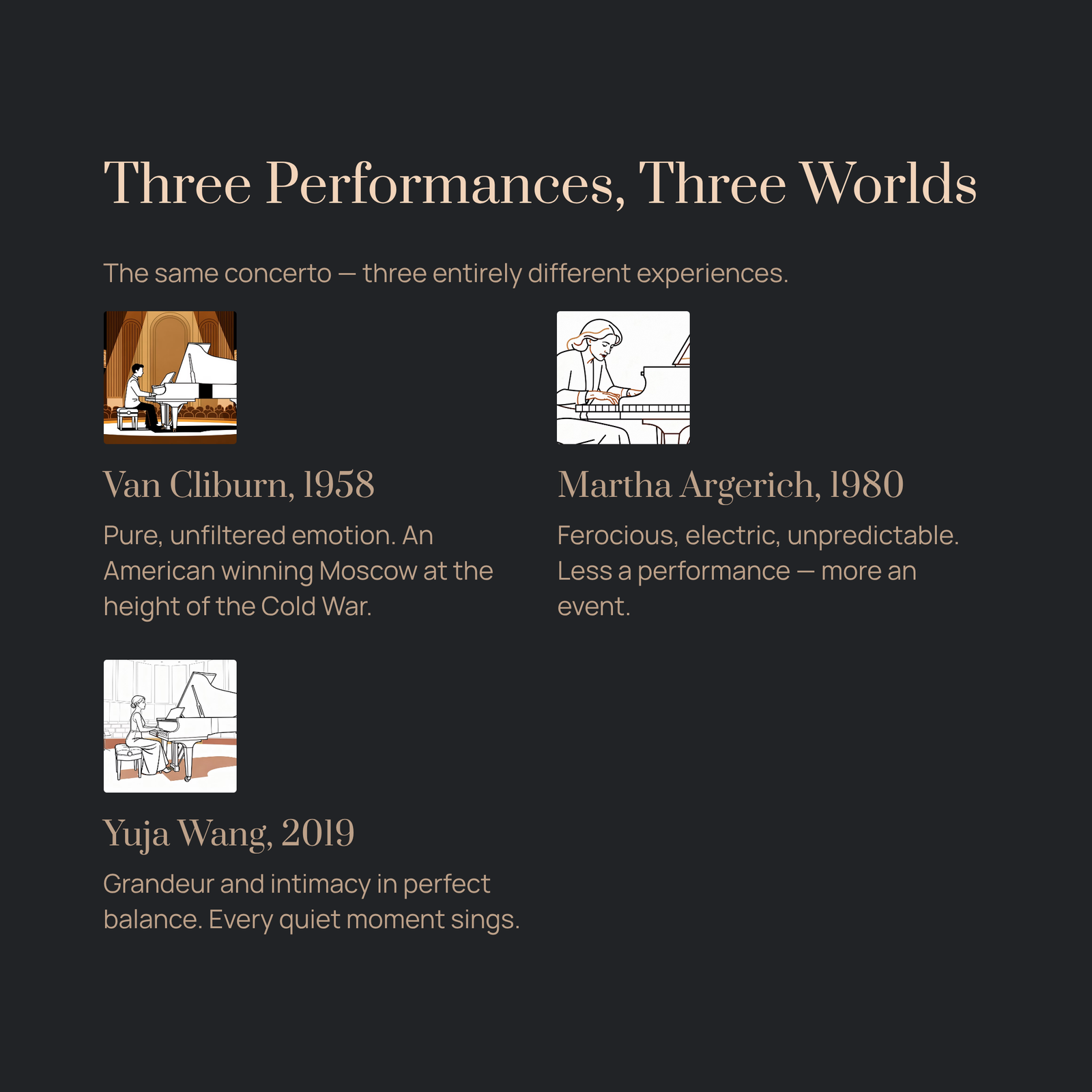
Listening Guide: Three Performances, Three Worlds
One of the joys of classical music is that the same piece can sound completely different depending on who is playing it. Here are three recordings of this first movement that I think represent three distinct ways of experiencing it.
Van Cliburn with Kirill Kondrashin (1958)
This is the recording that made Van Cliburn a household name overnight. He performed this concerto at the first International Tchaikovsky Competition in Moscow — an American pianist, in the Soviet Union, at the height of the Cold War — and won. The performance is youthful, generous, and blazing with conviction. If you want to feel the concerto as pure, unfiltered emotion, start here.
Martha Argerich with Kirill Kondrashin (1980)
Argerich brings a ferocity and rhythmic intensity that is entirely her own. Where Cliburn is warm and expansive, Argerich is electric and unpredictable. Her interpretation feels less like a performance and more like an event — something happening in real time that could go anywhere. It is thrilling in a way that keeps you slightly on edge throughout.
Yuja Wang with Gustavo Dudamel (2019)
For a more recent perspective, Yuja Wang’s performance captures both the grandeur and the intimacy of the concerto with remarkable clarity. Her technical command is breathtaking, but what stands out most is her ability to make the quieter moments sing with just as much intensity as the explosive passages. This is a wonderful recording for listeners who want to hear every detail.
My suggestion: listen to Van Cliburn first for the emotional arc, then return to Argerich for the fire, and finally let Yuja Wang show you the architecture underneath it all.
The Note He Refused to Change
There is a lesson buried in the story of this concerto that goes beyond music.
When Rubinstein told Tchaikovsky his work was worthless, he was not just offering criticism — he was asking Tchaikovsky to become someone else. To smooth out the rough edges. To make the concerto more conventional, more predictable, more palatable. In other words, to make it forgettable.
Tchaikovsky’s refusal was not arrogance. It was clarity. He knew what he had written. He knew why it mattered. And he trusted that the world would eventually hear what he heard.
That trust was rewarded — not immediately, and not without pain, but completely. The Piano Concerto No.1 has been performed thousands of times across every continent. It has opened competitions, closed seasons, and accompanied some of the most significant musical moments of the last 150 years.
And it sounds exactly the way Tchaikovsky intended. Every note. Every chord. Every storm and every silence.
Sometimes the most courageous thing a creator can do is simply refuse to change.