📑 Table of Contents
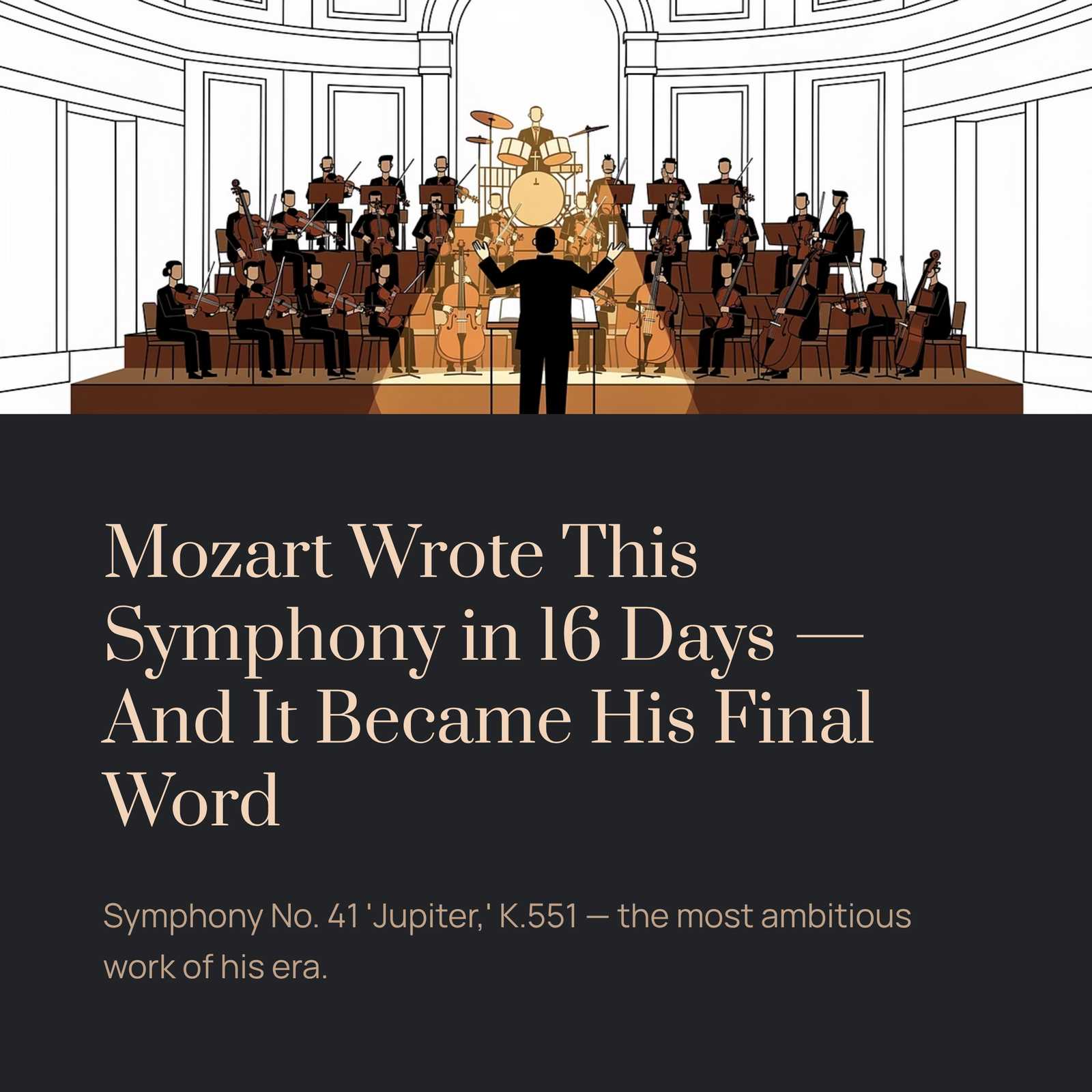
There are pieces of music that knock on the door politely. And then there is the opening of Mozart’s Symphony No. 41. It doesn’t knock. It announces itself like a king entering a room — not with arrogance, but with the calm certainty of someone who knows exactly who he is. The very first measure hits you with a full orchestral declaration in C major, bold and unapologetic, and before you even catch your breath, it softens into something tender, almost whispered. That contrast — power followed by gentleness, authority followed by intimacy — is the entire emotional blueprint of this movement compressed into its first few seconds.
I remember the first time I heard this opening. I wasn’t prepared for how physical it felt. Not just beautiful, not just impressive, but something that pressed against my chest like a sudden burst of wind. It was the sound of someone saying everything they needed to say, all at once, without hesitation.
The Summer of 1788: Genius Under Pressure
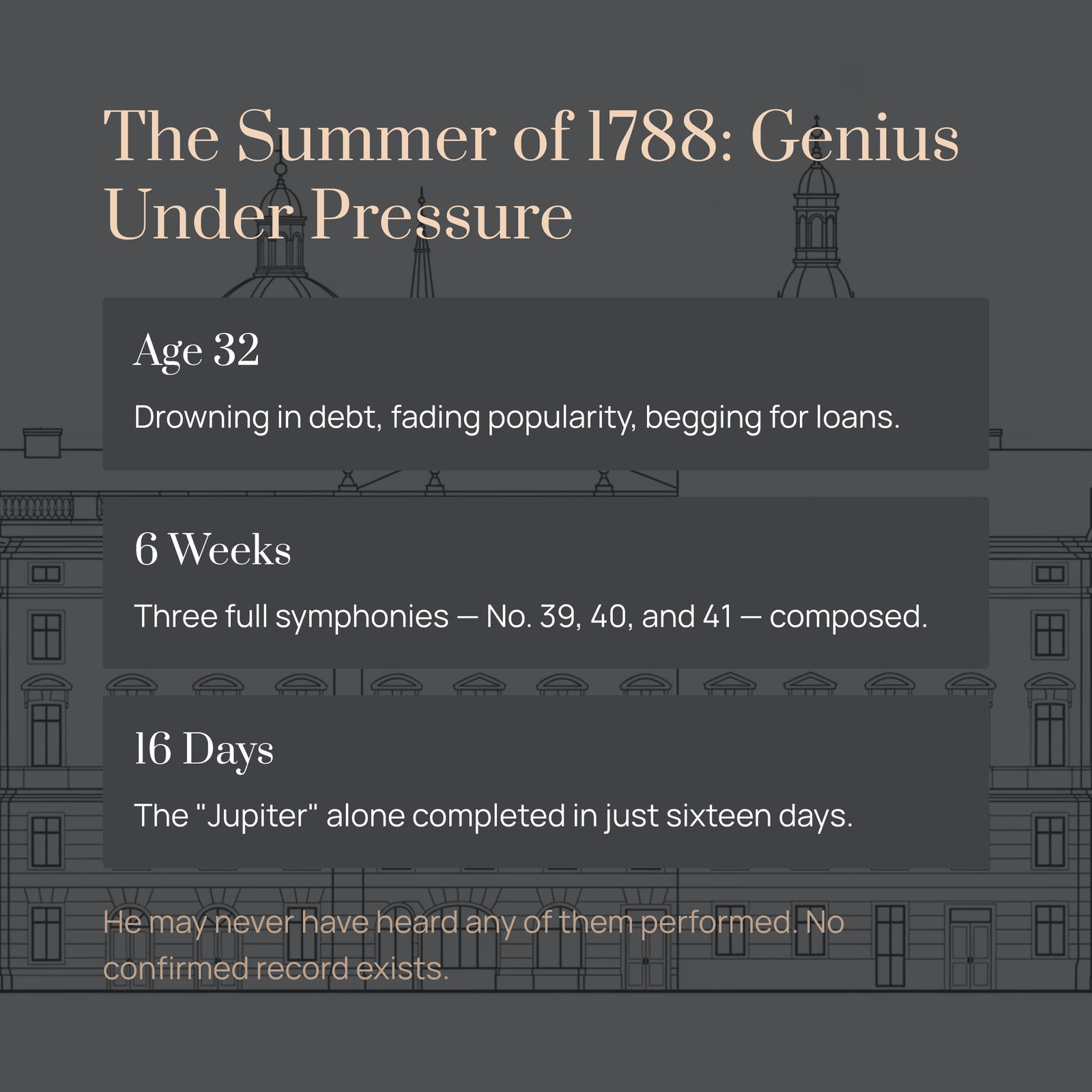
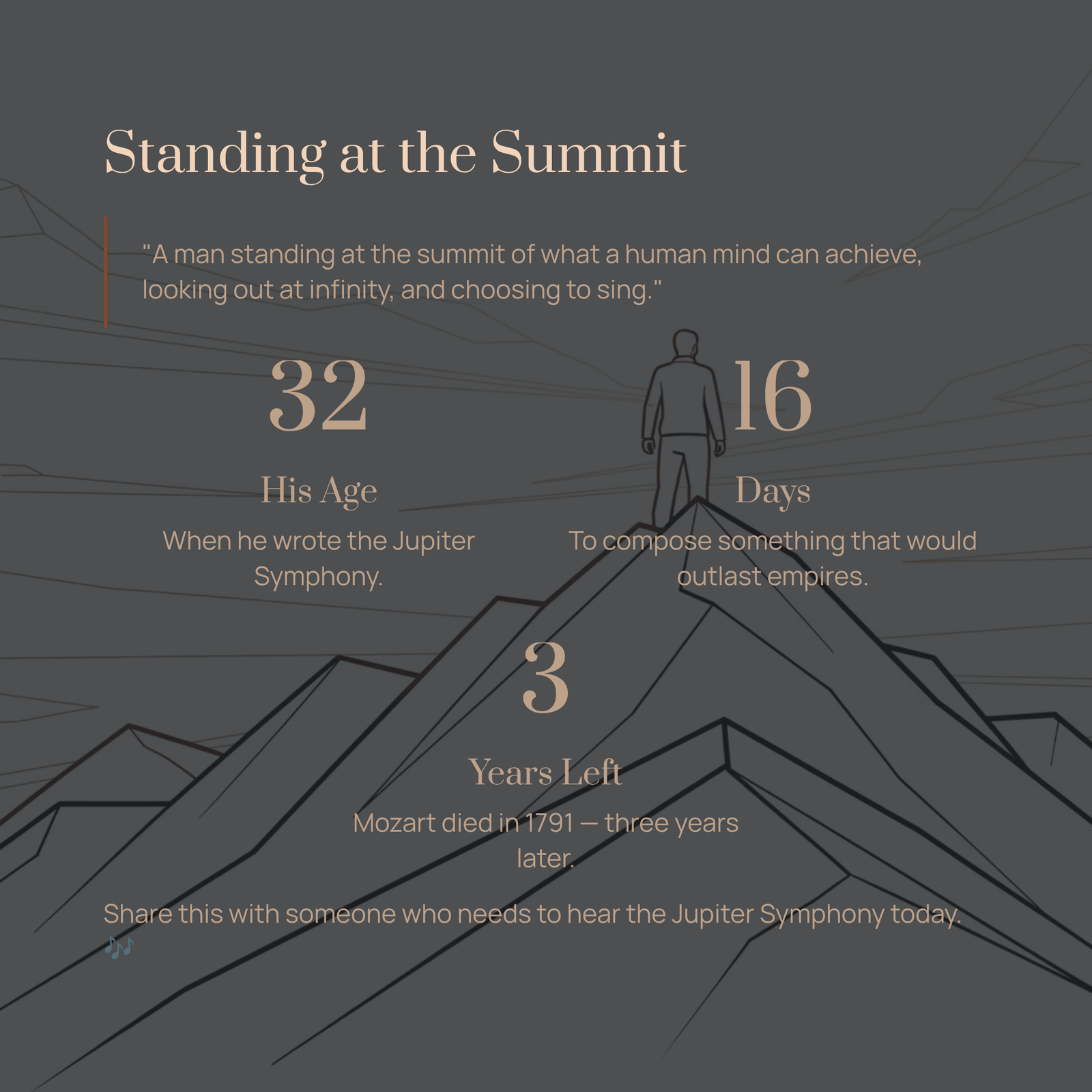
To understand this symphony, you need to understand the man who wrote it — and the impossible circumstances surrounding its creation. In the summer of 1788, Wolfgang Amadeus Mozart was thirty-two years old, living in Vienna, and drowning in financial trouble. His popularity with the Viennese public was fading. Concert subscriptions were drying up. He was writing desperate letters to friends begging for loans.
And yet, in the span of roughly six weeks between June and August of that year, Mozart composed not one, not two, but three full symphonies — No. 39, No. 40, and No. 41. The “Jupiter” alone was completed in just about sixteen days. These three works are now considered the crown jewels of the Classical symphony, and historians still debate whether Mozart ever heard any of them performed during his lifetime. There is no confirmed record that he did.
The nickname “Jupiter” was not Mozart’s own. It was likely coined by the impresario Johann Peter Salomon or possibly popularized by Mozart’s son Franz Xaver. But the name stuck for good reason. There is something planetary about this music — something that feels less like a human composition and more like a force of nature given shape and direction.
Inside the First Movement: A Conversation Between Strength and Grace
The first movement, marked Allegro vivace, is built on a sonata form structure, but don’t let that technical term intimidate you. Think of it as a story told in three acts: an introduction of characters, a journey through conflict, and a resolution that brings everything home.
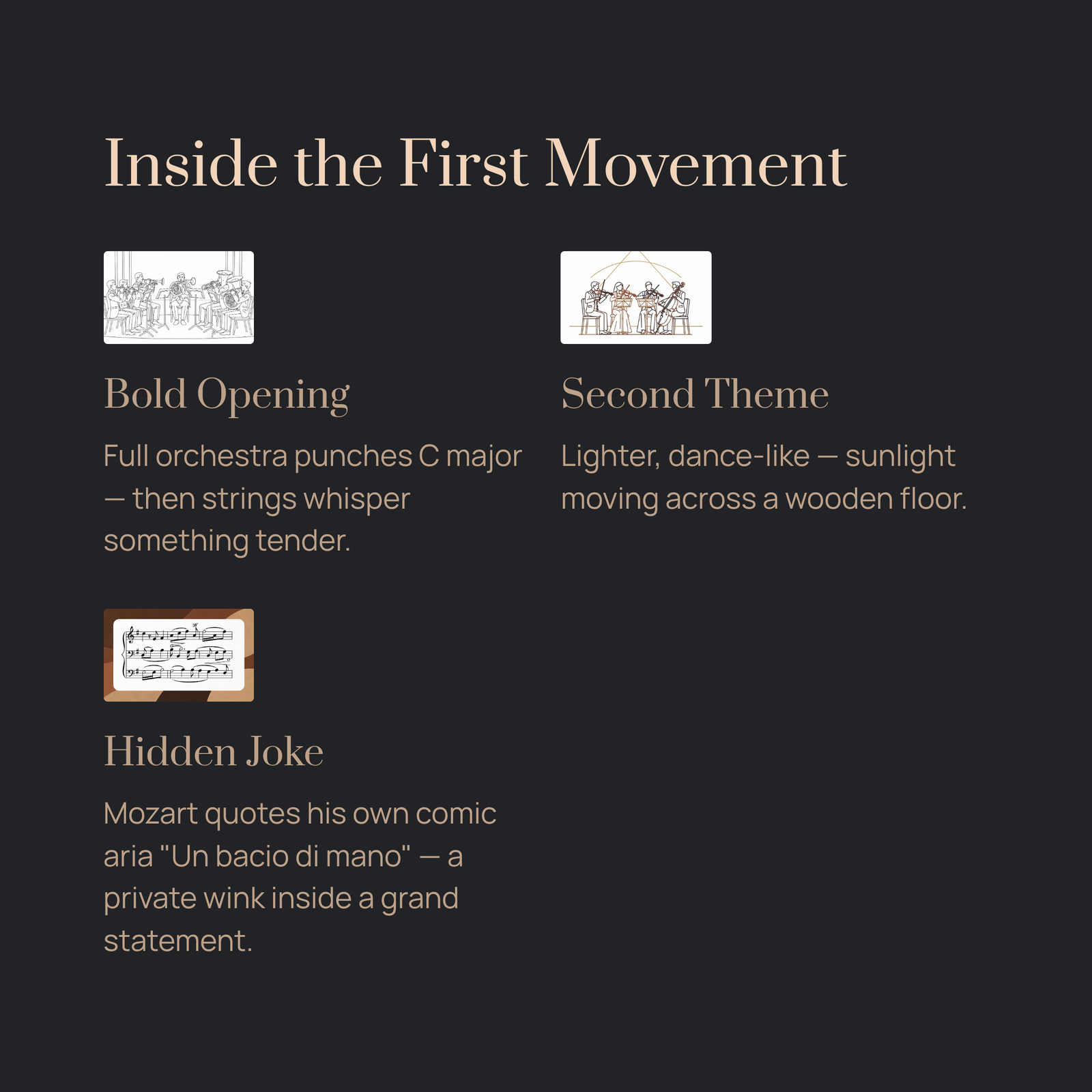
The “characters” here are musical themes, and Mozart gives us several that are strikingly different in personality. The opening theme is that bold, declarative statement — a full orchestra punching the air with a C major chord, followed immediately by a soft, lyrical response from the strings. It’s like watching someone deliver a powerful speech and then, in the next breath, lean over to whisper something kind to a child.
A second theme arrives later, lighter and more playful, almost dance-like. Listen for the moment when the strings begin a graceful, stepwise melody that feels like sunlight moving across a wooden floor. This is Mozart at his most effortlessly elegant.
What makes this movement extraordinary is how Mozart weaves these contrasting ideas together. The development section — the middle chapter of our story — takes those familiar melodies and runs them through a series of surprising key changes. The music grows restless, shifts into minor keys, becomes momentarily uncertain. It’s as if the confident voice from the opening has encountered doubt for the first time. But Mozart never lets the tension become unbearable. Just when the ground seems to shift beneath you, he pulls the music back toward home with a recapitulation that feels like exhaling after holding your breath.
One detail worth paying attention to: near the end of the exposition, Mozart quotes a melody from his own comic aria “Un bacio di mano,” K. 541, which he had composed just weeks earlier. It’s a small, almost cheeky gesture — as though he’s slipping a private joke into the most public and grand of statements. That mixture of the monumental and the personal is pure Mozart.
What I Hear When I Listen: Joy That Knows Sadness Exists
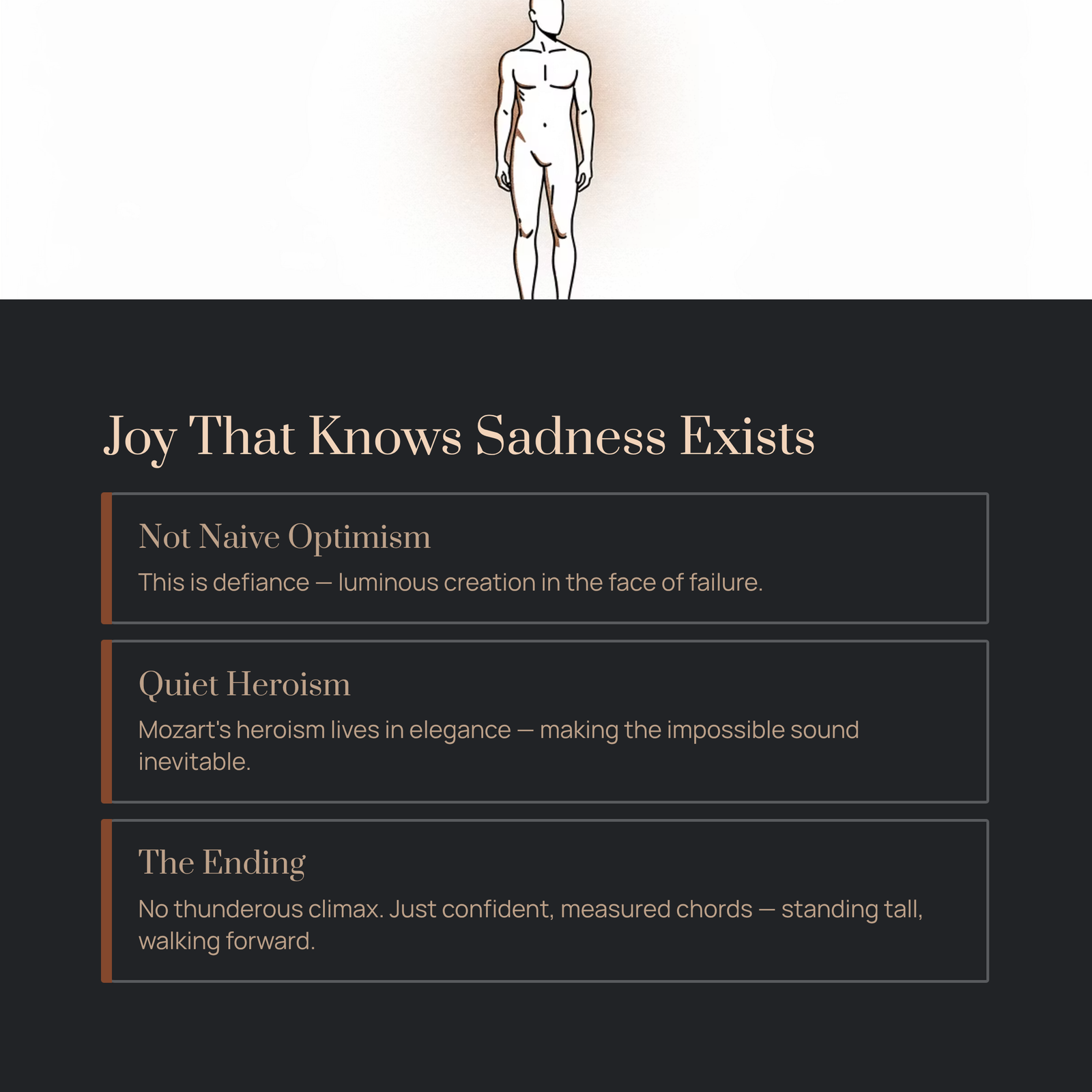
There’s a common misconception that Mozart’s music is simply “happy” or “pleasant.” It’s a shallow reading that misses the depth hiding beneath the surface. Yes, the Jupiter’s first movement is joyful. But it is the kind of joy that feels earned — the joy of someone who has looked directly at difficulty, at disappointment, at the possibility of failure, and chosen to create something luminous anyway.
When I listen to this movement, I don’t hear naive optimism. I hear defiance. I hear a man who was running out of money and running out of time deciding to write the most ambitious, architecturally complex symphony of his era. There is something almost heroic about that, not in the way we usually use that word for Beethoven, but in a quieter, more internal way. Mozart’s heroism lives in the elegance of his choices, in the way he makes the impossible sound inevitable.
The movement’s closing moments are particularly revealing. After all the drama and development, Mozart doesn’t end with a thunderous climax. Instead, the orchestra arrives at a series of confident, measured chords — not screaming victory, but stating it plainly. It’s the musical equivalent of someone standing tall, brushing the dust off their jacket, and walking forward without looking back.
How to Listen: A Practical Guide for First-Time Listeners
If this is your first time approaching the Jupiter Symphony, here are a few ways to make the experience richer.
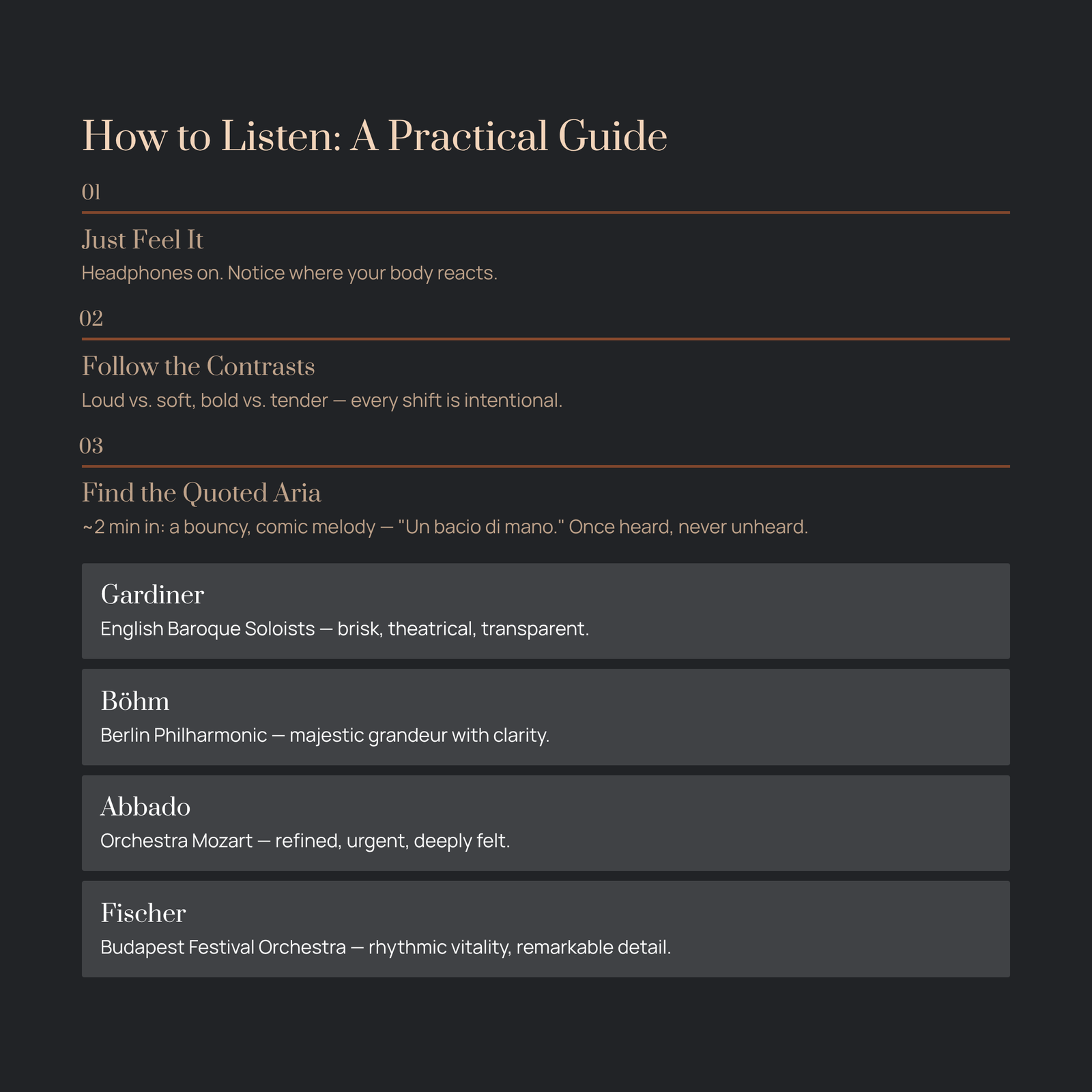
First listen — just feel it. Don’t try to analyze anything. Put on a good pair of headphones, press play, and let the music wash over you. Pay attention to where your body reacts. Do you feel a lift in your chest at the opening? Does your breathing change during the quieter passages? That physical response is your most honest guide.
Second listen — follow the contrasts. This movement lives on the tension between loud and soft, bold and tender, major and minor. Every time you hear the orchestra pull back from a powerful moment into something gentle, notice how that shift makes you feel. Mozart was a master of emotional contrast, and the first movement of the Jupiter is one of his finest demonstrations.
Third listen — find the quoted aria. Around the two-minute mark in most recordings, listen for a bouncy, almost comic melody that sounds slightly out of place in this grand context. That’s the “Un bacio di mano” quotation. Once you hear it, you can’t unhear it — and it adds a wonderful layer of personality to the movement.
Recommended performances:
For a historically informed approach with period instruments, try Sir John Eliot Gardiner with the English Baroque Soloists. The textures are transparent, the tempos are brisk, and the music feels alive with theatrical energy. For something warmer and more traditional, Karl Böhm with the Berlin Philharmonic offers a majestic reading that emphasizes the symphony’s grandeur without sacrificing clarity. And if you want something that balances both worlds beautifully, Claudio Abbado with the Orchestra Mozart delivers a performance that is refined, urgent, and deeply felt.
For a more recent take, Iván Fischer with the Budapest Festival Orchestra brings remarkable detail and rhythmic vitality that reveals layers you might miss in other recordings.
Standing at the Summit
There is a reason this symphony was given the name of a god. Not because it is distant or untouchable, but because it occupies a space that feels almost beyond human scale while remaining deeply, unmistakably human. The first movement of the Jupiter is Mozart showing us everything he had — his wit, his sorrow, his architectural genius, his ability to make complexity sound like the most natural thing in the world.
He was thirty-two when he wrote it. He would be dead in three years. And somehow, in those sixteen feverish summer days, he created something that would outlast empires.
That is what I hear every time I press play. Not just music. A man standing at the summit of what a human mind can achieve, looking out at infinity, and choosing to sing.