📑 Table of Contents
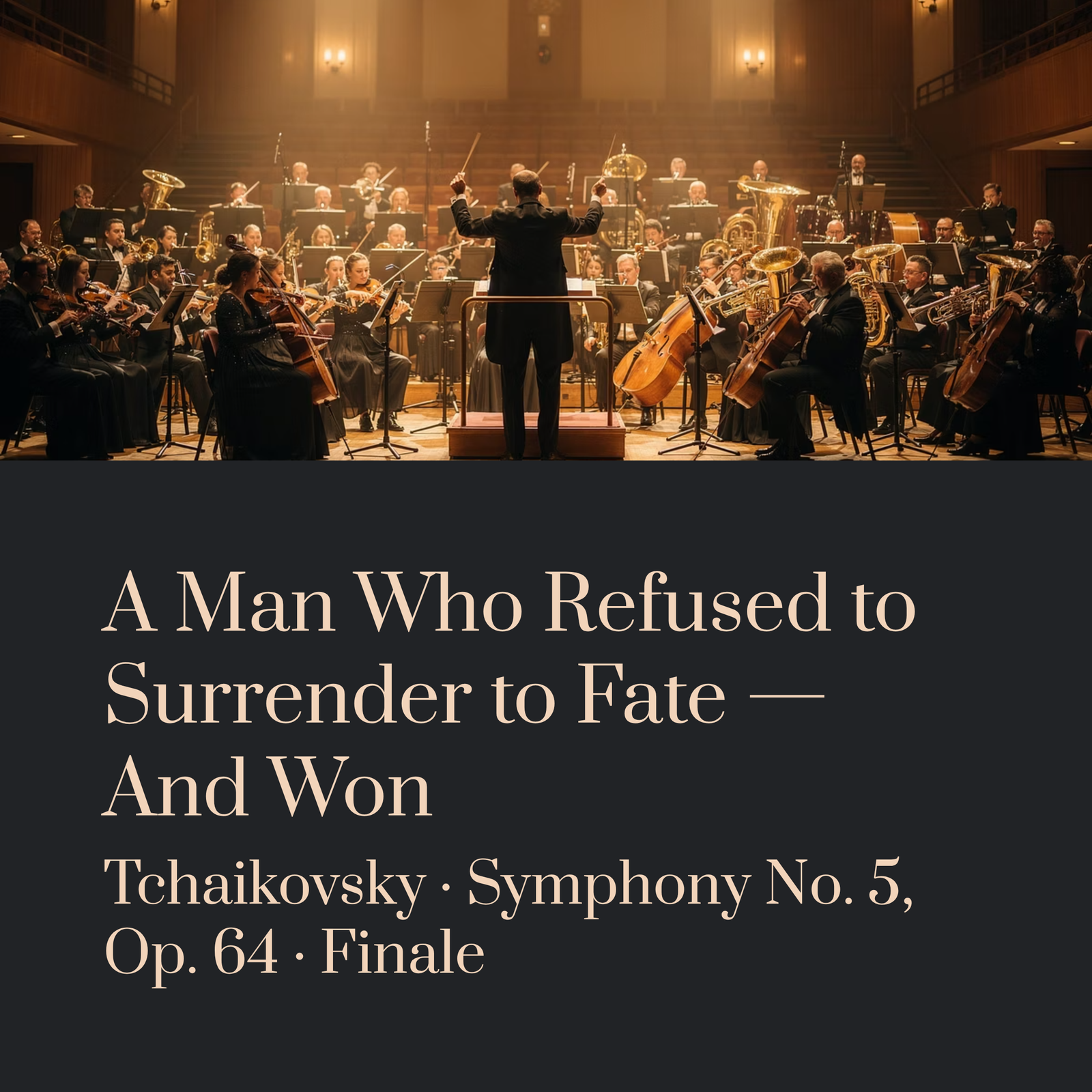
There is a particular kind of power in music that doesn’t simply arrive at joy — it fights its way there. Tchaikovsky’s Symphony No. 5, especially its final movement, is exactly that kind of music. It doesn’t hand you a happy ending on a silver platter. Instead, it drags you through doubt, hesitation, darkness, and then — only then — erupts into a blaze of triumph so overwhelming you might forget to breathe.
I remember the first time I heard this finale all the way through. It wasn’t the triumphant ending that shook me. It was the journey. The sense that this music knew what it felt like to be beaten down, and chose — deliberately, painfully — to stand back up.
If you’ve ever had a day, a week, or a season where everything felt stacked against you, this is the piece that understands. Not with gentle consolation, but with a fist raised to the sky.
The Man Behind the Storm: Tchaikovsky in 1888
By the time Pyotr Ilyich Tchaikovsky sat down to compose his Fifth Symphony in 1888, he was already one of the most celebrated composers in Russia — and one of the most tormented. His personal life was a labyrinth of loneliness, concealed identity, and the constant fear that his creative well had run dry. After completing his Fourth Symphony over a decade earlier, he openly questioned whether he still had anything meaningful to say.
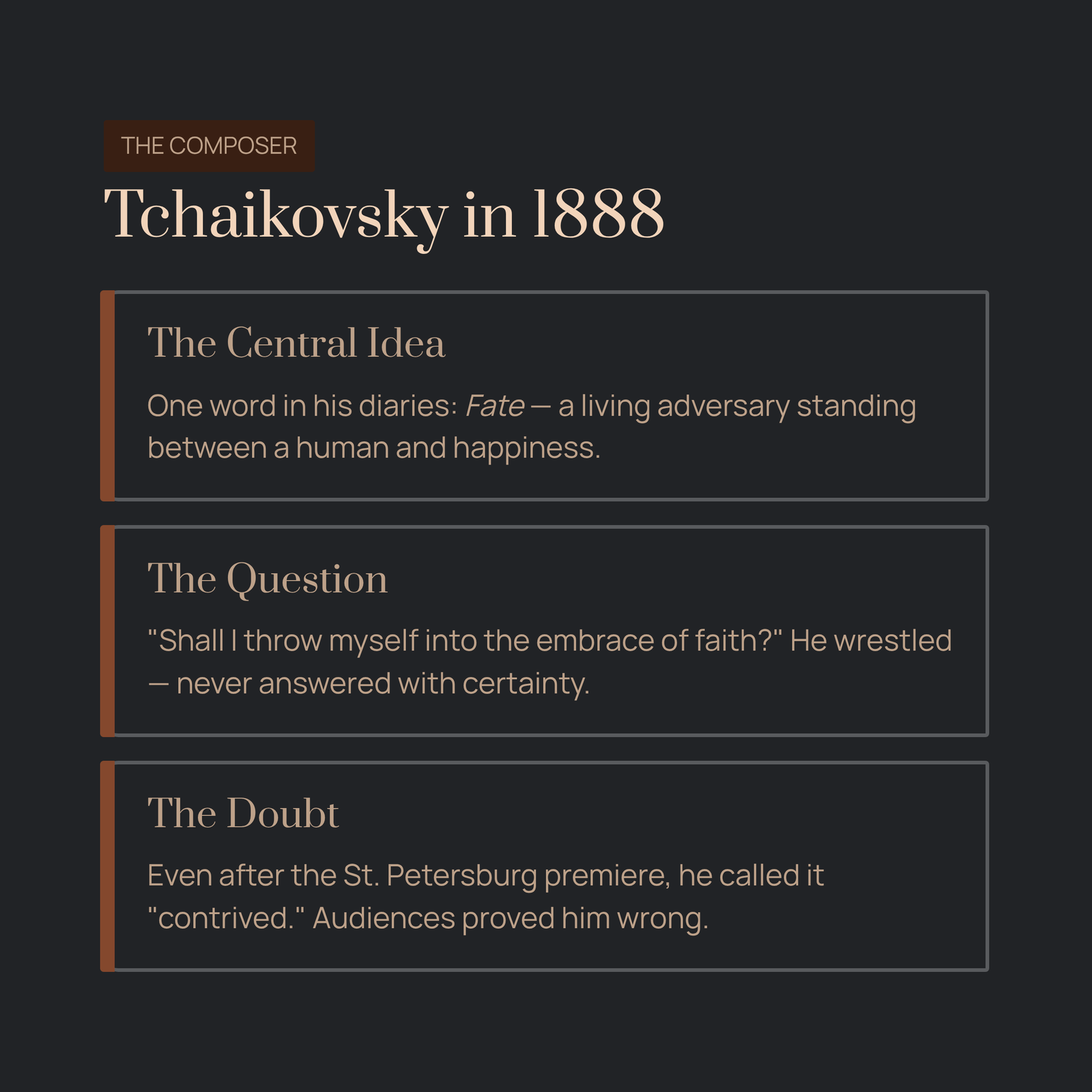
In his letters and diaries from that period, Tchaikovsky described the Fifth Symphony’s central idea in one devastating word: Fate. Not fate as some distant philosophical concept, but fate as a living, breathing adversary — the force that stands between a human being and happiness. He sketched a program for the symphony that reads almost like a confession: “Complete resignation before Fate… Murmurs, doubts, complaints… Shall I throw myself into the embrace of faith?”
What makes this symphony so remarkable is that Tchaikovsky didn’t answer that question with certainty. He wrestled with it. The entire four-movement arc is essentially one long argument between surrender and defiance, and the Finale is where the verdict is delivered.
Interestingly, Tchaikovsky himself was uncertain about the symphony’s quality even after its premiere in St. Petersburg. He confided to his patroness, Nadezhda von Meck, that something about the piece felt “contrived.” It took audiences — who responded with thunderous enthusiasm — to convince him that this symphony was, in fact, a masterpiece.
Inside the Finale: A Guide to Hearing the Triumph
The fourth movement (Finale: Andante maestoso — Allegro vivace) is structured as a modified sonata form, but you don’t need to know any of that to feel what’s happening. Here’s what to listen for, in plain language.
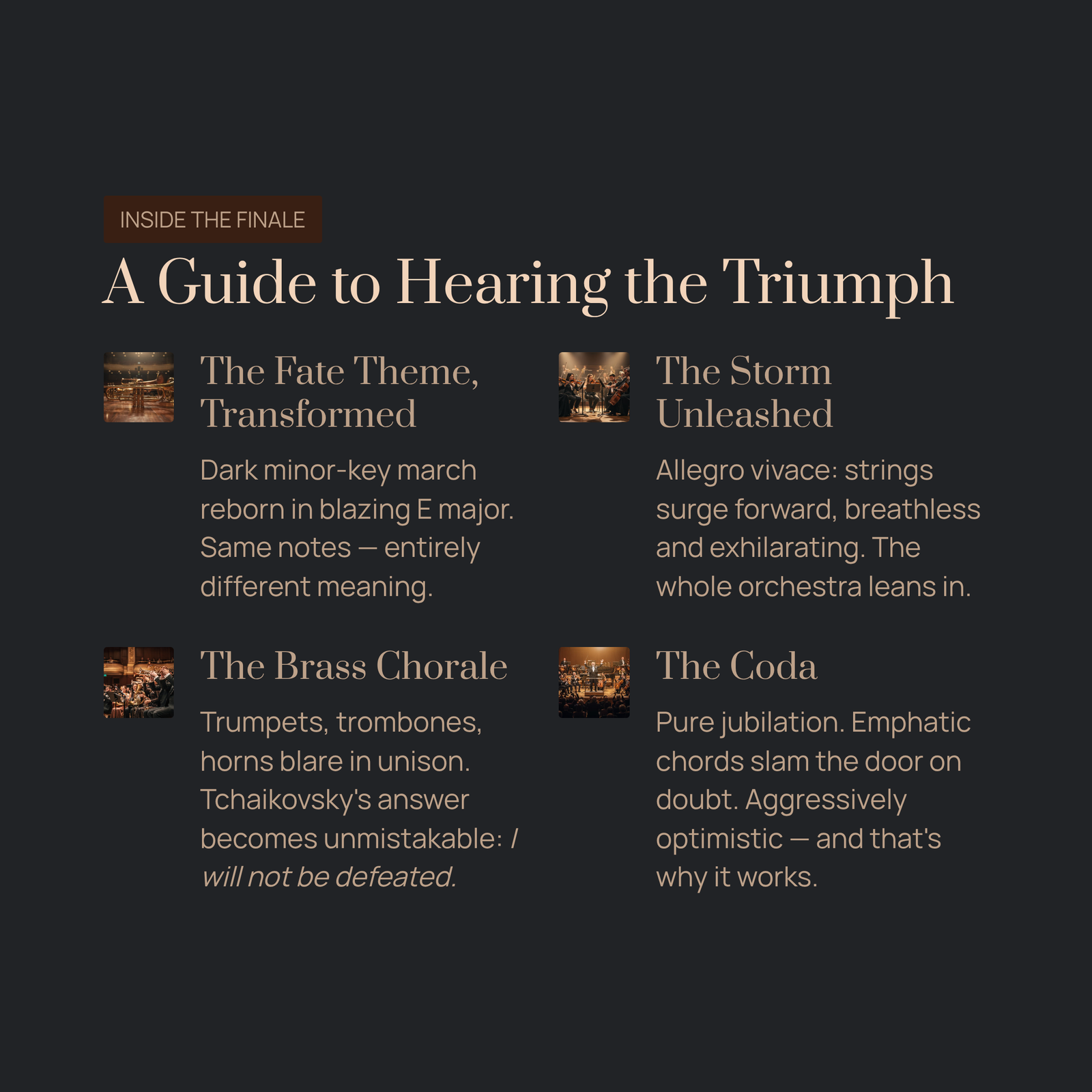
The Fate theme, transformed. The very opening of the Finale brings back a melody you’ve been hearing throughout the entire symphony — the so-called “fate motif” that first appeared in the introduction to the first movement. But here, something radical has happened. That same melody, which began as a dark, brooding march in a minor key, now appears in a blazing E major. Same notes, entirely different meaning. It’s as though Tchaikovsky took his deepest fear and forced it to sing a hymn of victory. This transformation — from shadow to light using the same musical material — is one of the most powerful gestures in all of Romantic music.
The slow, ceremonial opening. Before the Finale explodes into energy, it begins with a majestic, almost processional tempo. The brass section intones the transformed fate theme with enormous dignity, as if an army is marching not into battle but out of it, victorious. Give this section your full attention. It’s the emotional setup for everything that follows.
The storm unleashed. After the stately introduction, the tempo shifts dramatically into Allegro vivace. The strings surge forward with a propulsive, almost breathless energy. There are moments here that feel like running downhill — exhilarating, slightly out of control, utterly alive. The woodwinds toss melodic fragments back and forth, the timpani pound out rhythmic foundations, and the entire orchestra seems to lean forward with collective urgency.
The brass chorale near the end. As the Finale builds toward its conclusion, the brass section delivers the fate theme one final time with staggering force. Trumpets, trombones, and horns blare out the melody in unison while the strings race underneath in furious accompaniment. This is the moment — the climactic, fist-in-the-air moment — where Tchaikovsky’s answer to fate becomes unmistakable. I will not be defeated.
The coda. The last two minutes are pure, sustained jubilation. The tempo accelerates, the dynamics swell to fortissimo, and the symphony ends not with a whisper or a question mark but with repeated, emphatic chords that slam the door shut on any remaining doubt. It’s almost aggressive in its optimism — and that’s precisely why it works.

What I Hear When I Listen: A Personal Reading
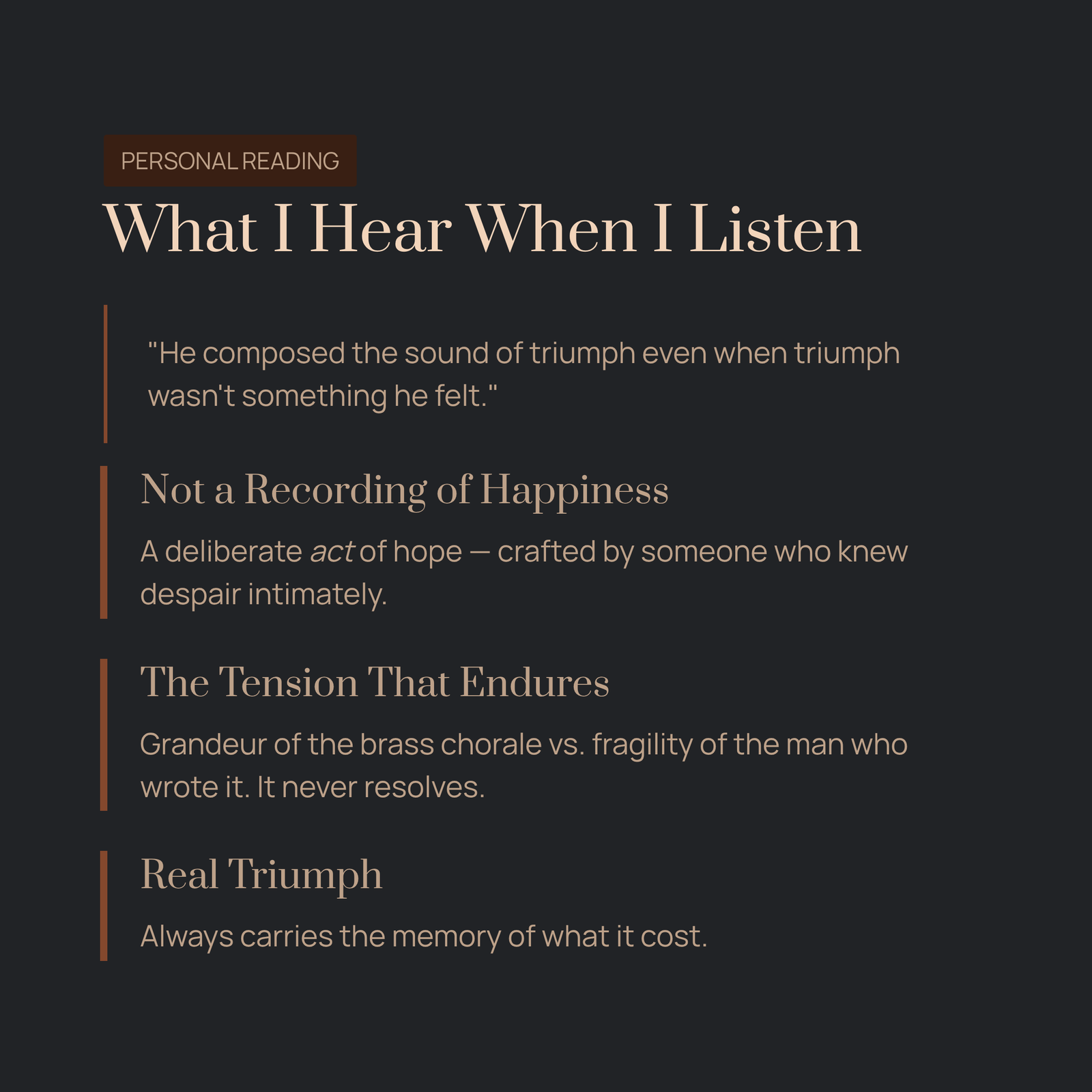
I’ll be honest — there’s a layer of this finale that moves me in a way I find difficult to articulate. It’s the sense that Tchaikovsky didn’t quite believe his own victory. When you read his letters after the premiere, there’s a vulnerability that never fully disappears. He wasn’t a man who conquered his demons and walked away clean. He was a man who chose, one morning, to sit at his desk and compose the sound of triumph even when triumph wasn’t something he felt.
And that, to me, is what makes this finale more powerful than any purely autobiographical reading could capture. This isn’t a recording of someone’s happiness. It’s a deliberate, crafted act of hope — created by someone who understood despair intimately enough to know exactly what its opposite should sound like.
Every time I return to this movement, I hear the same tension: between the grandeur of the final brass chorale and the fragility of the man who wrote it. That tension never resolves. And I think that’s why the piece endures. Because real triumph — the kind that matters — always carries the memory of what it cost.
Five Ways to Listen: Making This Finale Your Own
First listen: Just let it wash over you. Don’t analyze. Don’t follow a score. Put on a good pair of headphones, press play, and let the finale take you from its solemn opening to its thundering conclusion. Notice where your pulse quickens. Notice where you hold your breath.
Second listen: Track the fate theme. Now that you know the motto theme transforms from minor to major, listen for it specifically. Hear it in the opening brass chorale. Hear echoes of it in the string passages. Notice how Tchaikovsky weaves it through the entire movement like a golden thread.
Third listen: Focus on the brass. The brass section carries enormous weight in this movement. Close your eyes and follow the horns, trumpets, and trombones as a separate choir. Pay attention to the moment near the end when they take over completely — it’s one of the great brass moments in the symphonic repertoire.
Fourth listen: The quiet moments. Even in this explosive finale, there are passages where the dynamic drops, where a solo instrument emerges briefly before being swept back into the current. These moments of vulnerability make the loud passages hit harder. They’re easy to miss, but they’re the emotional architecture holding everything together.
Fifth listen: Compare recordings. This is where the piece really opens up. Different conductors hear radically different things in this finale, and comparing interpretations reveals just how much room Tchaikovsky left for personal expression.

Recordings That Will Change How You Hear This Piece
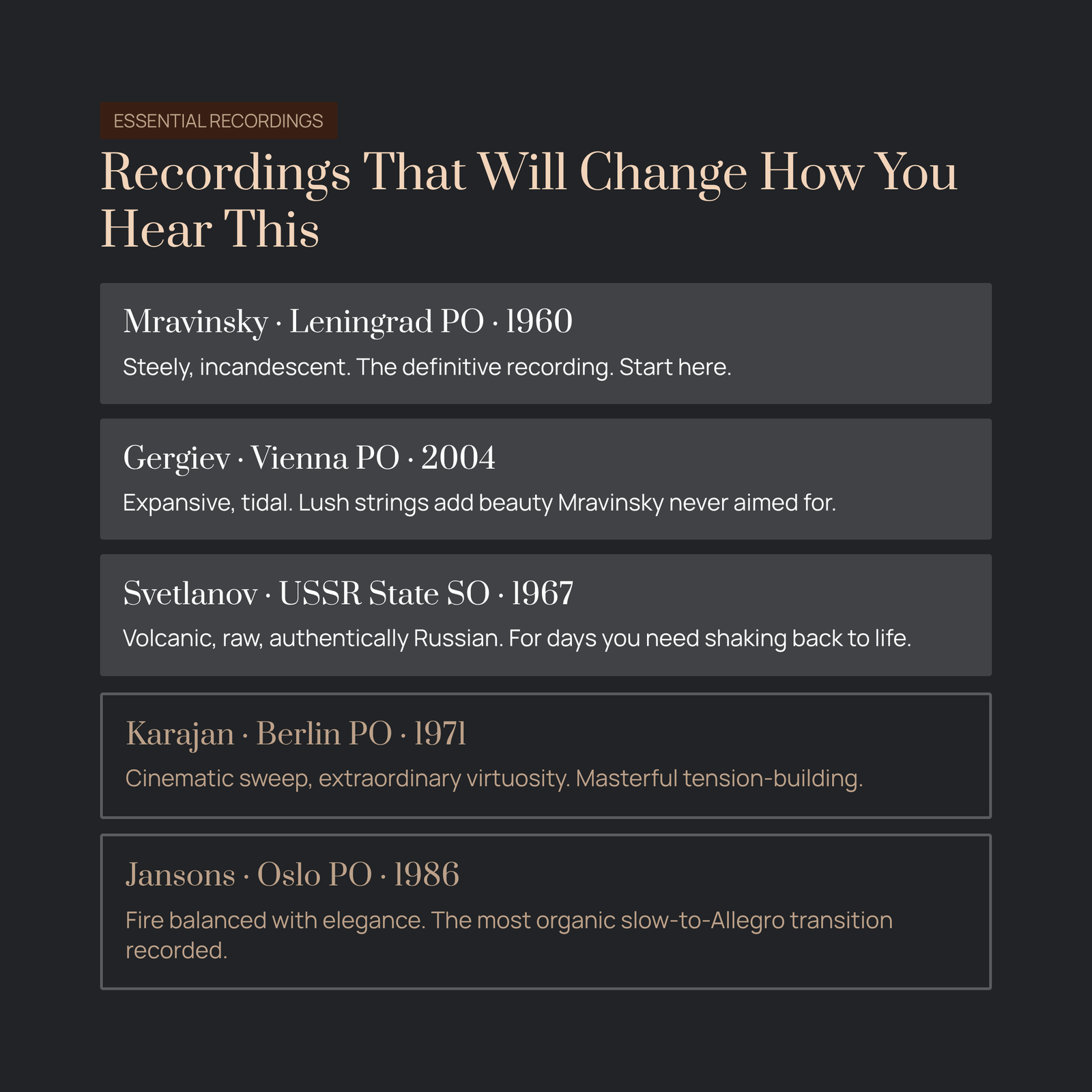
Evgeny Mravinsky with the Leningrad Philharmonic (1960, DG): This is the definitive recording for many listeners, and for good reason. Mravinsky brings a steely intensity and almost military precision to the Finale. The brass is incandescent, the tempos are urgent, and there’s a feeling of absolute conviction from the first note to the last. If you only listen to one recording, make it this one.
Valery Gergiev with the Vienna Philharmonic (2004, Philips): Gergiev takes a more expansive, emotionally generous approach. The opening Andante maestoso breathes more deeply, and the climactic passages feel less like an assault and more like a tidal wave — enormous, inevitable, warm. The Vienna Philharmonic’s lush string sound adds a layer of beauty that Mravinsky’s leaner Leningrad ensemble doesn’t aim for.
Yevgeny Svetlanov with the USSR State Symphony Orchestra (1967): For sheer volcanic power, Svetlanov is hard to beat. His reading of the Finale is big, bold, and unashamedly emotional. The brass plays with a raw, almost harsh intensity that feels authentically Russian. This is the recording for a day when you need the musical equivalent of someone shaking you by the shoulders and saying, “You’re going to be fine.”
Herbert von Karajan with the Berlin Philharmonic (1971, DG): Karajan’s approach is sleeker and more polished, with a cinematic sweep that makes the Finale feel like the climax of a great film. The Berlin Philharmonic plays with extraordinary virtuosity, and Karajan’s control of pacing — the way he builds tension across the entire movement — is masterful.
Mariss Jansons with the Oslo Philharmonic (1986, Chandos): A recording that balances fire with elegance. Jansons finds a middle ground between Mravinsky’s intensity and Karajan’s polish, and the result is deeply satisfying. Pay particular attention to the way he handles the transition from the slow introduction to the Allegro vivace — it’s one of the most natural, organic transitions I’ve heard.
The Sound of Choosing to Go On
There’s a reason Tchaikovsky’s Fifth Symphony has endured for well over a century while countless other orchestral works from the same era have faded from concert programs. It’s not because the melodies are beautiful — though they are. It’s not because the orchestration is brilliant — though it is. It’s because the emotional argument at its core is universal and timeless.
We all face moments when fate — whatever form it takes in our lives — feels overwhelming. Moments when giving in seems not just tempting but logical. What Tchaikovsky offers in this Finale isn’t a naive promise that everything will be fine. It’s something harder, and ultimately more honest: the sound of someone who looked directly at the darkness and decided, with full knowledge of what it might cost, to keep going.
That decision — the choice to transform despair into something blazing and defiant — is what you hear in every chord of this extraordinary finale. And it’s why, more than a century later, this music still has the power to make you sit up straighter, breathe a little deeper, and remember that you, too, have a say in how your story ends.