📑 Table of Contents
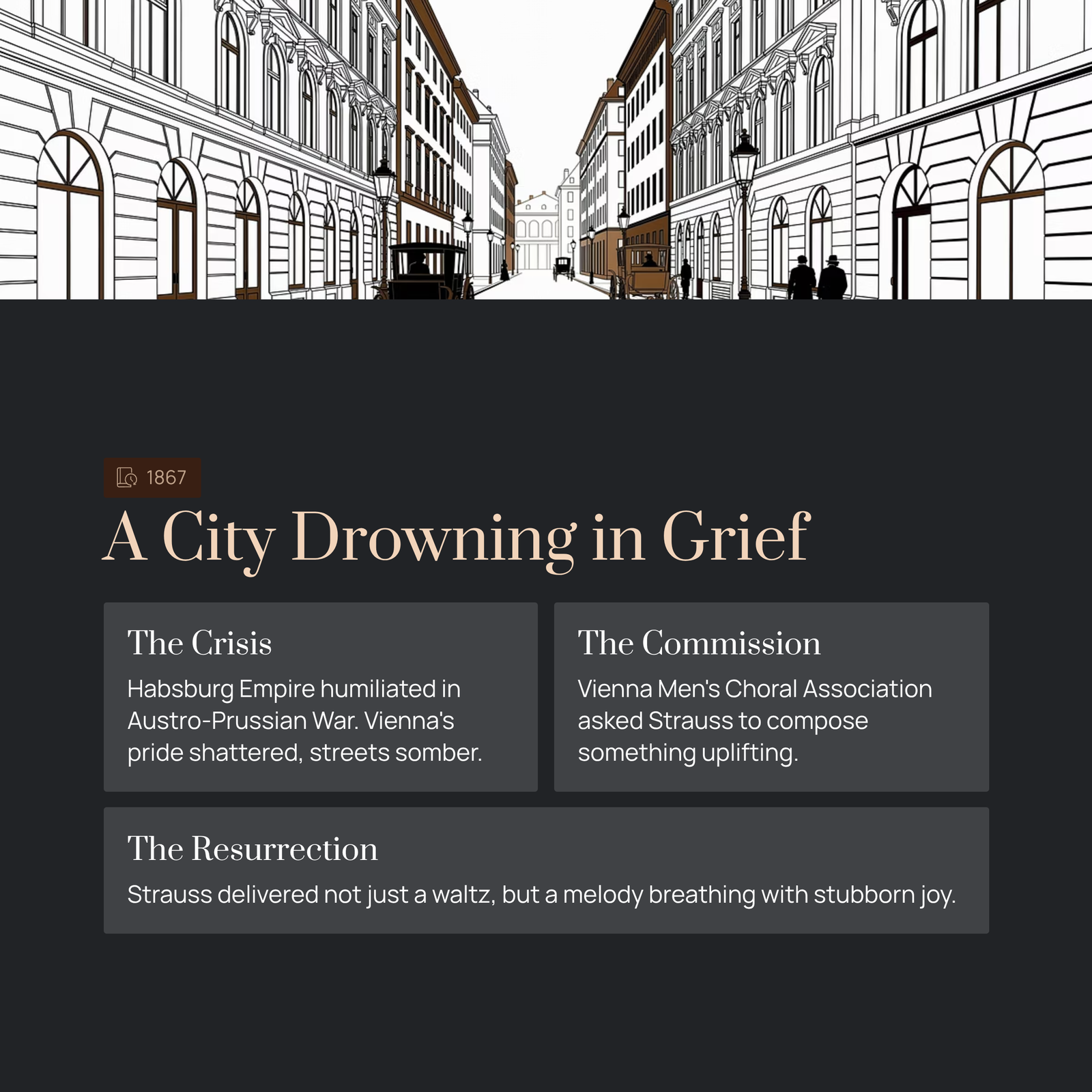
Vienna, 1867. The Habsburg Empire had just been humiliated in the Austro-Prussian War. The capital was drowning in collective grief — its pride shattered, its streets somber, its citizens wondering if the glory days were truly over.
Into this broken atmosphere walked Johann Strauss II, a man who already carried the weight of an impossible title: the Waltz King. His father had invented the Viennese waltz craze. His rivals whispered that he was simply riding a famous surname. And now, the Vienna Men’s Choral Association asked him to compose something — anything — that might lift the city’s spirits.
What he delivered was not just a waltz. It was a resurrection.
An der schönen blauen Donau — “By the Beautiful Blue Danube” — did not succeed immediately. Its choral premiere was, by most accounts, a polite disaster. The lyrics were clumsy and forgettable. But Strauss sensed something the audience hadn’t yet grasped: the melody itself was alive, breathing with a kind of stubborn joy that refused to be extinguished.
When he rearranged the piece for orchestra alone and premiered it at the 1867 Paris World Exhibition, everything changed. The waltz spread across Europe like wildfire, and Vienna found its heartbeat again.
Who Was the “Waltz King” — And Why Did He Almost Quit?
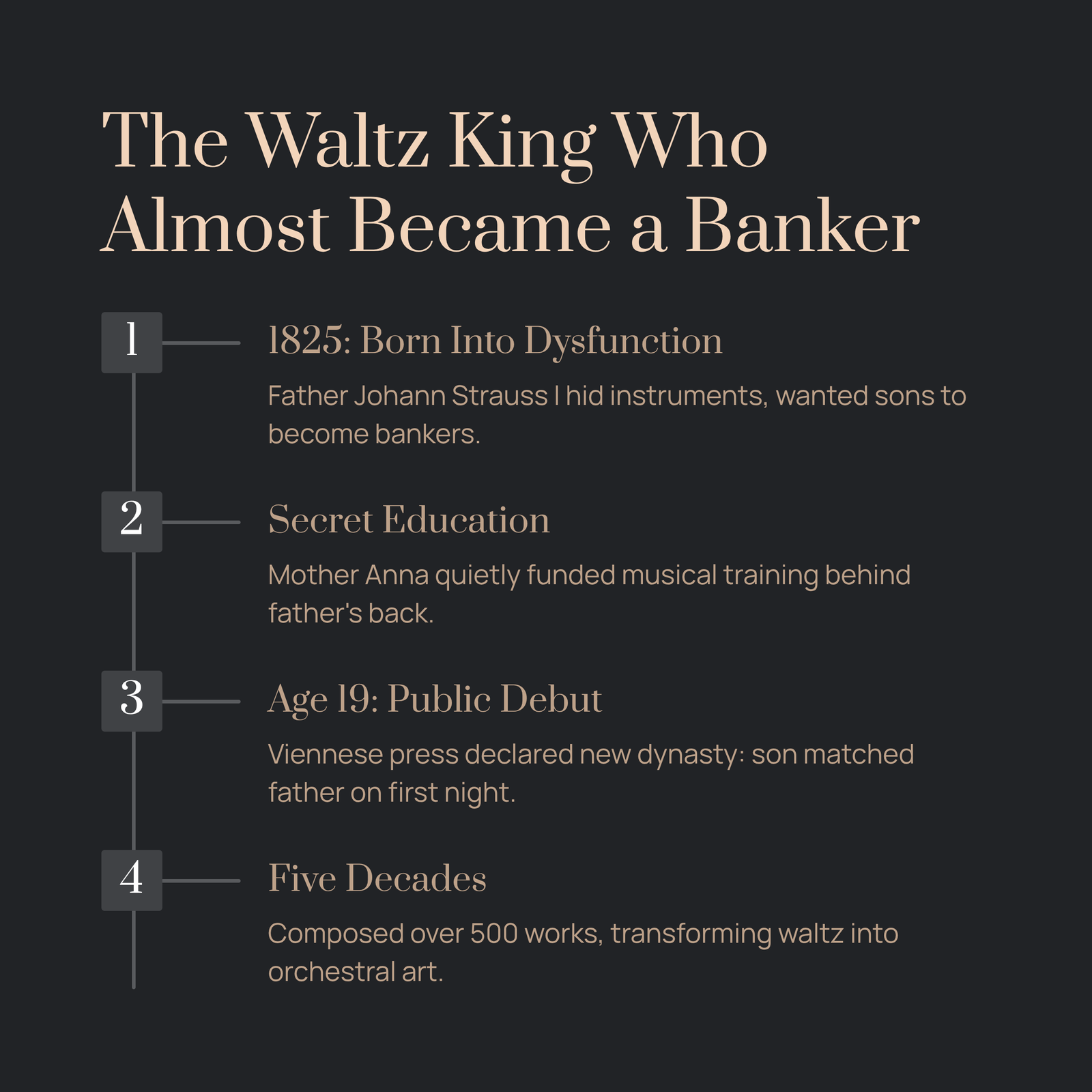
Johann Strauss II was born in 1825 into what might be the most musically dysfunctional family in history. His father, Johann Strauss I, was already Vienna’s reigning dance-music composer — and he was absolutely determined that none of his sons would follow in his footsteps. He wanted them to become bankers.
The elder Strauss went so far as to hide musical instruments from young Johann. When the boy secretly studied violin with a member of his father’s own orchestra, his father reportedly flew into a rage.
But his mother, Anna, quietly funded his musical education behind her husband’s back. When the elder Strauss abandoned the family for a mistress, the path finally cleared. Johann II made his public debut at age nineteen, and the Viennese press immediately declared a new dynasty: the son had matched the father on his very first night.
Over the next five decades, Strauss II composed over 500 works — waltzes, polkas, operettas, marches — and transformed the waltz from a simple dance form into something approaching orchestral art. He didn’t merely write melodies people could dance to; he wrote melodies that made people need to dance.
Inside the Music: Five Waltzes Disguised as One
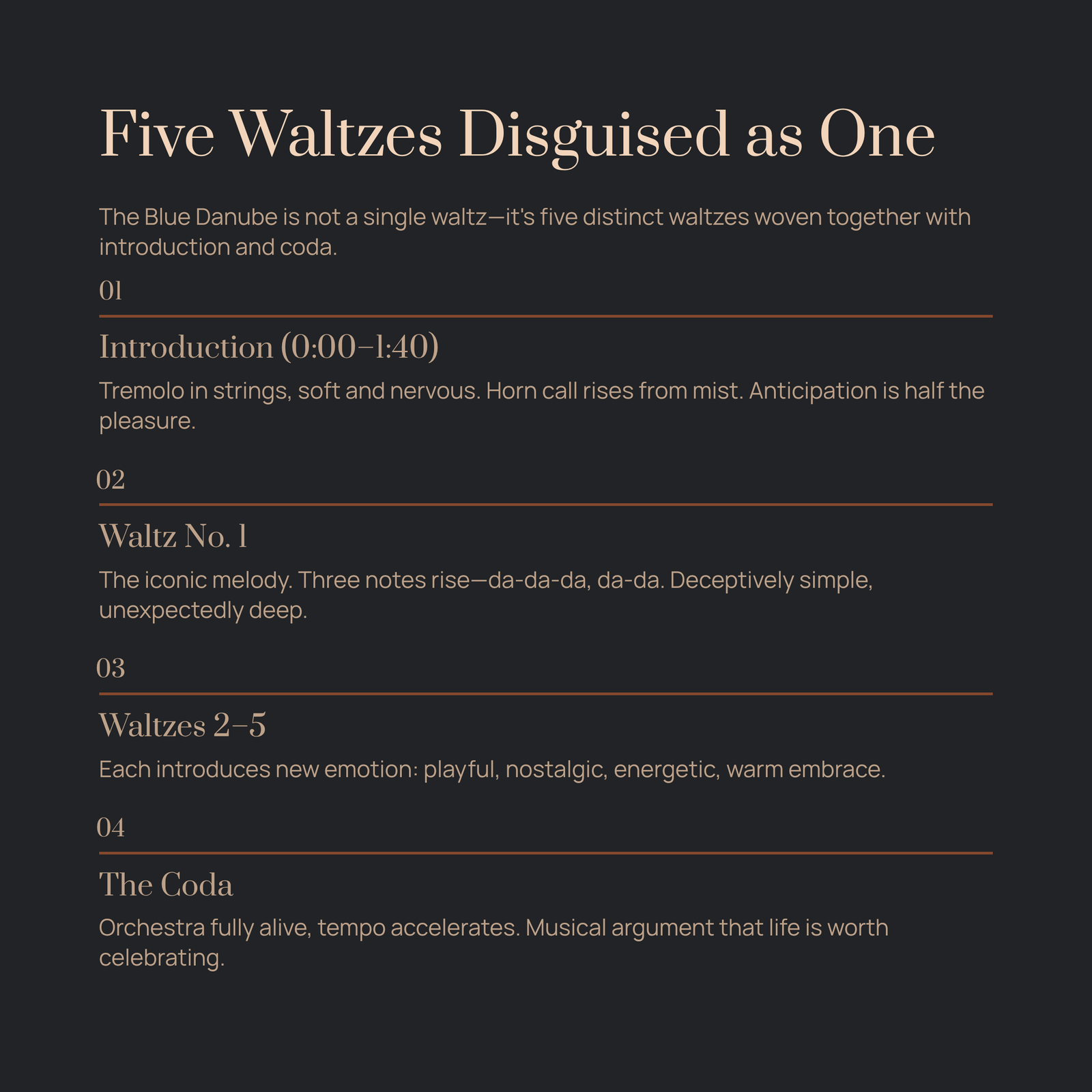
Here is what surprises most first-time listeners about The Blue Danube: it is not a single waltz. It is five distinct waltzes, woven together with an introduction and a coda, forming a kind of miniature symphony of joy.
The Introduction (0:00–1:40 in most recordings)
A tremolo in the strings — soft, almost nervous, like the surface of the Danube at dawn. A horn call rises gently from this mist. It is one of classical music’s most recognizable openings, yet it takes its time. Strauss understood that anticipation is half the pleasure. The waltz doesn’t rush toward you; it lets you come to it.
Waltz No. 1 (the iconic melody)
This is the tune the whole world knows. Three notes rise — da-da-da, da-da — and suddenly you understand why an entire empire fell in love with a song. The melody is deceptively simple. It moves in stepwise motion, almost childlike, but the harmonic support underneath gives it an unexpected depth, like sunlight penetrating clear water.
Waltzes No. 2 through 5
Each subsequent waltz introduces a new emotional color. The second is more playful, almost flirtatious. The third carries a touch of nostalgia — a wistfulness that hints this golden afternoon cannot last forever. The fourth surges with energy, demanding that the dancers spin faster. And the fifth brings a warm, expansive melody that feels like an embrace.
The Coda
Strauss revisits the opening theme, but this time there is no hesitation. The orchestra is fully alive, the tempo accelerates, and the piece races toward a joyful conclusion. It is a musical argument that life, despite everything, is worth celebrating.
Why This Waltz Feels Like Coming Home
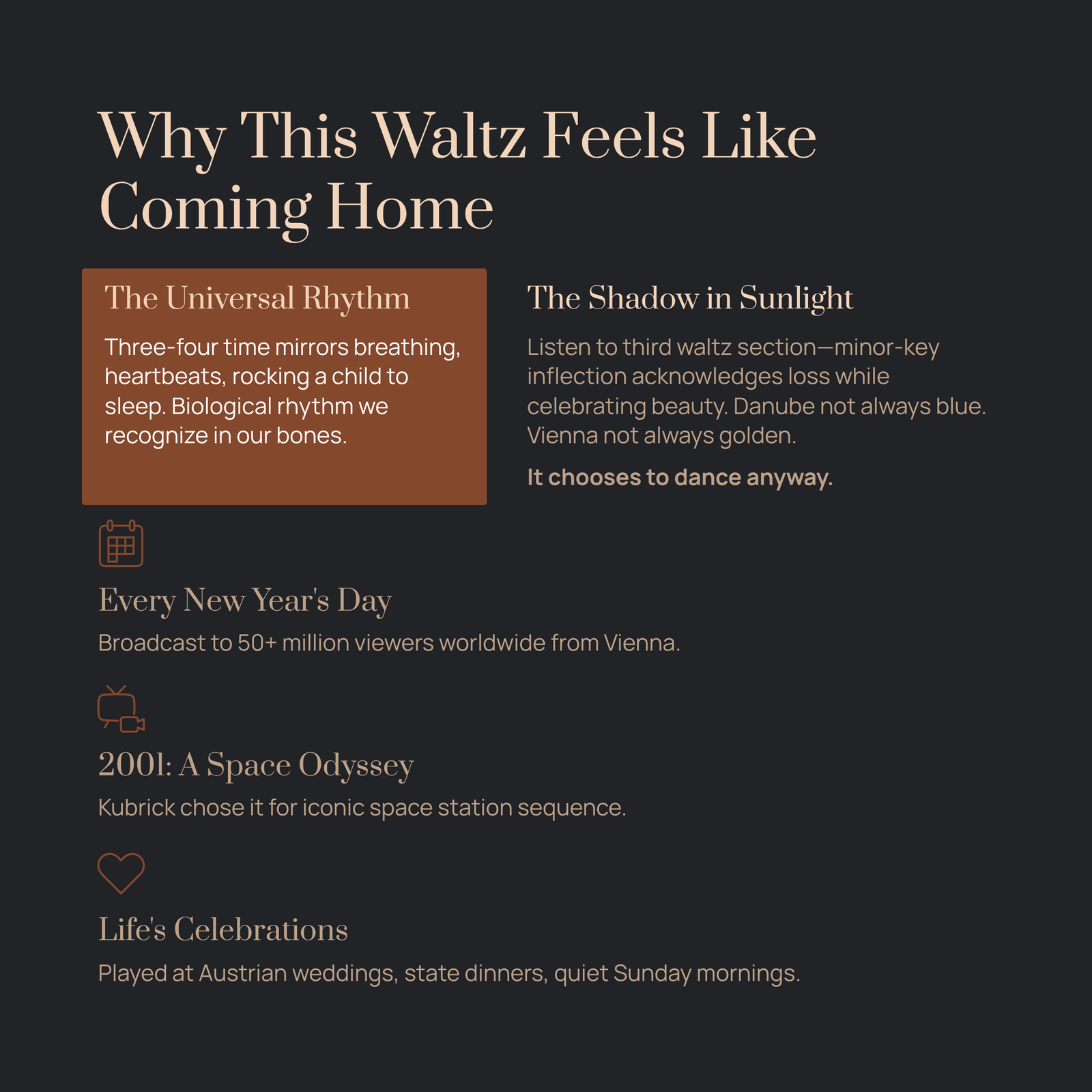
There is a reason The Blue Danube is played every New Year’s Day in Vienna, broadcast to over fifty million viewers worldwide. There is a reason Stanley Kubrick chose it for the space station sequence in 2001: A Space Odyssey. There is a reason it is played at Austrian weddings, state dinners, and quiet Sunday mornings in apartments overlooking the Ringstraße.
The waltz speaks to something older than words. Three-four time — ONE-two-three, ONE-two-three — mirrors the rhythm of breathing, of heartbeats, of rocking a child to sleep. When Strauss builds his melodies on this pulse, he is not merely composing entertainment. He is tapping into a biological rhythm that human beings recognize in their bones.
And yet there is melancholy woven into the fabric. Listen carefully to the third waltz section, and you will hear it — a shadow passing over the sunlight, a minor-key inflection that acknowledges loss even as it celebrates beauty. This is what elevates The Blue Danube beyond mere cheerfulness. It knows that the Danube is not always blue. It knows that Vienna was not always golden. And it chooses to dance anyway.
How to Listen: A Guide for First-Time Explorers
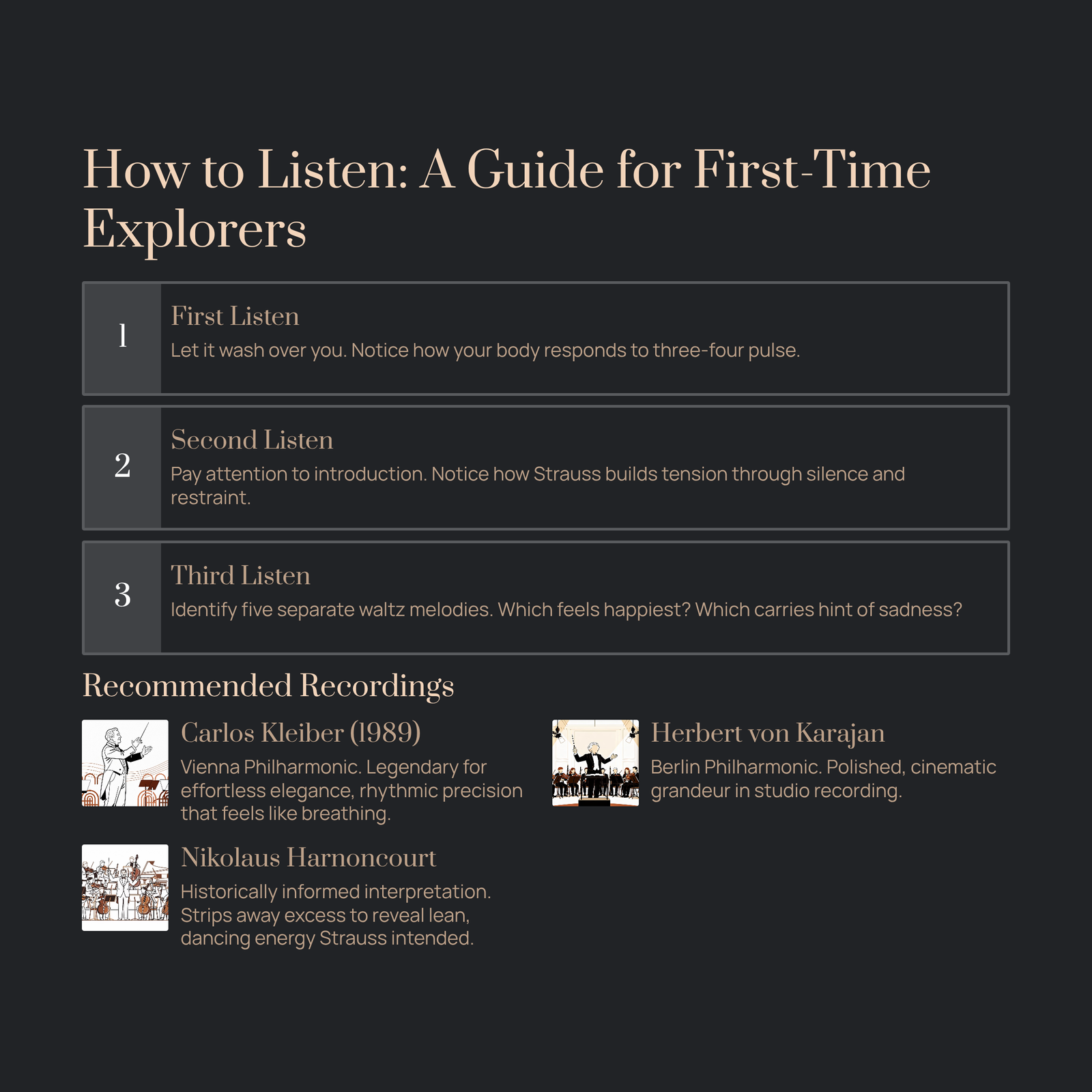
On your first listen, simply let the piece wash over you. Don’t analyze. Don’t count waltzes. Just notice how your body responds to the three-four pulse. If your foot starts tapping or your shoulders begin to sway, the piece is doing exactly what it was designed to do.
On your second listen, pay attention to the introduction. Notice how Strauss builds tension through silence and restraint before releasing the famous melody. This structural patience is what separates a master from a mere tunesmith.
On your third listen, try to identify the five separate waltz melodies. Each one has its own personality. Ask yourself: which one feels the happiest? Which one carries a hint of sadness? Which one makes you want to move?
Recommended recordings:
The Vienna Philharmonic’s annual New Year’s Concert performances are essential — Carlos Kleiber’s 1989 rendition is legendary for its effortless elegance and rhythmic precision that feels less like conducting and more like breathing. For a studio recording, Herbert von Karajan with the Berlin Philharmonic offers a more polished, cinematic grandeur. And for something unexpected, seek out Nikolaus Harnoncourt’s historically informed interpretation, which strips away decades of Romantic excess to reveal the lean, dancing energy Strauss originally intended.
The Waltz That Outlived an Empire
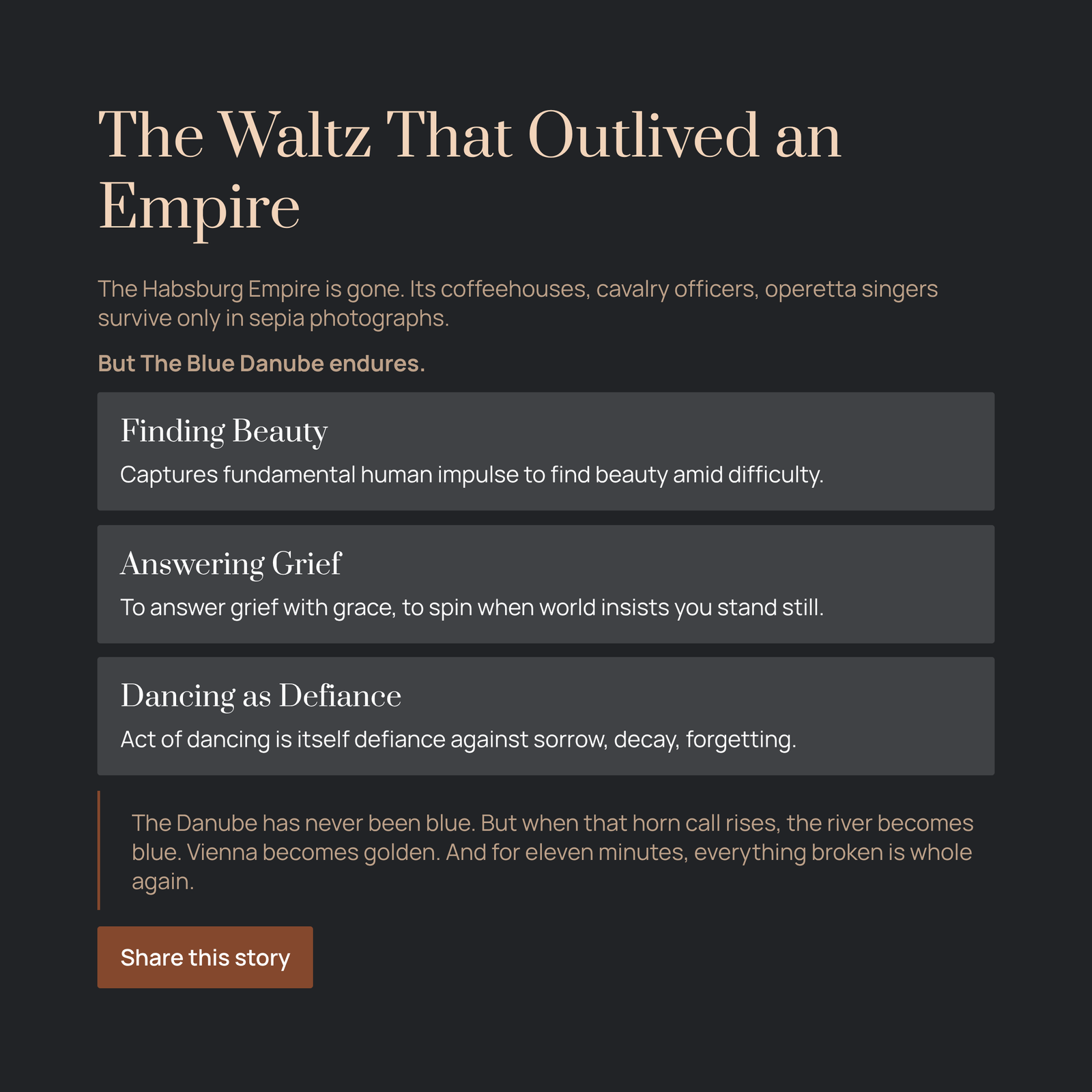
The Habsburg Empire is gone. The Austro-Hungarian world that produced Strauss — its coffeehouses and cavalry officers, its operetta singers and imperial balls — survives only in sepia photographs and museum displays.
But The Blue Danube endures. It endures because it captures something that no political collapse can erase: the fundamental human impulse to find beauty in the midst of difficulty, to answer grief with grace, to spin in three-four time when the world insists you should stand still.
Johann Strauss II did not save Vienna with a waltz. That would be too simple, too sentimental. What he did was remind Vienna — and eventually the world — that the act of dancing is itself a form of defiance. Against sorrow, against decay, against the slow forgetting of everything lovely.
The Danube has never been blue, not really. It runs gray-green through the heart of the city, indifferent to the music composed in its name. But when the first tremolo begins and that horn call rises from the strings, something shifts. The river becomes blue. Vienna becomes golden. And for eleven minutes, everything that was broken is whole again.