📑 Table of Contents
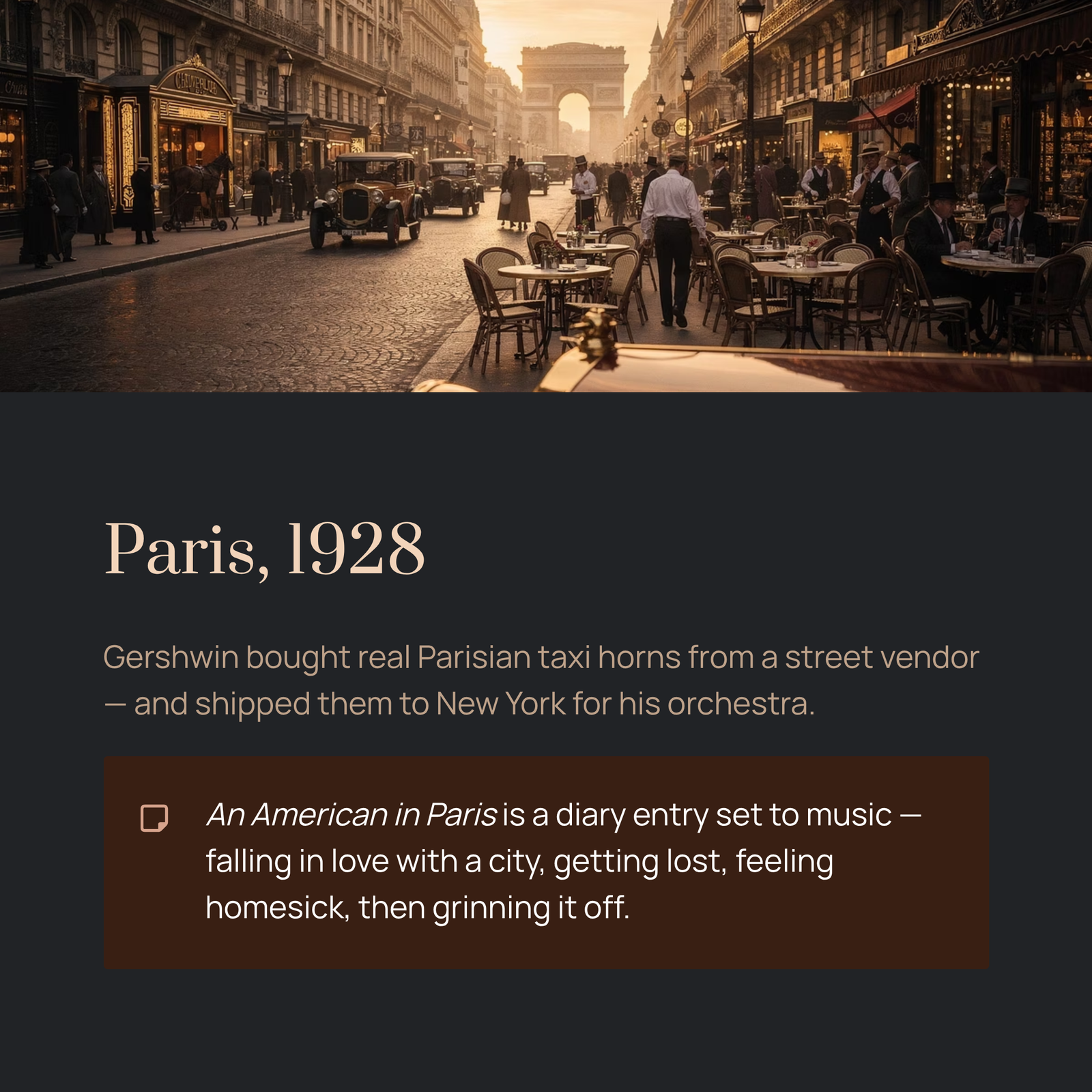
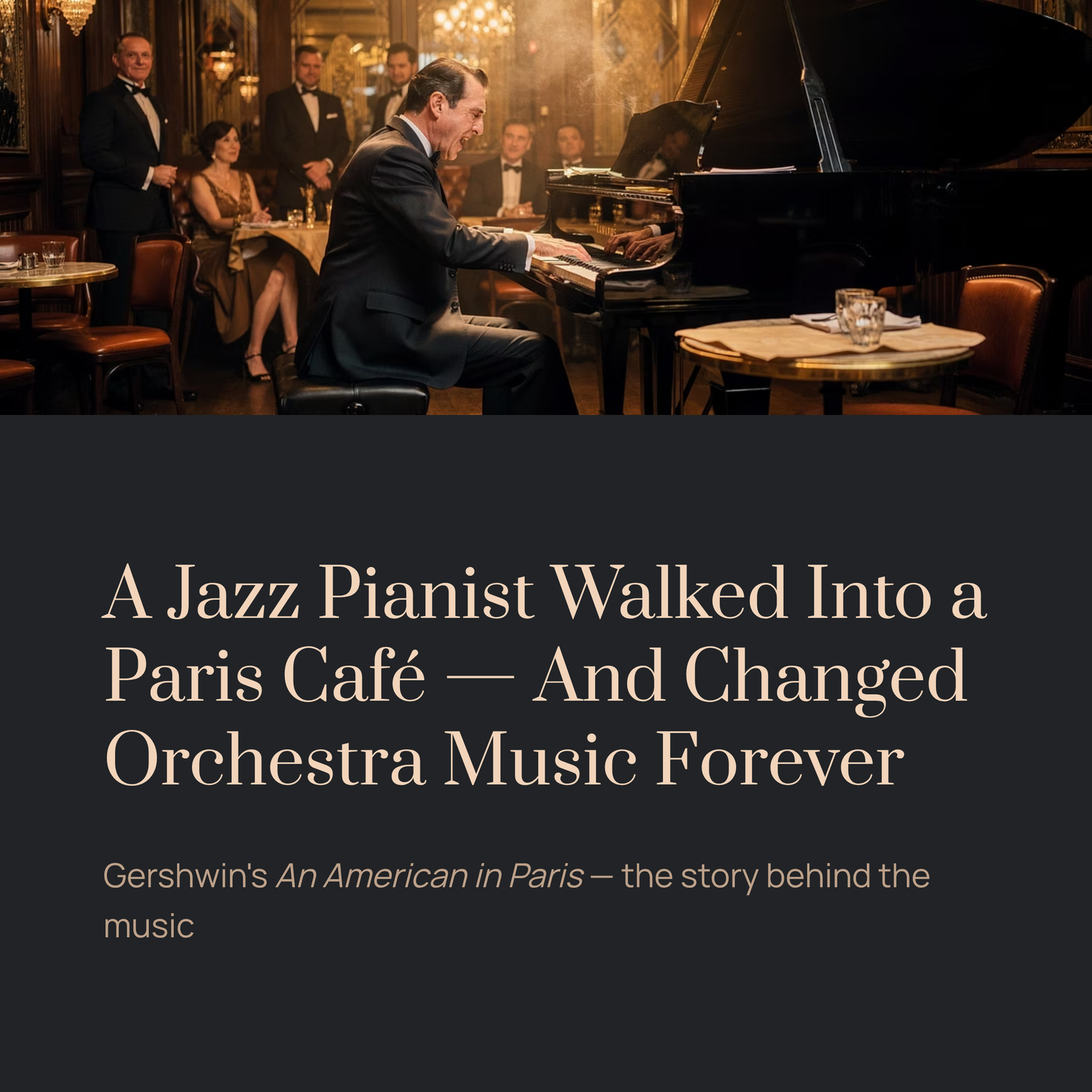
Picture this: it’s 1928, and a young American composer is wandering down the Champs-Élysées. He’s already famous back home — Broadway adores him, concert halls sell out for him — but here in Paris, he’s just another tourist gawking at the city lights. George Gershwin didn’t just soak in the sights, though. He bought actual Parisian taxi horns from a street vendor and shipped them back to New York. Those honking, brassy little noisemakers would end up in one of the most joyful orchestral pieces ever written.
An American in Paris isn’t just a composition. It’s a diary entry set to music — the sound of a man falling in love with a city, getting a little lost, feeling a pang of homesickness, and then shaking it all off with a grin.
The Man Who Refused to Stay in One Lane
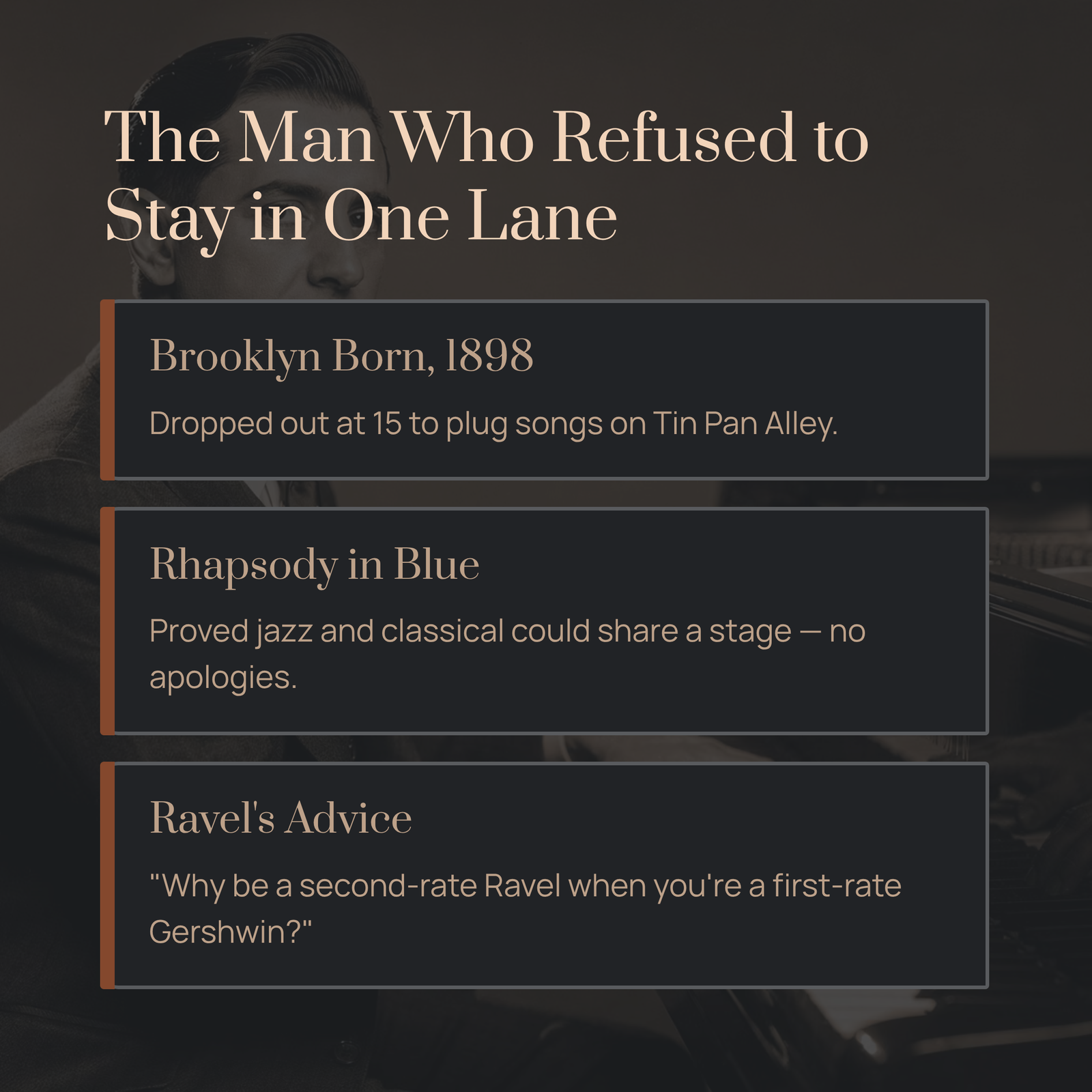
To understand this piece, you need to understand George Gershwin. Born in Brooklyn in 1898 to Russian-Jewish immigrant parents, he dropped out of school at fifteen to work as a song plugger on Tin Pan Alley. By his mid-twenties, he had already composed Rhapsody in Blue, a piece that shocked the classical world by proving jazz and orchestral music could share the same stage without apologizing to each other.
But Gershwin wasn’t satisfied. He wanted to study with the great European masters. When he approached Maurice Ravel in Paris for lessons, the French composer reportedly told him something along the lines of: “Why would you want to become a second-rate Ravel when you’re already a first-rate Gershwin?”
That trip to Paris in 1928, originally meant for studying, became something far more personal. Instead of textbooks and counterpoint exercises, Gershwin came home with a tone poem — a musical postcard soaked in the perfume of Parisian boulevards and the smoke of jazz clubs.
What You’re Actually Hearing: A Walking Tour in Sound
Here’s where An American in Paris becomes genuinely fun to follow, even if you’ve never listened to classical music before. Think of the entire piece as a movie soundtrack for a walk through Paris — except the movie hasn’t been filmed yet, and your imagination is the screen.
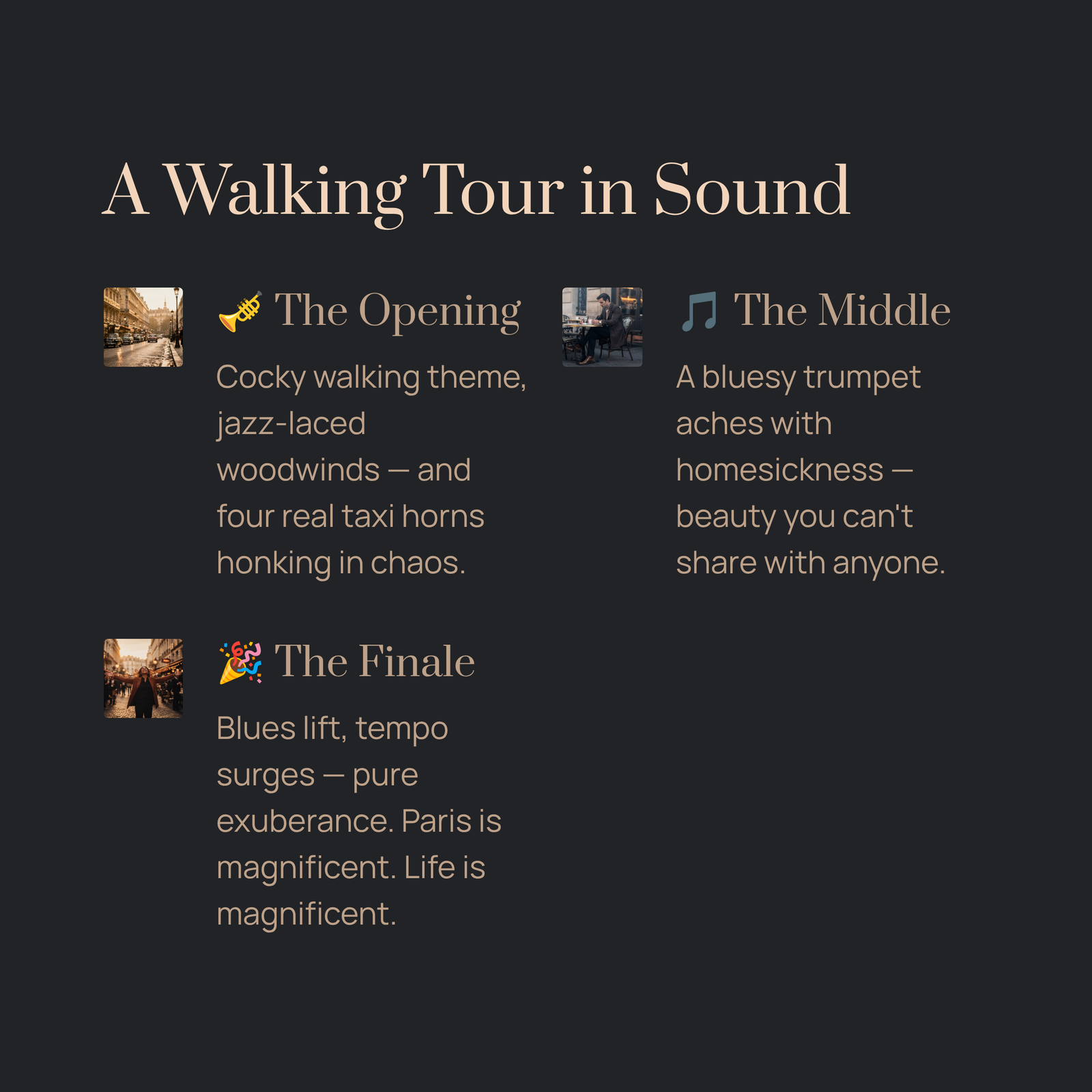
The opening minutes burst with energy. A jaunty, almost cocky walking theme bounces along — this is our American tourist stepping off the curb and into the city. The orchestration sparkles with that unmistakable Gershwin blend: French horns and woodwinds doing something that sounds suspiciously like jazz. And then, those taxi horns. Real ones. Four of them, honking in different pitches. It’s chaotic and charming and completely deliberate. You can practically smell the exhaust and fresh bread.
The middle section shifts dramatically. A slow, bluesy trumpet melody drifts in, and the whole mood changes. Our tourist is sitting alone at a café, maybe watching couples stroll by, suddenly aware of how far from home he is. This is the homesickness passage, and it’s one of the most beautifully melancholic things Gershwin ever wrote. The melody doesn’t weep — it aches, quietly, the way you miss someone when you’re surrounded by beauty you can’t share.
The finale is pure Gershwin exuberance. The blues lift, the tempo picks up, and the piece barrels toward a conclusion that feels like the musical equivalent of throwing your arms wide open. The American has shaken off his loneliness. Paris is magnificent. Life is magnificent. The orchestra roars with a joy so infectious you might catch yourself smiling at your headphones.
Why This Piece Still Feels So Alive
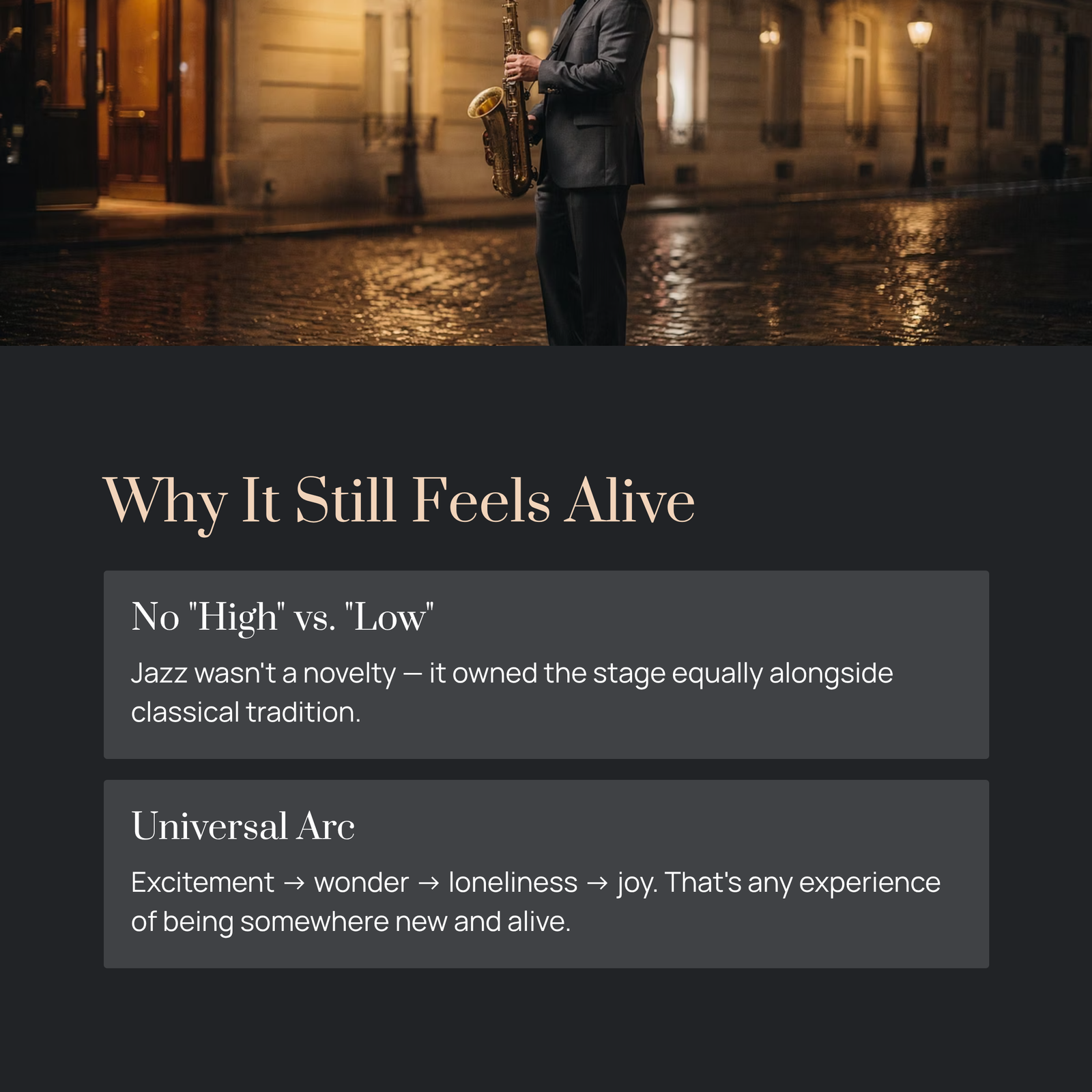
A lot of orchestral music from the 1920s sounds like a museum exhibit — historically important but emotionally distant. An American in Paris never does. Part of that is Gershwin’s refusal to separate “high” and “low” art. He didn’t sprinkle jazz into a classical framework as a novelty. He treated jazz as a legitimate musical language, equal to anything European tradition had to offer. The saxophones in this piece don’t feel like guests — they feel like they own the place.
There’s also something deeply human about the emotional arc. Excitement, wonder, loneliness, resilience, joy — that’s not just a walk through Paris. That’s any experience of being somewhere new, vulnerable, and fully alive. Gershwin captured the universal feeling of being a stranger in a beautiful place, and that resonance hasn’t faded in nearly a century.
Recordings Worth Your Time
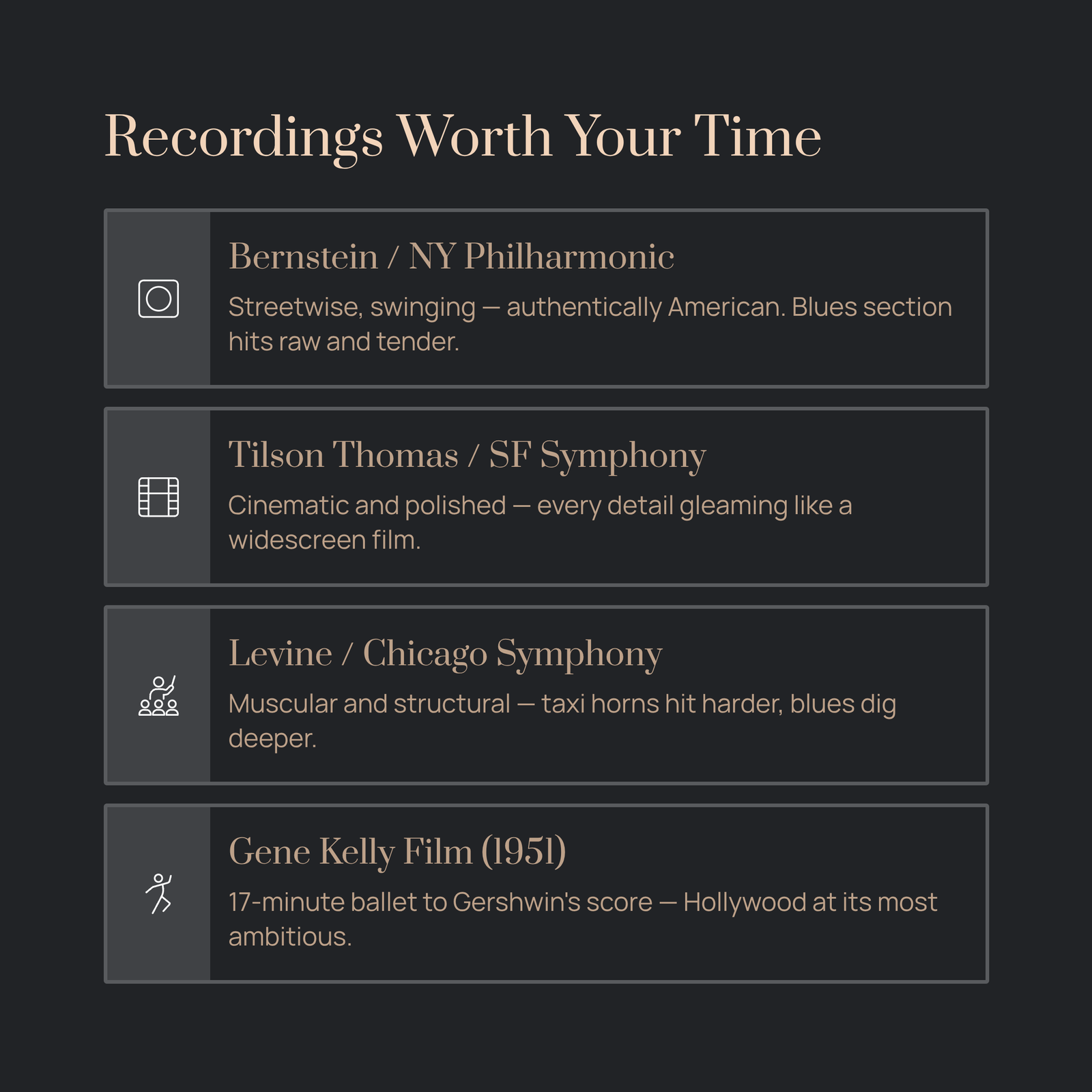
If you’re listening to this piece for the first time, the recording you choose matters more than you might think. Each conductor brings a different personality to the same notes.
Leonard Bernstein with the New York Philharmonic is the classic recommendation, and for good reason. Bernstein understood Gershwin’s jazz DNA in his bones, and his reading crackles with a streetwise energy that feels authentically American. The rhythms swing rather than march, and the homesick blues section has a raw tenderness that catches you off guard.
Michael Tilson Thomas with the San Francisco Symphony offers a more polished, cinematically vivid interpretation. If Bernstein’s version is a walk through Paris, Tilson Thomas’s is a widescreen film of the same walk — every detail magnified and gleaming.
For something unexpected, try James Levine with the Chicago Symphony Orchestra. Levine brings a muscular, almost symphonic weight to the piece that reveals structural details lighter performances can gloss over. The taxi horns hit harder, the blues dig deeper.
And if you want the full visual experience, the 1951 Gene Kelly film An American in Paris features a seventeen-minute ballet sequence set to this music. It’s Hollywood at its most ambitious, and while the orchestration differs from the concert version, watching Kelly dance through Gershwin’s Paris is an experience in itself.
A Composer Who Listened to Cities
George Gershwin died in 1937 at the age of thirty-eight, from a brain tumor that took him shockingly fast. He left behind a body of work that remains almost impossible to categorize — too jazzy for the classical purists, too orchestral for the jazz world, too sincere for the cynics, too inventive for the traditionalists.
An American in Paris captures everything that made Gershwin extraordinary. He listened to cities the way poets read landscapes — hearing rhythm in traffic, melody in conversation, harmony in the way sunlight hit a cobblestone street. He didn’t compose from theory. He composed from living.
So put on a good recording. Close your eyes. And for about eighteen minutes, let yourself be a stranger in the most beautiful city in the world — guided by a Brooklyn kid who heard music in everything, and had the genius to write it all down before the feeling faded.