📑 Table of Contents
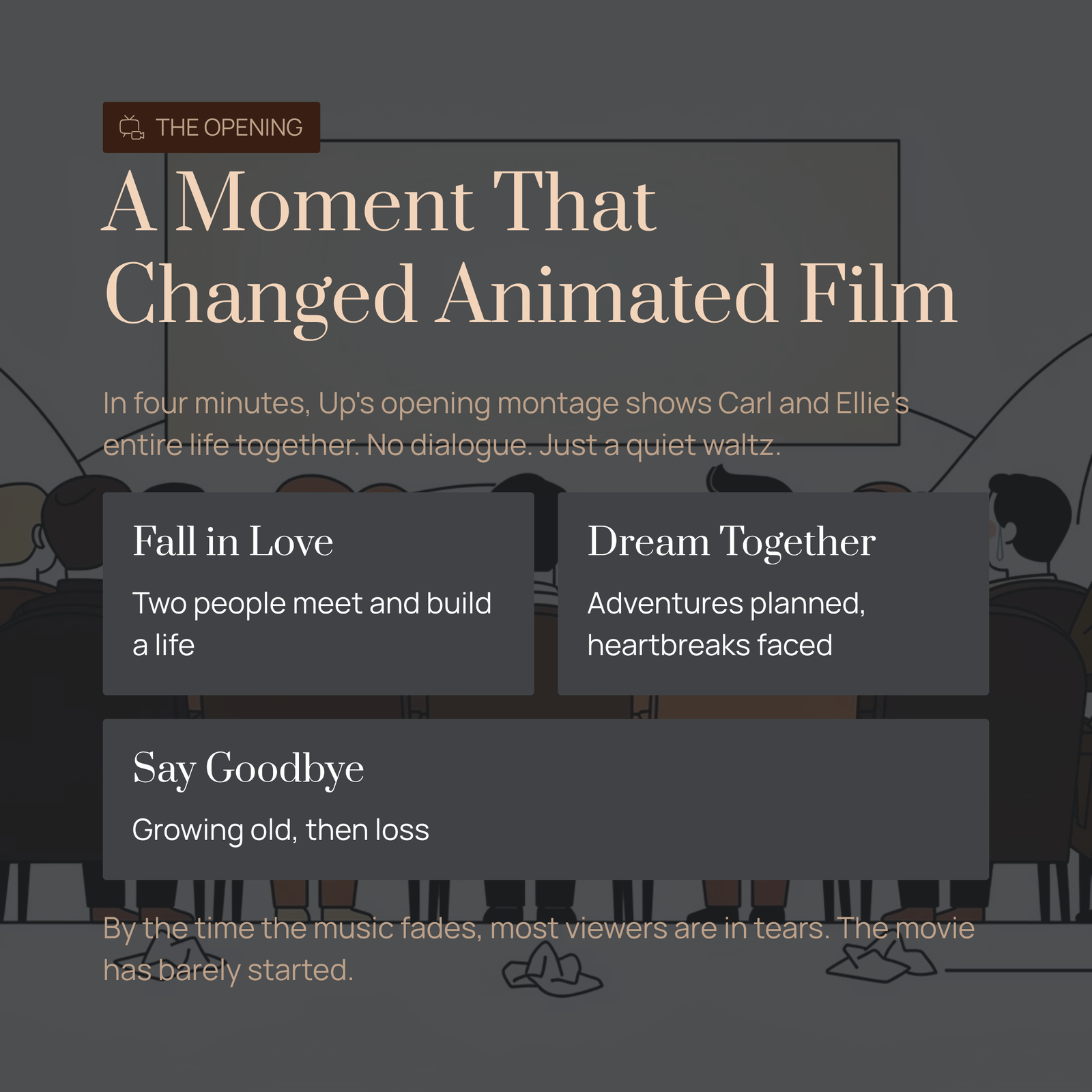
There is a moment near the beginning of Pixar’s Up (2009) that changed the way audiences think about animated film. No car chase, no villain monologue, no comedic sidekick — just a quiet waltz playing over a montage of two people living an entire life together. In roughly four minutes, you watch Carl and Ellie Fredricksen fall in love, build a home, dream of adventure, face heartbreak, grow old, and say goodbye. By the time the music fades, most people in the theater are in tears — and the movie has barely started.
That waltz is called “Married Life,” and the man who wrote it is Michael Giacchino.
Who Is Michael Giacchino?
If you’ve watched a Hollywood blockbuster in the past two decades, chances are you’ve heard Michael Giacchino’s music without even realizing it. Born in 1967 in Riverside Township, New Jersey, Giacchino grew up obsessed with two things: dinosaurs and movie scores. As a kid, he would watch monster films not for the scares but for the orchestral music swelling underneath. That childhood obsession eventually led him to Juilliard and then to the School of Visual Arts in New York, where he studied filmmaking — not just music, but the art of visual storytelling itself.
His early career took an unusual path through the world of video games. He composed scores for Medal of Honor and other titles at a time when most game soundtracks were electronic loops. Giacchino insisted on recording with a live orchestra, a move that raised eyebrows but also raised the bar for what game music could be. That commitment to orchestral warmth caught the attention of J.J. Abrams, leading to collaborations on Alias, Lost, and eventually the Star Trek reboot.
But it was Pixar that gave Giacchino his most emotionally resonant canvas. After scoring The Incredibles (2004) and Ratatouille (2007), he took on Up — and delivered a piece of music that would earn him the Academy Award for Best Original Score.
The Story Behind “Married Life”
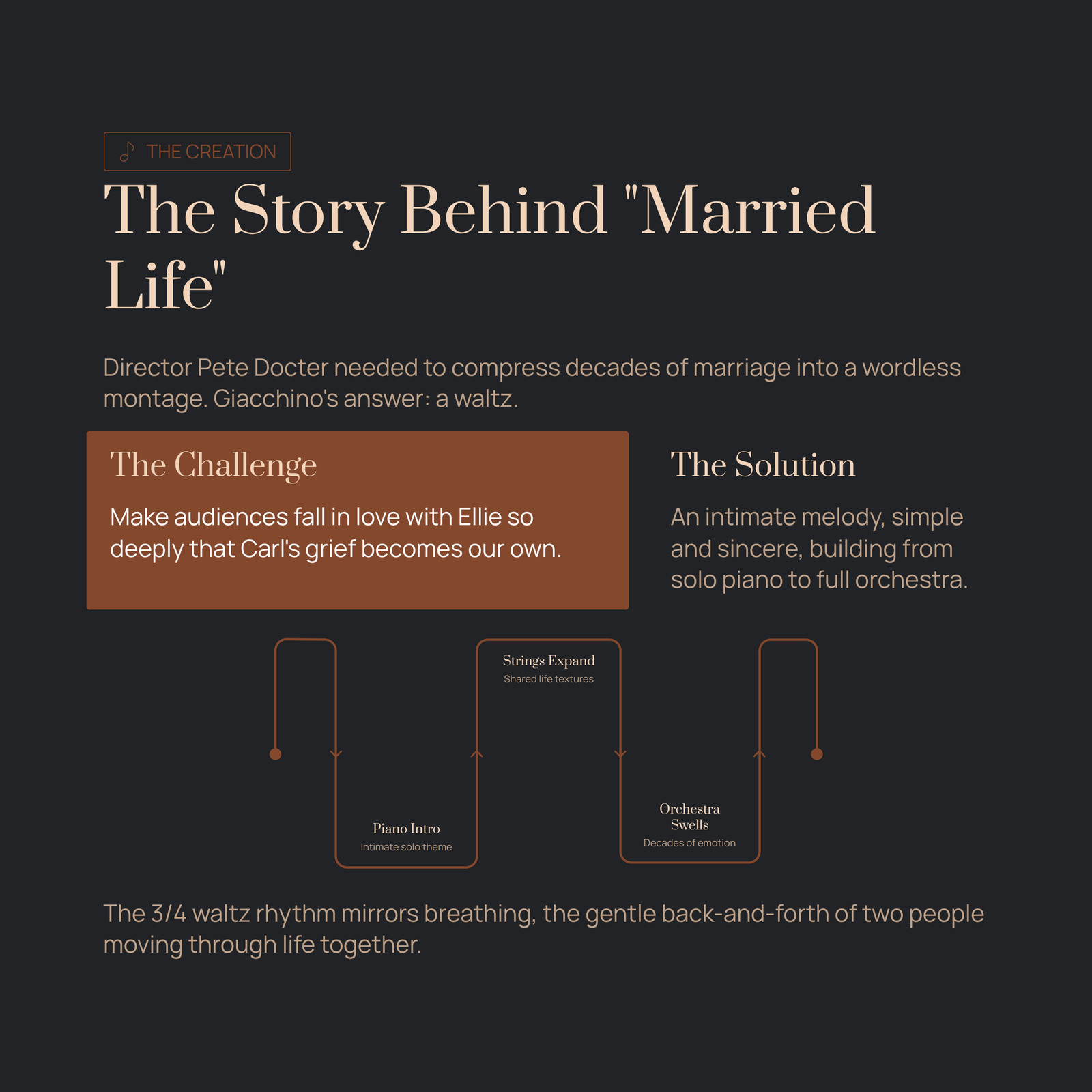
Director Pete Docter faced a daunting creative challenge with the opening sequence of Up. He needed to compress an entire marriage — decades of shared joy, quiet disappointment, and profound loss — into a single wordless montage. The sequence had to make the audience fall in love with Ellie so deeply that when she’s gone, Carl’s grief becomes our own. Without that emotional foundation, the rest of the film simply wouldn’t work.
Giacchino’s answer was a waltz. Not a grand, sweeping orchestral statement, but something intimate — the kind of melody you might hear drifting out of a small-town dance hall on a Saturday evening. He built the piece around a deceptively simple theme, first introduced on solo piano, then handed to strings, woodwinds, and eventually the full orchestra as the years of Carl and Ellie’s life unfold.
The genius of the composition lies in how Giacchino uses the waltz’s three-quarter time as a metaphor for the rhythm of a shared life. The lilting 1-2-3, 1-2-3 pattern feels like breathing, like the gentle back-and-forth of two people who have learned to move through the world together. When the music swells during moments of happiness — painting the nursery, picnicking under the clouds — the waltz feels buoyant, almost giddy. When tragedy strikes, the same melody returns in a minor key, slower, heavier, as if the dance has lost a partner but the rhythm stubbornly continues.
How to Listen: Three Layers Worth Your Attention
Even if you’ve heard this piece dozens of times, approaching it with fresh ears can reveal surprising depth. Here are three layers to listen for.
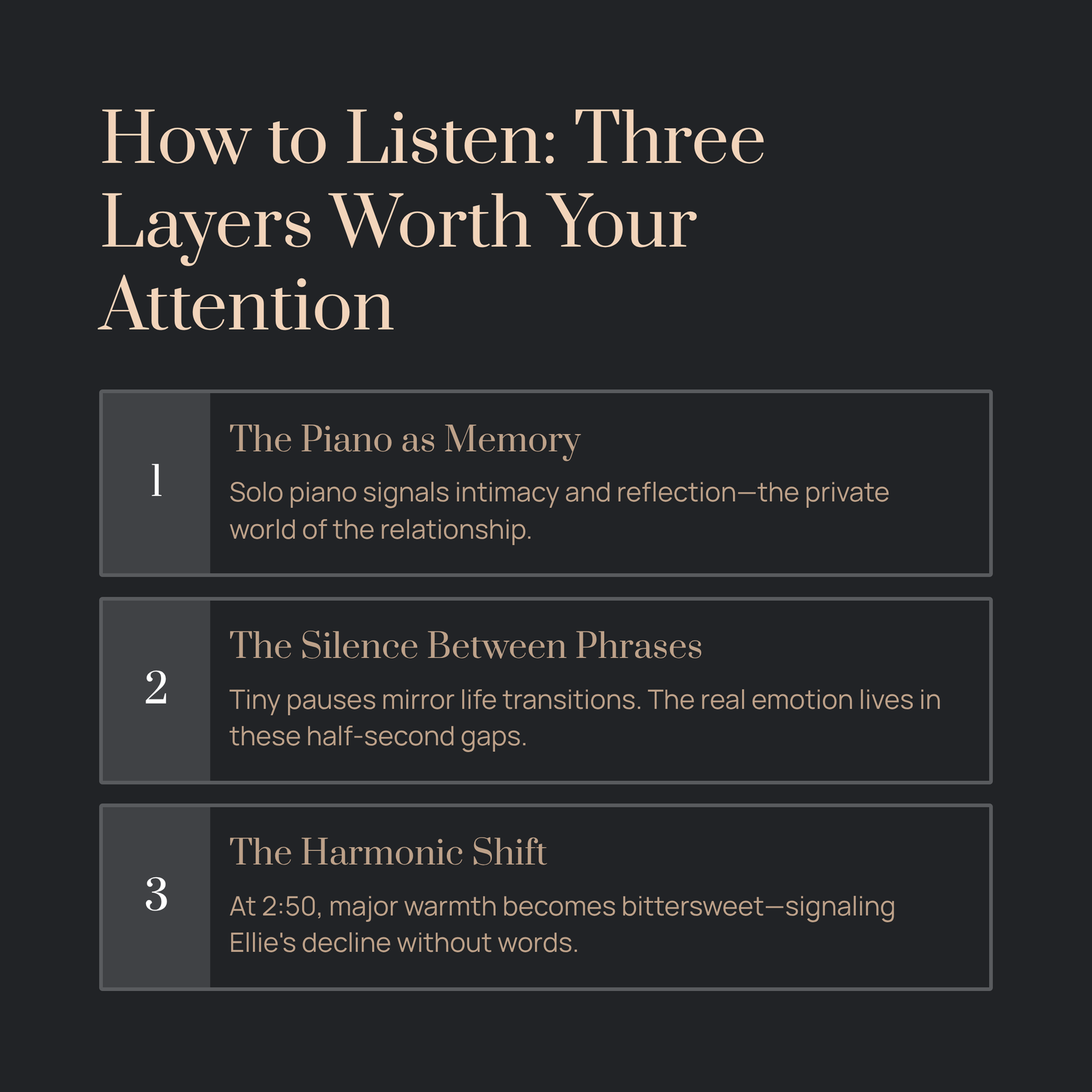
The piano as memory. Notice how the piece opens with solo piano playing the main theme. Throughout the track, every time the piano returns prominently, it signals a moment of intimacy or reflection — as if the piano represents the private, interior world of the relationship. When the orchestra joins, it’s the world outside acknowledging what Carl and Ellie have built together.
The silence between phrases. Giacchino is remarkably disciplined about leaving space in the music. There are tiny pauses — half-second gaps where the melody seems to hold its breath — that mirror the montage’s transitions between life stages. These silences aren’t empty; they’re where the real emotion lives. Pay attention to how much you feel during those brief moments when the music pulls back.
The harmonic shift at the three-minute mark. Around the 2:50–3:10 mark, the harmonic language changes. The major-key warmth gives way to something more bittersweet — not quite minor, but shadowed, as if sunlight has passed behind a cloud. This is Giacchino signaling Ellie’s decline without a single word. If you listen closely, the waltz rhythm never actually stops; it just becomes quieter, more fragile, as though the dance is continuing in a room that’s slowly emptying.
Why This Piece Matters Beyond the Film
“Married Life” has taken on a life far beyond the Pixar film that birthed it. It appears regularly on concert programs, from community orchestras to the London Symphony Orchestra. Wedding musicians report it as one of the most requested processional pieces of the past decade. It has become, in a way, a modern standard — a piece of orchestral music that people who never listen to orchestral music know by heart.
This matters because it challenges a long-standing assumption in the classical world: that film music is somehow lesser, that it borrows from the tradition without contributing to it. Giacchino’s waltz does something that the greatest concert works have always done — it captures a universal human experience in sound. The feeling of time passing too quickly with someone you love, the quiet terror of realizing those years are finite — these are not themes unique to a Pixar film. They are the themes of Schubert lieder, of Brahms intermezzi, of every slow movement that has ever made a listener’s throat tighten.
What Giacchino proves is that emotional sincerity and structural simplicity are not weaknesses. “Married Life” uses a standard waltz form, a lyrical melody, and conventional orchestration — and it devastates listeners every single time. There is no irony in it, no postmodern distance, no attempt to impress with complexity. It simply tells the truth about what it feels like to love someone for a lifetime, and that truth turns out to be enough.
Recommended Listening
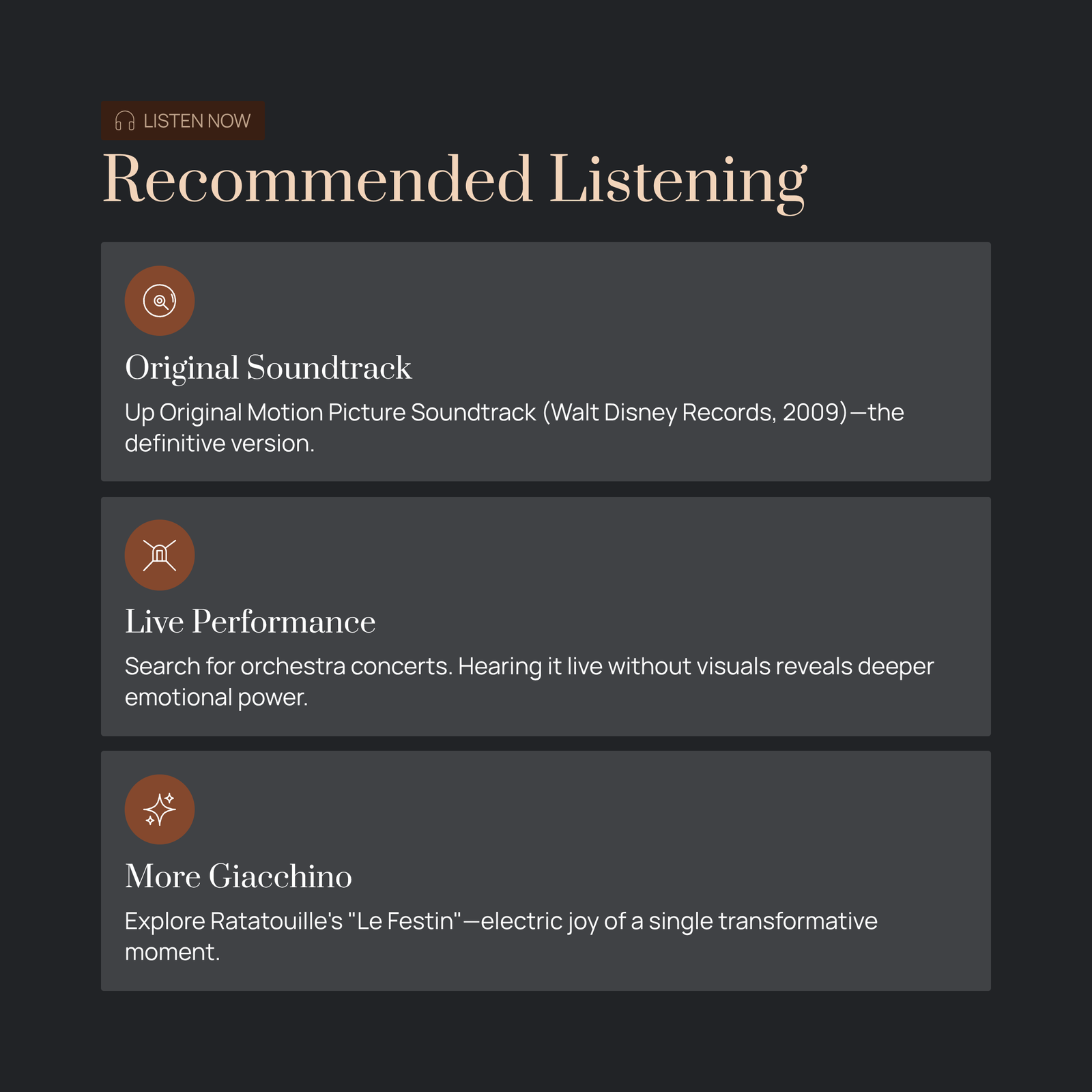
The definitive recording is the original soundtrack version from the Up Original Motion Picture Soundtrack (Walt Disney Records, 2009), performed by a full studio orchestra under Giacchino’s direction. This is the version most listeners know, and its engineering beautifully balances the intimate piano passages against the fuller orchestral moments.
For a live concert experience, search for performances by major orchestras as part of their “film music in concert” programs — hearing “Married Life” performed live, without the visual montage, forces you to engage with the music on its own terms, and many listeners report finding it even more moving in that context.
If this piece resonates with you, consider exploring Giacchino’s score for Ratatouille next — particularly the track “Le Festin.” Where “Married Life” is about love measured in decades, “Le Festin” captures the electric joy of a single, transformative moment. Together, they reveal a composer whose greatest instrument isn’t the orchestra — it’s empathy.
A Final Thought
There’s a reason “Married Life” still makes people cry more than fifteen years after its premiere. It’s not manipulation, and it’s not nostalgia for a cartoon. It’s recognition. Somewhere in that waltz, in the way the melody rises and gently falls, we hear our own lives — the ordinary, irreplaceable days we spend with the people we love, days that feel endless until suddenly they aren’t.
Michael Giacchino wrote a four-minute waltz about a fictional marriage in an animated film about a floating house. And somehow, he wrote one of the most honest pieces of music about love that the twenty-first century has produced.
That’s not a small thing. That might, in fact, be everything.