
📑 Table of Contents
- Who Is Yann Tiersen? Not the Composer You’d Expect
- The Story Behind the Song: A Nursery Rhyme from Another Summer
- What Makes This Piece So Unforgettable? A Closer Listen
- Why Does It Make Us Cry? The Psychology of Musical Nostalgia
- How to Listen: Three Ways to Experience This Piece
- A Nursery Rhyme That Holds the Weight of a Life
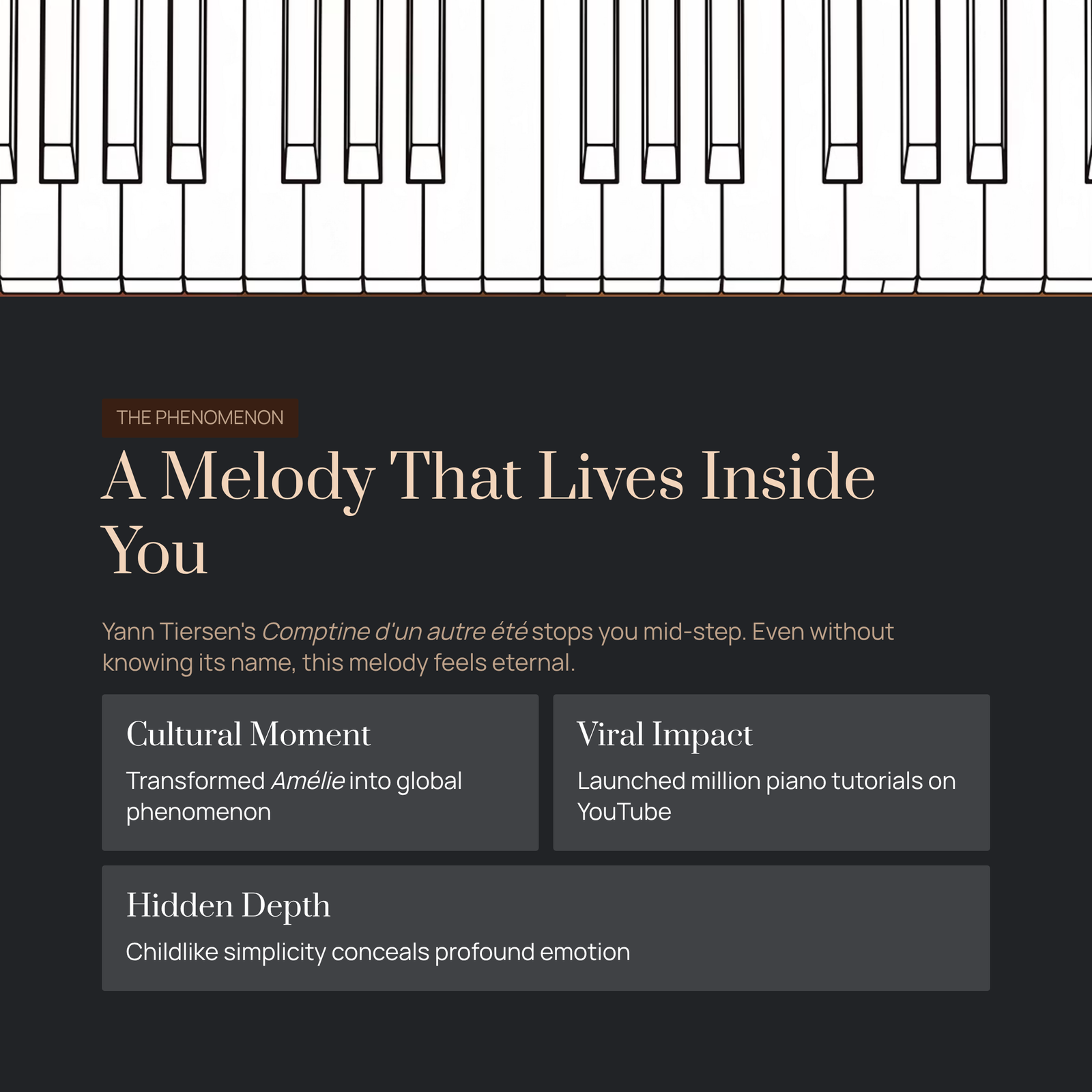
There’s a strange phenomenon that happens with certain pieces of music. You hear them once — maybe in a movie theater, maybe drifting from a stranger’s window — and suddenly they live inside you, as if they’d always been there. Yann Tiersen’s Comptine d’un autre été: L’après-midi is exactly that kind of piece. Even if you’ve never seen the film Amélie, even if you couldn’t name the composer, there’s a good chance this melody would stop you mid-step on a crowded street.
It’s the song that turned a quirky French film into a global cultural moment. It’s the piece that launched a million piano tutorials on YouTube. And beneath its childlike simplicity lies something far more profound than most listeners realize.

Who Is Yann Tiersen? Not the Composer You’d Expect
Here’s something that surprises most people: Yann Tiersen never set out to write film music. Born in 1970 in Brest, a port city on the westernmost tip of France, Tiersen grew up studying violin and piano at conservatories — but he was restless. Classical training felt too rigid. Rock felt too loud. He wanted something in between, something that breathed.
By the mid-1990s, Tiersen had carved out a quiet niche in the French indie music scene, releasing albums that blended toy pianos, accordions, violins, and typewriters into fragile sonic landscapes. His music didn’t fit neatly into any category — not quite classical, not quite pop, not quite ambient. It simply existed in its own tender, slightly melancholic world.
Then director Jean-Pierre Jeunet came calling. He’d been listening to Tiersen’s existing albums while editing Amélie and realized the music already was the film’s emotional language. Most of the soundtrack was pulled directly from Tiersen’s previous work, with only a handful of new compositions written specifically for the movie. Comptine d’un autre été was one of those new pieces — and it would change everything.
The Story Behind the Song: A Nursery Rhyme from Another Summer
The title itself is a quiet poem. Comptine d’un autre été: L’après-midi translates roughly to “Counting Rhyme of Another Summer: The Afternoon.” There’s an ache built right into those words — another summer, not this one. A summer remembered, perhaps idealized, possibly invented. The subtitle, L’après-midi, places us in that specific golden-hour territory: the lazy, drowsy stretch of a summer afternoon when time seems to slow down and the light turns everything amber.
In the film, this piece accompanies Amélie Poulain’s most whimsical moments — her private joys, her secret missions of kindness, her tentative steps toward connection. But the music does something the visuals alone cannot. It tells us that beneath Amélie’s playful exterior lives a profound loneliness, a yearning for something she can’t quite name. The melody smiles, but its eyes are wet.
Tiersen composed it on piano alone, deliberately keeping the arrangement spare. No orchestral swells. No dramatic crescendos. Just two hands, a keyboard, and an emotion too large for words.
What Makes This Piece So Unforgettable? A Closer Listen
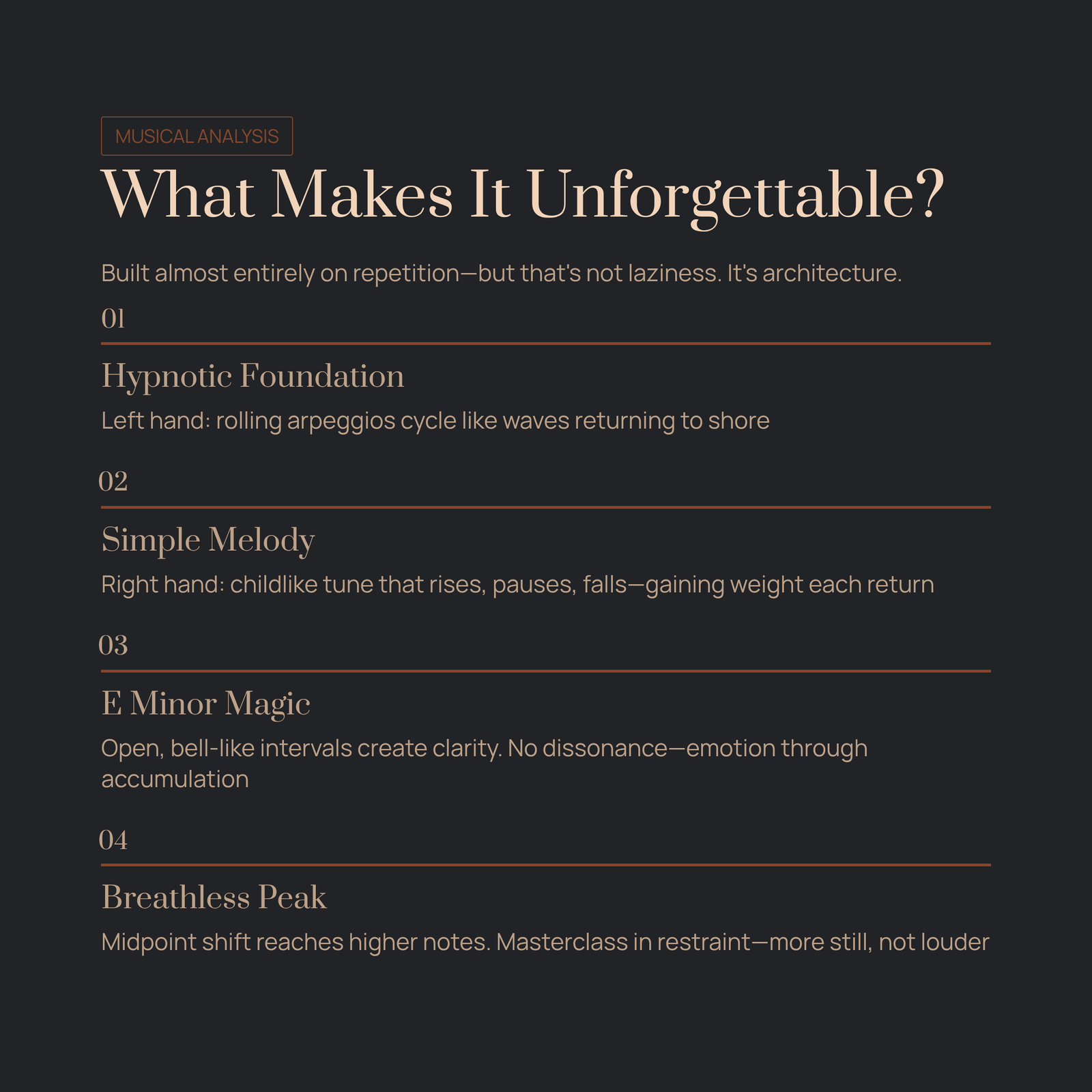
If you sit with Comptine d’un autre été and really pay attention, you’ll notice something curious: it’s built almost entirely on repetition. The left hand establishes a rolling pattern of arpeggios — broken chords that cycle through the same progression again and again, like waves returning to the same shore. This isn’t laziness. It’s architecture.
That hypnotic left-hand pattern creates a sense of motion without destination, of circling a memory you can’t quite reach. Against this, the right hand introduces a melody so simple it could be a children’s song. It rises, pauses, falls — and each time it returns, it carries slightly more weight, slightly more urgency.
The harmonic language is deceptively straightforward. Tiersen works primarily in E minor, one of the most naturally resonant keys on the piano. The chords move through familiar territory — E minor, B minor, D major, A minor — but the way they’re voiced, with those open, ringing intervals, gives them an almost bell-like clarity. There’s no dissonance to resolve, no harmonic tension demanding release. Instead, the piece creates emotion through accumulation. Each repetition adds another layer of feeling, the way returning to a childhood home reveals new details each visit.
Pay attention around the midpoint: the melody shifts slightly, reaching for higher notes, and there’s a moment — barely four measures — where the music seems to hold its breath. This is the emotional peak, and Tiersen achieves it not by getting louder but by getting more still. It’s a masterclass in restraint.

Why Does It Make Us Cry? The Psychology of Musical Nostalgia
There’s a reason Comptine d’un autre été appears on countless “music that makes you cry” playlists. Psychologically, the piece activates several emotional triggers simultaneously.
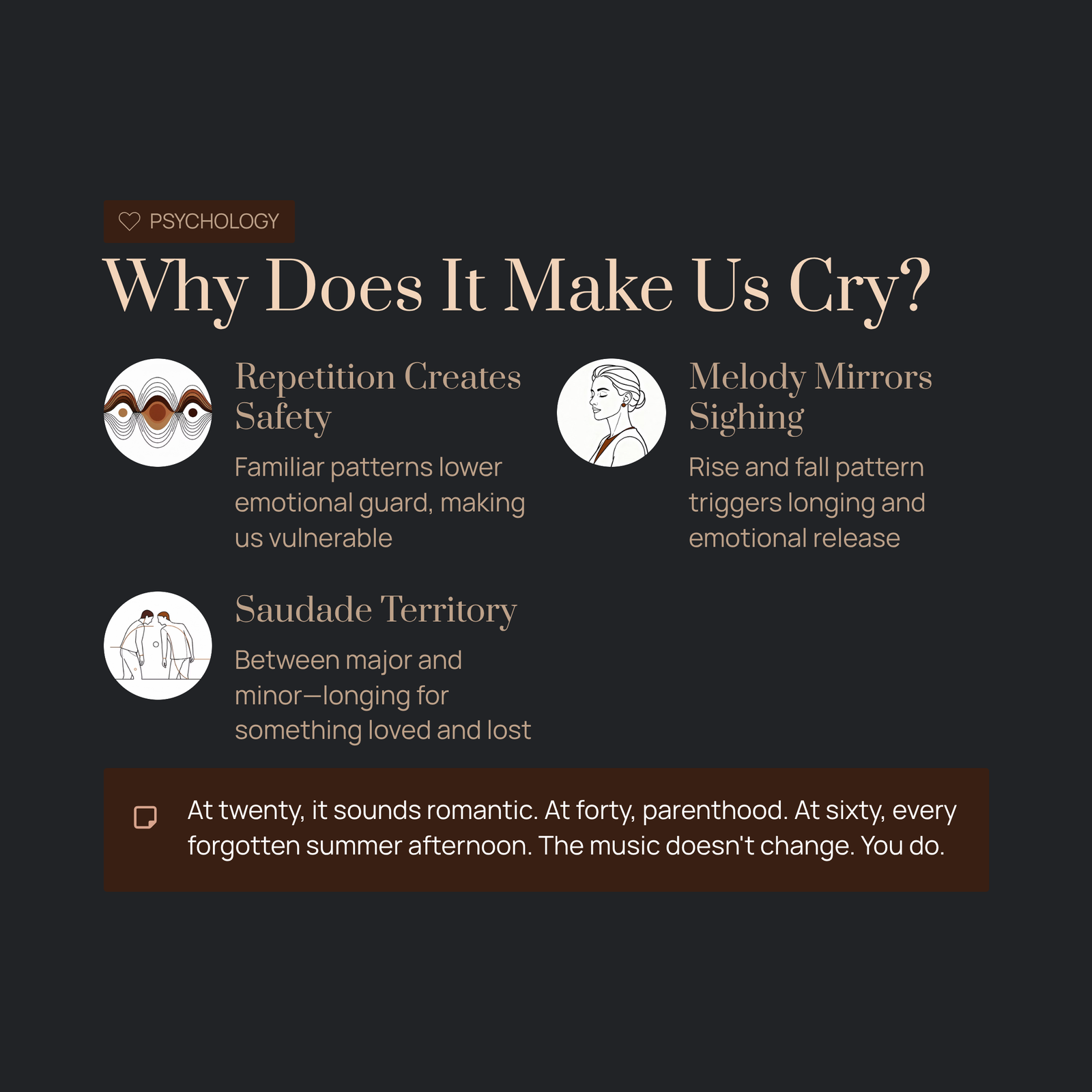
First, there’s the repetition factor. Neuroscience research suggests that repeating musical patterns create a sense of safety and familiarity, which paradoxically makes us more emotionally vulnerable. We let our guard down. Second, the melody’s contour — its rise and gentle fall — mirrors the patterns of human sighing, which our brains associate with longing and emotional release. Third, and perhaps most powerfully, the piece operates in what musicians call “the space between major and minor.” It’s not happy. It’s not sad. It occupies that bittersweet territory the Portuguese call saudade — a longing for something loved and lost, or perhaps never possessed at all.
This is why the piece hits differently depending on when you hear it. At twenty, it sounds romantic. At forty, it sounds like parenthood. At sixty, it sounds like every summer afternoon you forgot to memorize. The music doesn’t change. You do.
How to Listen: Three Ways to Experience This Piece
The First Listen — Let It Wash Over You. Don’t analyze. Don’t read along. Put on headphones, close your eyes, and give the piece your full three minutes and twenty seconds. Notice where your mind wanders. Whatever memory surfaces — that’s what the music is about, for you, today.
The Second Listen — Follow the Left Hand. This time, ignore the melody entirely and focus on the rolling arpeggios underneath. Listen to how they create a sense of perpetual motion, like a music box that never winds down. Notice how this pattern never changes, even as the emotion above it shifts and deepens. There’s something profound in that constancy.
The Third Listen — Watch a Live Performance. Find a video of a pianist performing this piece — not the studio recording, but a live one where you can see their hands. There’s something about watching human fingers create these sounds that reconnects the music to its physical reality. Recommended performances include Lang Lang’s tender interpretation and the countless heartfelt covers by amateur pianists on YouTube, many of whom learned piano specifically because of this piece.
For recordings, start with the original soundtrack version from the Amélie OST (2001). Then explore Tiersen’s live album L’Absente and his later reworkings on EUSA (2016), where he revisits his earlier compositions with a decade of new perspective. The evolution in interpretation is itself a lesson in how music grows alongside its creator.
A Nursery Rhyme That Holds the Weight of a Life
There’s a beautiful irony at the heart of Comptine d’un autre été. It’s one of the most technically accessible pieces in the modern piano repertoire — a determined beginner can learn the notes in a few weeks. Yet it’s also one of the hardest pieces to play well, because its simplicity leaves nowhere to hide. Every hesitation, every rushed note, every moment of emotional dishonesty is audible.
Perhaps that’s why it endures. In a world that often equates complexity with depth, Tiersen’s little counting rhyme reminds us that the most profound truths are usually the simplest ones. That summer afternoons end. That memory reshapes what it preserves. That sometimes, three minutes of honest piano music can hold more truth than a thousand words ever could.
The next time the afternoon light goes golden and the world gets quiet, put this piece on. Don’t think about Paris. Don’t think about Amélie. Just listen — and let the music remind you of a summer you may never have lived, but somehow remember perfectly.