📑 Table of Contents
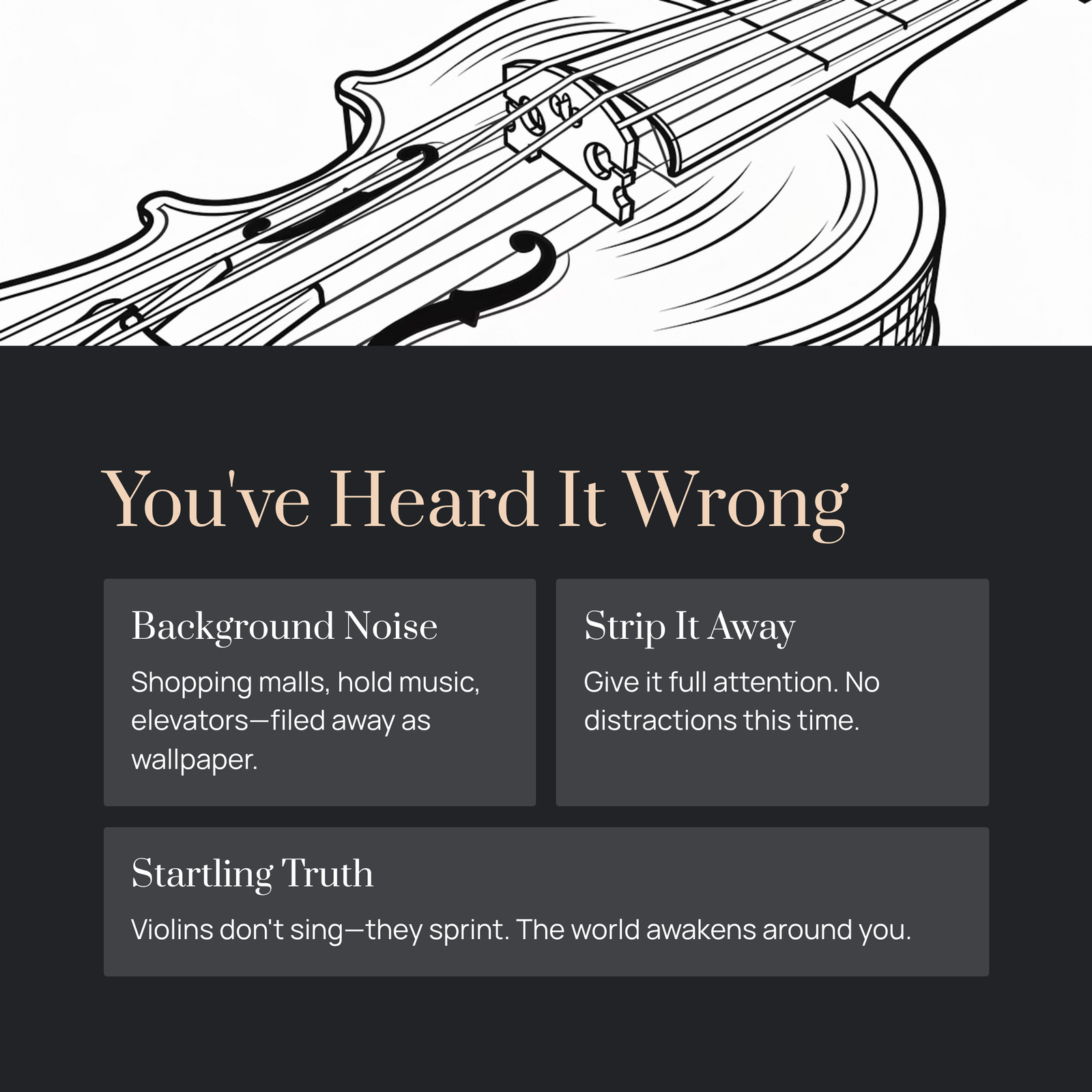
Here’s the thing about Vivaldi’s Spring. You’ve heard it. You’ve heard it in shopping malls, in phone hold music, in movie trailers, in elevators that smell faintly of carpet cleaner. It has been everywhere for so long that your brain probably filed it under “background noise” years ago.
And that’s exactly why you need to hear it again — properly, this time, with your full attention and no distractions.
Because when you strip away the cultural wallpaper and actually sit with this music for three and a half minutes, something startling happens. The opening bars don’t just play — they erupt. The violins don’t just sing — they sprint. And suddenly, you’re not listening to elevator music anymore. You’re standing in the middle of an 18th-century Italian countryside, and the entire world is waking up around you.
A Priest, a Violin, and a Radical Idea
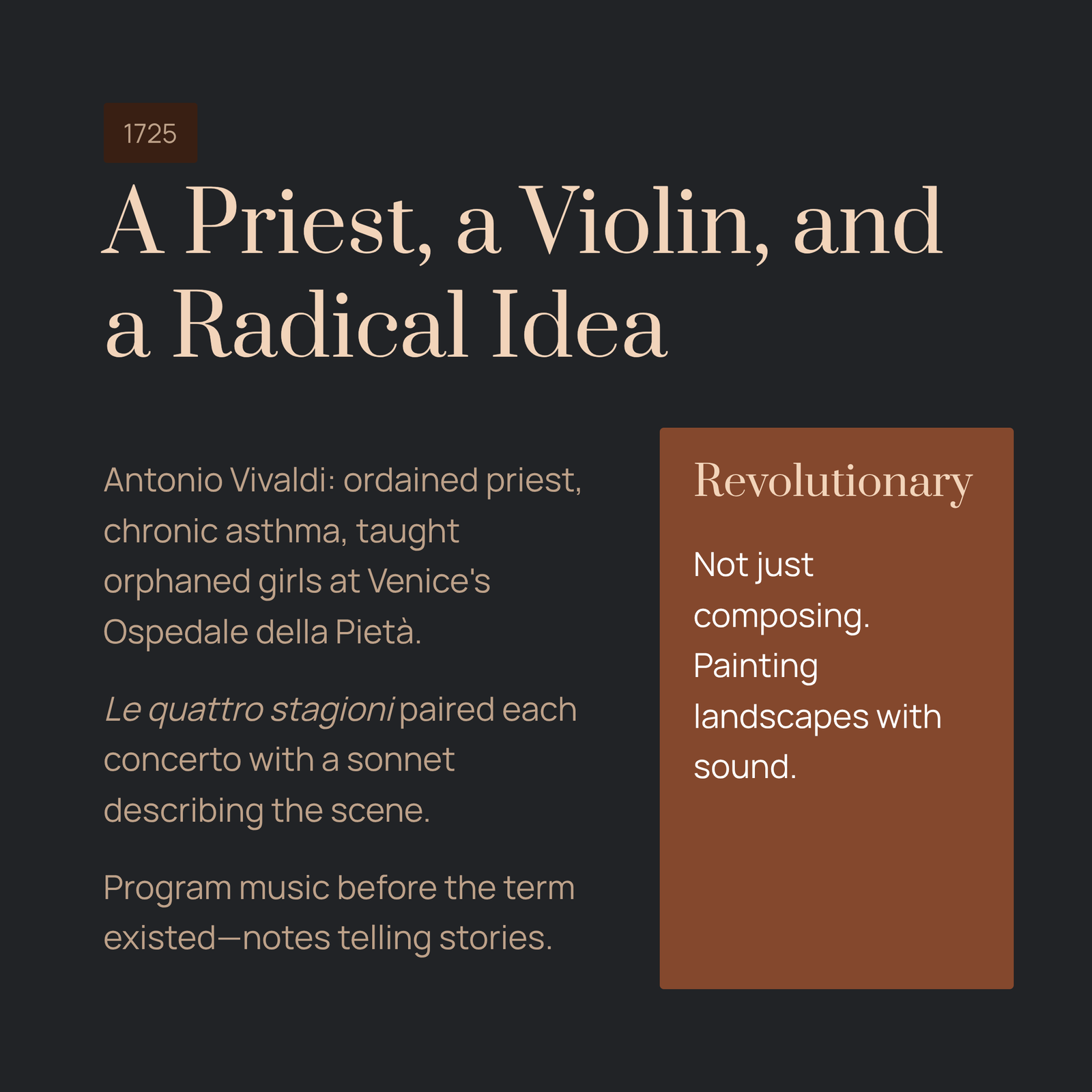
Antonio Vivaldi was not your typical composer. For one, he was an ordained Catholic priest — though he reportedly stopped saying Mass because of chronic chest pains (asthma, most likely). For another, he spent much of his career teaching music to orphaned girls at the Ospedale della Pietà in Venice, an institution that doubled as one of Europe’s finest musical ensembles.
It was in this unusual context — a red-haired priest surrounded by prodigiously talented young women — that Vivaldi wrote some of the most electrifying music of the Baroque era.
Le quattro stagioni, or The Four Seasons, was published in 1725 as part of a larger collection called Il cimento dell’armonia e dell’inventione (The Contest Between Harmony and Invention). But what made The Four Seasons revolutionary wasn’t just the music itself. Each concerto came paired with a sonnet — possibly written by Vivaldi himself — that described the scene the music was meant to paint.
This was program music before the term even existed. Vivaldi wasn’t just composing notes; he was telling you a story. And Spring is where that story begins.
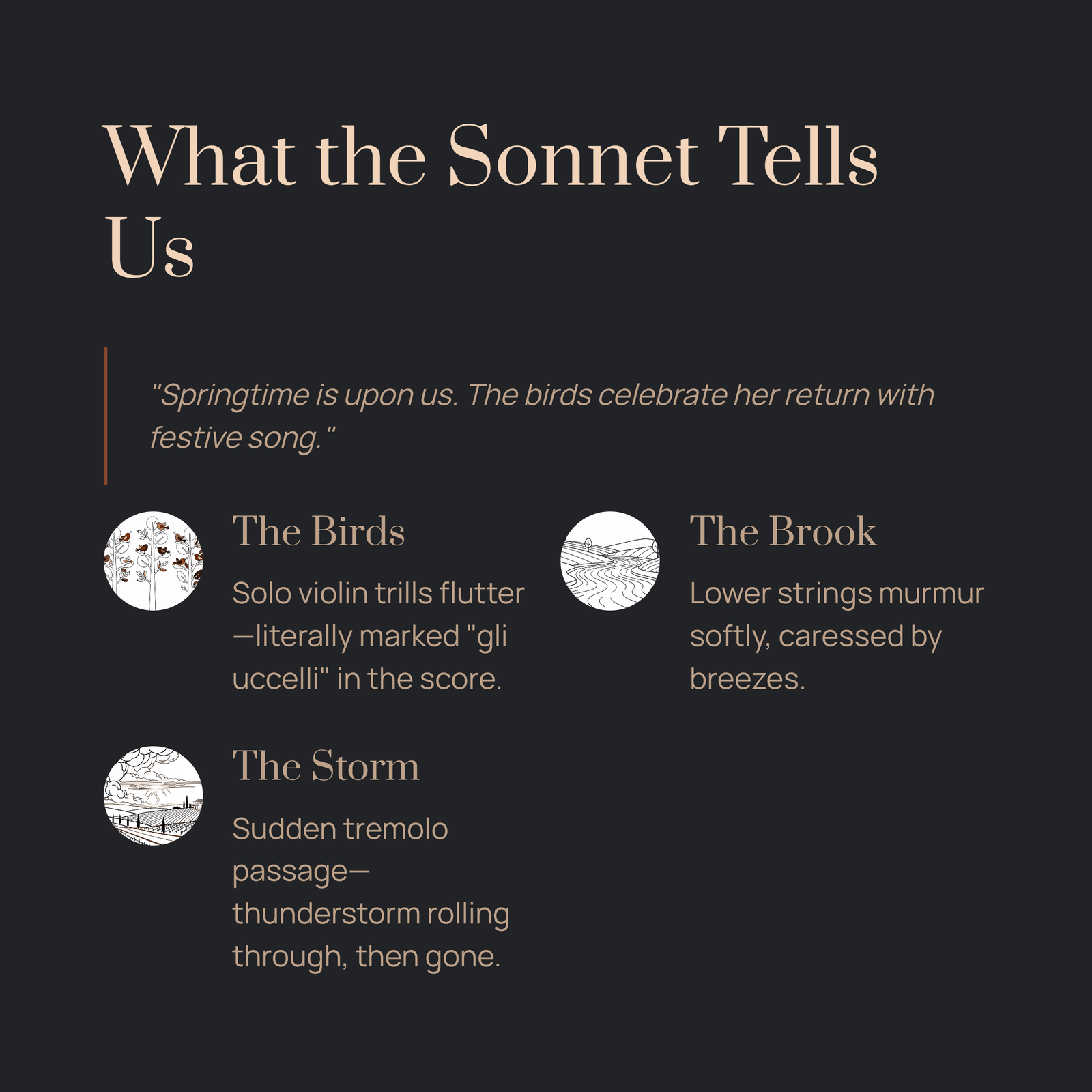
What the Sonnet Tells Us (Before a Single Note Plays)
The sonnet for Spring opens with these lines:
Springtime is upon us. The birds celebrate her return with festive song, and murmuring streams are softly caressed by the breezes.
Vivaldi took these words and translated them directly into sound. The opening ritornello — that famous, jubilant theme you already know — represents Spring herself arriving. It’s not a gentle entrance. It’s a celebration, an announcement, a collective exhale after winter.
Then listen for what happens between the big orchestral statements. The solo violin begins to trill and flutter — those are the birds. Not abstract, metaphorical birds. Vivaldi literally wrote “the birds” (gli uccelli) in the score above those passages. The gentle murmuring you hear in the lower strings? That’s the brook. The sudden, dark tremolo passage in the middle? A thunderstorm rolling across the countryside, gone almost as quickly as it arrived.
This is music with a screenplay built into its DNA.
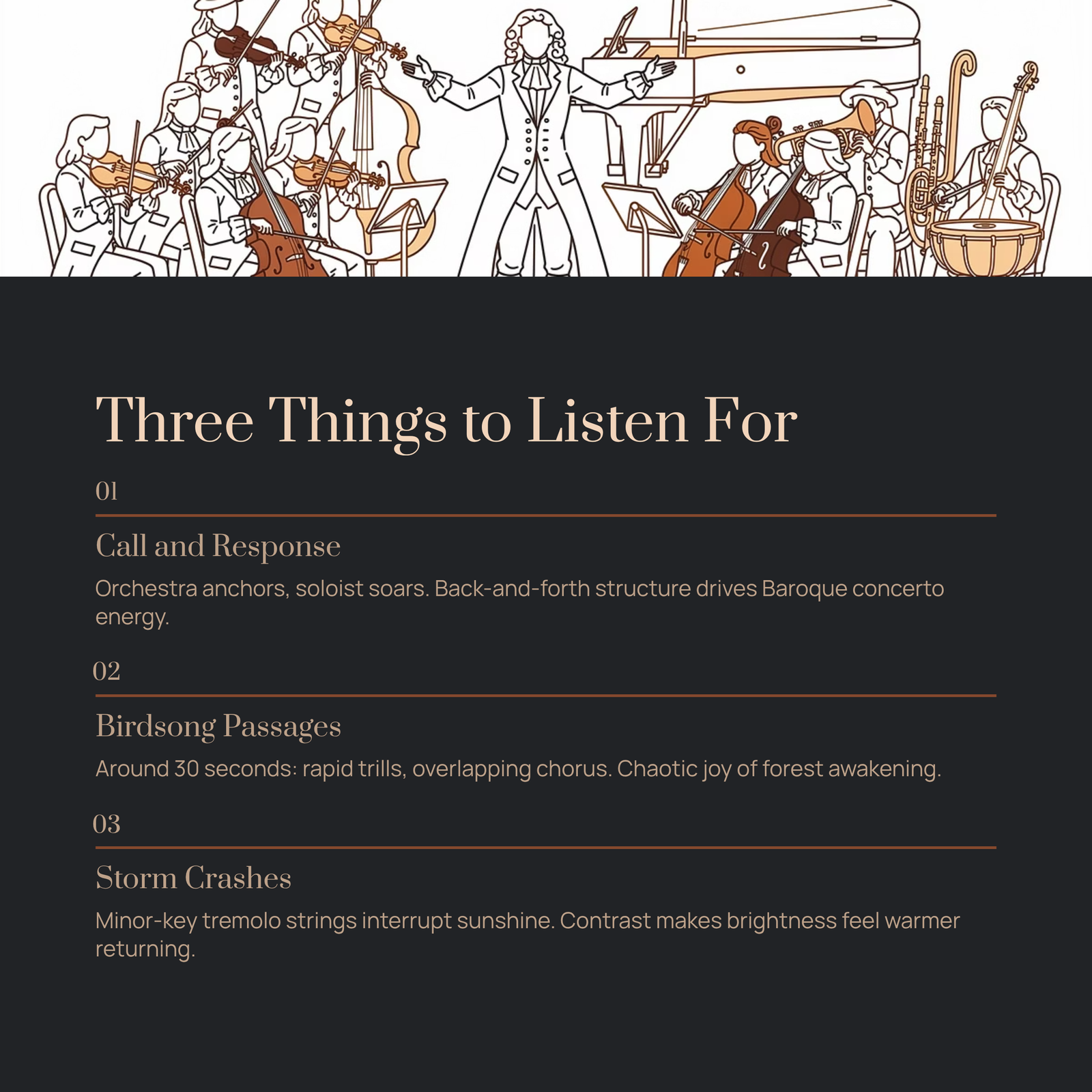
Three Things to Listen For (Even If You’re a Complete Beginner)
The “call and response” between orchestra and soloist. The full ensemble plays the main Spring theme, then steps back to let the solo violin take flight. This back-and-forth structure is the engine of a Baroque concerto, and Vivaldi does it with extraordinary energy here. Pay attention to how the orchestra anchors each section while the soloist is free to soar, improvise, and explore.
The birdsong passages. Around the 30-second mark in most recordings, you’ll hear the solo violin break into rapid trills and ornamental figures. Two or three violins often join in, creating an overlapping chorus. Close your eyes and you can almost see the branches shaking with movement. Vivaldi doesn’t imitate birds literally — he captures the feeling of birdsong, that chaotic, overlapping joy of a forest waking up.
The storm that crashes the party. Just when everything feels sunny and pastoral, Vivaldi drops in a brief but intense passage of minor-key tremolo strings. It’s the thunderstorm from the sonnet — sudden, dramatic, almost violent. And then, just as quickly, the main theme returns in all its brightness. It’s a masterclass in contrast: the storm makes the sunshine feel even warmer when it comes back.
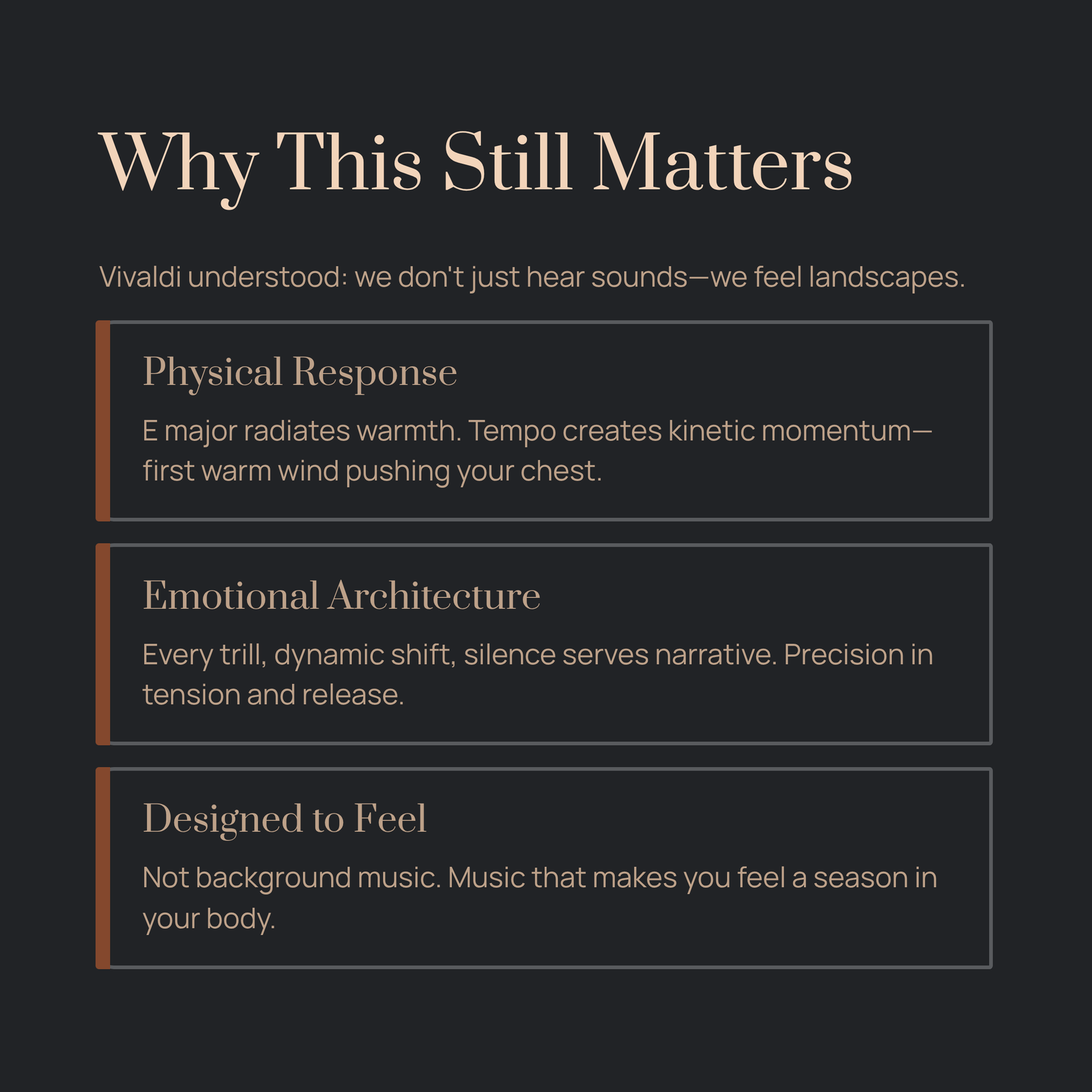
Why This Three-Minute Piece Still Matters
There’s a reason Spring has survived three centuries of overexposure and still has the power to stop you mid-step.
It’s because Vivaldi understood something fundamental about how humans experience music: we don’t just hear sounds — we feel landscapes. When those opening chords hit, something in your nervous system responds before your brain has time to analyze it. The tempo is brisk but not frantic. The key of E major radiates warmth. The rhythmic drive creates momentum that feels physical, almost kinetic, like the first warm wind of the year pushing against your chest.
This isn’t background music. This is music that was designed to make you feel a season in your body.
And the genius of it — the part that gets lost in all the familiarity — is how tightly composed it actually is. Every trill, every dynamic shift, every moment of silence serves the narrative. Vivaldi wasn’t just a melodist; he was an architect of emotional experience, building tension and release with the precision of someone who understood exactly how long a listener could hold their breath.
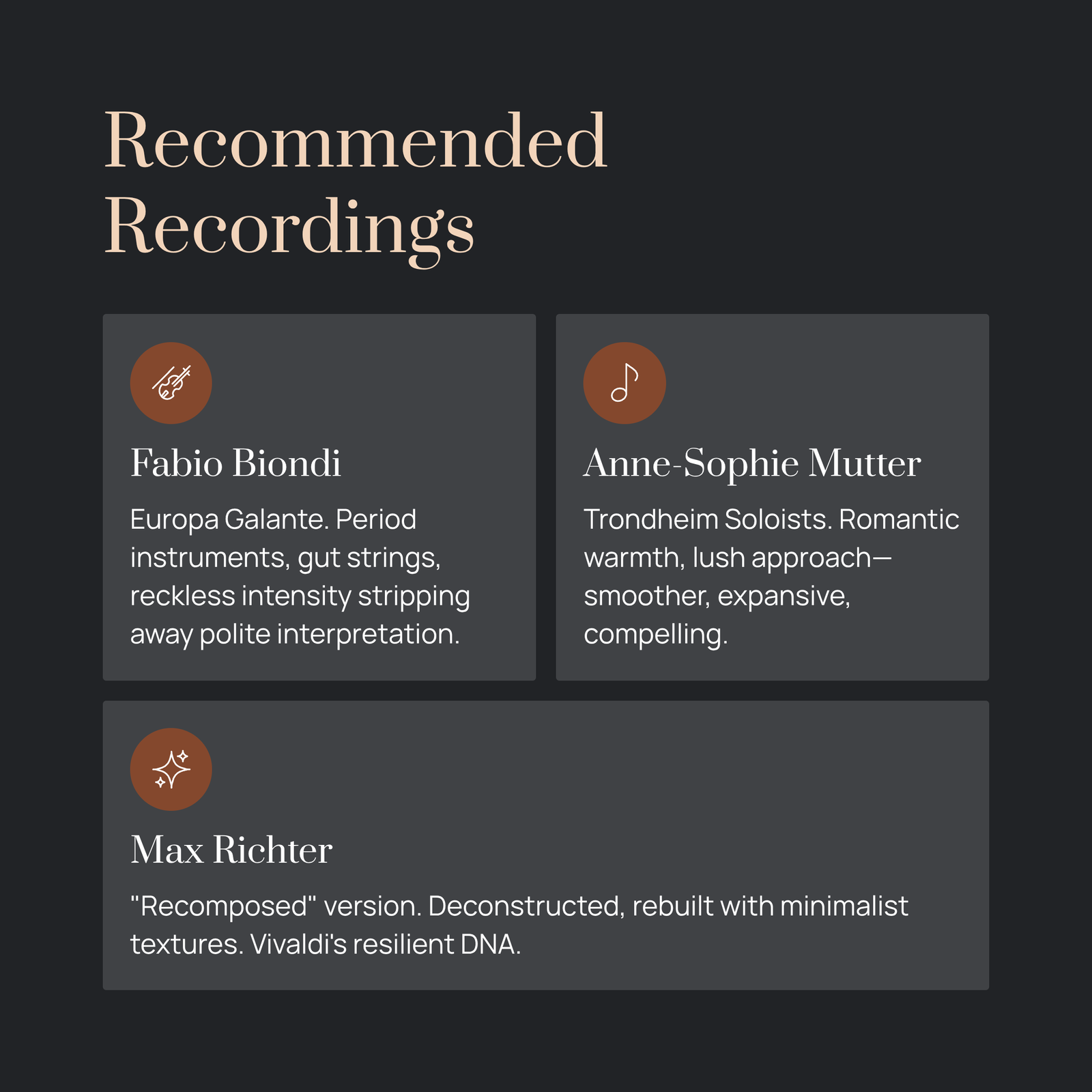
Recommended Recordings to Start With
If you want to hear Spring the way it was meant to hit — with period instruments, gut strings, and the raw energy of historically informed performance — try Fabio Biondi with Europa Galante. Their recording crackles with an almost reckless intensity that strips away centuries of polite interpretation.
For a more modern, lush approach, Anne-Sophie Mutter’s recording with the Trondheim Soloists brings a Romantic warmth to the Baroque framework. It’s a different animal entirely — smoother, more expansive — but no less compelling.
And if you want something truly radical, seek out Max Richter’s “Recomposed” version. Richter deconstructed Vivaldi’s Four Seasons and rebuilt them with minimalist textures and electronic elements. It’s not a replacement for the original, but listening to both back-to-back is a fascinating exercise in understanding what makes Vivaldi’s DNA so resilient.
Let It Be New Again
The greatest gift you can give yourself with this piece is permission to forget everything you think you know about it. Forget the hold music. Forget the commercial breaks. Put on a good pair of headphones, press play, and give Vivaldi three minutes and forty seconds of your honest, undivided attention.
You might be surprised by what happens. Because behind all that familiarity, there’s a red-haired priest in Venice who figured out how to bottle the feeling of a season — and three hundred years later, the bottle hasn’t lost a drop.