📑 Table of Contents
- Who Is Masakatsu Takagi? A Composer Who Listens to the Wind
- The Story Behind the Song: A Director’s Love Letter to Mothers
- Listening to Okaasan no Uta: Where Silence Says Everything
- Why This Song Breaks Us — And Why It Should
- How to Listen: Three Ways to Experience This Song
- Recommended Recording
- Final Thoughts: The Melody That Mothers Hum When No One Is Listening
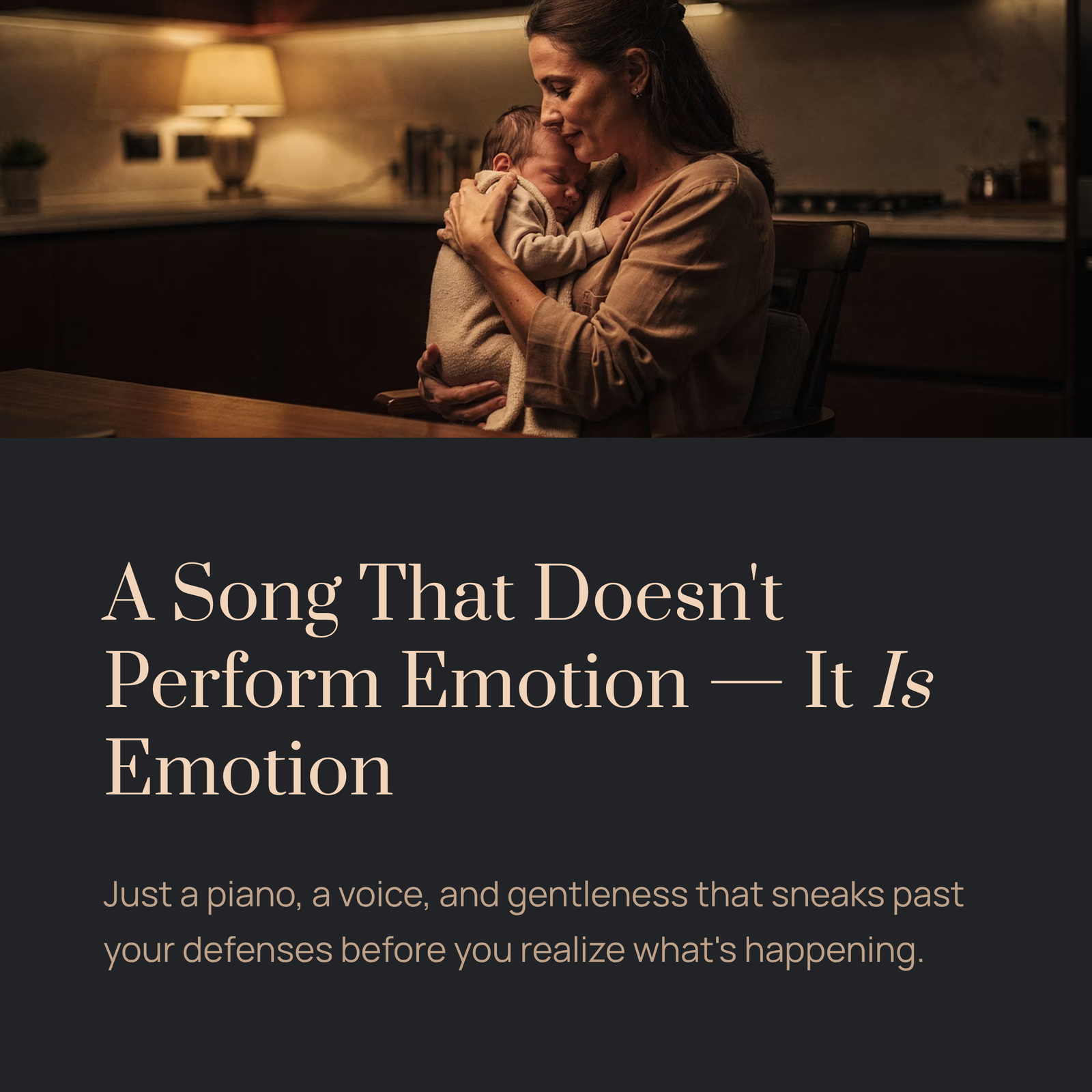
There are songs that announce their sadness. They swell with strings, crash with percussion, and practically beg for your tears. And then there is Okaasan no Uta. It arrives quietly — just a piano, a voice, and the kind of gentleness that sneaks past your defenses before you even realize what’s happening.
By the time the melody settles in your chest, you’re not just listening to a song anymore. You’re sitting in Hana’s kitchen, watching her catch a falling drawer with one hand while holding a half-wolf baby in the other. You’re standing beside her in a countryside field she has no idea how to farm. You’re watching her smile at her children when everything inside her must be breaking.
This is what Okaasan no Uta does. It doesn’t perform emotion. It is emotion — the kind that mothers carry so quietly that the world almost forgets to notice.
Who Is Masakatsu Takagi? A Composer Who Listens to the Wind
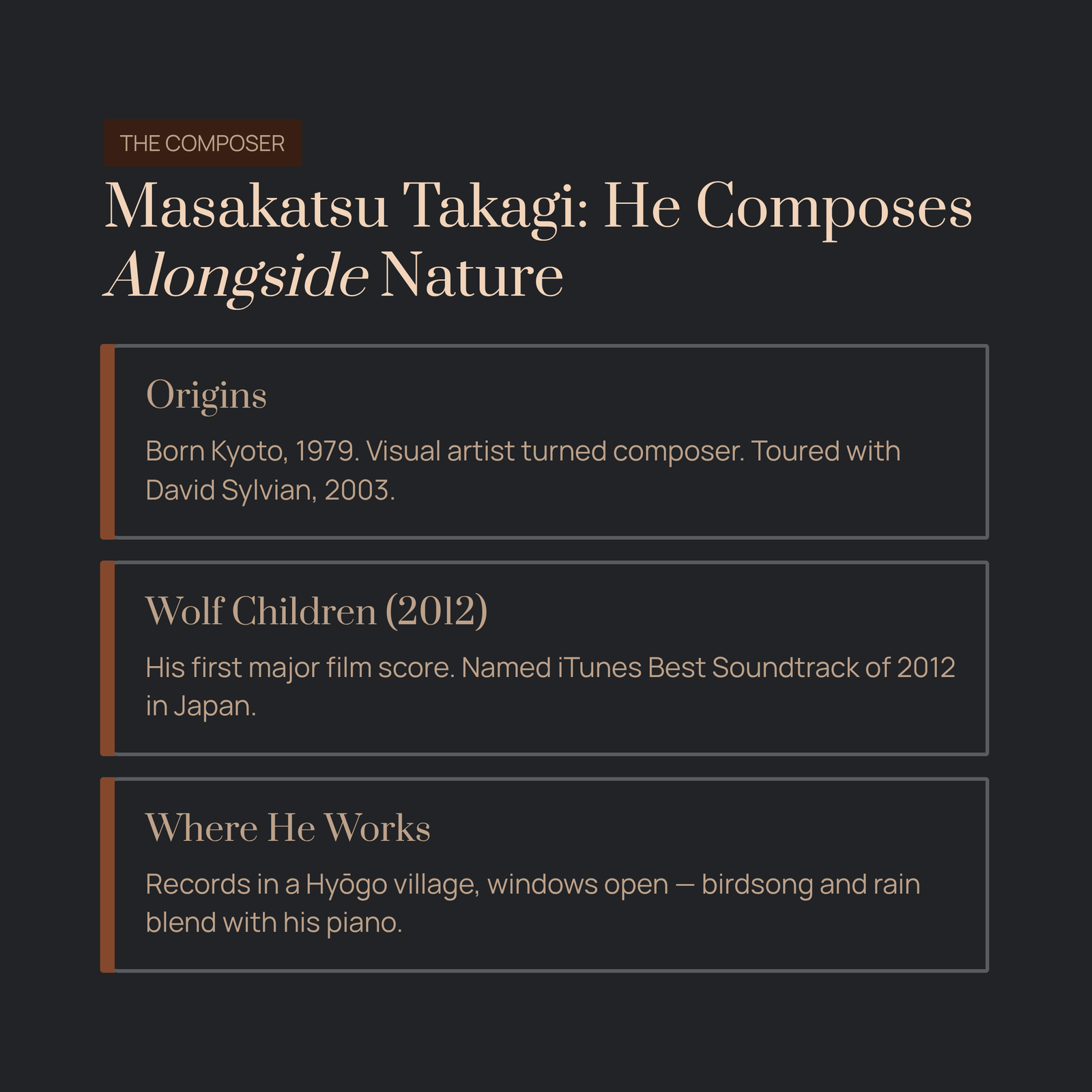
Masakatsu Takagi is not the kind of composer who chases fame. Born in Kyoto in 1979, he started as a visual artist, creating videos accompanied by his own piano playing. His early work lived in the experimental space — glitchy, collage-like ambient soundscapes that caught the attention of artists like David Sylvian, with whom he toured in 2003.
But Takagi’s artistic life took a pivotal turn when director Mamoru Hosoda invited him to score Wolf Children in 2012. It was Takagi’s first major film score, and it became something extraordinary — the soundtrack was named iTunes Best Soundtrack of 2012 in Japan. The collaboration continued with The Boy and the Beast (2015) and Mirai (2018), establishing Takagi as one of the most emotionally intuitive film composers working today.
What makes Takagi remarkable is where he creates. In 2013, he moved to a small village in Hyōgo Prefecture, where he now lives with his wife and children. His later work, particularly the Marginalia series, is recorded with his studio windows open — capturing birdsong, rainfall, and the ambient sounds of the Japanese countryside blending with his piano. He doesn’t just compose music. He composes alongside nature.
That sensibility — that patient attention to what’s quiet and easily overlooked — is exactly what makes Okaasan no Uta so devastating.
The Story Behind the Song: A Director’s Love Letter to Mothers
To understand Okaasan no Uta, you need to understand Wolf Children.
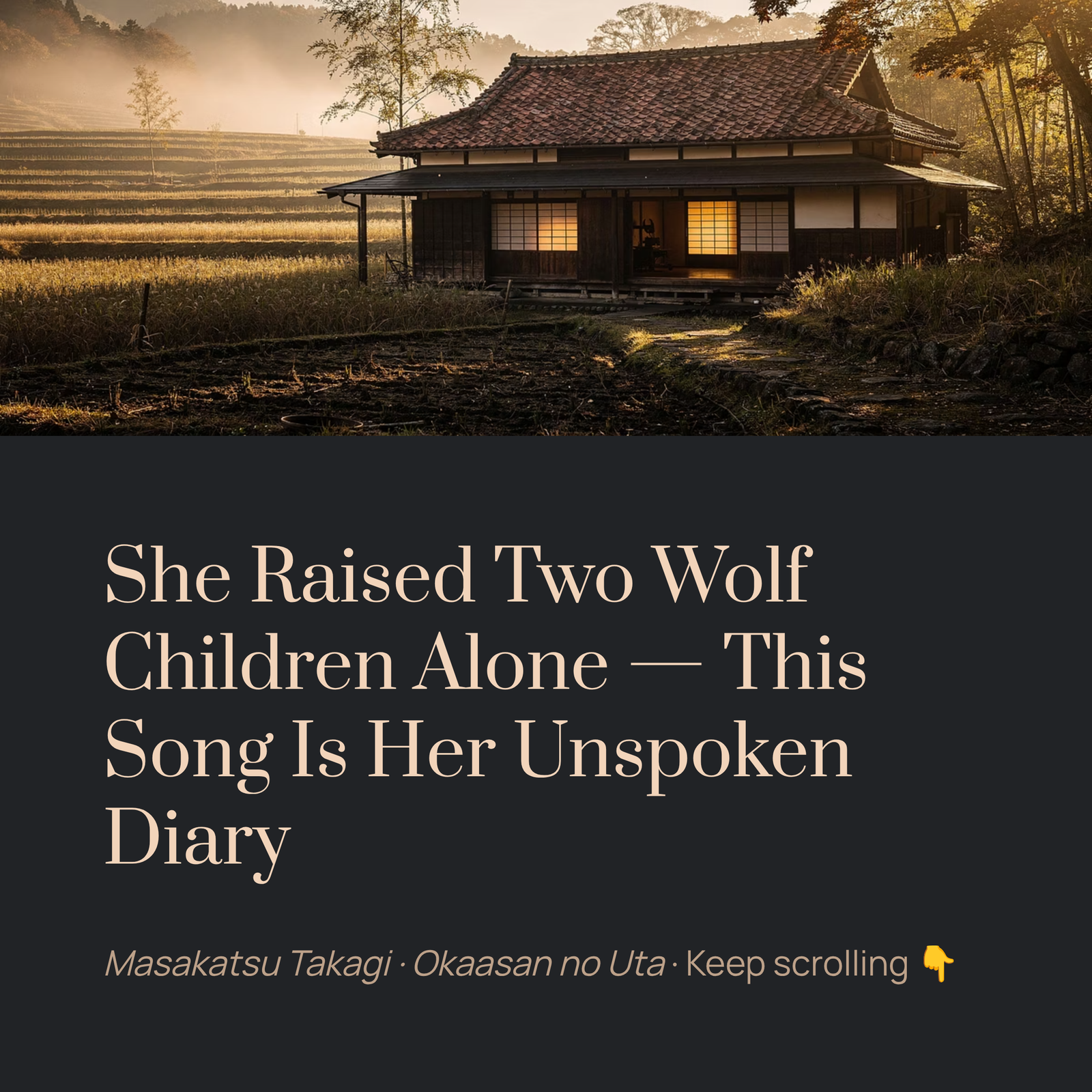
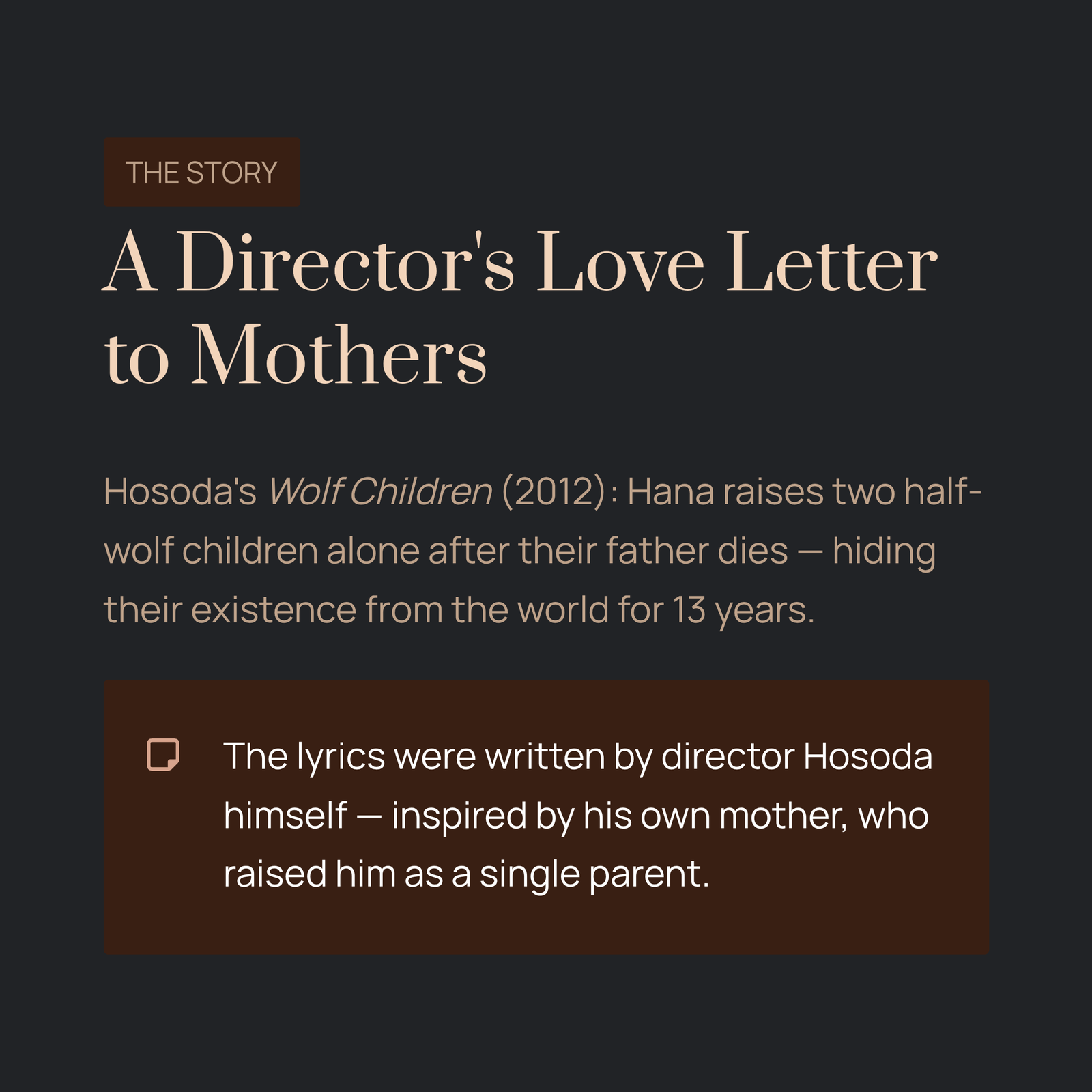
Mamoru Hosoda’s 2012 animated film tells the story of Hana, a young college student who falls in love with a man who is secretly a werewolf. They have two children — energetic, bold Yuki, and gentle, reserved Ame — who inherit their father’s ability to shift between human and wolf forms. When their father dies suddenly, Hana is left completely alone to raise two children whose very existence she must hide from the world.
The film follows thirteen years of Hana’s life as she moves from a cramped Tokyo apartment to a dilapidated farmhouse in the countryside. She teaches herself carpentry, farming, and resilience — not because she’s some mythic supermother, but because she has no other choice. She does it all with a smile that is both her greatest strength and her most heartbreaking mask.
Here is the crucial detail: the lyrics of Okaasan no Uta were written by Hosoda himself. Not a professional lyricist. The director. The man who, in interviews, admitted he was inspired by watching people around him becoming parents, and by his own mother, who raised him as a single parent. These lyrics are not crafted poetry. They are the raw, almost diary-like thoughts of a mother talking to her children — from before they were born, through their first steps, through the moment they inevitably walk away.
Listening to Okaasan no Uta: Where Silence Says Everything
The arrangement is deliberately sparse. A piano plays a simple, circular melody — the kind of tune you might hum while washing dishes or folding laundry at midnight. Then Ann Sally’s voice enters, warm and unhurried, as if she’s singing not to an audience but to someone sleeping in the next room.
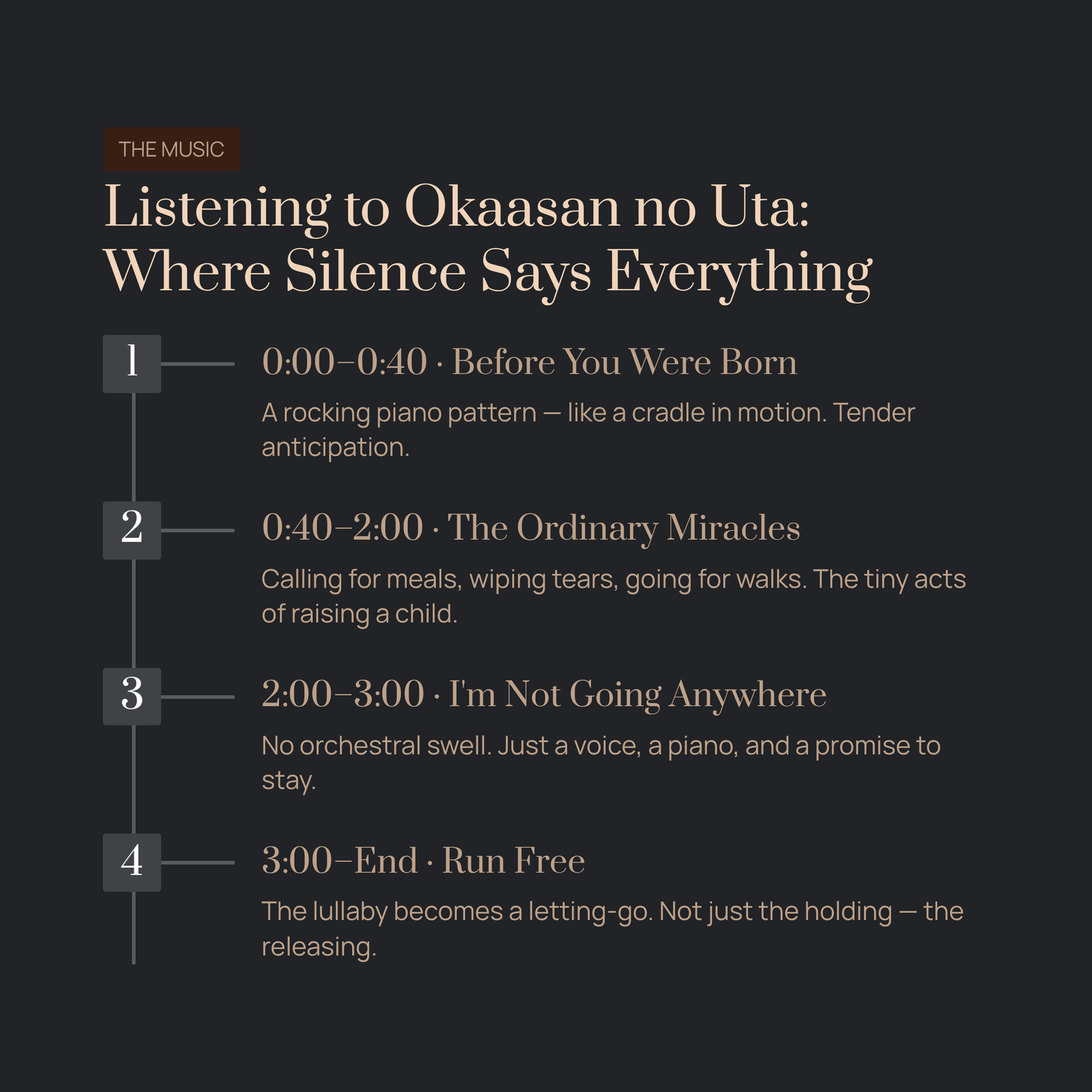
The Opening (0:00–0:40): Before You Were Born
The song begins with a mother’s whispered anticipation. The piano introduces a gentle, rocking pattern — almost like a cradle in motion. Even before you understand the Japanese lyrics, the melody tells you something tender and fragile is happening. This is the sound of someone rubbing her belly, wondering what face her child will have, what voice they’ll speak with.
The Middle Passage (0:40–2:00): The Ordinary Miracles
As the song progresses, the vocal melody opens up slightly, as though the mother’s world is expanding with each new experience of parenthood. There are phrases that translate roughly to calling out for meals, inviting a child on a walk, wiping away tears. None of these are grand gestures. They are the tiny, repetitive acts that constitute the actual substance of raising a child. The piano never overwhelms the voice. It supports it the way a mother supports a child learning to walk — present, steady, ready to catch.
The Emotional Core (2:00–3:00): I’m Not Going Anywhere
Here the song reaches its emotional center without ever raising its volume. The melody carries lines about reassurance — promising to stay, promising not to leave, promising to listen to everything. If you’re a parent, these words will hit like a physical sensation. If you’re someone who was raised by a single parent, they might stop you entirely. The simplicity is the point. There’s no dramatic key change, no orchestral swell. Just a voice, a piano, and a promise.
The Release (3:00–End): Run Free
The final section shifts into something more open and airy. Hummed passages, gentle nonsense syllables, and a melody that seems to release its grip. This is the mother watching her children run into the snow, count the clouds, play in the rain. The lullaby becomes a letting-go. And that, in the end, is what the song is really about — not just the holding, but the releasing. Not just the love, but the courage it takes to let that love run wild.

Why This Song Breaks Us — And Why It Should
There is a reason Okaasan no Uta reduces grown adults to tears, even those who’ve never seen Wolf Children. It captures something that most art about motherhood gets wrong.
Most portrayals of motherhood lean toward one of two extremes: saintly sacrifice or comedic chaos. Okaasan no Uta does neither. It simply sits inside the daily texture of caring for someone more than you care for yourself — the feeding, the singing, the comforting at 3 AM, the letting go at 18 — and treats each of these moments as worthy of a melody.
Takagi understood something essential when he composed this piece. The most powerful music isn’t always the loudest or the most complex. Sometimes it’s the music that sounds like what love would sound like if love had a frequency — steady, warm, and so constant you almost forget it’s there until it stops.
In the context of the film, the song plays during the closing credits, after we’ve watched Hana’s entire journey. By that point, the audience has no defenses left. The piano enters, Ann Sally begins to sing, and the cumulative weight of thirteen years of quiet heroism comes pouring out. It’s not the song that makes you cry. It’s everything the song reminds you of.
How to Listen: Three Ways to Experience This Song
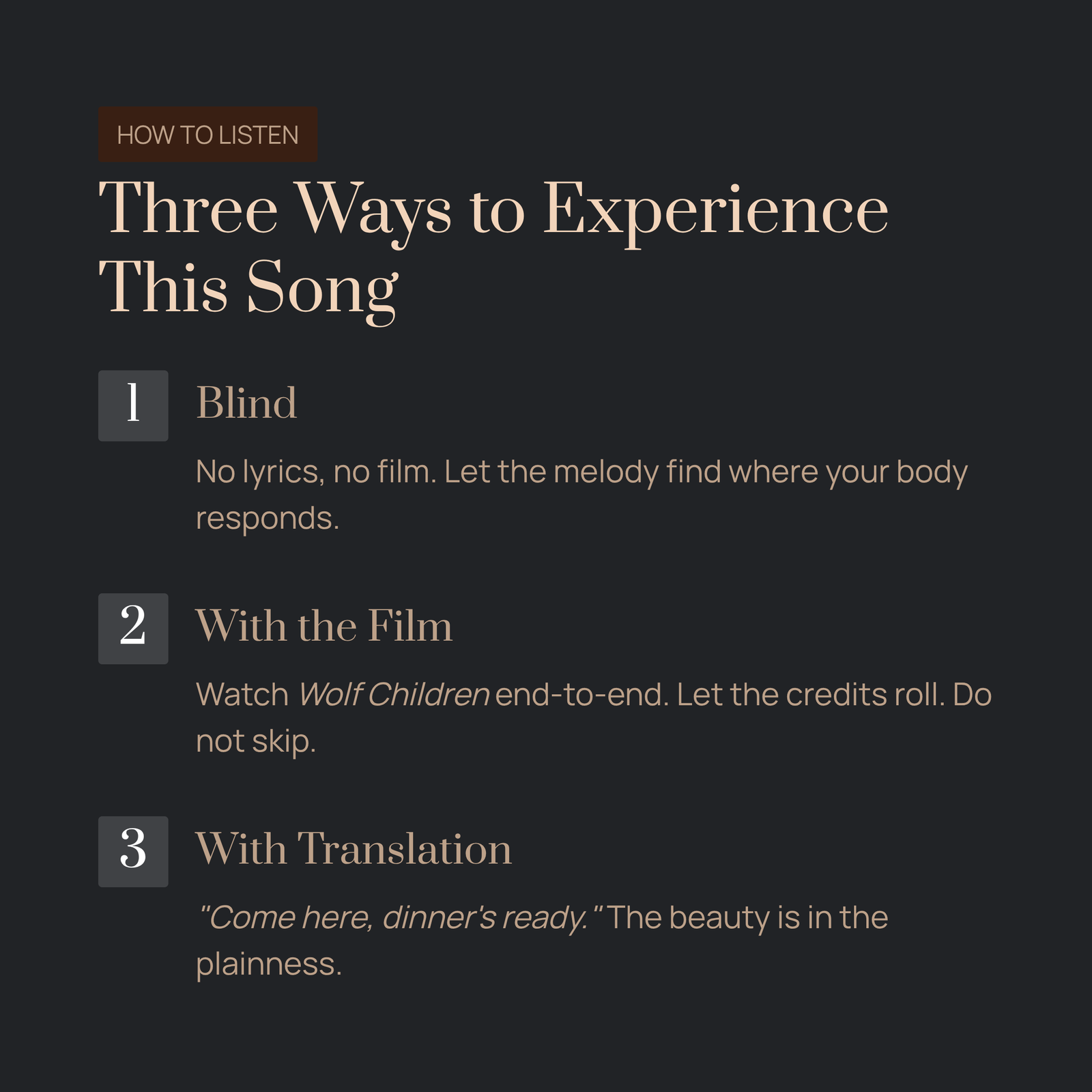
First Listen — Blind: Play Okaasan no Uta without watching the film. Don’t look up the lyrics. Just let the melody and Ann Sally’s voice wash over you. Pay attention to where your body responds — the tightness in your throat, the warmth in your chest. This is the song working on its most instinctive, human level.
Second Listen — With the Film: Watch Wolf Children from beginning to end, then let the credits roll. Do not skip ahead. Let the song arrive the way Hosoda intended — as the emotional epilogue to a story you’ve just lived through. This is the listen that will undo you.
Third Listen — With Translation: Find the translated lyrics and follow along. Notice how the words are not poetic in any conventional sense. They’re the actual, mundane sentences of motherhood: Come here, dinner’s ready. Come on, let’s go for a walk. It’s okay, I’m not going anywhere. The beauty is in their plainness. These aren’t words composed for a song. They’re words that were always a song, even before Takagi gave them a melody.
Recommended Recording
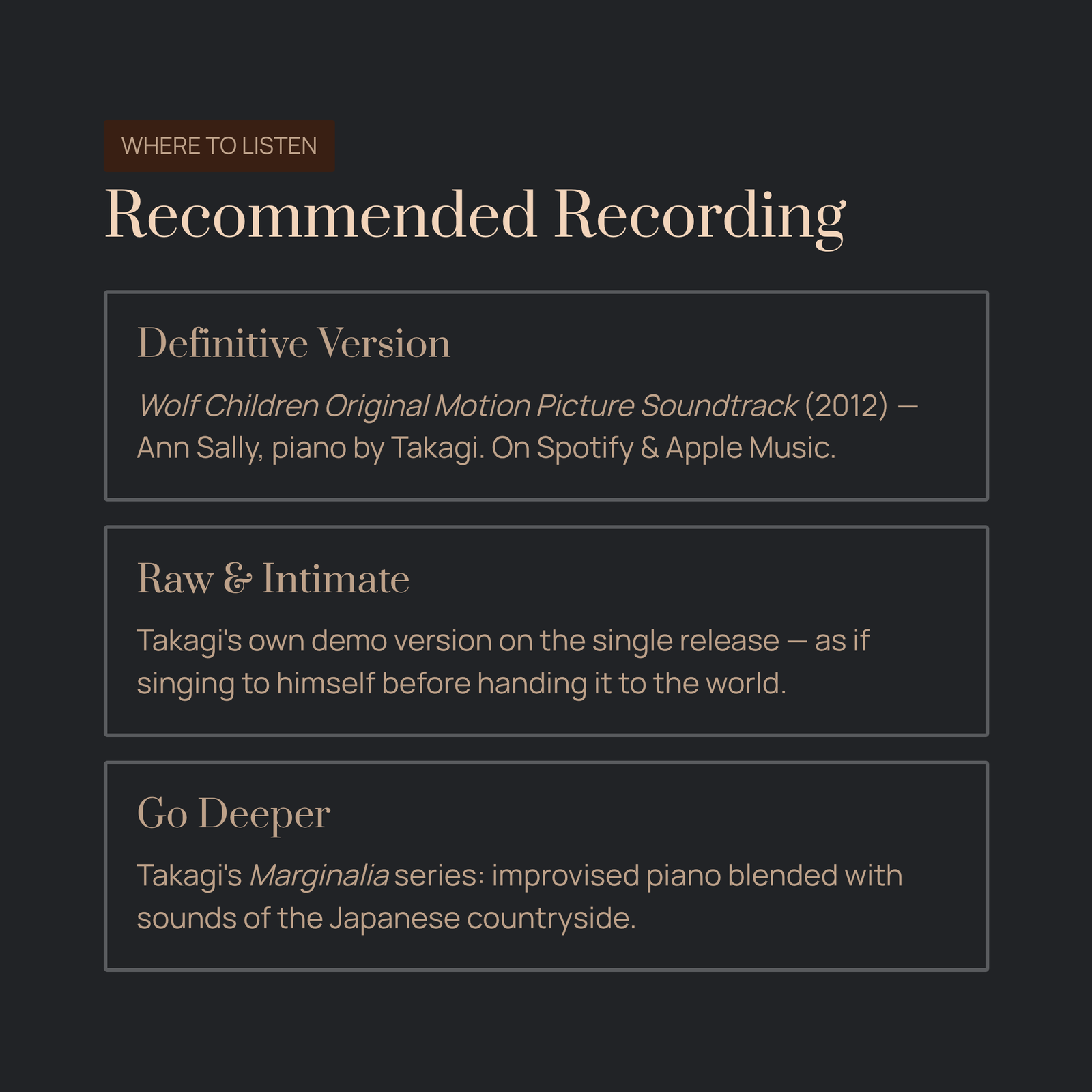
The definitive version is the one from the Wolf Children Original Motion Picture Soundtrack (2012), performed by Ann Sally with piano by Masakatsu Takagi. The album is available on Spotify, Apple Music, and most streaming platforms. The demo version performed by Takagi himself also exists on the single release and offers a rawer, more intimate perspective — as if the composer is singing the song to himself before handing it to the world.
For those who want to explore deeper, Takagi’s Marginalia series offers a window into his creative process — improvised piano pieces recorded in his countryside home, blending music with the sounds of the natural world around him.
Final Thoughts: The Melody That Mothers Hum When No One Is Listening
We live in a culture that celebrates loud achievements. We give awards for the biggest, the fastest, the most visible. But Okaasan no Uta is a reminder that some of the most extraordinary things that happen in this world happen in kitchens, in hallways, in the space between a mother’s arms.
Masakatsu Takagi did not write a grand orchestral tribute to motherhood. He wrote something far harder to compose — a song that sounds exactly like what it feels like to love someone so much that you learn to let them go. The piano keeps its gentle rhythm. Ann Sally keeps singing. And somewhere, in a countryside house with the windows open, a mother hums along without knowing she’s heard it before.
She has. She’s been humming it all her life.