📑 Table of Contents
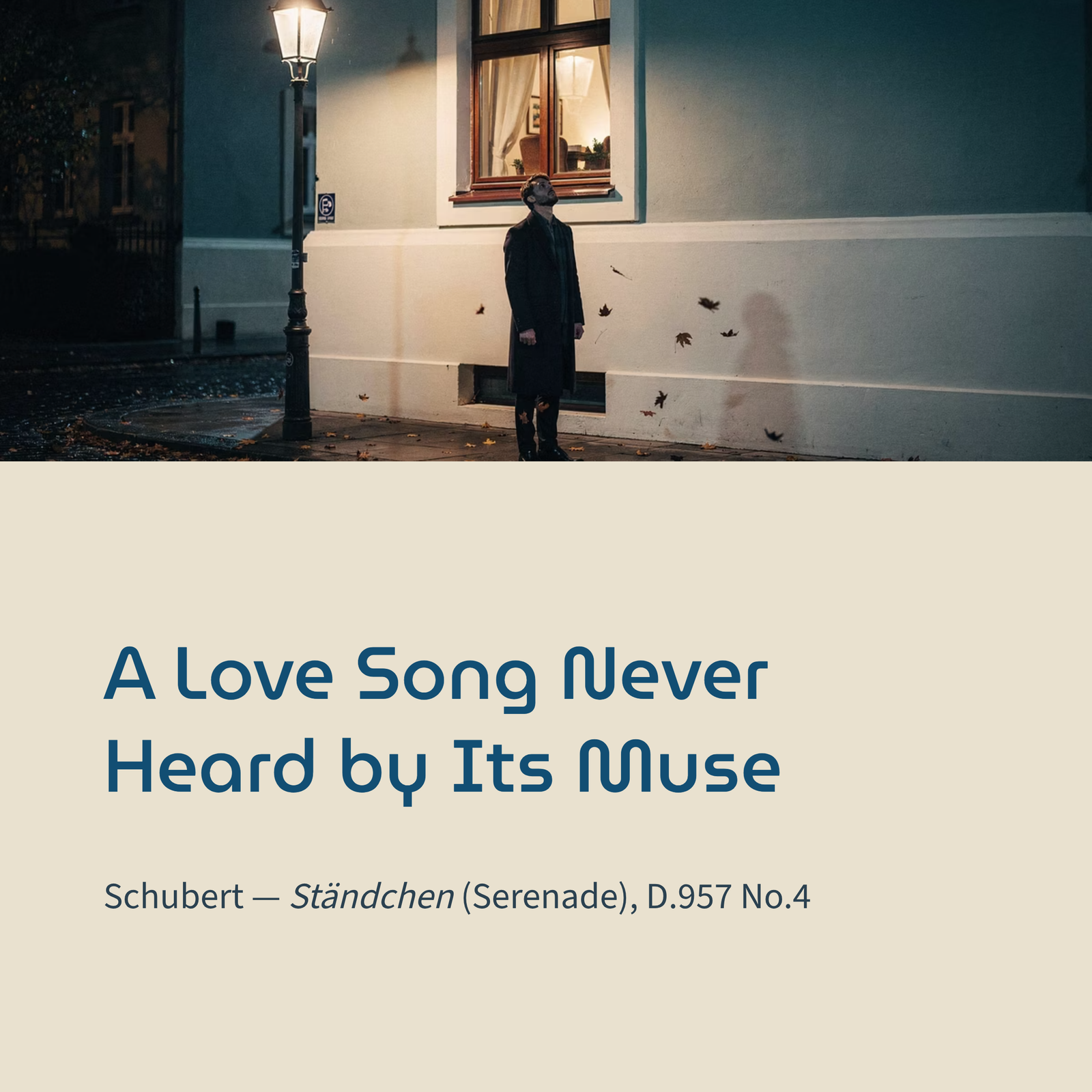
Imagine standing beneath someone’s window on a cool autumn evening. The streetlamps flicker. You’ve rehearsed what you want to say a hundred times, but the words dissolve the moment you open your mouth. So instead, you sing — quietly, almost to yourself — hoping the melody will carry what language cannot.
That is exactly the world Franz Schubert pulls you into with his Ständchen (Serenade), the fourth piece in his posthumous collection Schwanengesang, D.957. It is, without exaggeration, one of the most achingly tender melodies ever written. And the person it was meant for likely never heard it performed in Schubert’s lifetime.
The Quiet Tragedy Behind the Music
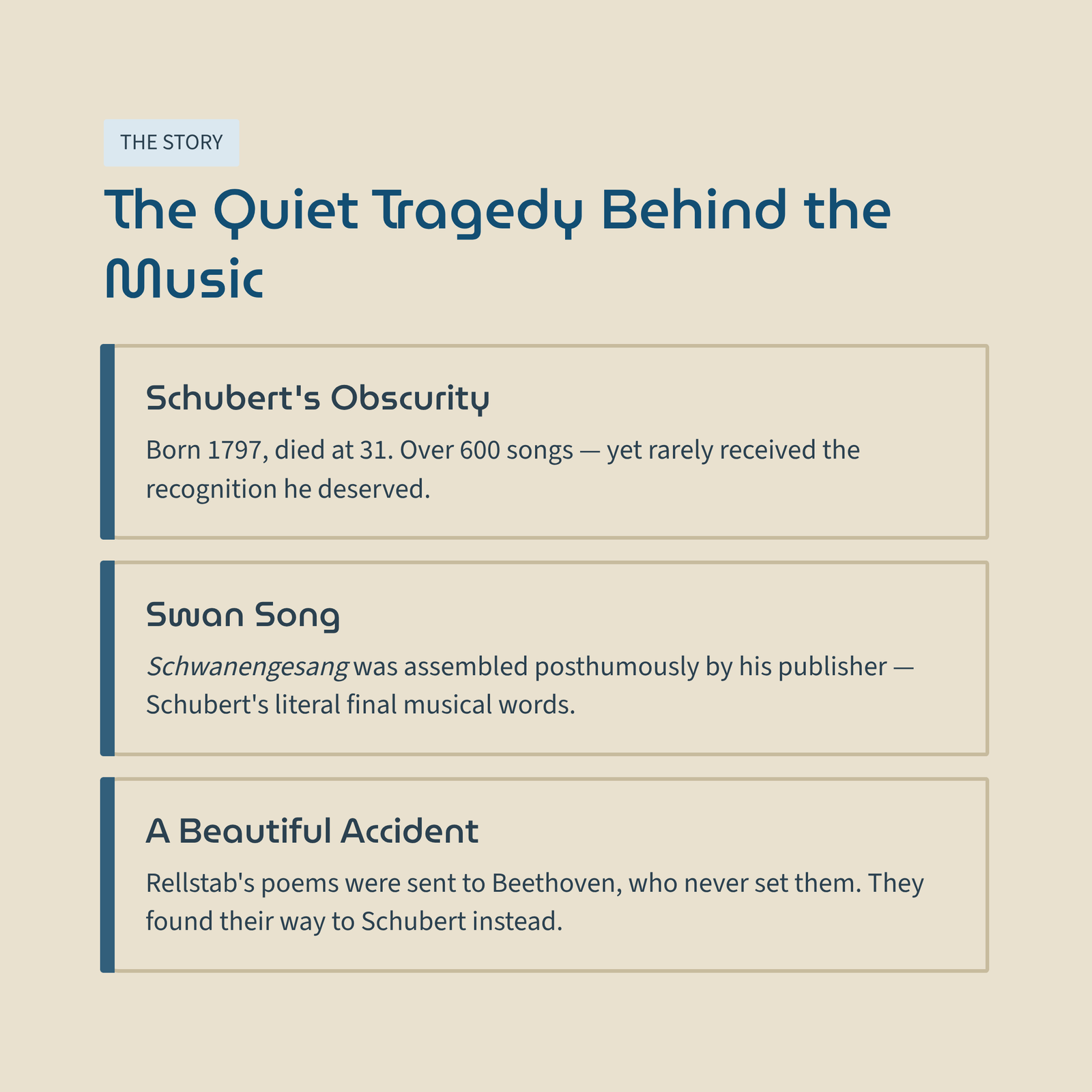
Franz Schubert was not a man who lived loudly. Born in Vienna in 1797, he spent most of his 31 years in relative obscurity — composing at a pace that bordered on compulsive, yet rarely receiving the public recognition he deserved. While Beethoven filled concert halls, Schubert filled notebooks. Over 600 songs, nine symphonies, chamber works, piano sonatas — an almost incomprehensible output for someone who died so young.
Schwanengesang (“Swan Song”) was never intended as a unified song cycle. It was assembled by his publisher Tobias Haslinger after Schubert’s death in November 1828, gathering together the last songs the composer had written. The title was a marketing decision, but an eerily fitting one. These were, quite literally, Schubert’s final musical words.
Ständchen sets a poem by Ludwig Rellstab, a Berlin critic and poet who had actually sent his verses to Beethoven, hoping the great master might set them to music. Beethoven never did. After his death, the poems somehow found their way to Schubert — a beautiful accident of history. Rellstab’s words describe a lover serenading beneath a window, begging the beloved to come down into the night, where the nightingales are singing and the moonlight trembles on the water.
What Makes This Melody So Unforgettable
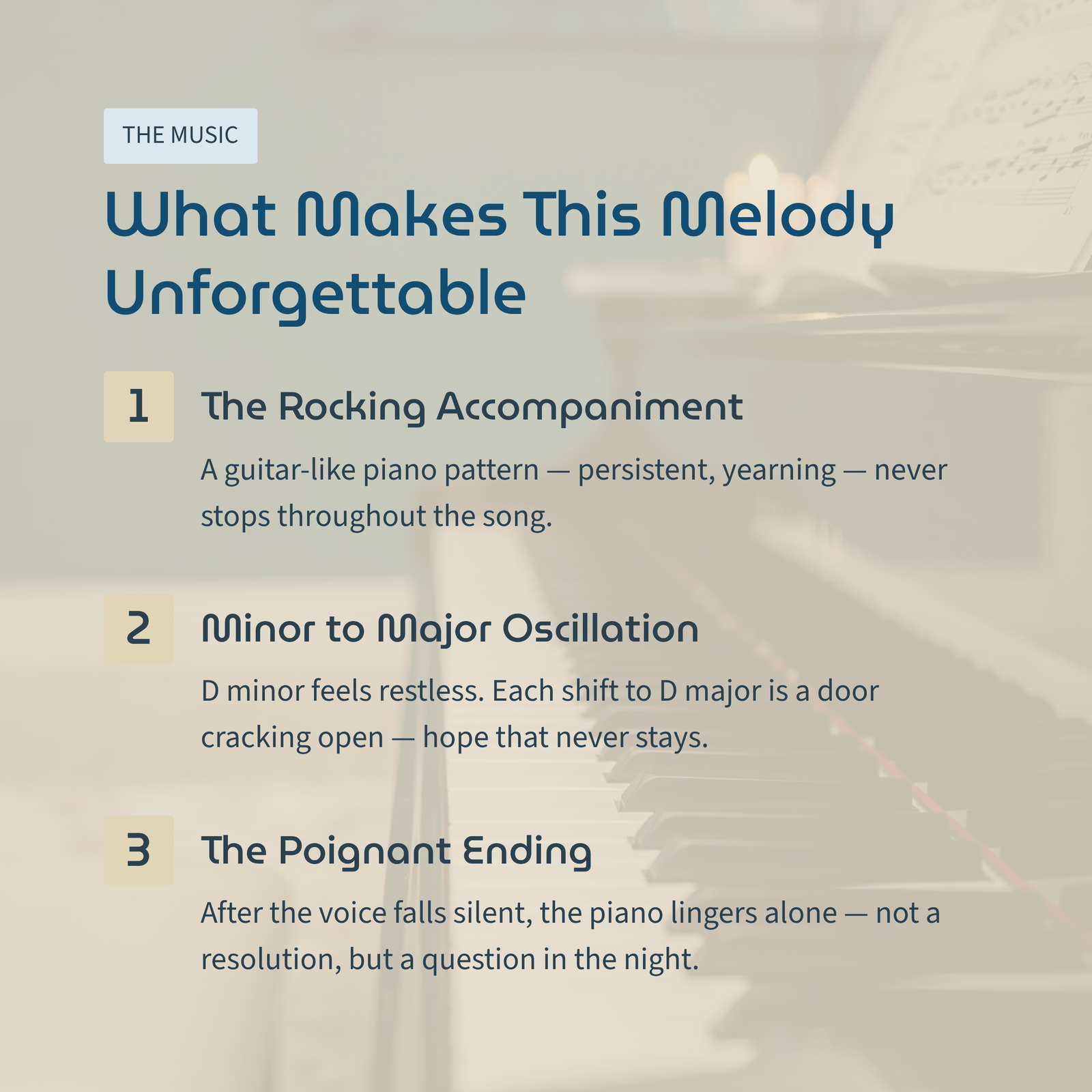
From the very first measure, Ständchen establishes a gentle rocking motion in the piano — a pattern that feels like a guitar being softly strummed in the dark. This accompaniment never stops throughout the song. It creates a sense of persistent yearning, as though the singer simply cannot bring himself to stop pleading.
The melody enters almost hesitantly, beginning in D minor — a key that feels unsettled, restless, slightly shadowed. Pay close attention to how Schubert handles the shift from minor to major. Each time the music brightens into D major, it is as if a door cracks open, letting in a sliver of hope. But it never stays. The major key dissolves back into minor like a smile fading from someone’s face. This constant oscillation between hope and sorrow is the emotional engine of the entire piece.
There is a particular moment — roughly halfway through — where the vocal line rises with sudden intensity, almost desperate. The singer is no longer whispering. He is reaching. And then, just as quickly, the music pulls back to its quiet, trembling plea. If you listen for this dynamic arc, you will feel the architecture of longing Schubert built into every phrase.
Another detail worth noticing: the piano’s final measures after the voice falls silent. The accompaniment continues alone for a few bars, as though the singer has walked away but the echo of his song still lingers in the air. It is one of the most poignant endings in all of art song — not a resolution, but a question left hanging in the night.
How to Listen: Three Doorways Into the Music
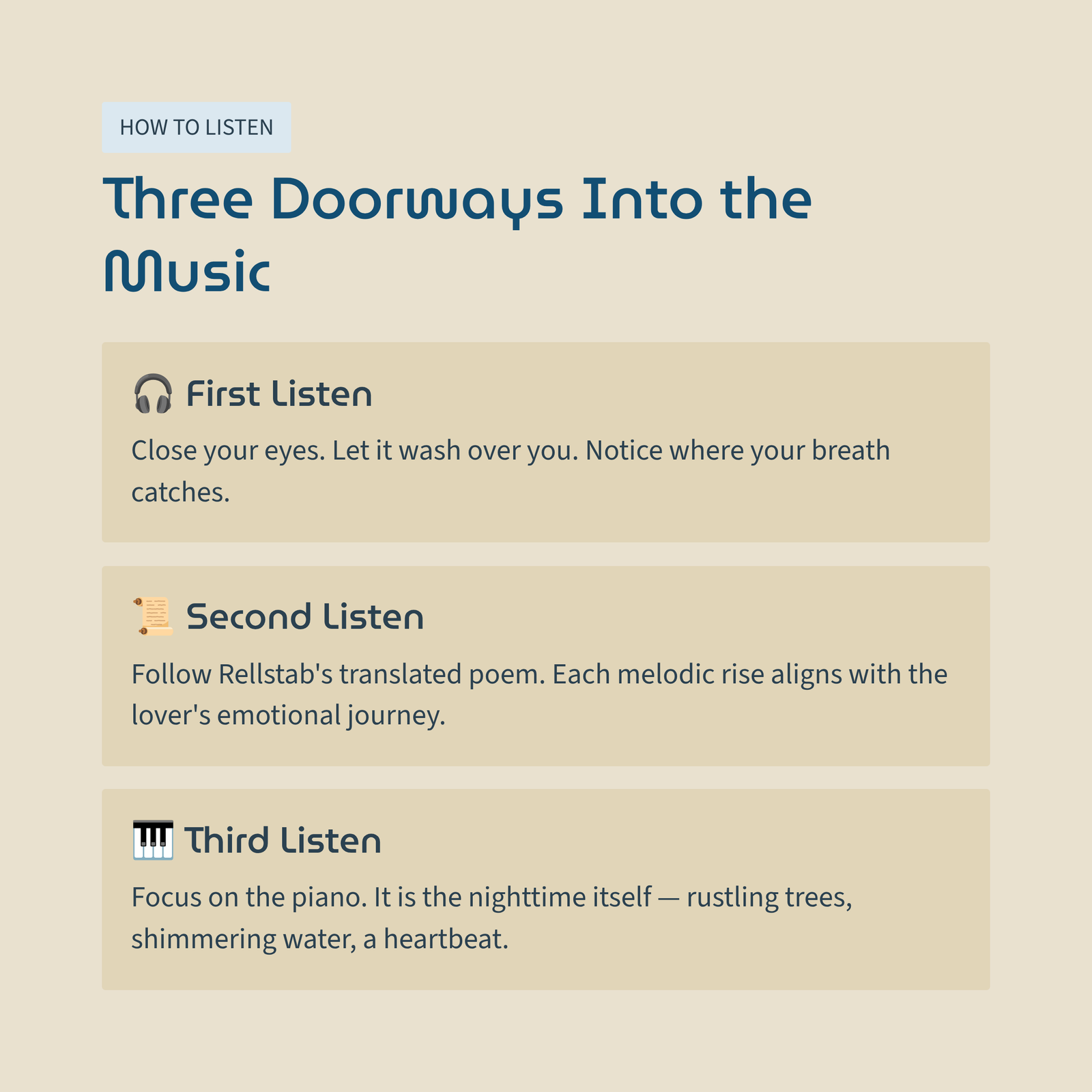
First listen — just let it wash over you. Don’t analyze. Don’t read the text. Simply close your eyes and follow the melody. Notice where your breath catches. Notice where the music makes you feel something shift in your chest. That instinctive response is exactly what Schubert was writing toward.
Second listen — follow the words. Look up a translation of Rellstab’s poem alongside the music. Suddenly, each melodic rise and fall will align with the lover’s emotional journey — from gentle invitation to urgent pleading, and finally to a resigned, open-ended tenderness.
Third listen — focus on the piano. The accompaniment is not mere background. It is the nighttime itself: the rustling trees, the shimmering water, the heartbeat of someone standing alone in the dark. Once you hear the piano as a character rather than a backdrop, the piece opens up in an entirely new dimension.
Recordings Worth Your Time
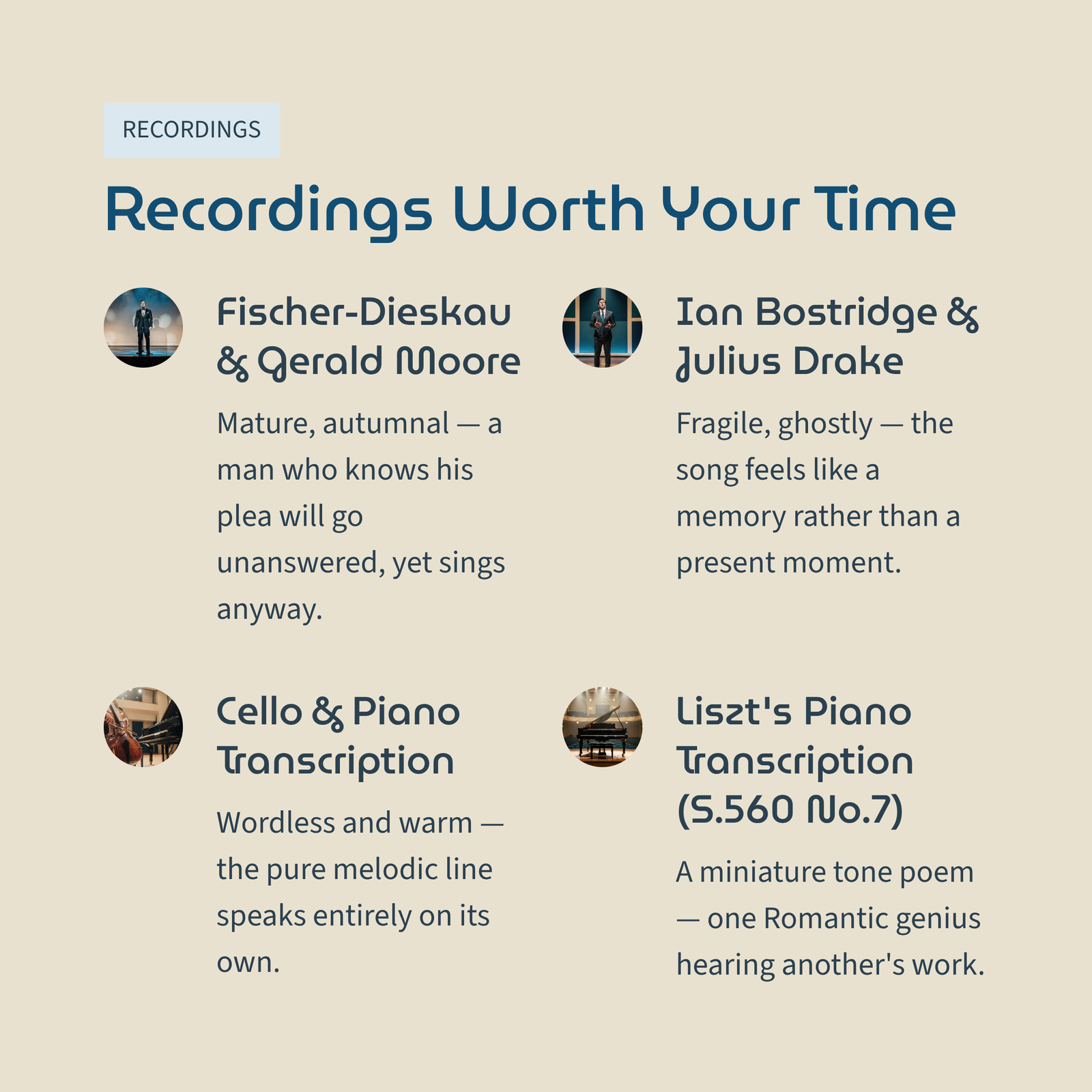
For a classic, definitive interpretation, seek out Dietrich Fischer-Dieskau with pianist Gerald Moore. Fischer-Dieskau’s baritone brings a mature, autumnal quality to the serenade — you hear a man who understands that this plea will likely go unanswered, yet sings it anyway.
For a more intimate, almost whispered reading, try Ian Bostridge with Julius Drake. Bostridge’s tenor carries a fragile, ghostly quality that makes the song feel like a memory rather than a moment happening in real time.
If you prefer an instrumental arrangement, the transcription for cello and piano (often attributed to various arrangers) is stunning. The cello’s voice, warm and wordless, strips the song of its text and lets the pure melodic line speak on its own.
And for something unexpected, look for Liszt’s solo piano transcription (S.560 No.7). Liszt, who adored Schubert’s music, turned Ständchen into a miniature tone poem for piano alone. It is a fascinating window into how one Romantic genius heard another’s work.
Why This Piece Still Matters, Two Centuries Later
There is something almost uncomfortably honest about Ständchen. It does not try to impress you with virtuosity or structural complexity. It simply stands beneath your window and sings. And in that simplicity lies its power.
We live in an age of constant noise — notifications, algorithms, content engineered to grab our attention for three seconds before we scroll past. Schubert’s serenade asks for something different. It asks you to slow down. To sit with an emotion that has no resolution. To let a melody written by a dying man in 1828 reach across two centuries and remind you what it feels like to want something you cannot have — and to find beauty in the wanting itself.
Schubert never became famous in his lifetime. He never heard most of his greatest works performed for a proper audience. In a very real sense, his entire creative life was a serenade sung beneath a window that never opened. And yet here we are, still listening. Still moved. Still reaching back through time toward that quiet, trembling voice in the dark.
Perhaps that is the deepest truth Ständchen teaches us: the most powerful music is not the kind that demands to be heard. It is the kind that cannot help but be sung.