📑 Table of Contents
There are pieces in classical music that ask for your patience. They build slowly, unfold in whispers, and reveal themselves over long, quiet stretches of time. Mozart’s Overture to The Marriage of Figaro is not one of those pieces.
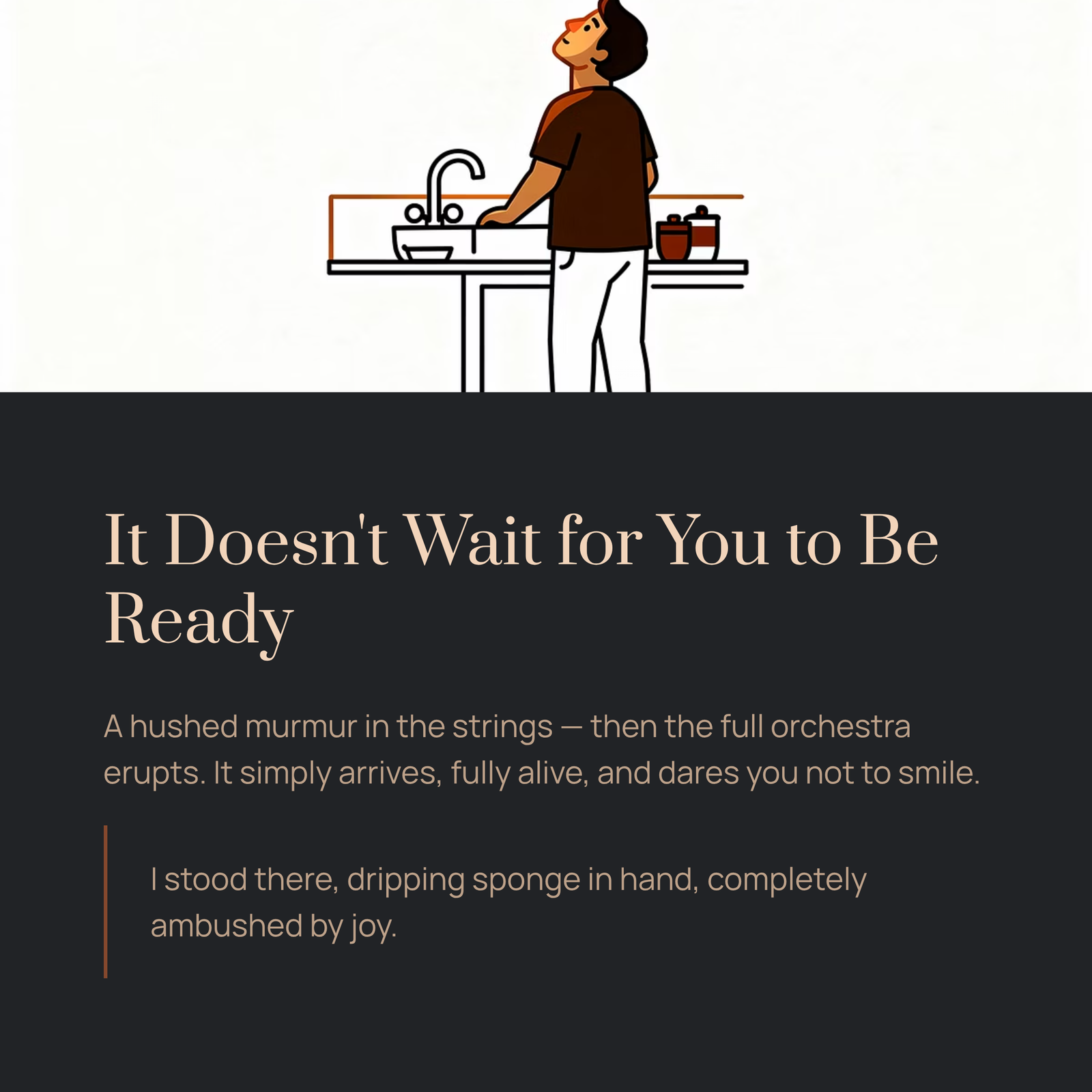
From the very first measure, it grabs you by the collar. A hushed, almost conspiratorial murmur rises from the strings — soft, rapid, impossibly precise — and within seconds, the full orchestra erupts into a blaze of sound that feels less like a formal introduction and more like someone throwing open the doors to the most entertaining party you’ve ever attended. I remember the first time I heard it clearly: I was in the middle of something mundane, probably washing dishes, and those opening notes stopped me mid-scrub. I stood there, dripping sponge in hand, completely ambushed by joy.
That’s what this overture does. It doesn’t wait for you to be ready. It simply arrives, fully alive, and dares you not to smile.
Mozart in 1786: A Composer at the Height of His Powers
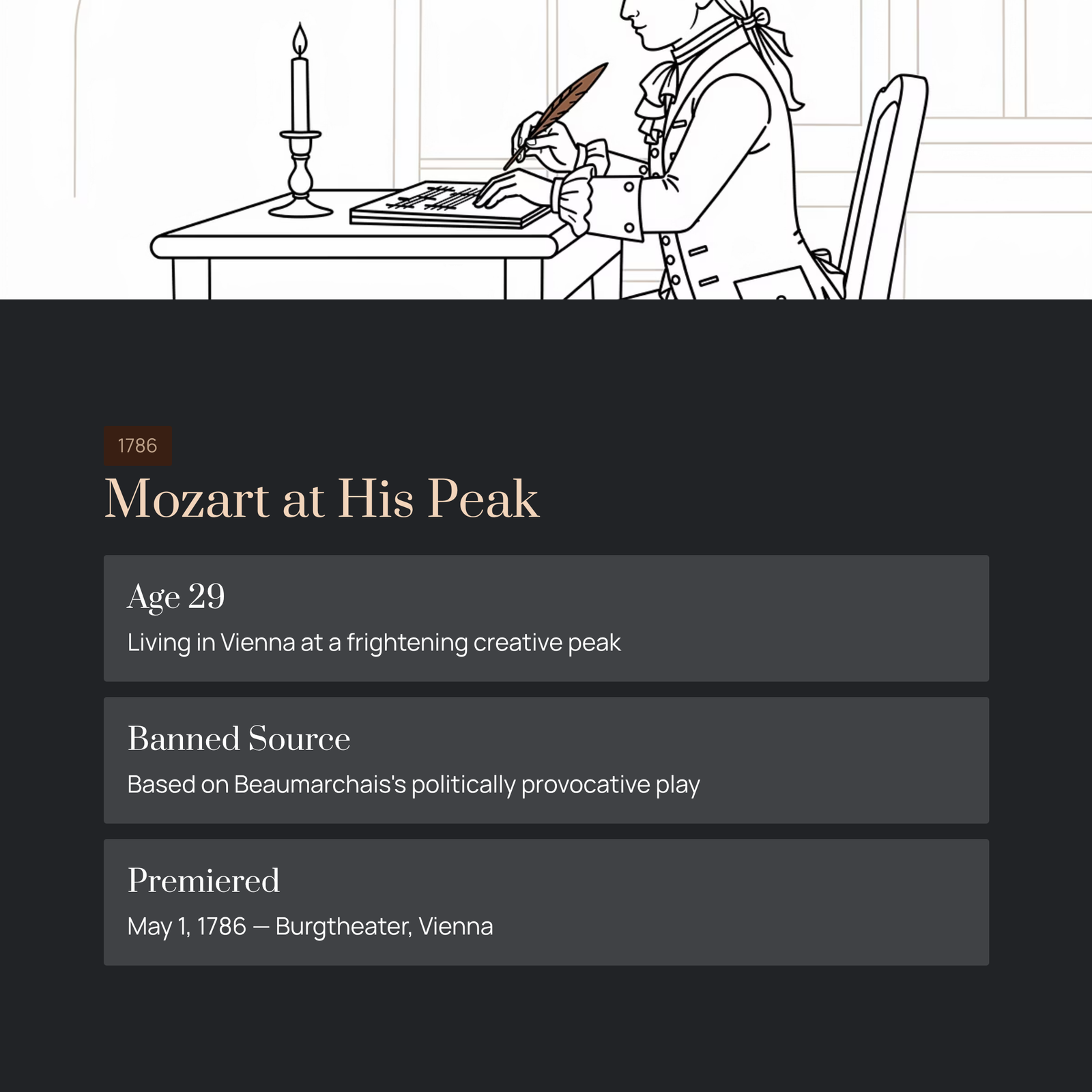
To understand why this overture crackles with such irrepressible energy, it helps to know what Mozart was up to in 1786. He was twenty-nine years old, living in Vienna, and operating at a creative peak that remains almost frightening in its productivity. In this single year, he would compose not only The Marriage of Figaro but also several piano concertos, chamber works, and songs — each one a masterpiece by any reasonable standard.
The Marriage of Figaro was based on a play by Pierre Beaumarchais, a work so politically provocative that it had been banned in Vienna by Emperor Joseph II himself. The story centers on a single chaotic day in which a clever servant named Figaro outmaneuvers his aristocratic master, Count Almaviva, who is scheming to seduce Figaro’s bride-to-be. It was a comedy, yes — but one with sharp teeth, poking fun at class privilege and the arrogance of power.
Mozart and his librettist Lorenzo Da Ponte managed to soften the political edges just enough to slip past the censors, while keeping all the wit, intrigue, and human warmth intact. The opera premiered on May 1, 1786, at the Burgtheater in Vienna. And it began, as it still begins today, with this overture — a piece that contains no melodies from the opera itself, yet somehow captures its entire spirit in under four minutes.
What to Listen For: A Friendly Map of the Music
If this is your first time really sitting down with the Figaro Overture, here are a few things that might deepen your experience.
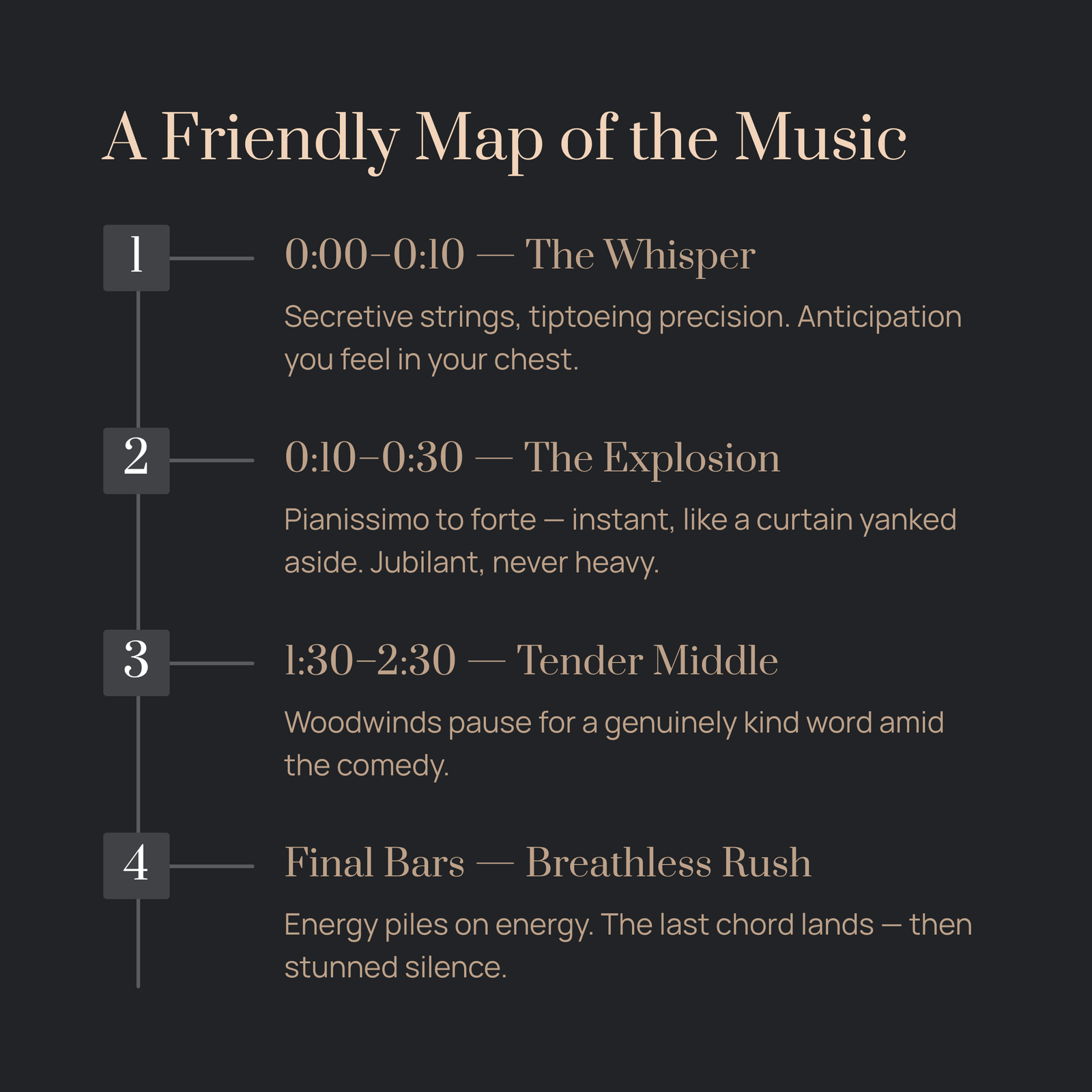
The whispering opening (0:00–0:10). Those first soft, scurrying notes in the strings are one of the most recognizable beginnings in all of classical music. They feel secretive, like footsteps tiptoeing down a hallway. There’s a sense of anticipation — something is about to happen, and you can feel it in your chest. Try to notice how every instrument enters with absolute precision; this passage is famously difficult for orchestras to play together cleanly, and the best performances make it sound effortless.
The joyful explosion (0:10–0:30). When the full orchestra crashes in, pay attention to how Mozart uses the contrast. The shift from pianissimo to forte is not gradual — it’s instant, like a curtain being yanked aside. The oboes and bassoons add a warm, almost laughing quality to the sound, while the horns and trumpets give it a ceremonial brightness. It’s jubilant without being heavy.
The lyrical middle section (around 1:30–2:30). After the initial fireworks, Mozart introduces a gentler, more singing theme. This is where you can hear something remarkable: even in the midst of all this speed and energy, there are moments of surprising tenderness. A brief phrase in the woodwinds, a soft response from the strings — it’s as if, in the middle of all the comedy, someone pauses to share a genuinely kind word. These fleeting moments of warmth are what separate Mozart from composers who are merely clever.
The breathless conclusion. The overture doesn’t so much end as it accelerates toward the finish line. The final bars pile energy on top of energy, rushing forward with a momentum that feels almost physical. When the last chord lands, there’s a split second of stunned silence before the opera begins — and that silence, filled with the echo of everything you just heard, is one of the great thrills in live performance.
Why This Overture Feels Like Organized Chaos
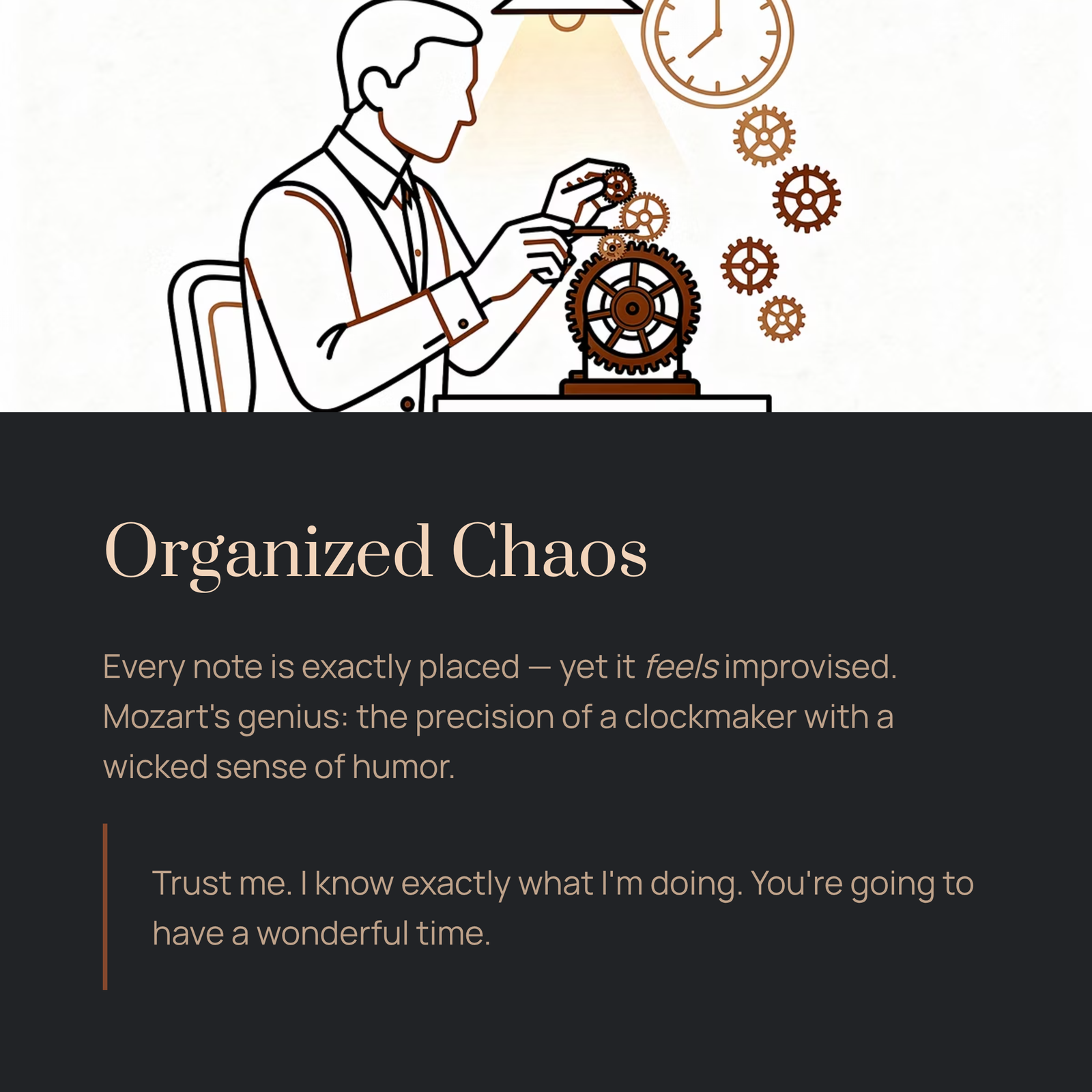
One of the things I find endlessly fascinating about this piece is how it manages to sound both perfectly ordered and completely spontaneous at the same time. Every note is exactly where it needs to be. The structure is clear, the harmonies are logical, the orchestration is balanced. And yet, it feels improvised — like a brilliant conversationalist who is making it all up as they go, hitting every punchline with seemingly no effort.
This is Mozart’s particular genius, and it’s on full display here. He understood that true comedy in music, as in life, requires impeccable timing. The pauses between phrases, the unexpected turns, the way a soft passage suddenly gives way to a thunderous one — these are not random. They’re calibrated with the precision of a master clockmaker who also happens to have a wicked sense of humor.
I sometimes think of this overture as a kind of contract between Mozart and his audience. He’s saying: Trust me. I know exactly what I’m doing. You’re going to have a wonderful time. And then he delivers on that promise so completely that it almost feels unfair to every other overture that has to follow in its wake.
Recordings Worth Your Time
If you’re looking for a place to start, here are a few interpretations that each reveal something different about this music.
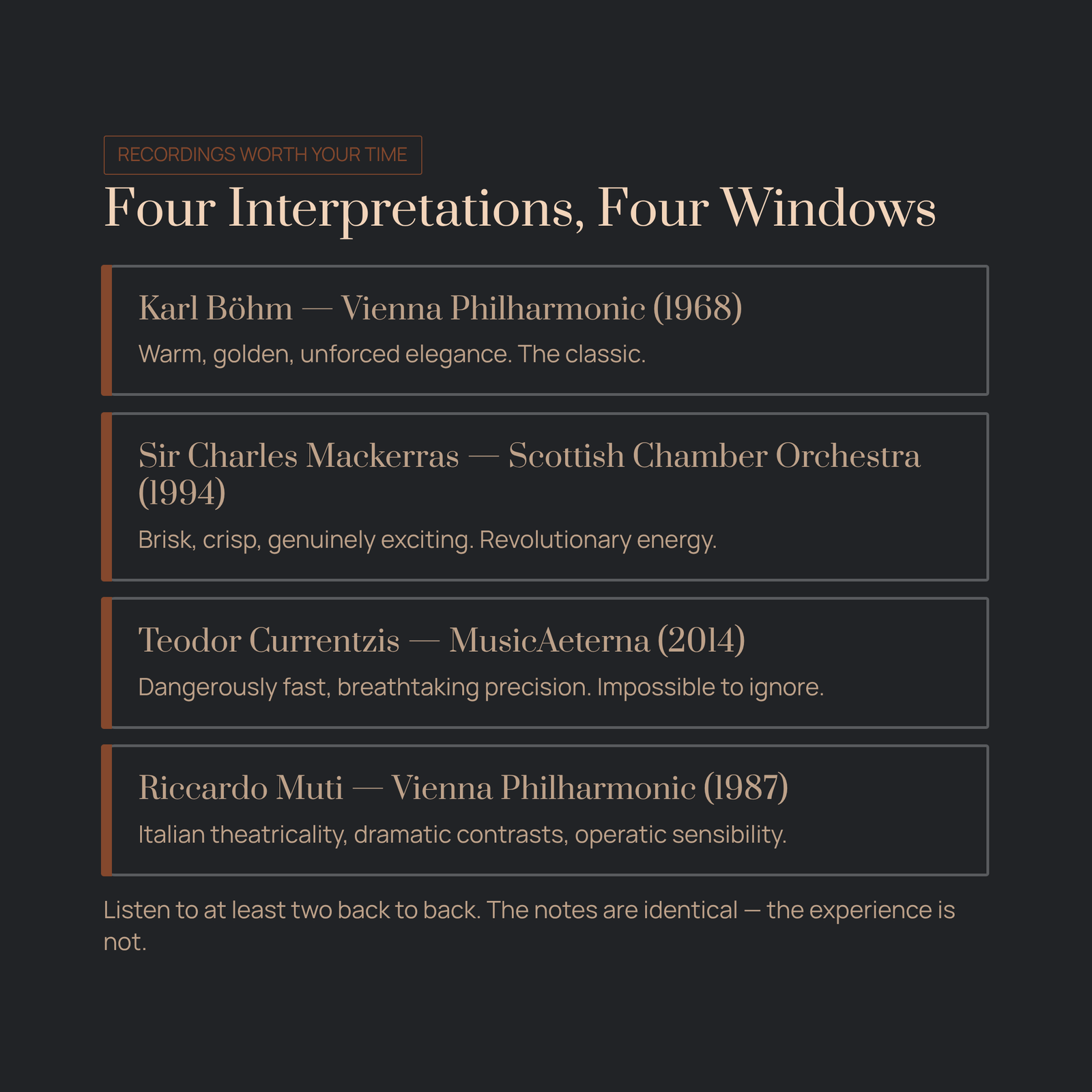
Karl Böhm with the Vienna Philharmonic (1968) — This is the classic recording for a reason. Böhm understood Mozart’s operas in his bones, and his Figaro Overture has a natural, unforced elegance. The Vienna Philharmonic’s string sound is warm and golden, and the pacing feels exactly right — never rushed, never dragging.
Sir Charles Mackerras with the Scottish Chamber Orchestra (1994) — For a performance that leans into the overture’s revolutionary energy, Mackerras is hard to beat. His tempos are brisk, the articulation is crisp, and there’s a sense of genuine excitement in every phrase. This recording makes a strong case for hearing Mozart with a smaller, more agile ensemble.
Teodor Currentzis with MusicAeterna (2014) — If you want to hear this overture as if it were written yesterday, Currentzis delivers an electrifying, almost dangerously fast performance that strips away any sense of routine. It’s not for everyone, but it’s impossible to ignore. The sheer velocity is astonishing, and the orchestra plays with breathtaking precision at speeds that would make most ensembles fall apart.
Riccardo Muti with the Vienna Philharmonic (1987) — Muti brings an Italian operatic sensibility to the piece, emphasizing its singing qualities and dramatic contrasts. There’s a theatricality here that reminds you this overture was meant to precede a stage full of scheming servants and lovesick counts.
Each of these recordings is a different window into the same room. I’d suggest listening to at least two of them, back to back, and noticing what changes. The notes are identical; the experience is not.
Four Minutes That Contain an Entire World
There’s a temptation, when writing about a piece this short, to treat it as a minor work — a charming appetizer before the real meal of the opera. But I think that misses what makes the Figaro Overture so extraordinary. In fewer than four minutes, Mozart gives us anticipation and fulfillment, mischief and tenderness, breathtaking speed and moments of unexpected stillness. He gives us, in other words, a complete emotional experience — one that doesn’t need the three hours of opera that follow to justify its existence.
I return to this overture more often than I return to many full symphonies. It’s the piece I play when I need to be reminded that the world contains things that are simply, irreducibly good. Not good in a complicated way. Not good despite their flaws. Just good — the way sunlight through a window is good, or the way laughter from the next room is good.
Mozart wrote it in a single sitting, or so the story goes. Whether that’s true or apocryphal hardly matters. What matters is that it sounds true. It sounds like something that arrived whole, fully formed, as if it had always existed and was simply waiting for someone with the right pen to write it down.
If you’ve never listened to classical music before, this is not a bad place to begin. And if you’ve listened to classical music your whole life, this is not a bad place to return.