📑 Table of Contents
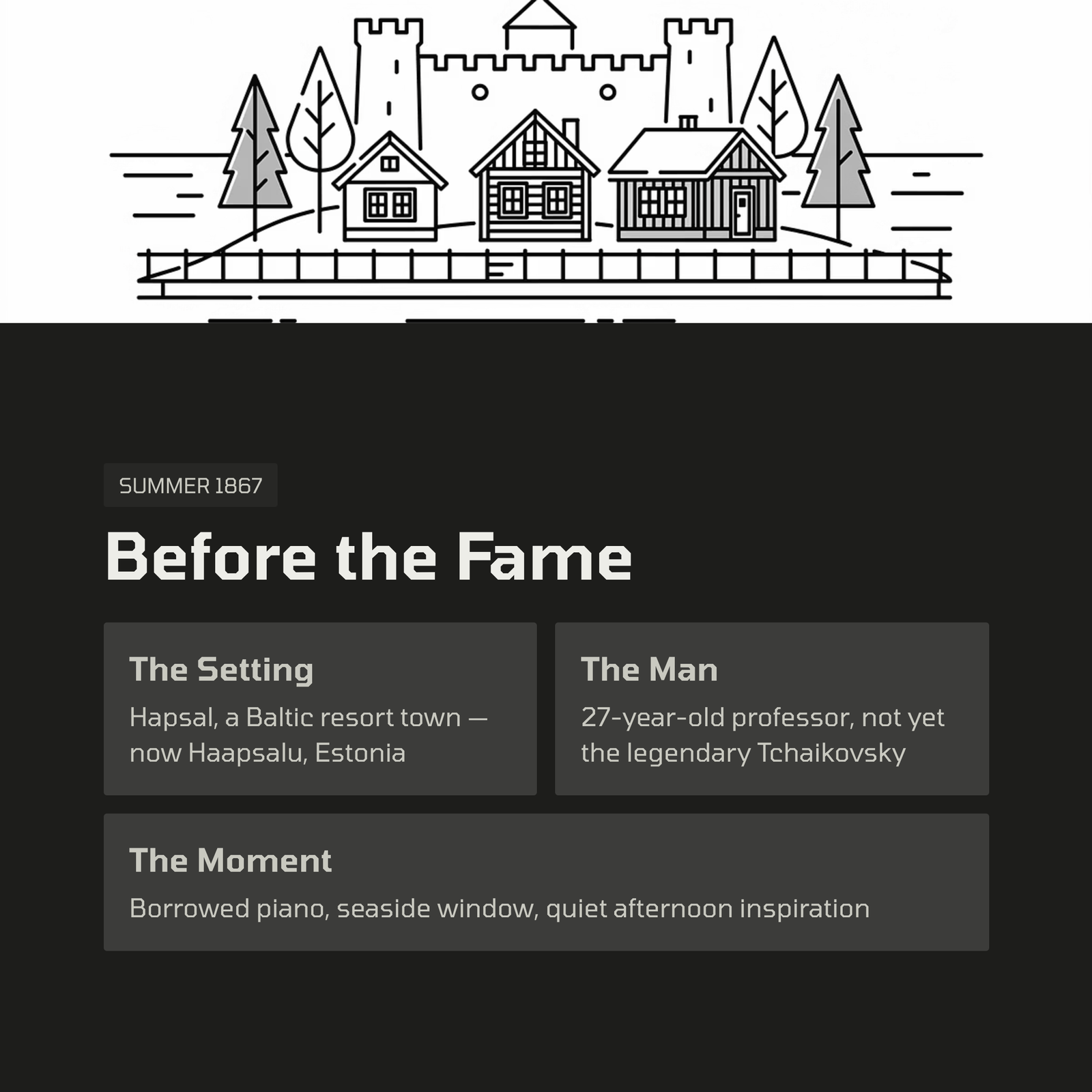
Picture a small seaside town on the Baltic coast. It is the summer of 1867. The air smells of salt and pine resin. A young man — only twenty-seven — sits near a window overlooking the water, his fingers tracing patterns on the keys of a borrowed piano. He is not yet the Tchaikovsky the world will come to know. No Swan Lake. No Nutcracker. No symphonies that would shake concert halls from Moscow to New York. He is simply Pyotr — a newly appointed professor at the Moscow Conservatory, escaping the city’s heat with his brothers and the family of his sister’s in-laws.
The town is called Hapsal — known today as Haapsalu, Estonia. And the piece that emerges from those quiet seaside afternoons will outlast nearly everything else he writes that summer. It is the Song without Words, Op. 2, No. 3 — a piece so unassuming that you might almost overlook it. Almost.
The Summer That Planted the Seeds
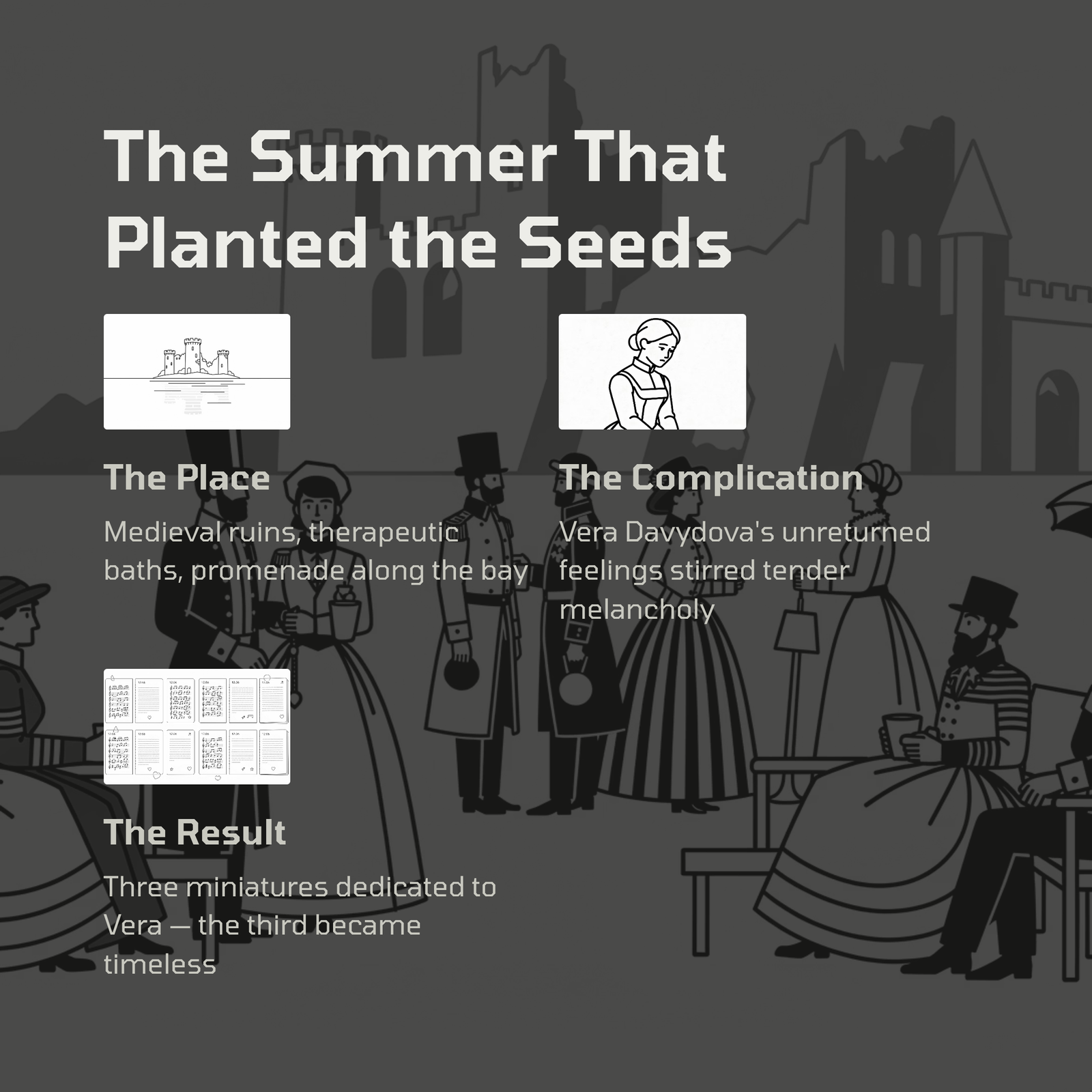
To understand this music, you need to understand the moment it was born. Tchaikovsky arrived in Hapsal alongside his brothers Modest and Anatoly, joining members of the Davydov family at this popular resort town on the edge of the Russian Empire. He was supposed to be resting — taking a break from the intense labor of composing his first opera, The Voyevoda. But composers rarely rest. They simply listen differently.
Hapsal was the kind of place designed for listening. A promenade along the bay where one could watch the sun crawl across the water at dawn. Medieval castle ruins whispering of centuries past. Therapeutic mud baths that drew the Russian aristocracy each summer. And woven into all of this — a quiet, complicated emotional undercurrent. Vera Davydova, the sister of Tchaikovsky’s brother-in-law, had developed romantic feelings for the young composer. These feelings were not returned, though they clearly stirred something in Tchaikovsky — a tenderness, perhaps, or a melancholy awareness of distances that cannot be closed.
He poured all of it into a cycle of three piano miniatures he titled Souvenir de Hapsal (Recollections of Hapsal), dedicating the entire set to Vera. The first piece evoked the ruins of the old castle. The second was a playful scherzo. But the third — the Chant sans paroles, or Song without Words — became something altogether different. It became a piece that, even today, seems to speak in a voice just below the threshold of language.
What Is a “Song without Words,” Anyway?
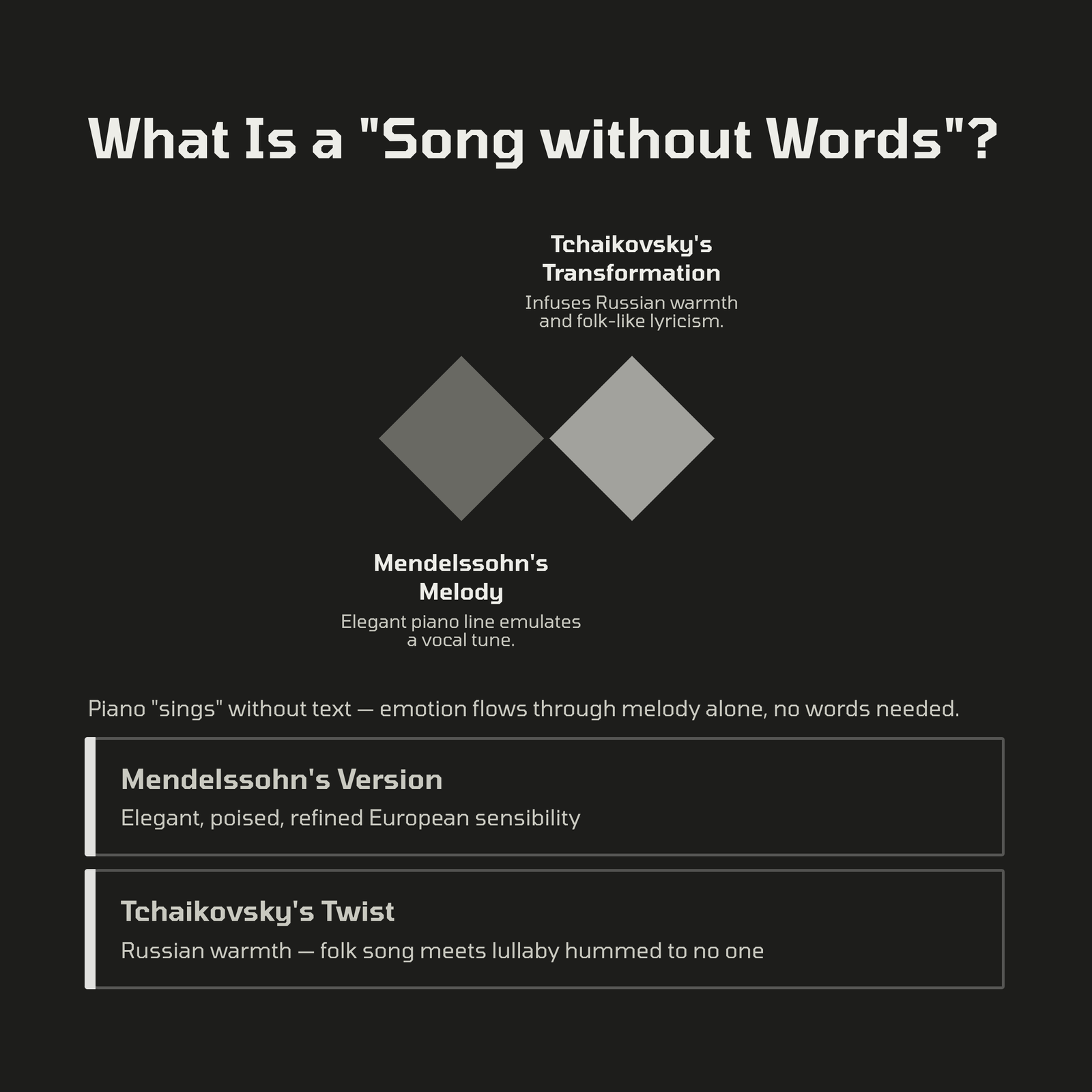
If you are new to classical music, the title itself is worth pausing on. The concept was made famous by Felix Mendelssohn some forty years earlier — short piano pieces written in the style of a vocal melody, but without any actual text. The idea is that the piano “sings” on its own. The emotion comes through without needing a single syllable.
Tchaikovsky borrowed this concept and made it unmistakably his own. Where Mendelssohn’s songs without words tend toward elegance and poise, Tchaikovsky’s version carries a particular Russian warmth — something between a folk song heard from a distant room and a lullaby hummed to no one in particular.
Inside the Music: What to Listen For
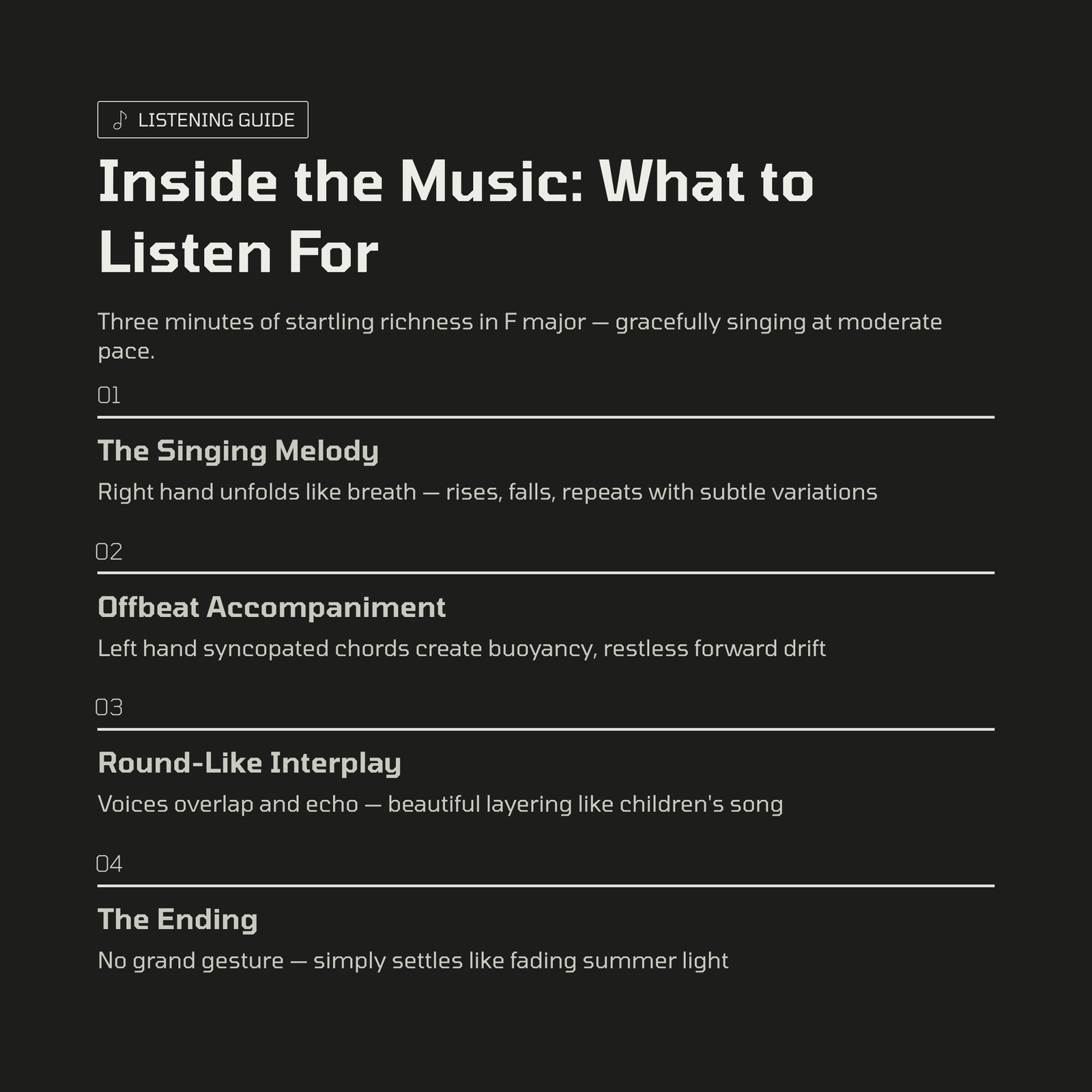
The piece is marked Allegretto grazioso e cantabile — which translates roughly to “gracefully and in a singing style, at a moderately quick pace.” It lives in F major, a key that often radiates a kind of pastoral gentleness. The whole thing lasts only about three minutes, but those three minutes are startlingly rich.
The Singing Melody. From the very first measure, the right hand unfolds a melody that truly does feel like someone singing. It rises and falls with the natural rhythm of breath. If you close your eyes, you can almost imagine a soprano voice tracing these phrases over the Baltic horizon. Pay attention to how the melody repeats but never quite the same way — Tchaikovsky subtly reshapes each return, the way a storyteller retells a favorite memory with slight variations each time.
The Offbeat Accompaniment. Beneath the melody, the left hand provides gently syncopated chords — slightly off the beat, creating a sense of buoyancy and forward motion. This is not a piece that sits still. It drifts. It floats. There is an underlying restlessness, a sense of expectation, as though something is about to happen just beyond the next phrase.
The Round-Like Interplay. As the piece progresses, listen for moments when the left hand begins to echo or overlap the melody, almost like a round — the way children might sing the same song starting at different times. This creates a beautiful layering effect, as if multiple voices are joining in on a tune that was never meant for words.
The Ending. Notice how the piece does not resolve with a grand gesture. It simply… settles. Like a conversation that trails off naturally, or like watching the last light fade from a summer sky. The final measures carry a particular tenderness that only simplicity can achieve.
Recommended Recordings: Three Ways to Experience It
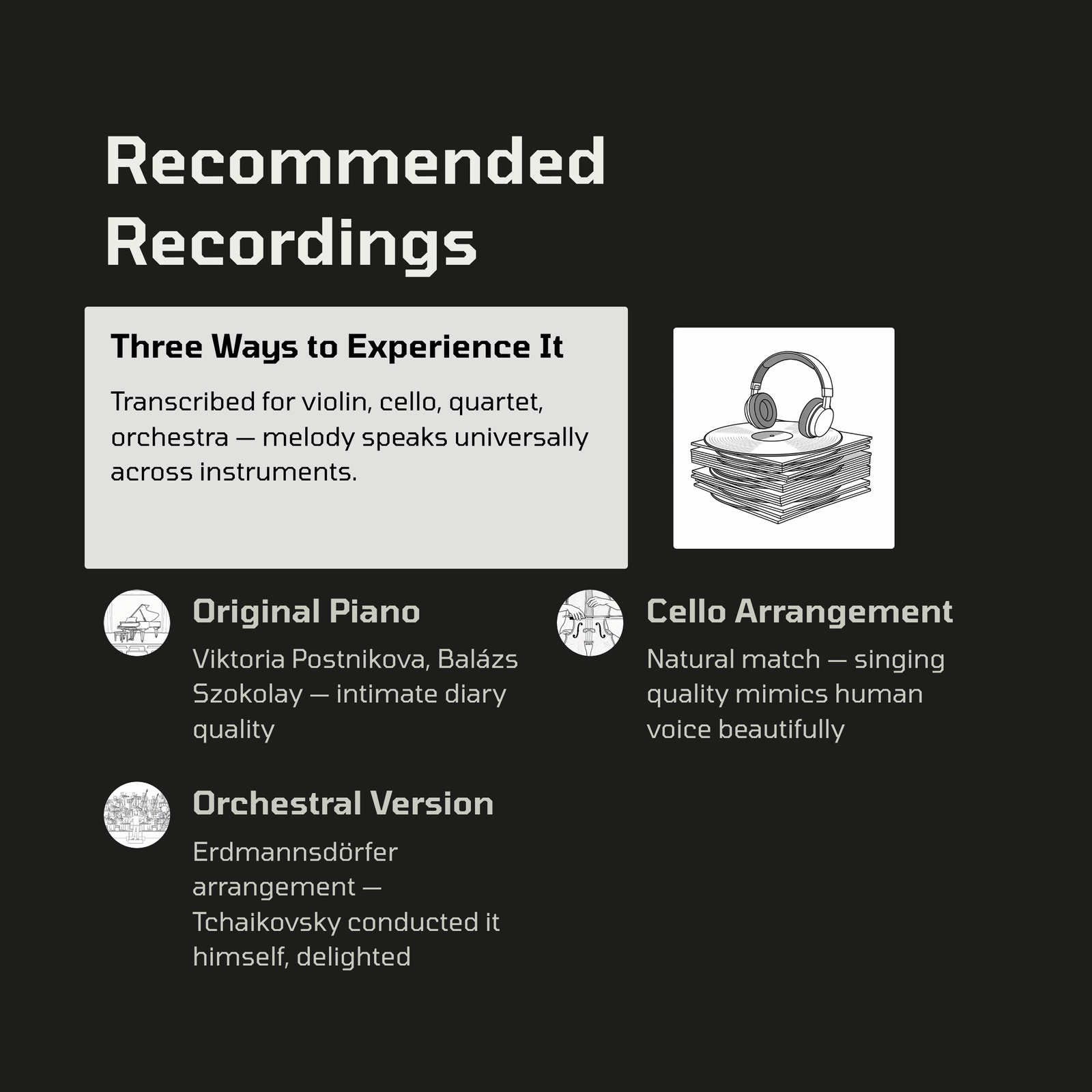
This piece has been transcribed for violin, cello, string quartet, and even full orchestra — a testament to how universally its melody speaks. Here are a few ways to explore it:
For the original piano version, seek out Viktoria Postnikova’s recording of the complete Souvenir de Hapsal. Her touch captures the intimacy of a private musical diary. Balázs Szokolay’s interpretation also brings a lovely crystalline quality to the melody.
For a different instrumental color, look for arrangements featuring cello and piano. The singing quality of the cello is a natural match for this particular melody — Tchaikovsky himself would have appreciated hearing it, given how much the piece already mimics the human voice.
And for a fascinating historical footnote: conductor Max Erdmannsdörfer arranged the piece for orchestra, and Tchaikovsky was so delighted with the result that he conducted the orchestral version himself. If you can find an orchestral recording, it reveals a completely different dimension — the same intimate melody suddenly dressed in the colors of a full ensemble.
Why This Tiny Piece Still Matters
There is a temptation, when discussing Tchaikovsky, to rush toward the blockbusters — the symphonies, the concertos, the ballets that fill the world’s largest concert halls. But pieces like the Song without Words remind us of something crucial: some of the most powerful music lives in the smallest spaces.
This is the work of a young man on the verge of becoming one of history’s great composers, writing not for an audience, but for a moment. A particular light on the water. An emotion too complicated for conversation. A summer that would end, as all summers do, but that left behind something permanent in the only way music can.
When you listen, do not worry about analyzing. Do not try to decode hidden meanings. Simply let the melody carry you the way it must have carried Tchaikovsky on those long Estonian evenings — gently, without hurry, toward a feeling that has no name but is immediately, unmistakably real.
That is, after all, exactly what a song without words is for.