📑 Table of Contents
There are pieces of music that impress you. There are pieces that move you. And then, very rarely, there is a piece that simply stops you — mid-step, mid-thought, mid-breath.
Handel’s “Lascia ch’io pianga” is that kind of music.
The first time I heard it, I didn’t know a word of Italian. I didn’t know anything about Baroque opera. I couldn’t have told you the difference between a da capo aria and a cappuccino. And yet, within the first eight bars, something inside me went very, very quiet. The melody — impossibly simple, almost hymn-like — carried a sadness so dignified, so restrained, that it bypassed every intellectual filter I had and went straight to the place where tears live.
If you’ve never listened to opera before, this is the door I’d hold open for you. Not because it’s easy, but because it’s honest.
Who Was Handel, and Why Should You Care?
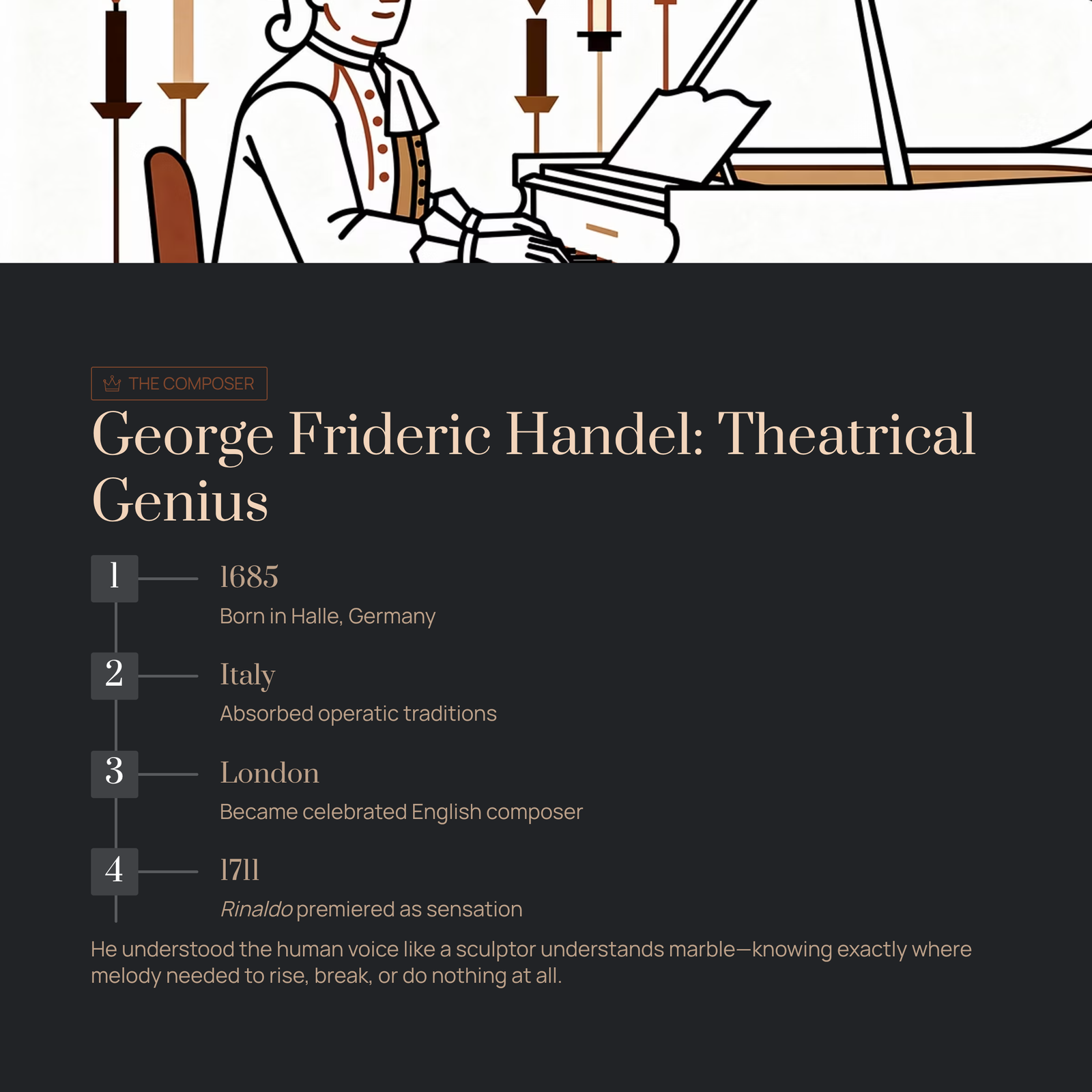
George Frideric Handel (1685–1759) is one of those composers whose name most people recognize but whose music they often can’t quite place. Born in Halle, Germany, he spent his formative years soaking up the operatic traditions of Italy before settling permanently in London, where he became one of the most celebrated composers in English history.
Here’s the thing about Handel that sets him apart: he was a theatrical genius who understood the human voice the way a sculptor understands marble. He knew exactly where a melody needed to rise, where it needed to break, and — crucially — where it needed to do absolutely nothing at all. His operas weren’t just entertainment; they were laboratories of human emotion.
Rinaldo, premiered in London in 1711, was Handel’s first Italian-language opera written specifically for the English stage. It was a sensation. Based on episodes from Torquato Tasso’s epic poem about the First Crusade, the opera tells the story of the Christian knight Rinaldo, his beloved Almirena, and the sorceress Armida who captures Almirena to use as a weapon against the Crusaders.
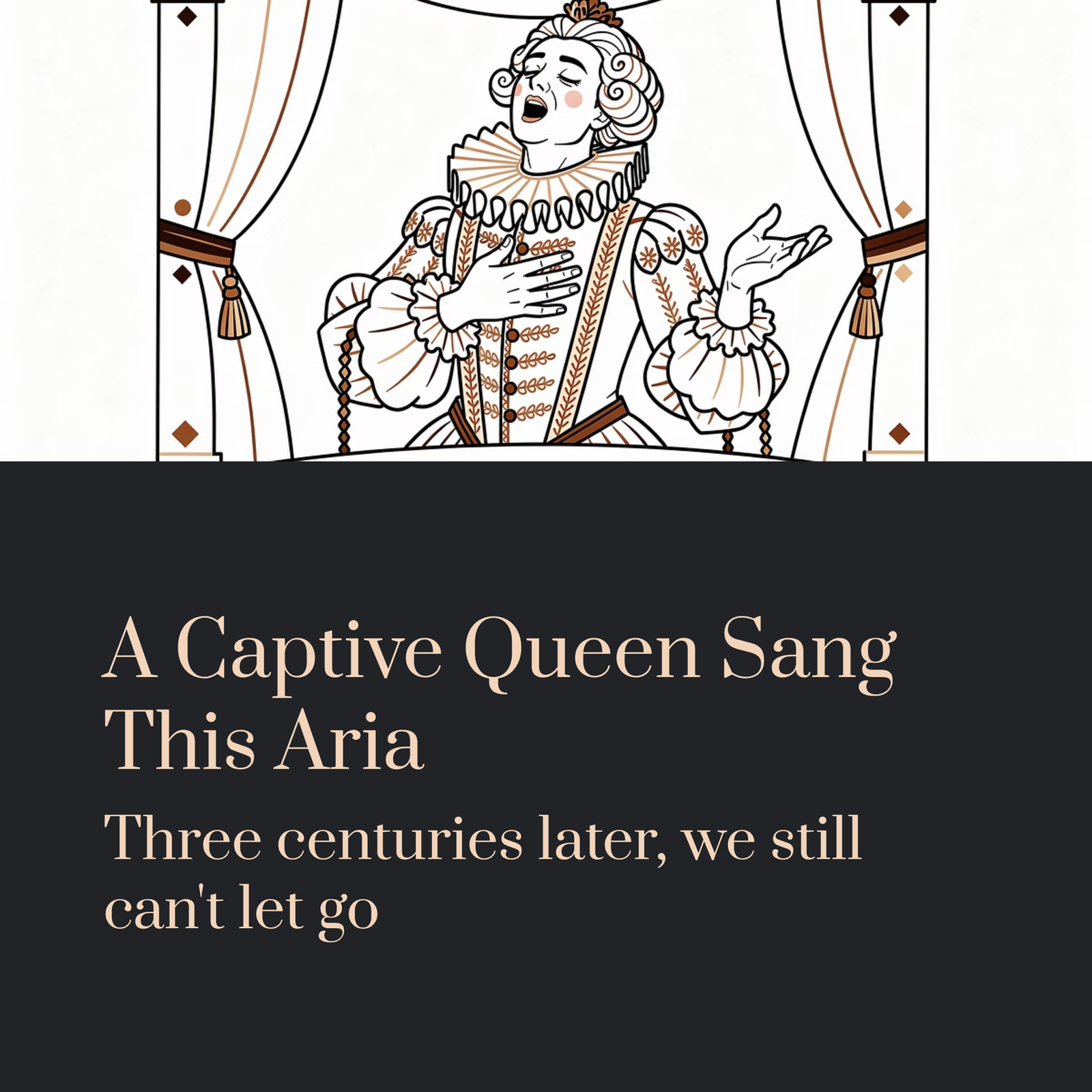
And it is Almirena — imprisoned, powerless, utterly alone — who sings “Lascia ch’io pianga.”
The Story Behind the Song: A Prayer with No One to Hear It
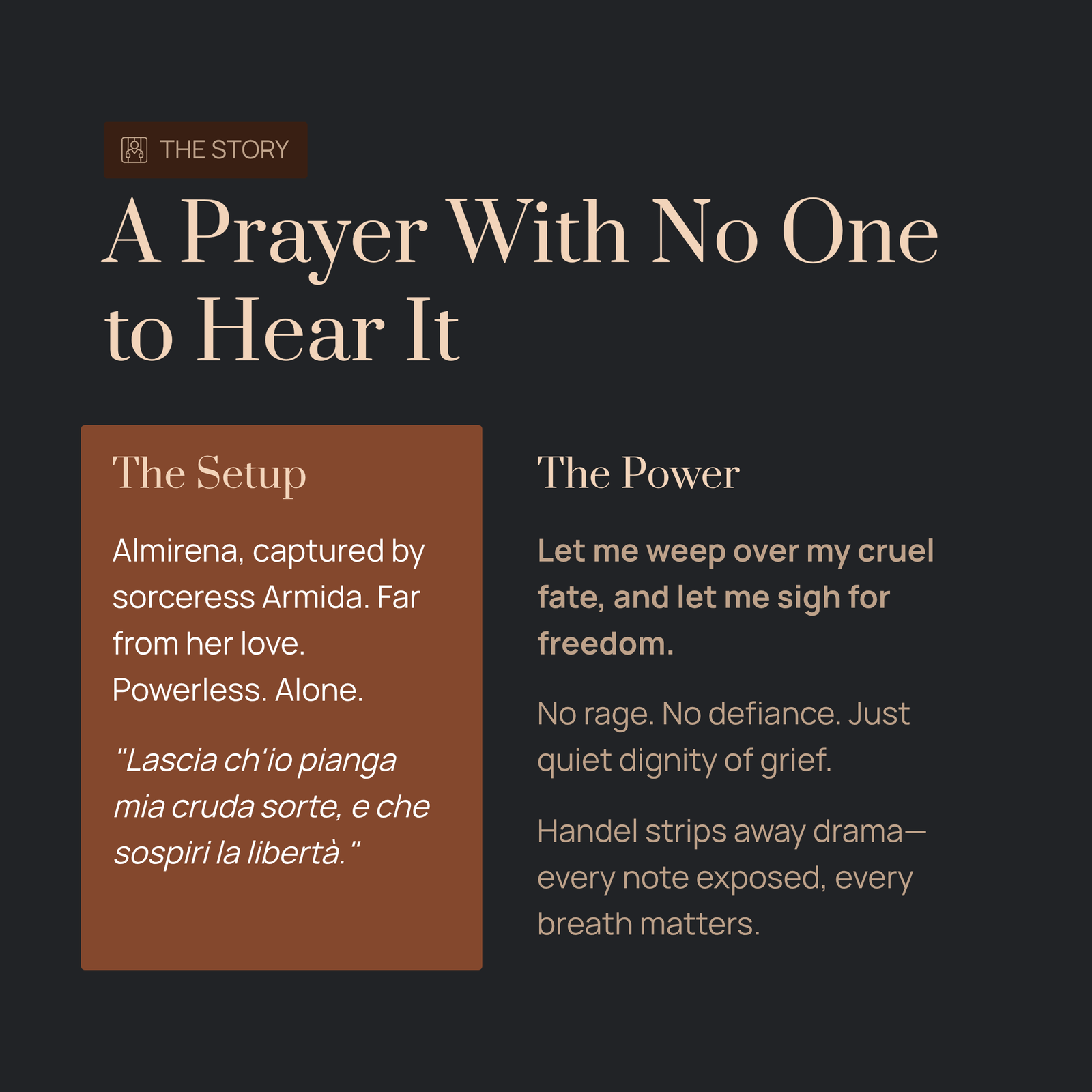
The setup is devastating in its simplicity. Almirena has been taken captive by the sorceress Armida. She is far from the man she loves, held in a place she cannot escape, and surrounded by a power she cannot fight. She has no army. She has no clever plan. She has nothing left but her voice.
And so she sings:
Lascia ch’io pianga mia cruda sorte,
e che sospiri la libertà.
“Let me weep over my cruel fate, and let me sigh for freedom.”
That’s it. That’s the entire emotional universe of the aria. There’s no rage, no defiance, no promise of revenge. Just a human being asking — not demanding, not screaming, but quietly, almost politely asking — to be allowed the dignity of their own grief.
What makes this moment so powerful is what Handel does not do. He doesn’t pile on orchestral drama. He doesn’t give Almirena coloratura fireworks or virtuosic runs. Instead, he writes a melody so stripped-down, so nakedly plain, that there is nowhere for the singer to hide. Every note is exposed. Every breath matters.
It’s the musical equivalent of someone crying in a room alone, not performing their sadness for anyone, but simply living inside it.
What to Listen For: A Beginner’s Guide to the Music
Even if you’ve never analyzed a piece of music in your life, “Lascia ch’io pianga” has so much to offer your ears. Here’s what to pay attention to.
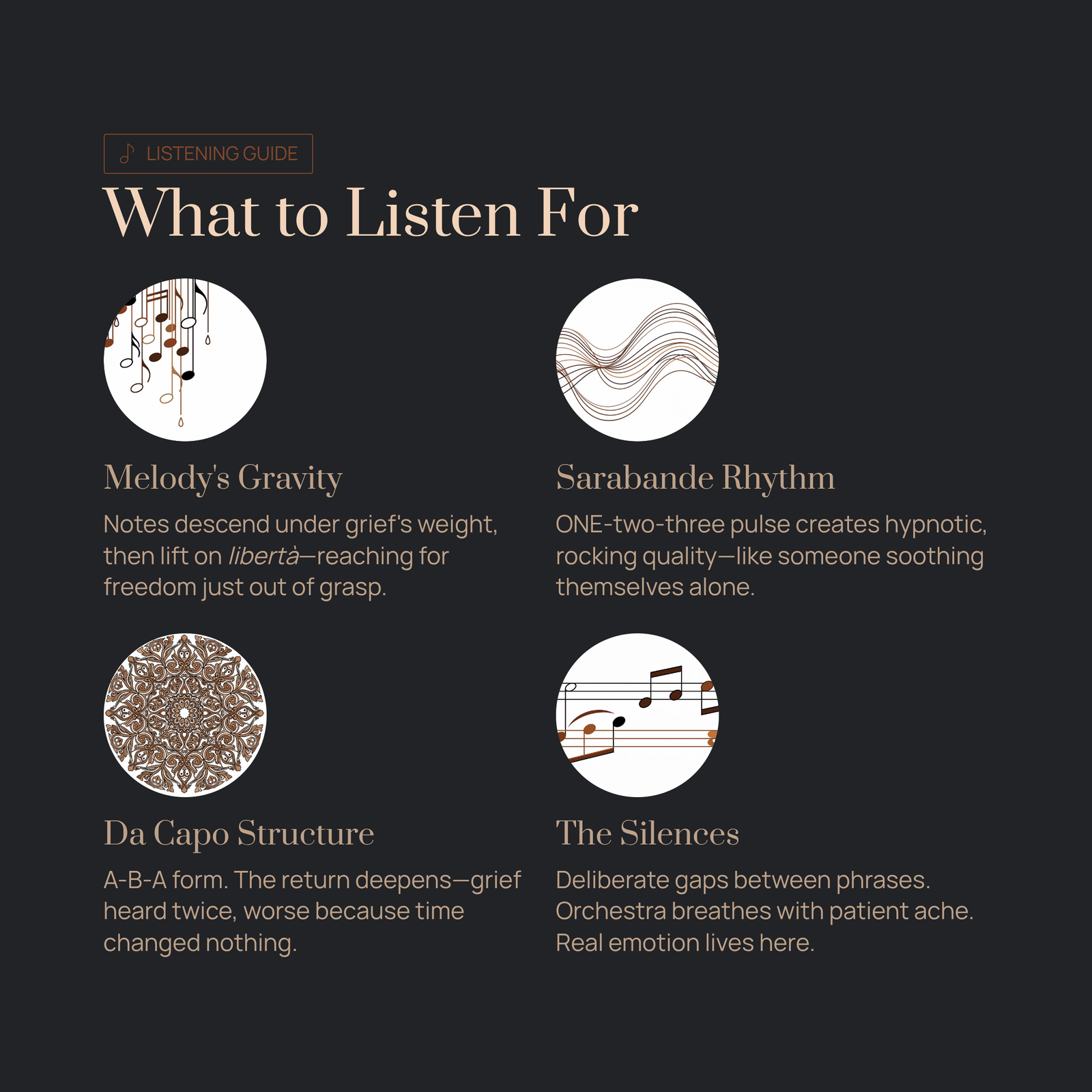
The Melody’s Gravity. Notice how the main melody moves in a gently descending pattern, as if the notes themselves are sinking under the weight of grief. Then, at certain moments, the melody lifts upward — on the word libertà (freedom) — as if reaching for something just out of grasp. That push-and-pull between sinking and reaching is the entire emotional architecture of the piece.
The Sarabande Rhythm. The aria is built on a sarabande, a slow triple-meter dance. You’ll feel a gentle, swaying pulse — ONE-two-three, ONE-two-three — that gives the music a strange, almost hypnotic quality. It’s the rhythm of rocking, of lullabies, of someone trying to soothe themselves in the absence of all comfort.
The Da Capo Structure. Like most Baroque arias, this follows an A-B-A form. The opening section presents the main theme, a brief middle section offers a contrasting emotional shade, and then the opening returns. In the hands of a great singer, that return is never a mere repetition — it becomes a deepening. You’ve heard this grief once; now you hear it again, and it’s worse, because the passage of time has changed nothing.
The Silence Between the Phrases. Perhaps the most powerful element of all. Handel leaves deliberate spaces between the vocal phrases, and in those silences, the orchestra breathes with a kind of patient ache. Don’t rush past these gaps. They are where the real emotion lives.
Why This Aria Still Breaks Us, Three Hundred Years Later
Music scholars will tell you that “Lascia ch’io pianga” succeeds because of its perfect balance of simplicity and depth. And that’s true. But I think there’s something more personal happening when this aria reaches people.
We’ve all been Almirena.
Maybe not literally imprisoned by a sorceress, but we have all known what it feels like to be trapped — in a job, in a relationship, in grief, in our own heads. We have all known the exhaustion that comes after anger has burned itself out, when all that’s left is the quiet wish to be allowed to feel what we feel without apology.
That’s what Almirena is doing. She is not fighting. She is not strategizing. She is simply saying: This hurts. Let me acknowledge that it hurts. And somehow, hearing her say it — hearing Handel give her the most tender, most generous melody imaginable to say it with — gives us permission to do the same.
There’s a reason this aria appears in films like Antichrist and Barry Lyndon, a reason it’s been recorded by everyone from opera legends to pop crossover artists. It speaks a language that predates genre, predates culture, predates even the Italian words themselves. It is the sound of a soul asking for room to breathe.
Recommended Recordings: Where to Start
If this is your first encounter with “Lascia ch’io pianga,” here are a few recordings that showcase different dimensions of the aria.
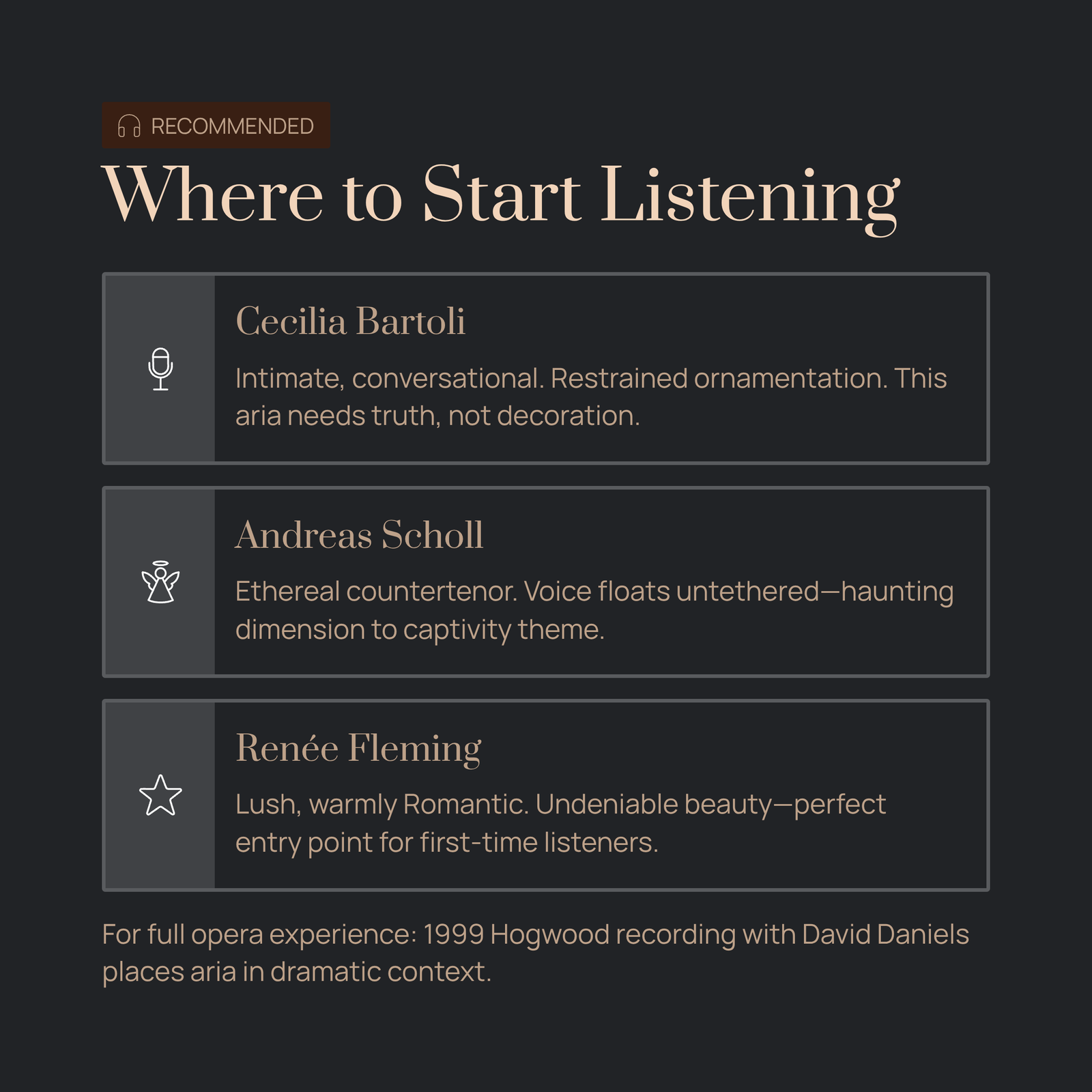
Cecilia Bartoli delivers a version that is intimate and almost conversational, as if Almirena is confiding in you directly. Her ornamentation in the da capo repeat is restrained and tasteful — she understands that this aria doesn’t need decoration; it needs truth.
Andreas Scholl, the countertenor, brings a ethereal, almost otherworldly quality to the piece. His voice floats in a register that feels untethered from the body, which adds a haunting dimension to the captivity theme. If you want to hear this aria as if it’s drifting through the walls of a stone cell, start here.
Renée Fleming offers a lush, warmly Romantic reading that leans into the aria’s emotional weight. It’s less historically informed than Bartoli or Scholl, but its beauty is undeniable — and for a first-time listener, that warmth can be exactly the right entry point.
For a full opera experience, the 1999 Hogwood recording with David Daniels as Rinaldo is a landmark of period-instrument performance that places the aria in its dramatic context.
A Final Thought: The Courage of Stillness
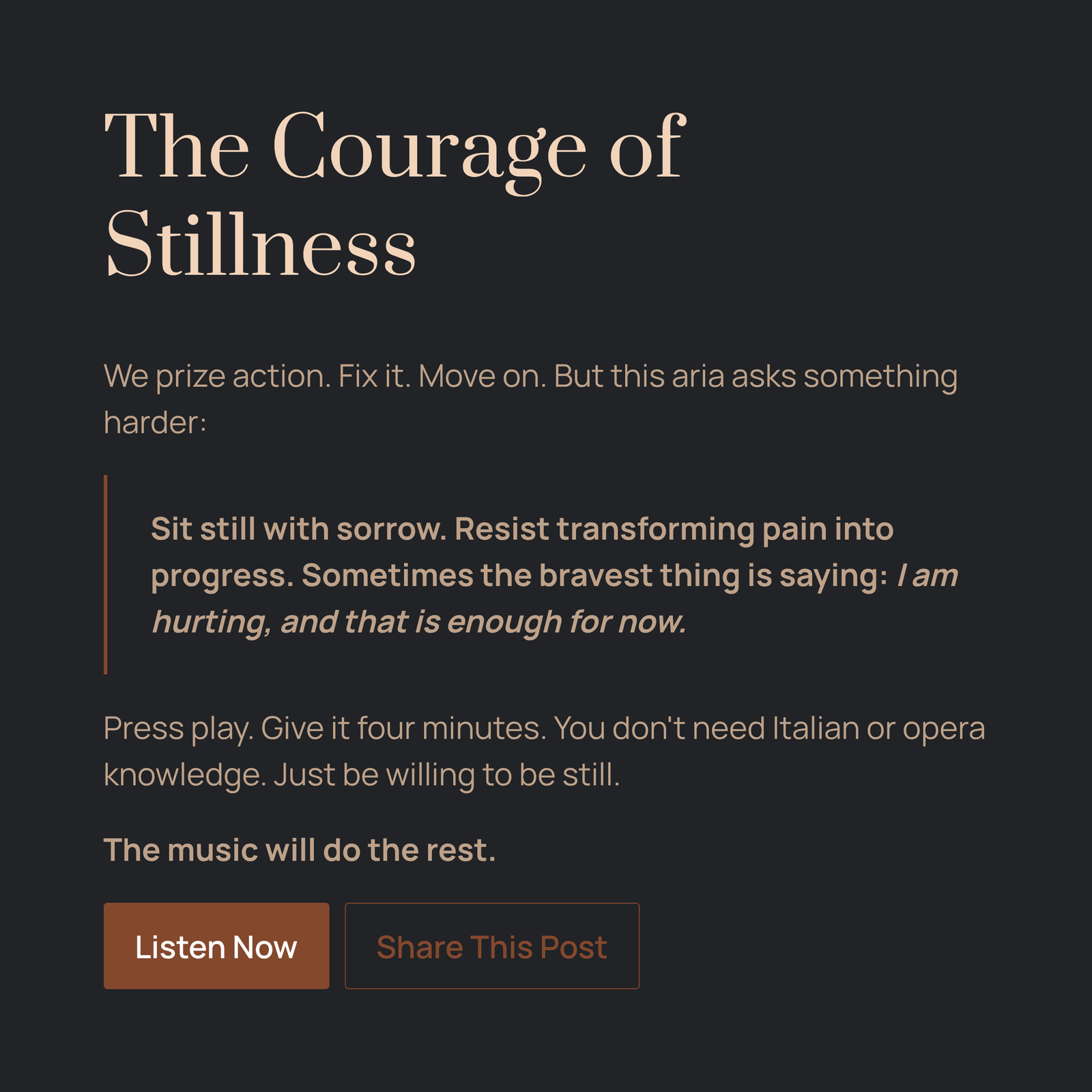
We live in a world that prizes action. Fix the problem. Find the solution. Move on. But “Lascia ch’io pianga” asks us to do something far more difficult: to sit still with sorrow, to resist the urge to immediately transform pain into progress, and to recognize that sometimes the bravest thing a person can do is simply say, I am hurting, and that is enough for now.
Handel wrote this melody over three hundred years ago for a fictional queen in a fictional prison. And yet every time a voice rises with those opening notes — slow, steady, unbearably gentle — it feels like someone is finally saying the thing we’ve been too afraid to say ourselves.
Press play. Give it four minutes. You don’t need to understand Italian. You don’t need to know anything about Baroque opera. You just need to be willing to be still.
The music will do the rest.