📑 Table of Contents
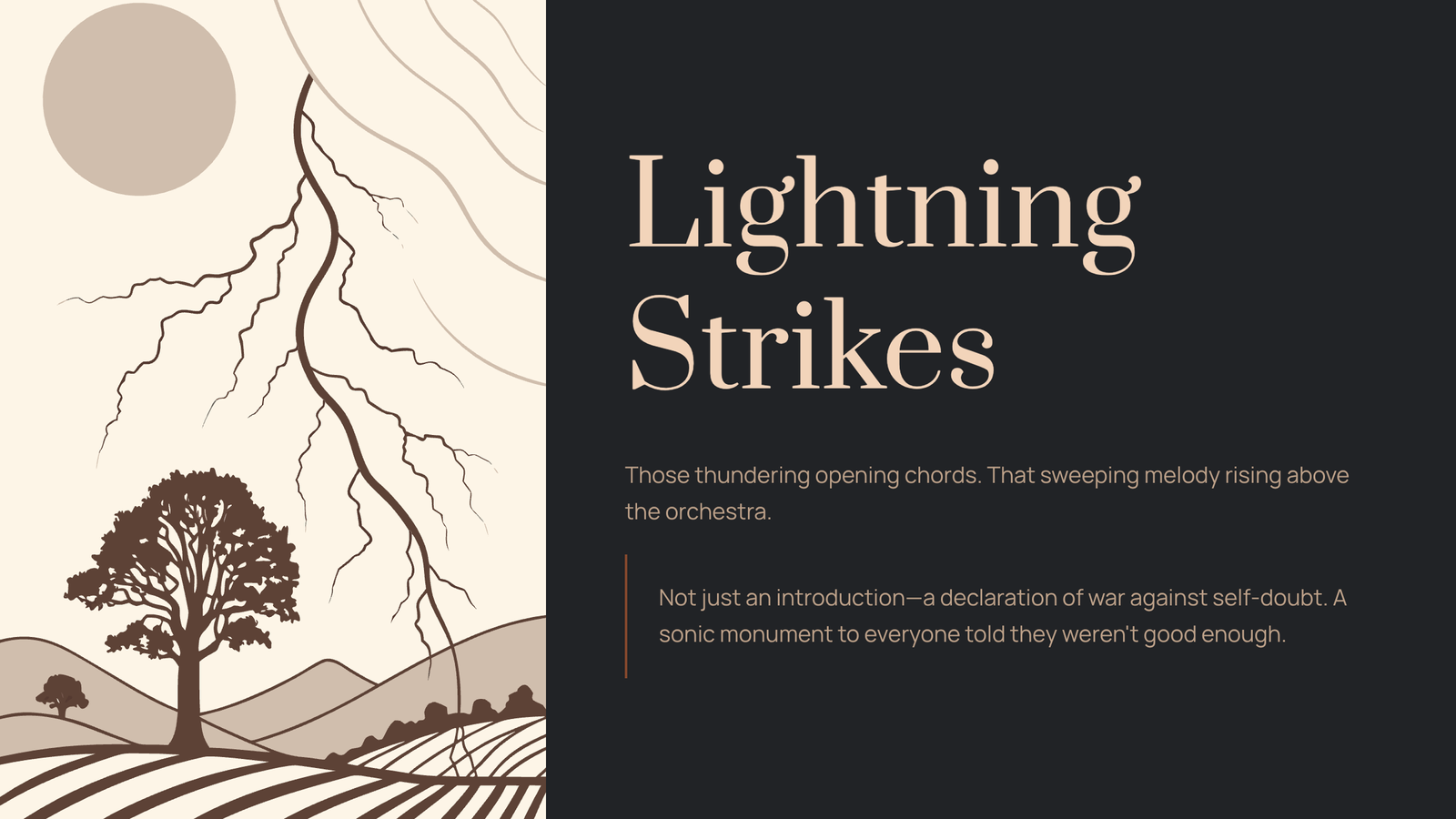
There are moments in music when the first notes strike you like lightning—sudden, overwhelming, impossible to forget. Tchaikovsky’s Piano Concerto No. 1 begins exactly this way. Those thundering opening chords, that sweeping melody rising above the orchestra—it’s not just an introduction. It’s a declaration of war against self-doubt, a sonic monument to everyone who was ever told they weren’t good enough.
The Story Behind the Thunder: A Rejection That Shook the World
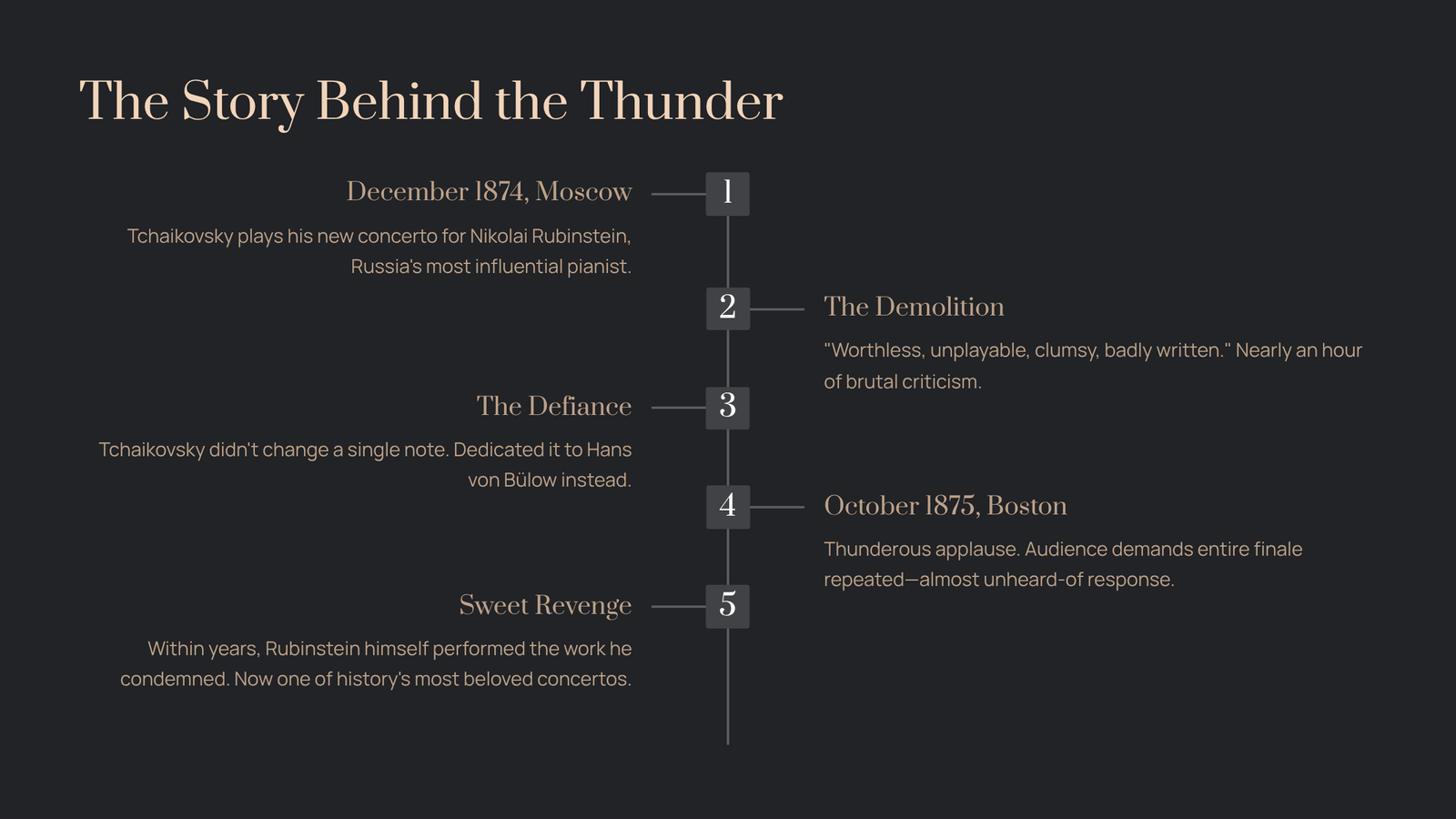
Picture this: December 1874, Moscow. A young Pyotr Ilyich Tchaikovsky, already struggling with crippling self-doubt, plays his newly completed piano concerto for Nikolai Rubinstein—the most influential pianist and music director in Russia. Tchaikovsky expected feedback. What he received was demolition.
Rubinstein called the work “worthless, unplayable, clumsy, and badly written.” He declared that only two or three pages could be salvaged. For nearly an hour, he tore the composition apart while Tchaikovsky sat in stunned silence.
But here’s where the story turns. Tchaikovsky didn’t change a single note. He dedicated the concerto to Hans von Bülow instead, who premiered it in Boston in October 1875 to thunderous applause. The audience demanded the entire finale be repeated—an almost unheard-of response. Within years, Rubinstein himself was performing the very work he had condemned, and today it stands as one of the most beloved concertos ever written.
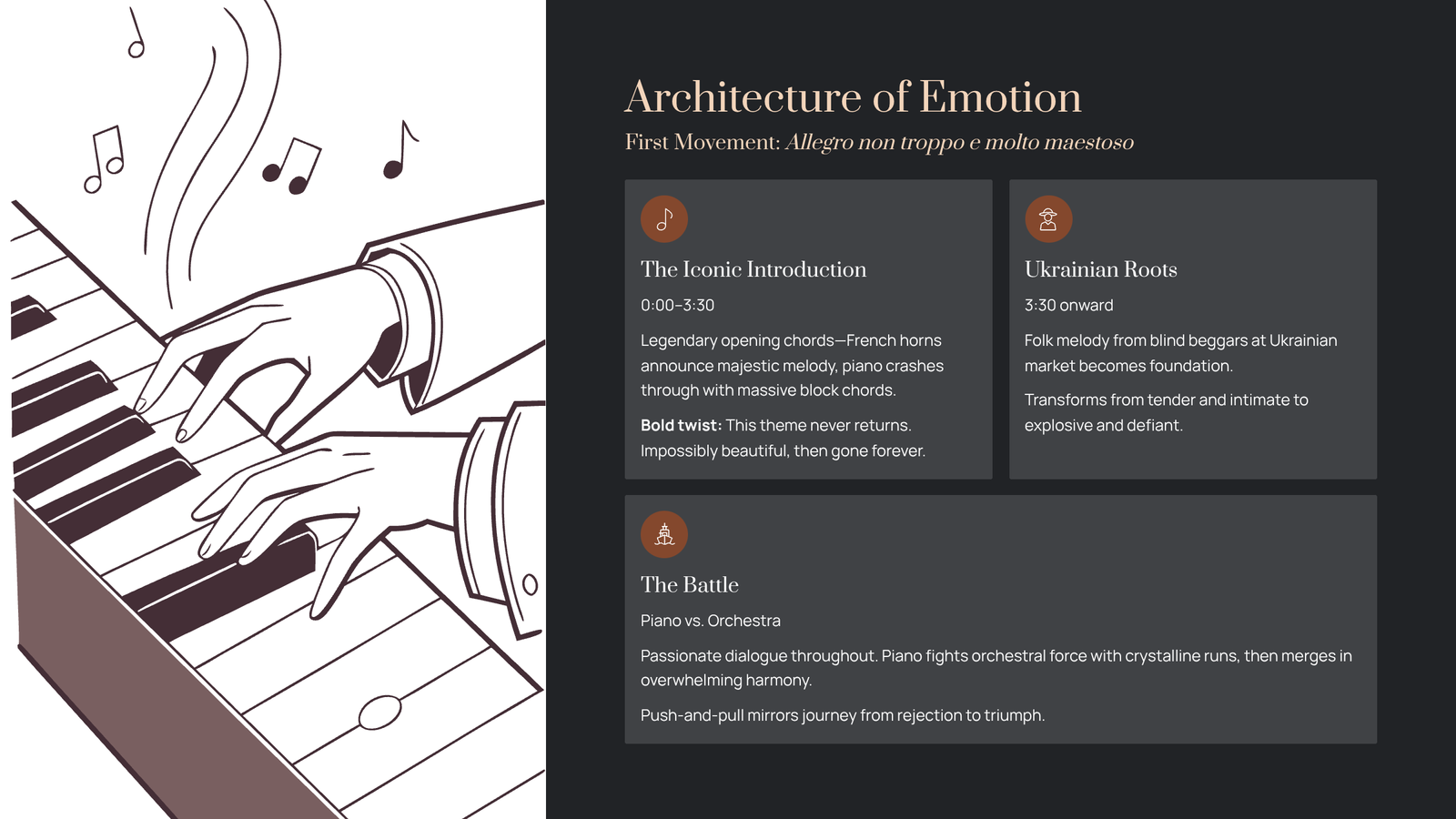
Understanding the First Movement: Architecture of Emotion
The first movement, marked Allegro non troppo e molto maestoso, is a masterclass in emotional storytelling through sound. Let me guide you through its dramatic landscape.
The Iconic Introduction (0:00–3:30)
Those legendary opening chords aren’t actually the main theme—a fact that puzzled critics for decades. The French horns announce a majestic melody while the piano crashes through with massive block chords, like waves breaking against cliffs. This introduction never returns in the movement. Tchaikovsky gives us something impossibly beautiful, then takes it away forever. It’s a bold, almost reckless compositional choice that somehow works perfectly.
The First Theme: Ukrainian Roots (3:30–onward)
When the movement proper begins, you’ll hear something unexpected—a folk melody Tchaikovsky heard blind beggars singing at a Ukrainian market. This simple, almost playful tune becomes the foundation for everything that follows. Listen for how it transforms: sometimes tender and intimate, sometimes explosive and defiant.
The Battle Between Piano and Orchestra
Throughout this movement, the piano and orchestra engage in a passionate dialogue. There are moments when the piano seems to fight against the entire orchestral force, its crystalline runs cutting through waves of strings. Other times, they merge in perfect harmony, creating textures of overwhelming richness. This push-and-pull dynamic mirrors the concerto’s own journey from rejection to triumph.
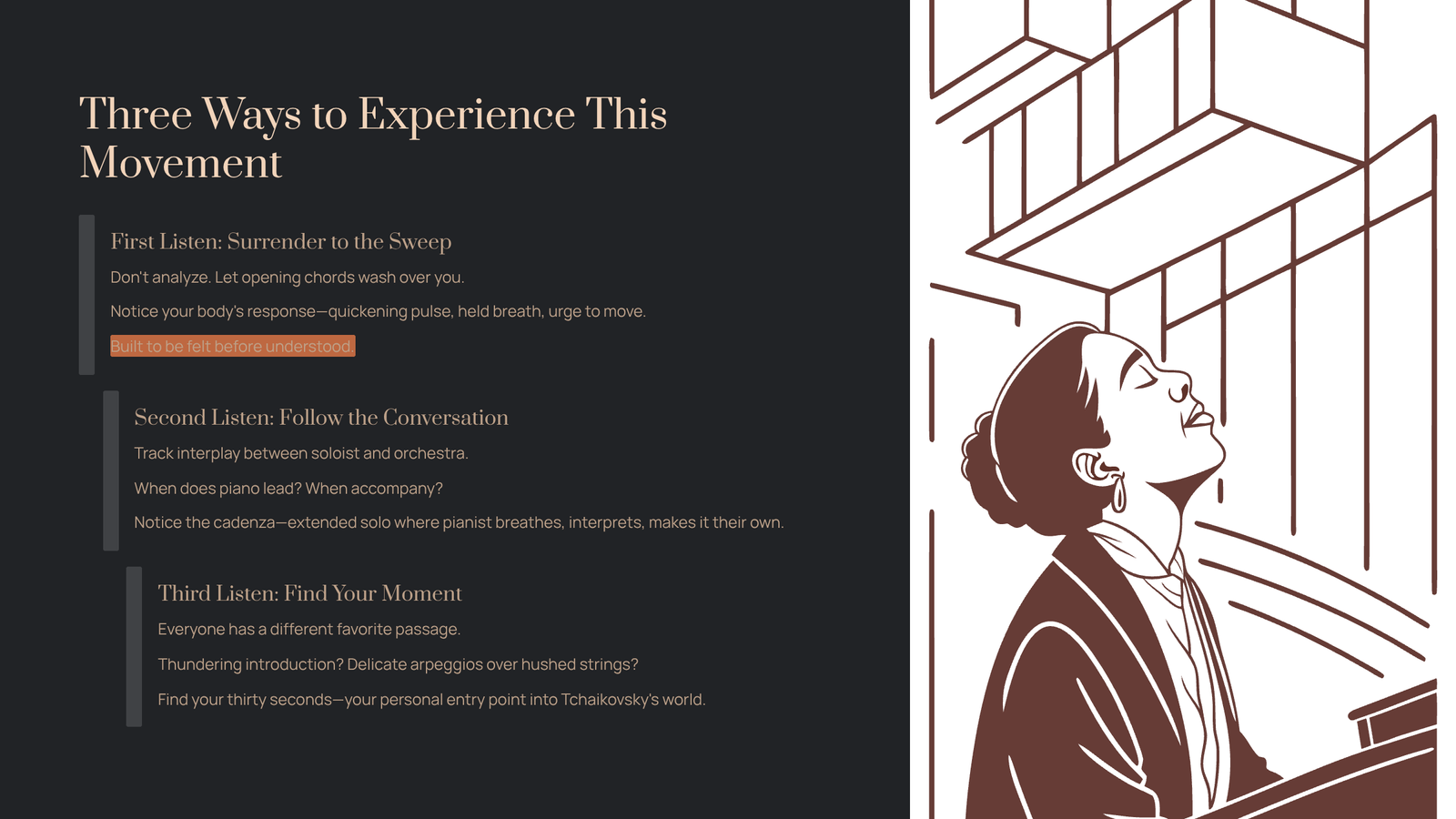
Three Ways to Experience This Movement
First Listen: Surrender to the Sweep
Don’t analyze. Don’t count measures. Simply let those opening chords wash over you. Notice how your body responds—the quickening pulse, the held breath, the involuntary urge to move. This concerto was built to be felt before it’s understood.
Second Listen: Follow the Conversation
Now track the interplay between soloist and orchestra. When does the piano lead? When does it accompany? Notice the cadenza—that extended solo passage where the pianist takes center stage without orchestral support. It’s Tchaikovsky giving the performer space to breathe, to interpret, to make the music their own.
Third Listen: Find Your Moment
Everyone has a different favorite passage in this movement. Maybe it’s the thundering introduction. Perhaps it’s a quiet moment when the piano traces delicate arpeggios over hushed strings. Find the thirty seconds that speak directly to you, and understand that this is your personal entry point into Tchaikovsky’s world.
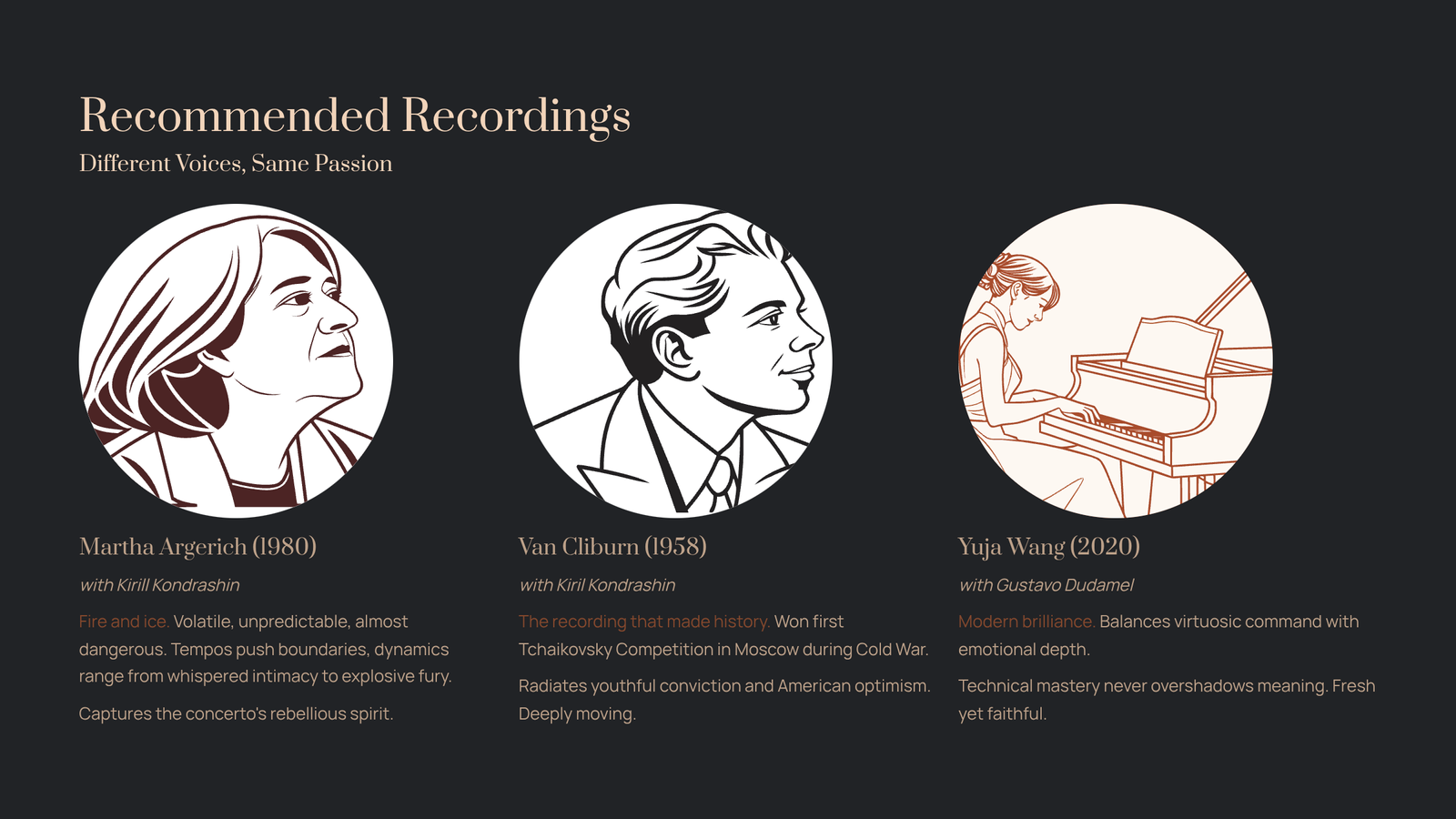
Recommended Recordings: Different Voices, Same Passion
Martha Argerich (1980, with Kirill Kondrashin)
Fire and ice. Argerich’s interpretation is volatile, unpredictable, almost dangerous. Her tempos push boundaries, her dynamics range from whispered intimacy to explosive fury. This recording captures the concerto’s rebellious spirit.
Van Cliburn (1958, with Kiril Kondrashin)
The recording that made history. Cliburn won the first Tchaikovsky Competition in Moscow during the Cold War, and this performance radiates youthful conviction and American optimism. There’s something deeply moving about hearing a young Texan champion Russian music in Soviet Russia.
Yuja Wang (2020, with Gustavo Dudamel)
A modern interpretation that balances virtuosic brilliance with emotional depth. Wang’s technical command is staggering, but she never lets display overshadow meaning. Her reading feels both fresh and faithful.
Why This Concerto Still Matters
Tchaikovsky poured his wounded soul into this music. Every triumphant passage carries the memory of Rubinstein’s cruel words; every tender moment reflects the composer’s perpetual longing for acceptance. When we hear this concerto, we don’t just witness technical brilliance—we participate in an act of artistic revenge, a transformation of pain into beauty.
Perhaps that’s why it resonates so deeply with listeners facing their own battles. The student awaiting exam results, the professional preparing for a pivotal presentation, the artist whose work has been dismissed—this concerto speaks to anyone who has ever been told their best isn’t good enough.
Tchaikovsky proved them wrong. And somewhere in those cascading piano runs and soaring orchestral swells, he whispers that we can too.
The opening chords still thunder. The melody still rises. And after nearly 150 years, the world is still listening.