📑 Table of Contents

There is a strange paradox at the heart of Für Elise. It might be the single most recognized piece of classical music on the planet — you have heard it in music boxes, on hold lines, drifting out of ice cream trucks, and looping endlessly in phone ringtones. Yet for all its ubiquity, most people have never sat down and truly listened to it. Not the first thirty seconds everyone can hum, but the whole thing — all five minutes of it, from its fragile opening to its stormy middle section to the quiet, almost resigned way it closes.
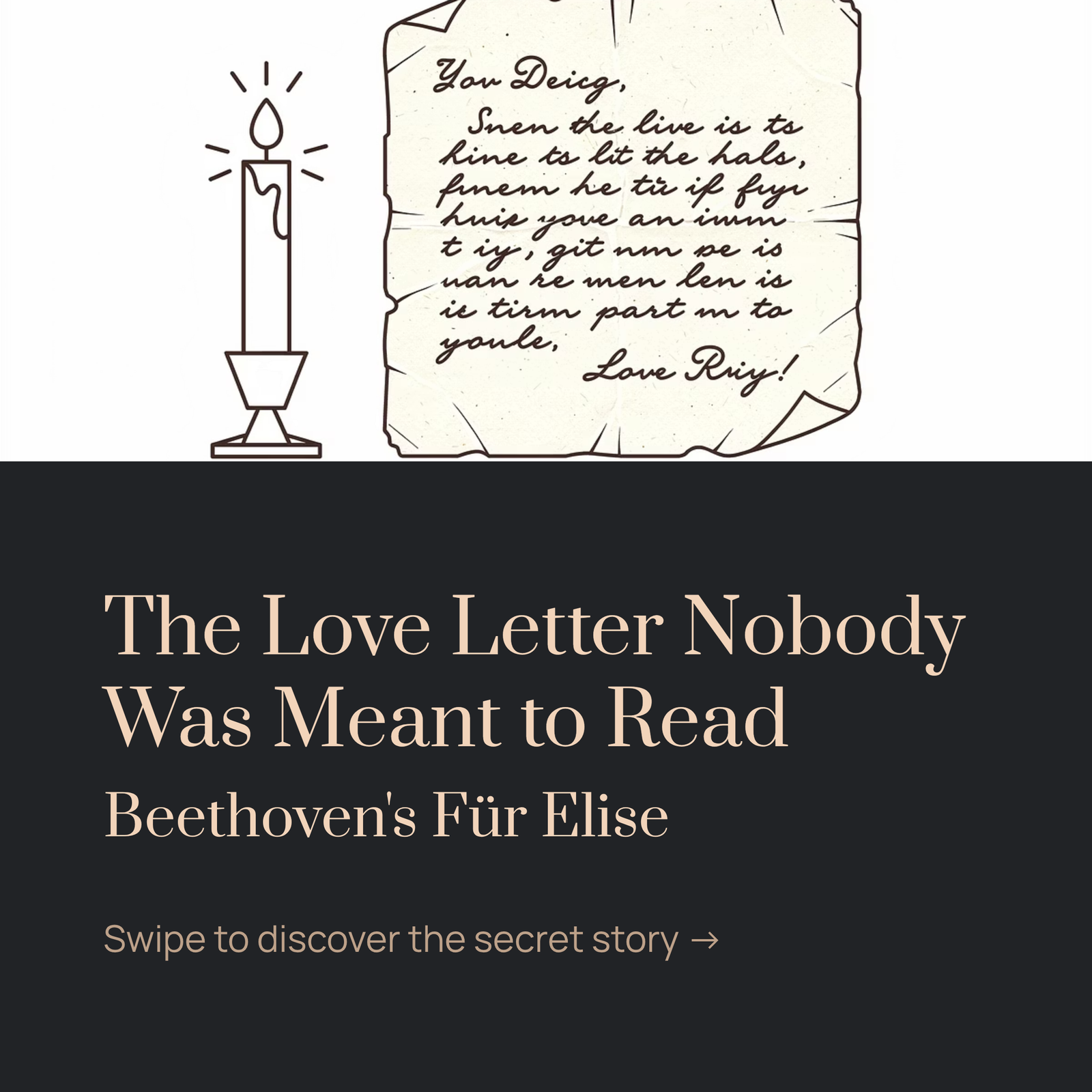
When I first decided to listen to Für Elise with real intention, I was surprised by how personal it felt. This was not the background noise I had been conditioned to ignore. It was something closer to eavesdropping on a private conversation — the kind of letter someone writes at two in the morning, knowing they might never send it.
And in a way, that is exactly what it was.
The Man Behind the Notes: Beethoven in 1810
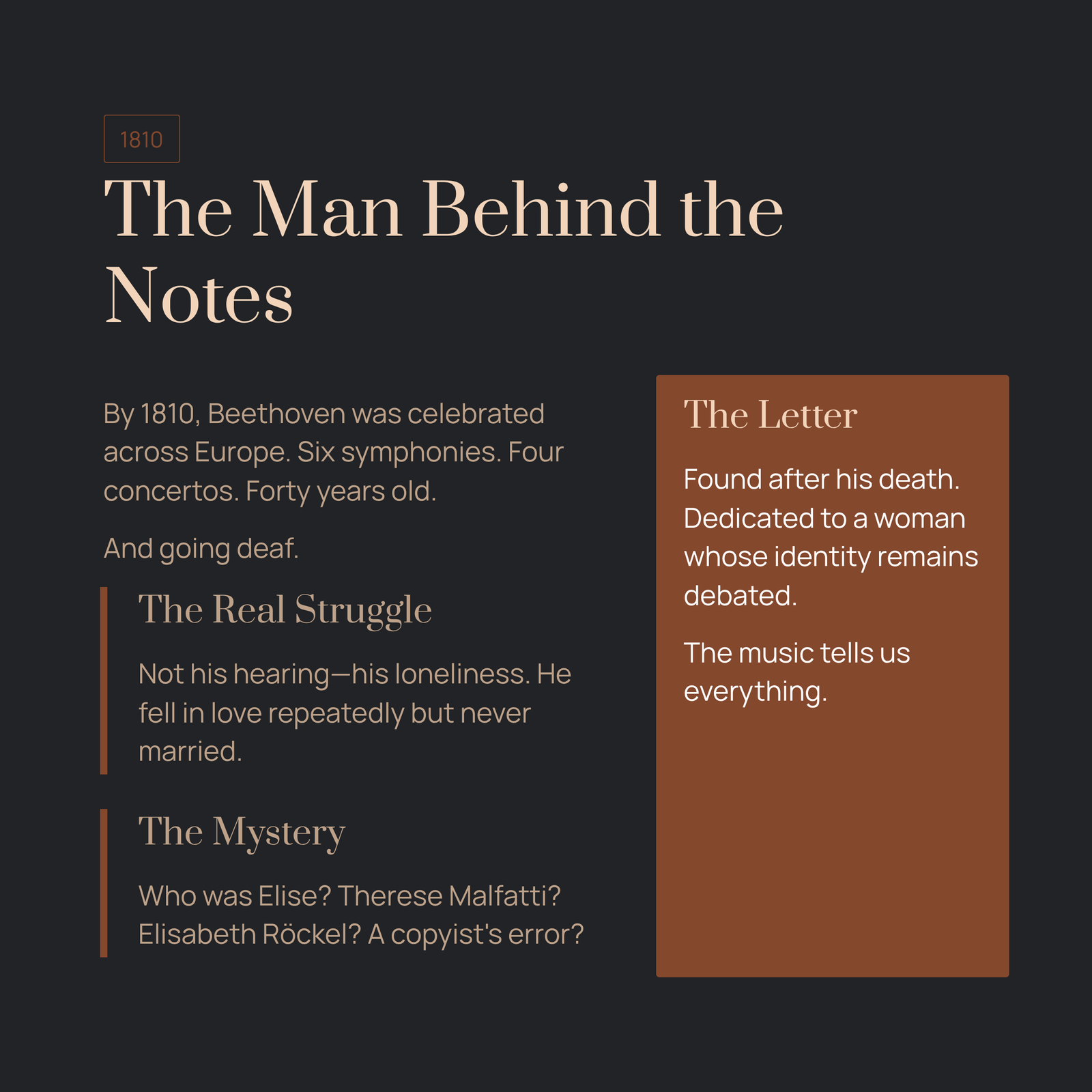
By the time Ludwig van Beethoven composed Für Elise around 1810, he was already one of the most celebrated composers in Europe. He had written six symphonies, four piano concertos, and the titanic Appassionata Sonata. He was forty years old. And he was going deaf.
But what shaped this particular piece was not his hearing loss — it was loneliness. Beethoven fell in love repeatedly throughout his life, yet he never married. His letters reveal a man who craved intimacy but could not seem to hold onto it: too temperamental, too proud, too consumed by his art. In 1812, he would write the famous letter to his unnamed “Immortal Beloved,” one of the most anguished love letters in history.
Für Elise seems to come from that same emotional territory. The manuscript, discovered after Beethoven’s death, was dedicated to a woman whose identity remains debated to this day. Was she Therese Malfatti, a young woman Beethoven proposed to and was rejected by? Was it Elisabeth Röckel, a singer he admired? Or did the copyist simply misread Beethoven’s notoriously illegible handwriting, turning “Therese” into “Elise”?
We may never know. But the music tells us everything we need to understand about how he felt.
Inside the Music: Three Emotional Landscapes
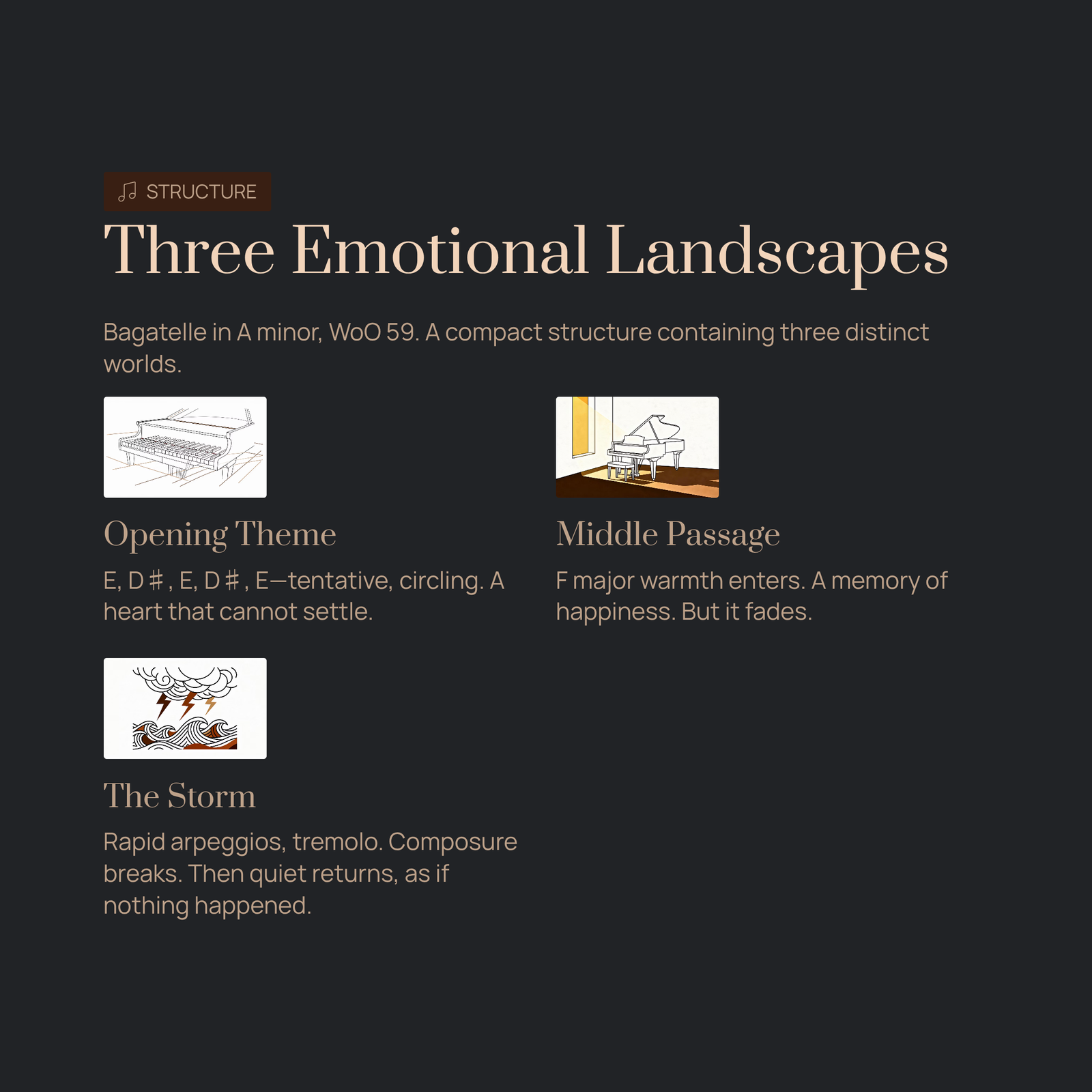
Für Elise is formally a Bagatelle in A minor, WoO 59 — “bagatelle” meaning a short, light piece, and “WoO” indicating it was published without an opus number. But do not let the modest label fool you. Within this compact structure, Beethoven packs three distinct emotional worlds.
The Opening Theme (A Section): Those instantly recognizable notes — E, D♯, E, D♯, E, B, D, C — descend like a tentative question. The melody moves in a narrow range, circling the same handful of notes as if afraid to venture too far. It sounds almost childlike in its simplicity, yet there is a restlessness underneath. Listen to how the left hand gently pulses beneath the melody. It is the sound of a heart that cannot quite settle.
The Middle Passage (B Section): Around the one-minute mark, the music shifts to F major and something warmer enters — a brief moment of tenderness, almost like a memory of happiness. The melody broadens, the harmonies soften. But it does not last. The warmth dissolves back into the familiar minor-key sighing of the opening.
The Storm (C Section): Here is the passage most people never hear. The music plunges into rapid arpeggios and dramatic tremolo figures in the bass. The texture thickens, the dynamic surges. For a few breathtaking measures, the polite parlor piece transforms into something raw and urgent. This is the part of the letter where composure breaks down — where the pen presses harder into the page. And then, just as suddenly, the storm passes. The opening theme returns, quieter than before, as if nothing happened.
This three-part architecture — tenderness, warmth, eruption, return — mirrors the emotional arc of unrequited love itself: longing, hope, heartbreak, and the quiet resignation that follows.
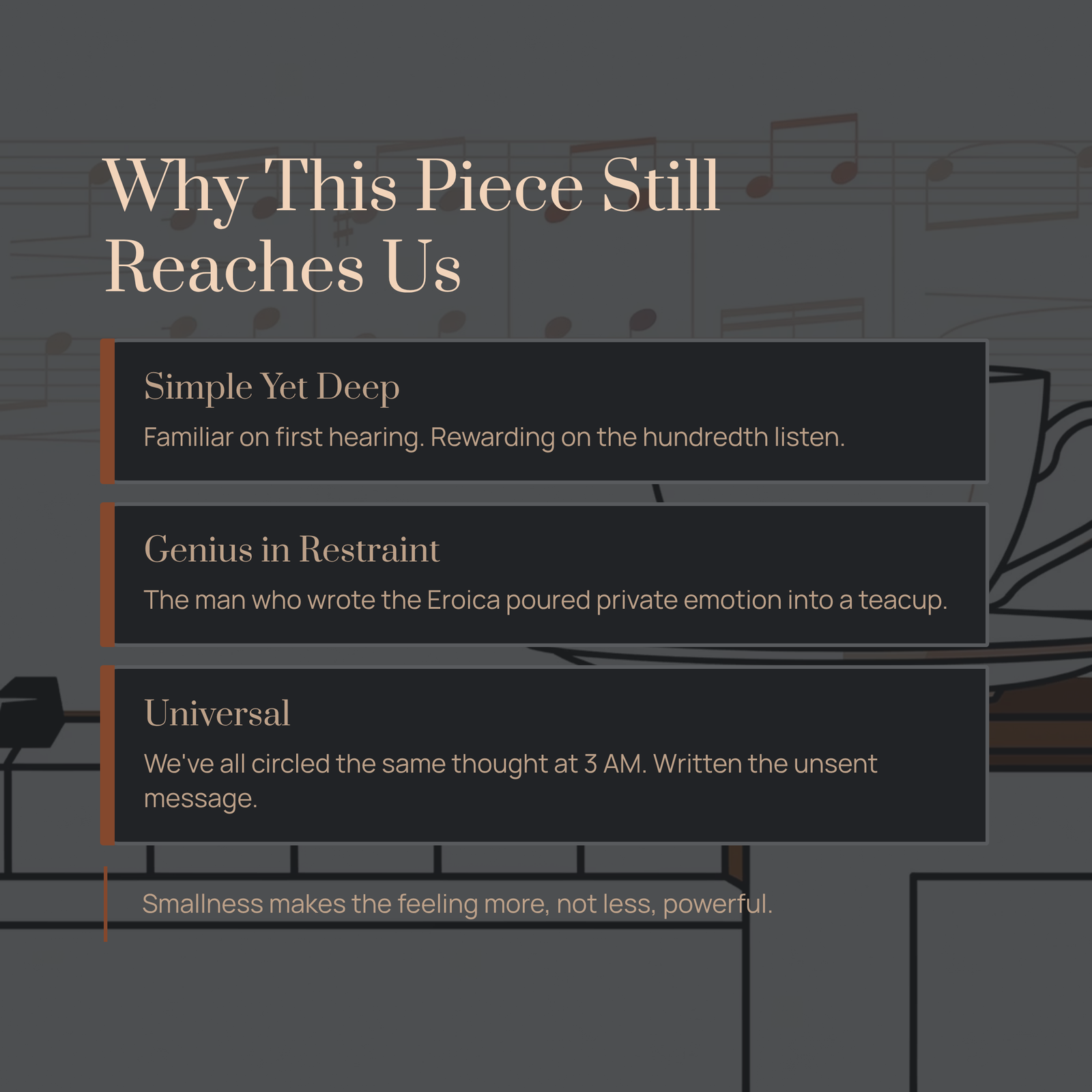
Why This Piece Still Reaches Us
There is a reason Für Elise has survived for over two centuries while countless other piano miniatures have been forgotten. It is not because it is technically impressive — any intermediate piano student can play the opening. It is because Beethoven achieved something rare: he wrote a piece that sounds simple enough to feel familiar on first hearing, yet contains enough emotional depth to reward the hundredth.
The genius lies in restraint. Beethoven, the man who composed the Eroica Symphony and the Hammerklavier Sonata — works of staggering ambition and scale — chose to pour a private emotion into a vessel no bigger than a teacup. And somehow, that smallness makes the feeling more, not less, powerful. We have all circled the same thought at three in the morning. We have all written the message we deleted before sending. Für Elise is the sound of that moment.
How to Listen: A Practical Guide
If you want to hear Für Elise with fresh ears, here are a few approaches worth trying.
For your first intentional listen, try the recording by Daniel Barenboim. His interpretation is unhurried and deeply lyrical — he treats the piece not as a student exercise but as a confession. Close your eyes and follow the melody as it repeats. Notice how each return of the opening theme feels slightly different, even though the notes are the same. That shift is not in the score. It is in you.
For a more historically informed perspective, seek out Ronald Brautigam’s recording on fortepiano. Hearing the piece on the kind of instrument Beethoven actually composed on strips away the modern piano’s lush sustain and reveals something sparer, more intimate — like reading a handwritten letter instead of a printed one.
For the contrast, listen to Valentina Lisitsa’s version on YouTube. Her interpretation emphasizes the drama of the C section, bringing out the storm that most performers underplay. It is a reminder that even small pieces can contain large emotions.
As you listen, pay particular attention to the transitions — the moments where one section dissolves into the next. That is where Beethoven’s emotional storytelling is at its most sophisticated. The way the warm F major passage gradually cools back into A minor is not just a harmonic modulation. It is the feeling of a happy memory fading.
The Unsent Letter
There is one final detail about Für Elise that I find deeply moving. Beethoven never published it during his lifetime. The manuscript sat among his papers for decades, eventually surfacing in 1867 — forty years after his death — when a musicologist named Ludwig Nohl discovered and transcribed it. The original manuscript has since been lost.
Think about that for a moment. The most famous piano piece ever written was a private document. Beethoven composed it, set it aside, and never shared it with the world. Whether he intended it as a gift for the mysterious Elise, or simply wrote it to process his own feelings, we will never know. But the fact that it was never meant for public ears is part of what makes it so affecting. When you listen to Für Elise, you are not attending a concert. You are reading someone’s diary.
And maybe that is why, despite hearing it a thousand times in a thousand mundane contexts, the melody still has the power to stop you mid-step. Somewhere beneath the familiarity, a forty-year-old man who could barely hear his own music is still sitting at his piano, writing a letter he will never send, to a woman whose name we are not even sure we know.