📑 Table of Contents
Imagine writing something so extraordinary that the world ignores it for over a hundred years. Then, one day, a stranger picks it up, rewrites it in their own hand, and suddenly the whole world thinks it’s the most beautiful thing ever composed. That is the strange, almost unfair story of Bach’s Air on the G String.
Johann Sebastian Bach composed the original Air—the second movement of his Orchestral Suite No. 3 in D major, BWV 1068—sometime around 1731. It was a brief, luminous slow movement nestled between more energetic dances: overtures, gavottes, bourrées. In its original scoring for strings and continuo, it was lovely, certainly, but it didn’t stand apart from the rest of the suite. It was simply one movement among several, written for an ensemble at the court of a minor German prince.
For well over a century, it stayed that way—buried, unheard, waiting.
The Man Who Gave It a Second Life
In 1871, the German violinist August Wilhelmj did something audacious. He took Bach’s Air, transposed it down from D major to C major, and arranged the entire melody so that it could be played on a single string—the lowest string of the violin, the G string. It was a technical stunt, a showpiece designed to demonstrate the richness and warmth a solo violin could produce in its deepest register.
And it worked beyond anyone’s expectation.
The arrangement stripped away the orchestral texture and left only that long, unhurried melody, singing low and alone. Audiences were mesmerized. The piece began its slow climb from obscurity to ubiquity. Within decades, it had become the piece people thought of when they heard the name Bach—even though Bach himself never wrote it in that form.
This is worth sitting with for a moment. The version of this music most people know and love is, in a sense, a collaboration across centuries: Bach’s melodic genius filtered through Wilhelmj’s theatrical instinct. The Air on the G String is not exactly Bach’s. It is not exactly Wilhelmj’s. It belongs to the space between them.
What Makes This Melody So Disarmingly Simple—and So Impossible to Forget
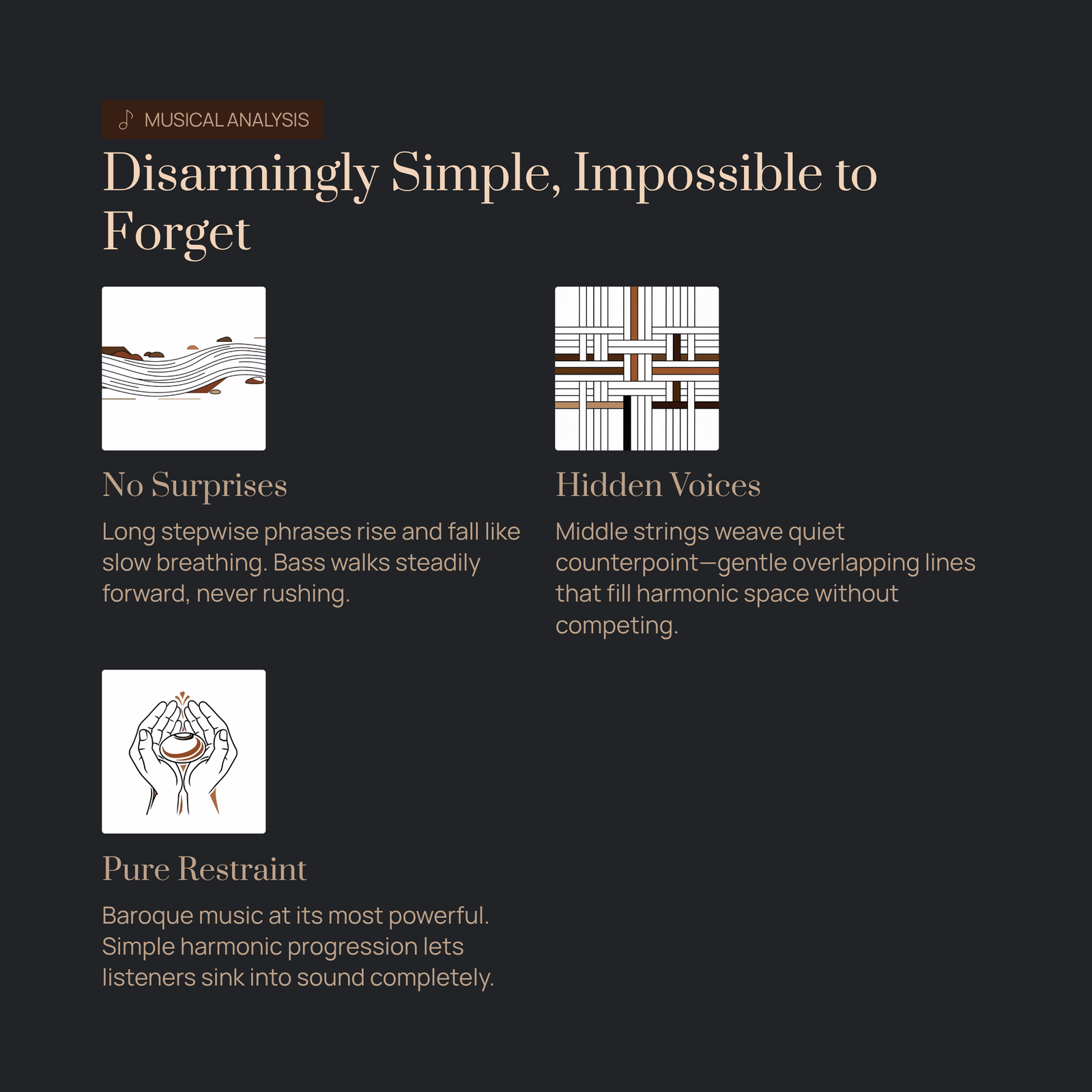
If you listen closely to the Air, you’ll notice something unusual: almost nothing happens. There are no dramatic crescendos, no sudden shifts in tempo, no virtuosic fireworks. The melody moves in long, stepwise phrases, rising and falling like slow breathing. The bass line beneath it walks steadily forward, one note at a time, never rushing.
This is Baroque music at its most restrained and its most powerful. Bach builds the entire movement on a simple harmonic progression—chords that resolve predictably, almost inevitably, into one another. There is no surprise. And yet, precisely because there is no surprise, the listener is free to sink into the sound completely.
Think of it this way: a river with rapids demands your attention. You watch, you brace, you react. But a river that moves slowly and steadily—that’s the one you can stare into until you lose yourself. The Air is that kind of music. It doesn’t ask you to listen. It asks you to let go.
The inner voices deserve attention, too. While the melody floats on top and the bass walks below, the middle strings weave a quiet counterpoint—gentle, overlapping lines that fill the harmonic space without ever competing for attention. This is where Bach’s craftsmanship reveals itself most clearly. Every voice has its own logic, its own direction, and yet they all breathe together as one.
A Confession from the Listening Chair
I first heard the Air on the G String in a waiting room. I don’t remember what I was waiting for—probably something forgettable, a routine appointment. But I remember the music. It came through a low-quality speaker, tinny and compressed, and still it stopped me.
There’s a particular quality to this piece that I’ve never quite been able to name. It isn’t sadness, exactly, though it borders on it. It isn’t joy, though there’s a warmth in it that feels close to contentment. The closest word I can find is tenderness—as though someone is holding something fragile and choosing, moment by moment, not to let go.
Over the years, I’ve returned to the Air at very different moments: late nights when sleep wouldn’t come, early mornings when the world felt too loud before it had even begun, afternoons when I simply needed three minutes of stillness. It never sounds the same twice. It meets you wherever you are, and it doesn’t ask you to be anywhere else.
That, I think, is the rarest gift a piece of music can offer.
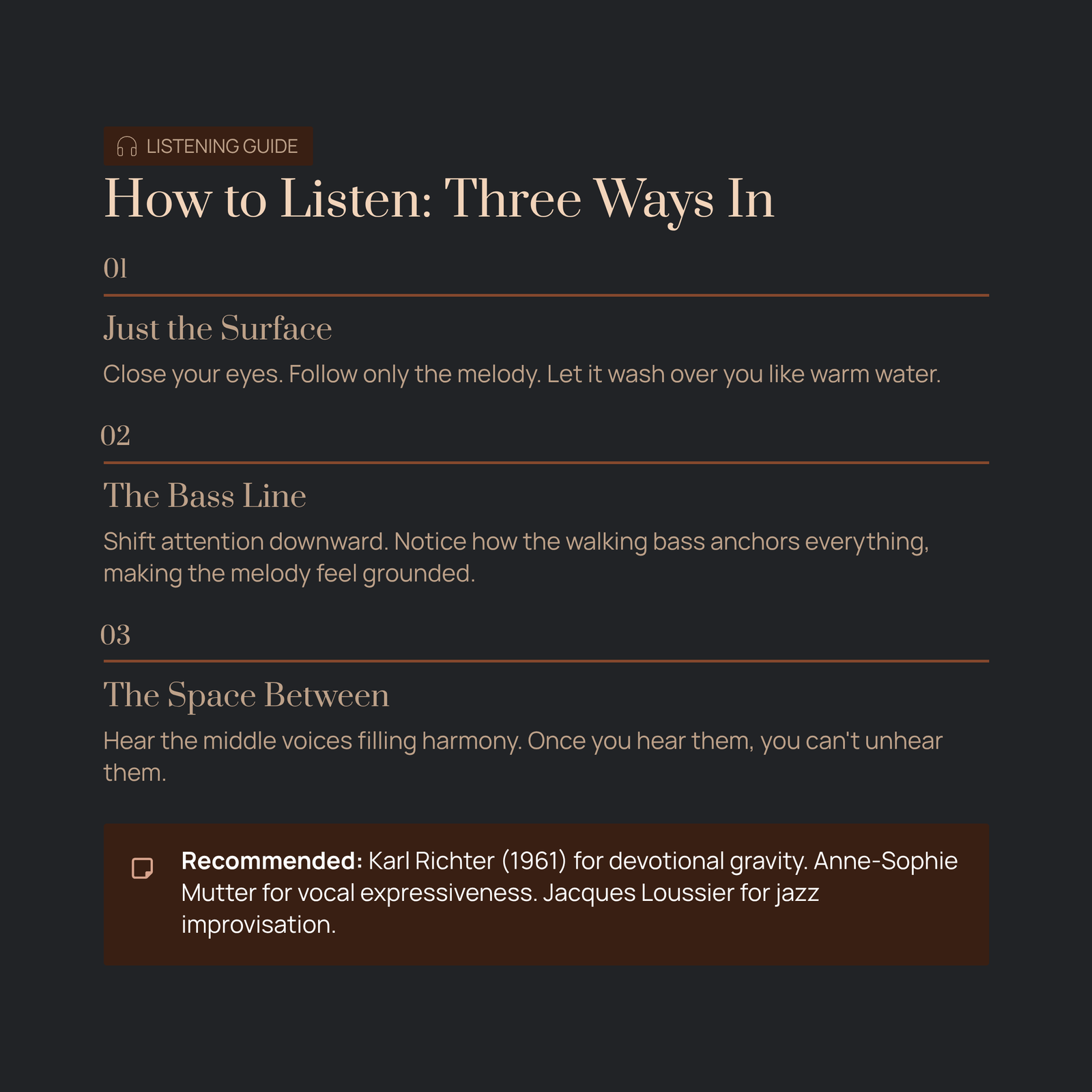
How to Listen: Three Ways In
First listen—just the surface. Put on a recording, close your eyes, and follow only the melody. Don’t analyze. Don’t think about history or theory. Let it wash over you the way warm water does. Notice how the phrases breathe—how each one rises gently and then settles back down. This is the simplest and perhaps the most important way to hear this piece.
Second listen—the bass line. Now shift your attention downward. Listen to the lowest voice, the steady, walking bass that moves underneath the melody. Notice how it anchors everything. Without this bass, the melody would float away into abstraction. With it, the music feels grounded, almost gravitational. Try humming along with the bass instead of the melody—it changes the entire experience.
Third listen—the space between. On your third pass, try to hear the middle voices, the inner strings that fill the harmony. These are the voices most listeners never consciously notice, but they are the reason the piece feels so full and so warm. Once you hear them, you can’t unhear them. The Air becomes a conversation, not a solo.
Recommended recordings: Karl Richter’s 1961 version with the Munich Bach Orchestra captures the devotional gravity of the original suite. For the solo violin arrangement, Anne-Sophie Mutter’s recording brings an almost vocal expressiveness to Wilhelmj’s version. And if you want something unexpected, try Jacques Loussier’s jazz trio interpretation—it reveals the improvisational potential hiding inside Bach’s harmonies all along.
Why Three Minutes of Stillness Still Matters
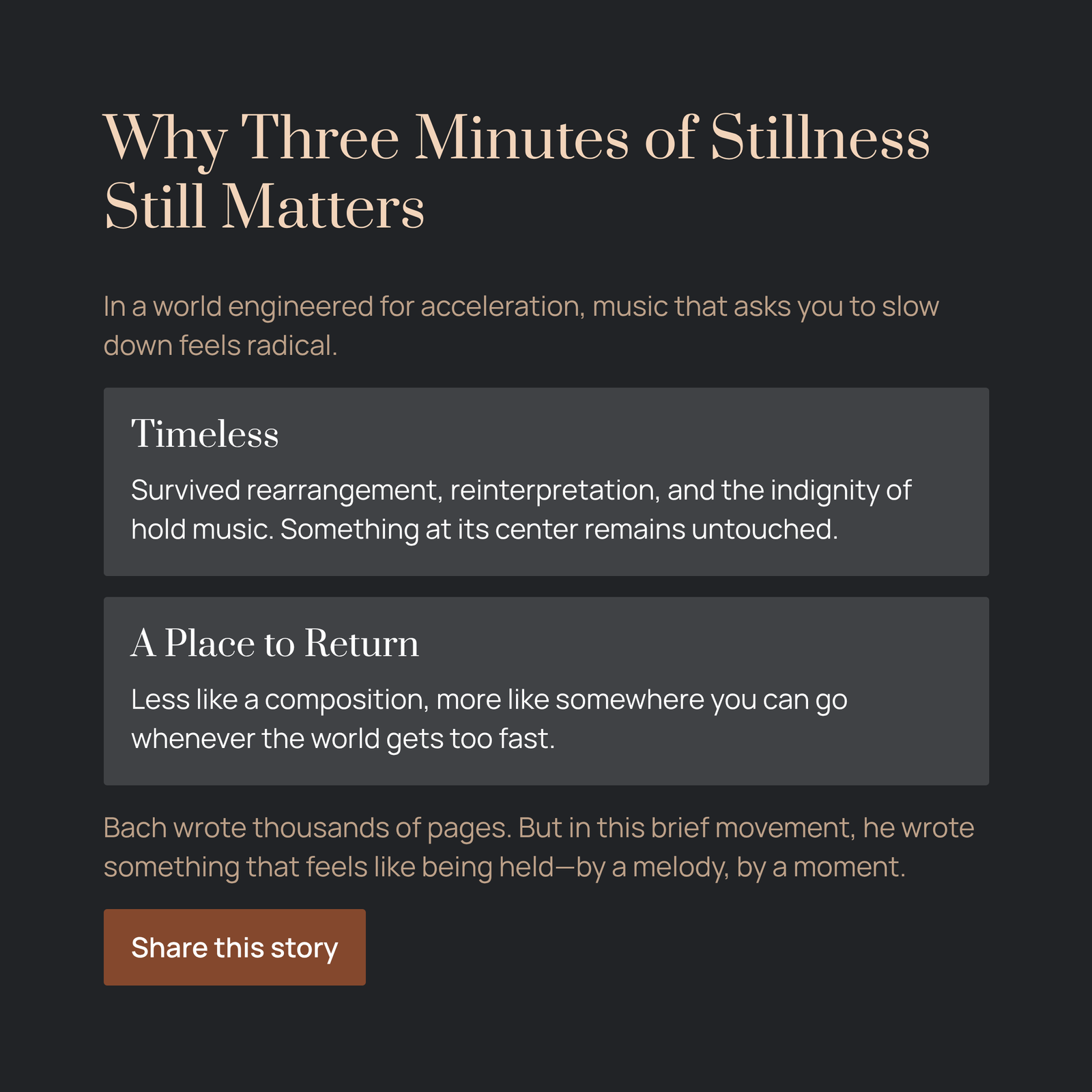
We live in a world engineered for acceleration. Every notification, every algorithm, every scrolling feed is designed to move us faster, to the next thing, and the next. Against this backdrop, a piece of music that asks you to slow down—to simply breathe and listen—feels almost radical.
Bach didn’t know he was writing music for the twenty-first century. He was writing for a court, for an evening, for a moment that would pass and never return. But the Air on the G String has outlasted its occasion, its century, its original form. It has survived rearrangement, reinterpretation, and the indignity of being used as hold music and advertising soundtracks. And through all of it, something at its center remains untouched.
Perhaps that’s because the Air isn’t really about music at all. It’s about the experience of being held—by a melody, by a moment, by the quiet insistence that some things are worth slowing down for. Bach wrote thousands of pages of music in his lifetime. But in this one brief movement, he wrote something that feels less like a composition and more like a place you can return to whenever the world gets too fast.
And it will always be there, waiting, unhurried, on that single low string.