📑 Table of Contents
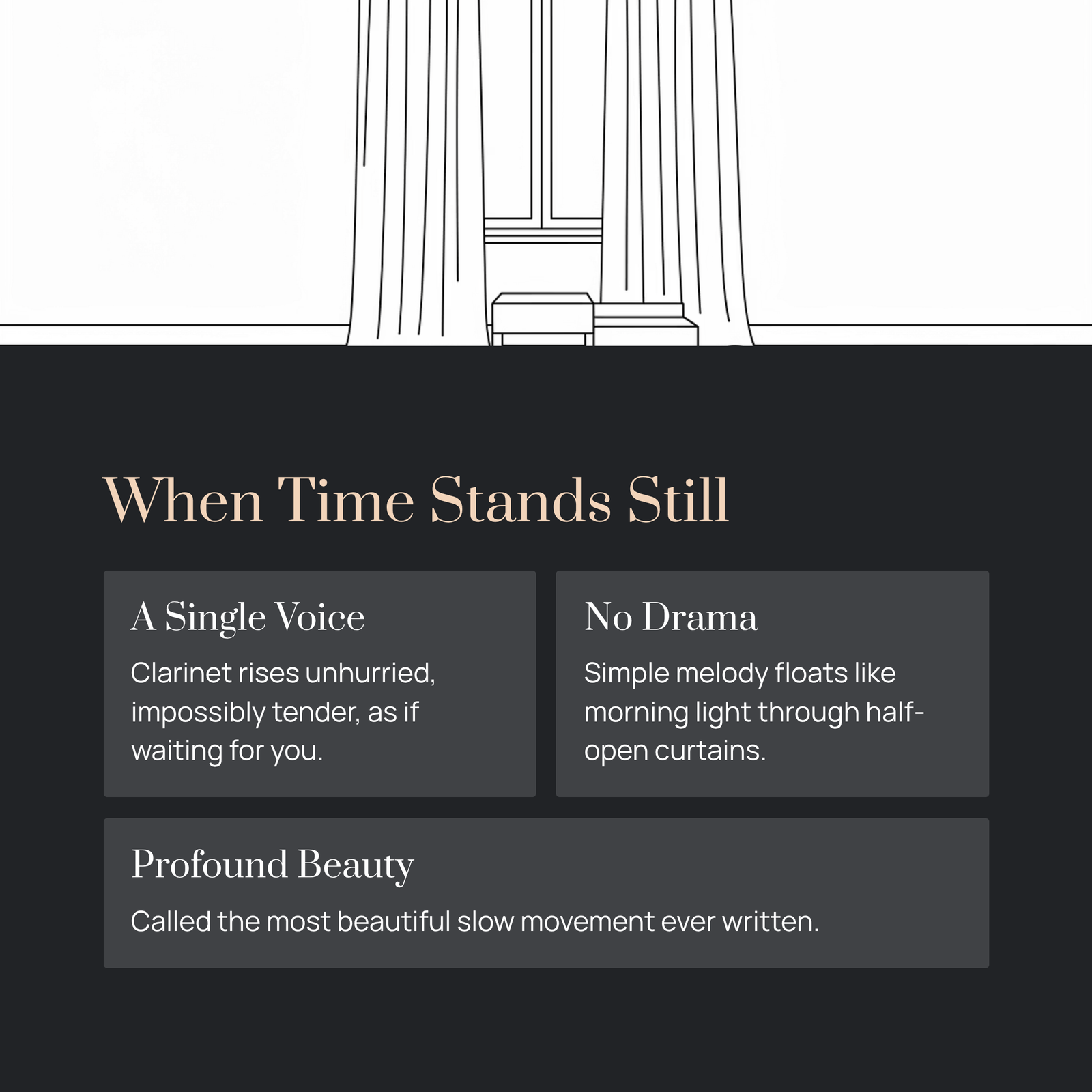
There are moments in music where time seems to lose its grip. The room goes still. Your breath slows without you noticing. And then a single clarinet voice rises — unhurried, impossibly tender — as if it has always been there, waiting for you to finally hear it.
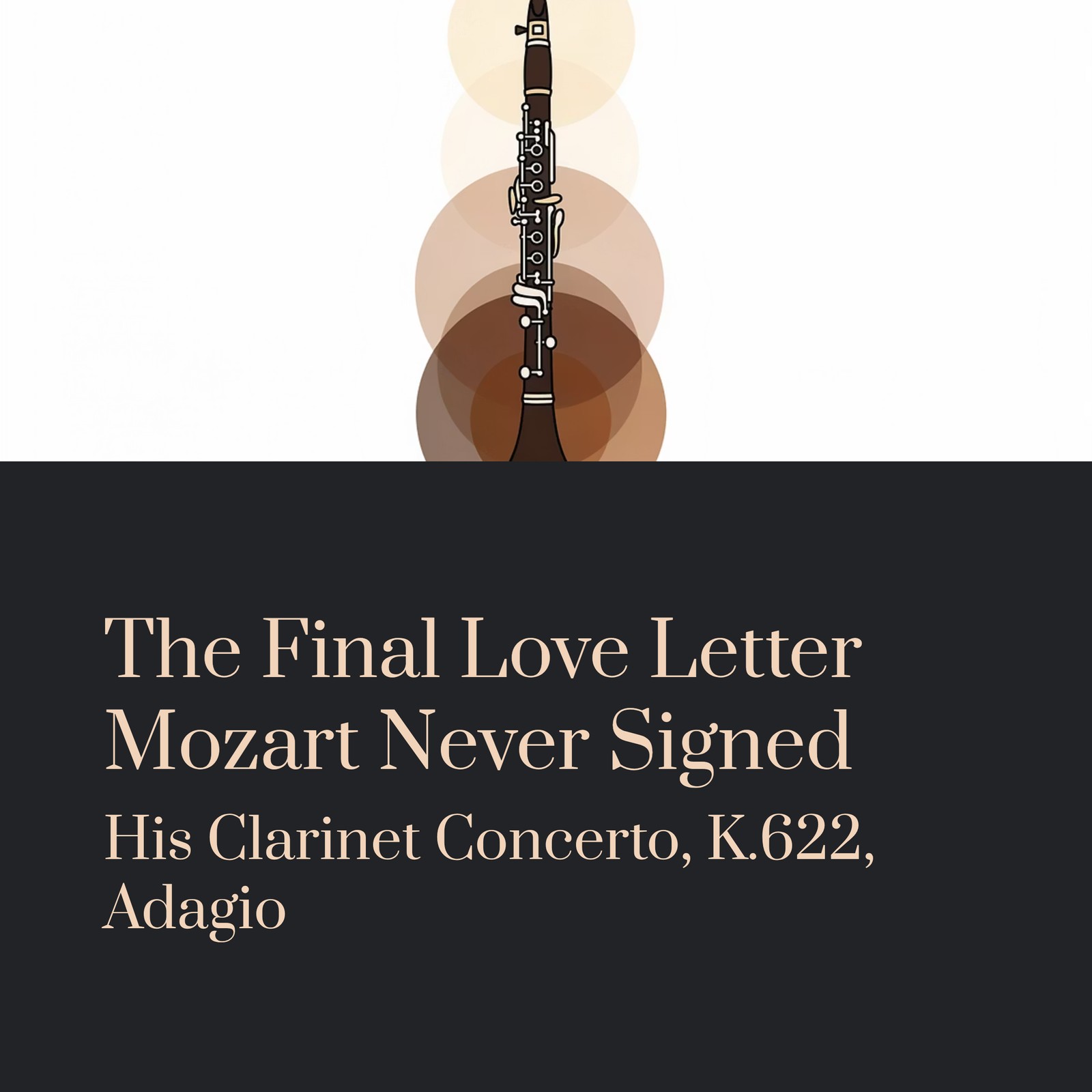
That is what happens when the second movement of Mozart’s Clarinet Concerto in A Major, K.622, begins.
No dramatic entrance. No thunderous orchestral buildup. Just a simple, singing melody that floats in like the first light of morning through half-open curtains. And yet, within its quiet simplicity lies something so profoundly moving that even seasoned musicians struggle to explain why it brings them to the edge of tears.
This piece has been called the most beautiful slow movement ever written. That’s a bold claim. But spend five minutes with this Adagio — truly spend them, with nothing else competing for your attention — and you might find it difficult to argue.
The Man Behind the Notes: Mozart in His Final Autumn
To understand why this music sounds the way it does, you need to know when it was written.
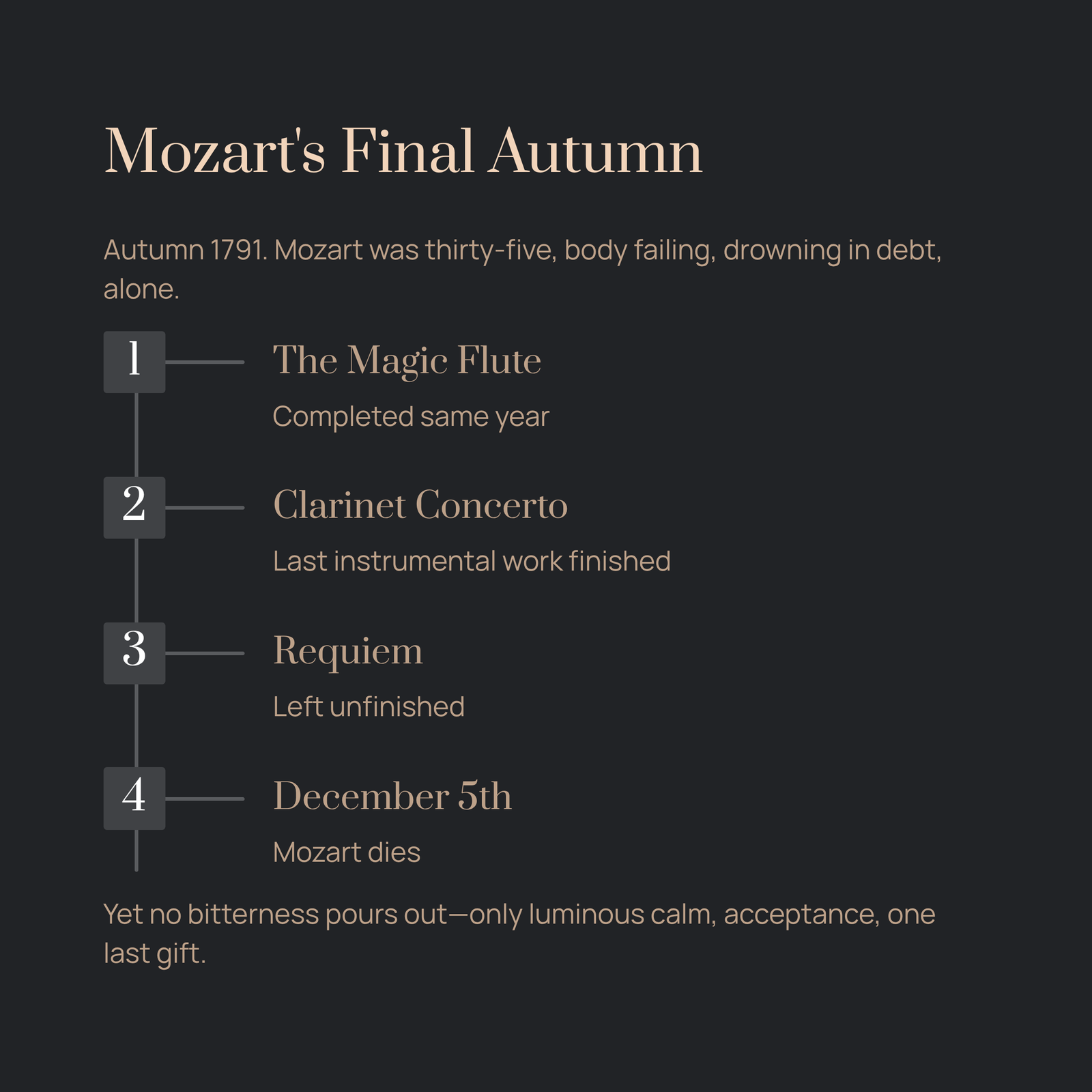
It was the autumn of 1791. Wolfgang Amadeus Mozart was thirty-five years old, though by every account he looked and felt much older. His body was failing — plagued by fevers, swelling, and an exhaustion that no amount of rest could cure. He was drowning in debt. His wife Constanze was away at a spa, seeking treatment for her own ailments. He was, in many ways, alone.
And yet, remarkably, Mozart was composing at a furious pace. That same year saw the completion of The Magic Flute, the unfinished Requiem, and this — his Clarinet Concerto. It was the last instrumental work he would ever finish. He would be dead by December 5th.
But here is what makes this piece extraordinary: there is no bitterness in it. No rage against fate. No self-pity. If you didn’t know the circumstances, you would never guess that a dying man wrote this music. Instead, what pours out of every measure is acceptance — a luminous, almost otherworldly calm, as if Mozart had already made peace with everything and was simply offering the world one last gift.
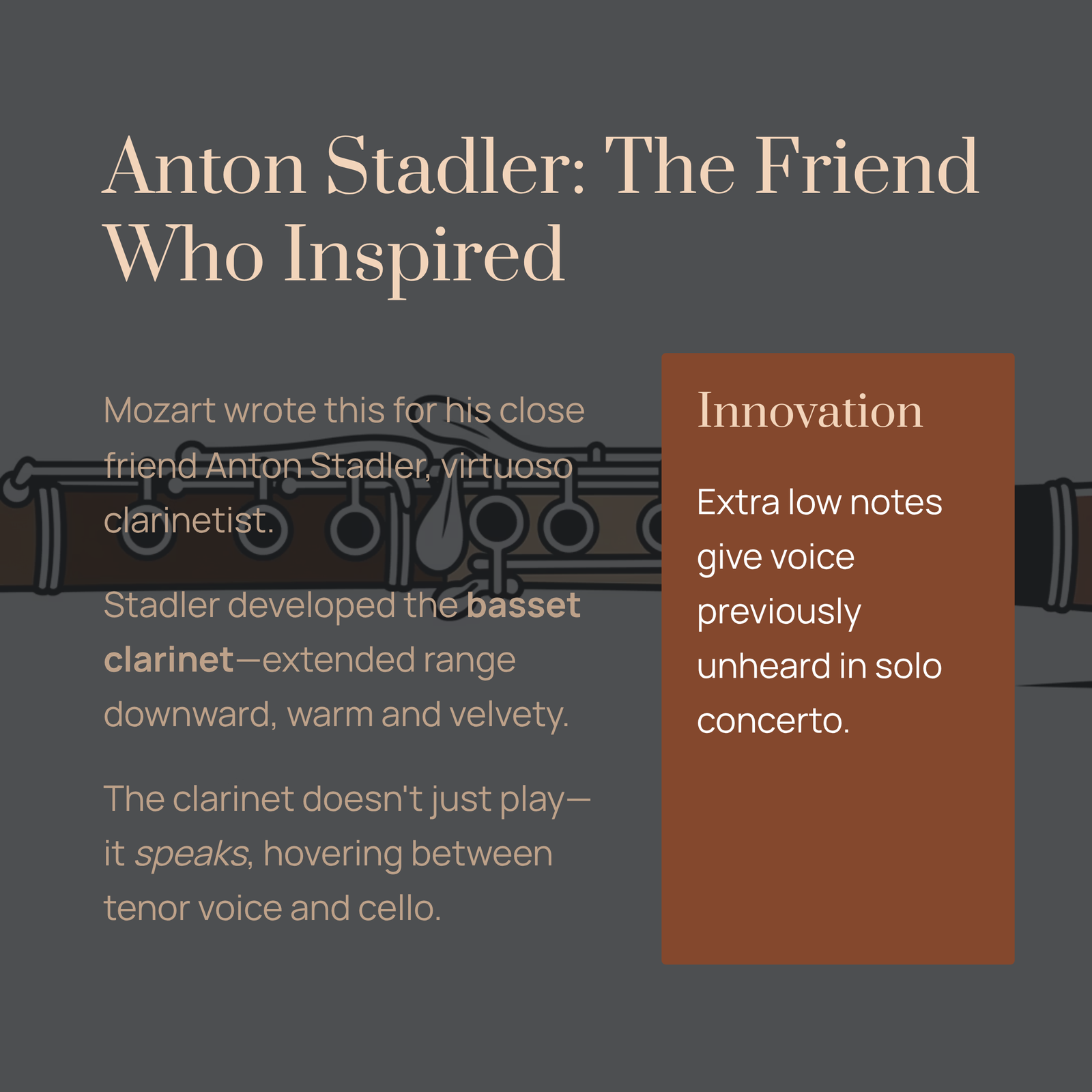
Anton Stadler: The Friend Who Inspired a Masterpiece
Mozart didn’t write this concerto for an abstract instrument. He wrote it for a specific person — his close friend Anton Stadler, a virtuoso clarinetist in the Viennese court orchestra.
Stadler was not just a gifted player; he was an innovator. He had developed a modified version of the clarinet called the basset clarinet, which extended the instrument’s range downward by several notes. This deeper register — warm, dark, and velvety — fascinated Mozart. He wrote the concerto specifically to exploit these extra low notes, giving the clarinet a voice that could sing in registers previously unheard in a solo concerto.
This matters because it changes how you hear the Adagio. The clarinet doesn’t just play a melody here — it speaks. It inhabits a tonal space that feels almost human, hovering somewhere between a tenor voice and a cello, with an intimacy that neither can quite match. When the clarinet descends into those low basset notes, it’s like someone leaning in close to whisper something they’ve never told anyone.
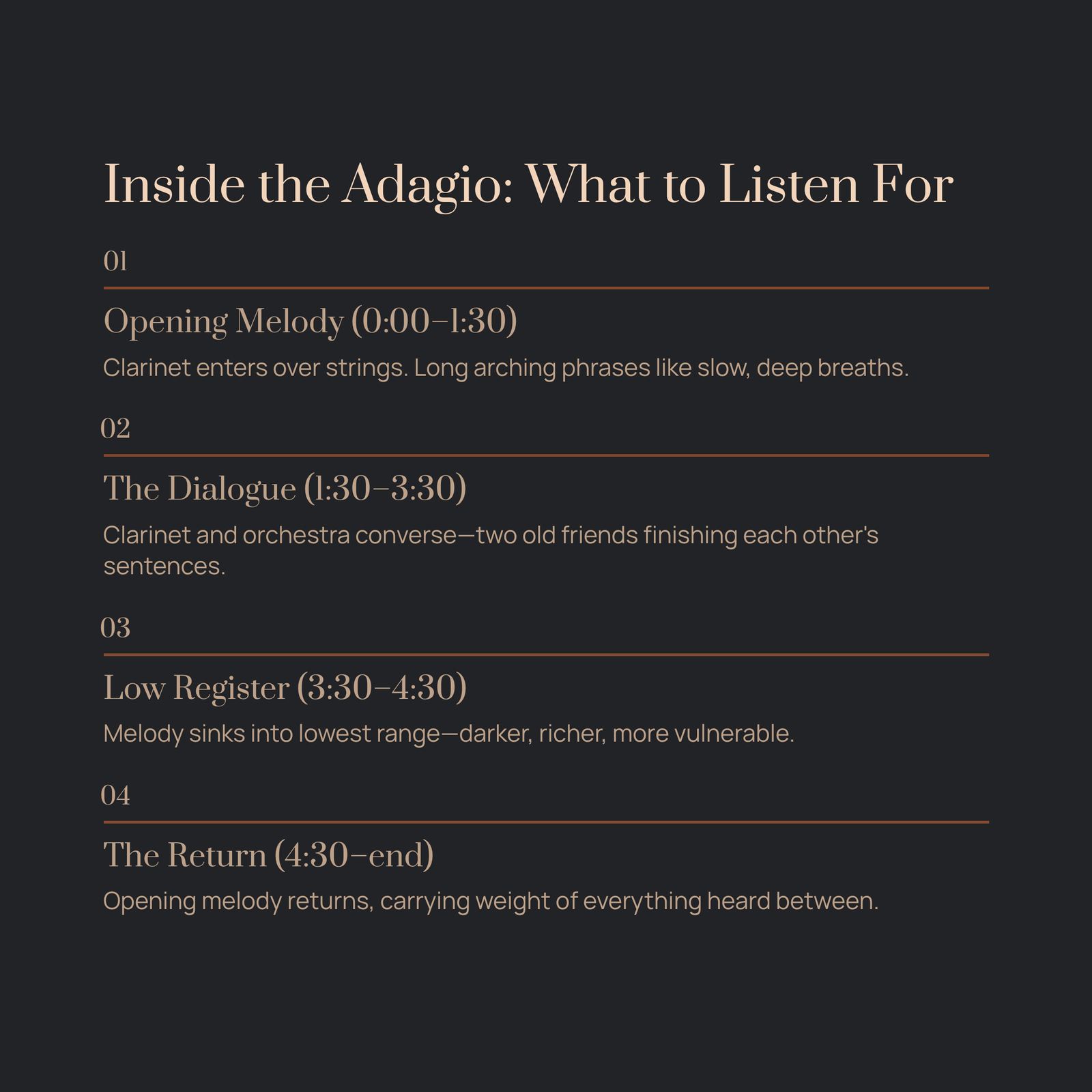
Inside the Adagio: What to Listen For
You don’t need to read sheet music to appreciate this movement, but knowing a few things about its structure will deepen your experience enormously.
The opening melody (0:00–1:30): The clarinet enters alone over a gentle orchestral cushion of strings. The melody is in D major — a key Mozart often associated with warmth and trust. Notice how the melody moves in long, arching phrases, like slow, deep breaths. There are no sudden leaps or virtuosic fireworks. Every note feels inevitable, as if the melody could only have gone exactly where it goes.
The dialogue (1:30–3:30): Pay attention to the conversation between the clarinet and the orchestra. The strings will introduce a phrase, and the clarinet responds — sometimes echoing, sometimes transforming what the strings have said. It’s not a debate. It’s more like two old friends finishing each other’s sentences. There’s a mutual tenderness in this exchange that makes it one of the most intimate passages in all of classical music.
The descent into the low register (around 3:30–4:30): This is where Stadler’s basset clarinet makes its presence felt. The melody sinks into the instrument’s lowest range, and the color of the sound changes completely — darker, richer, more vulnerable. If the higher passages feel like gazing at a sunset, these low notes feel like the quiet that follows. Let yourself sink into them.
The return (4:30–end): The opening melody comes back, but something has shifted. It sounds the same on the surface, yet it carries the weight of everything you’ve heard in between. This is Mozart’s genius — the melody hasn’t changed, but you have.
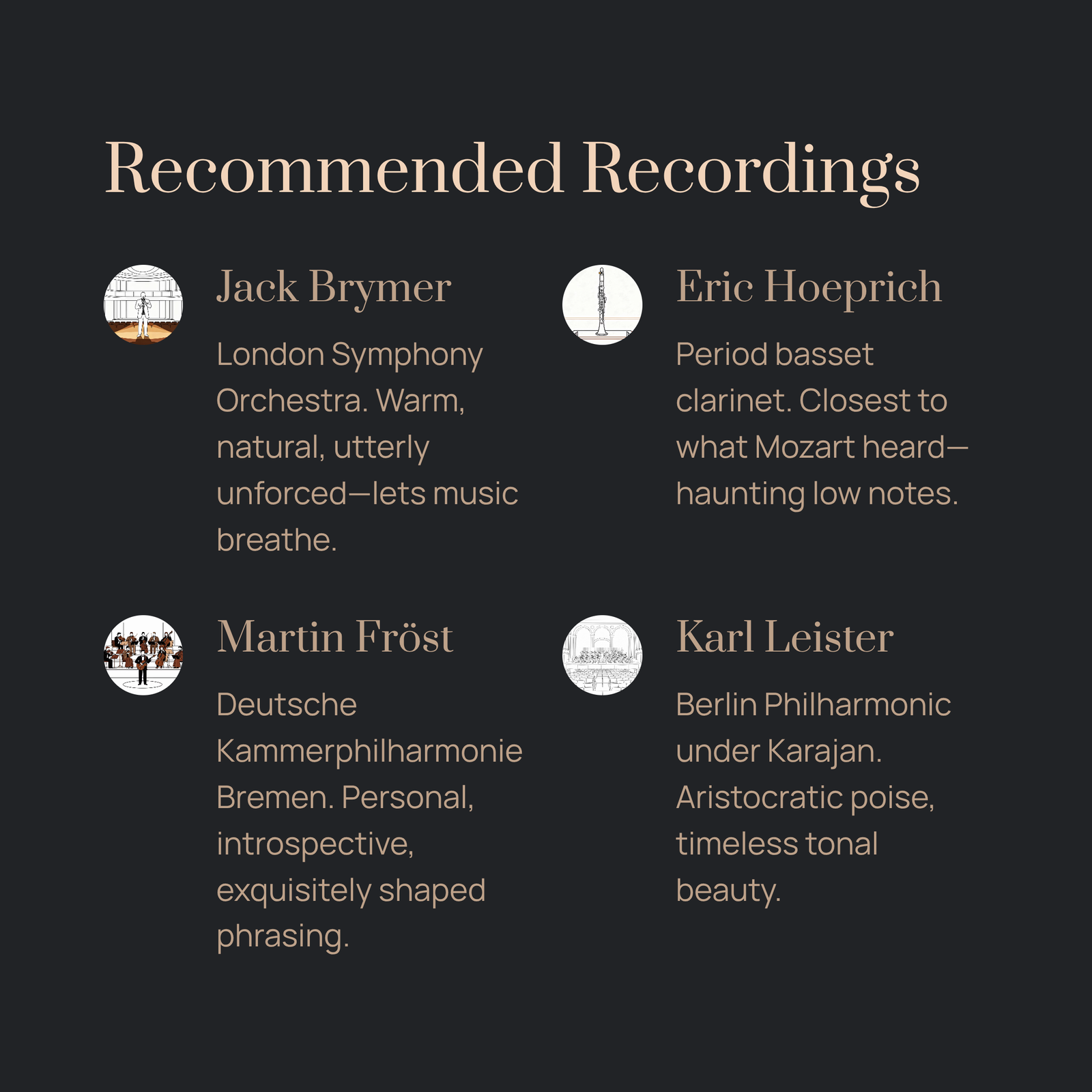
Recommended Recordings: Where to Start
The choice of performer matters deeply with this piece, because every clarinetist brings a different emotional temperature to it.
For your first listen: Try Jack Brymer with the London Symphony Orchestra conducted by Sir Colin Davis. Brymer’s tone is round, warm, and utterly unforced — he lets the music breathe without imposing anything on it. This is perhaps the most “natural” recording of the piece.
For historical authenticity: Eric Hoeprich performs on a period basset clarinet, giving you the closest approximation of what Mozart and Stadler actually heard. The sound is woodier, more transparent, and the extended low notes have a haunting quality that modern instruments can’t quite replicate.
For emotional depth: Martin Fröst with the Deutsche Kammerphilharmonie Bremen brings a slightly more personal, introspective quality. His phrasing is exquisitely shaped, with subtle dynamic shadings that reveal new details even on the tenth listen.
For a timeless classic: Karl Leister with the Berlin Philharmonic under Herbert von Karajan. Leister’s playing has an aristocratic poise and tonal beauty that suits Mozart’s elegance perfectly, and Karajan’s accompaniment is as silken as it gets.
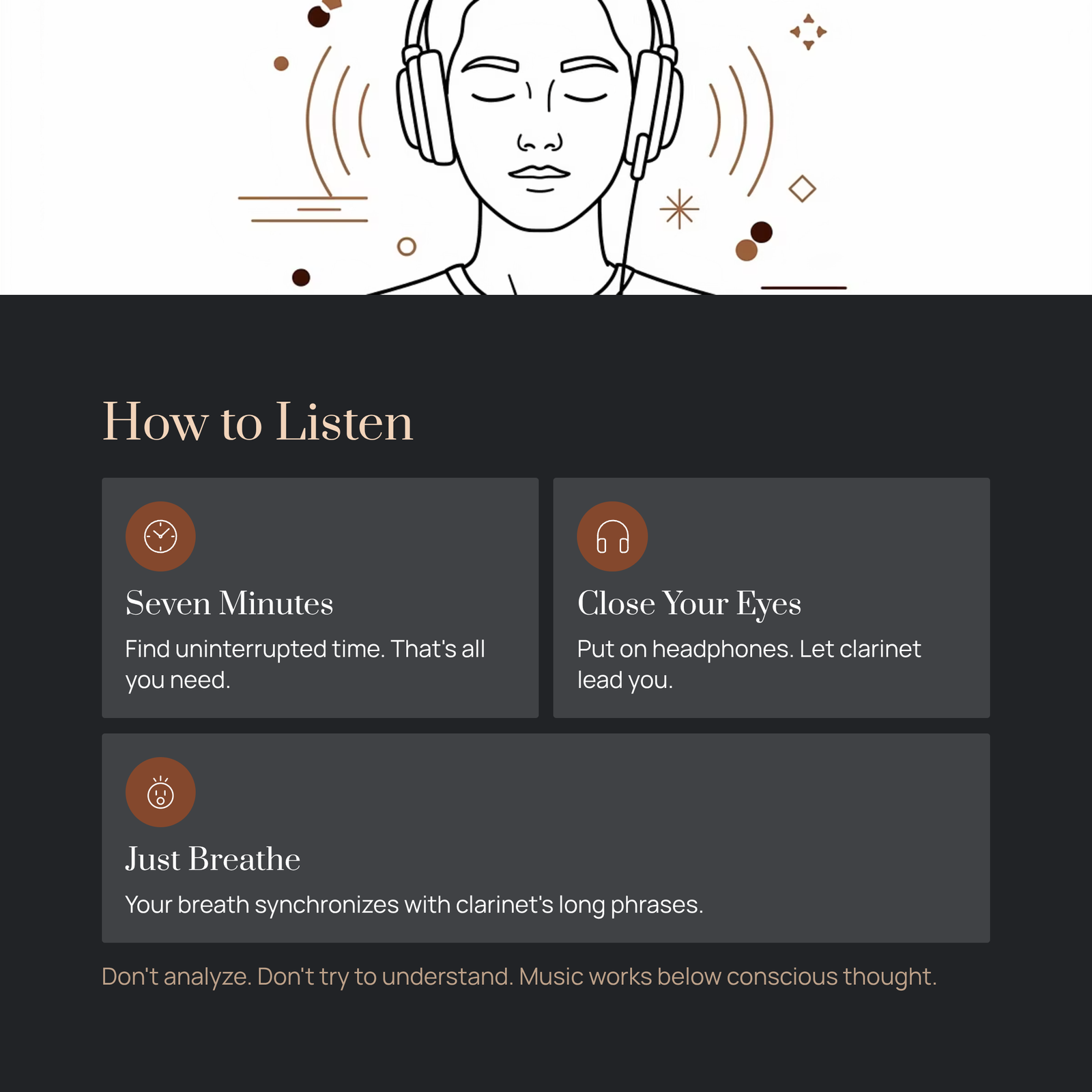
How to Listen: Creating the Right Space
This is not background music. Please don’t treat it as such — at least not the first time.
Find seven uninterrupted minutes. That’s all you need. Put on headphones if you can. Close your eyes. And just listen. Don’t analyze. Don’t try to “understand” it. Let the clarinet lead you wherever it wants to go.
You might notice that the music does something unusual to your breathing. Many listeners report that their breath unconsciously synchronizes with the clarinet’s long phrases. This isn’t accidental. Mozart’s phrasing in this movement mirrors the natural rhythm of calm, deep respiration. The music doesn’t just sound peaceful — it physically teaches your body how to be at peace.
If you find yourself moved and you’re not sure why, that’s the right response. This is music that works below the level of conscious understanding. It reaches the part of you that existed before language, before thought — the part that simply knows what beauty is.

A Farewell Disguised as a Greeting
There is a profound paradox at the heart of this Adagio. It was written by a man who was dying, yet it sounds like the most life-affirming music ever composed. It is a farewell, yet it feels like a beginning. It is the simplest thing Mozart ever wrote, yet it contains something inexhaustible.
Perhaps that is what makes it so enduring. Mozart, in his final weeks, didn’t reach for complexity or grandeur. He reached for clarity. He stripped everything away until only the essential remained — a single voice, singing a single melody, saying the one thing that matters most.
What that one thing is, the music never quite tells you in words. But after the last note fades and the silence returns, you’ll know. You’ll feel it in the space the music has opened inside you — a space that is quiet, and warm, and strangely, impossibly, full.