Table of Contents
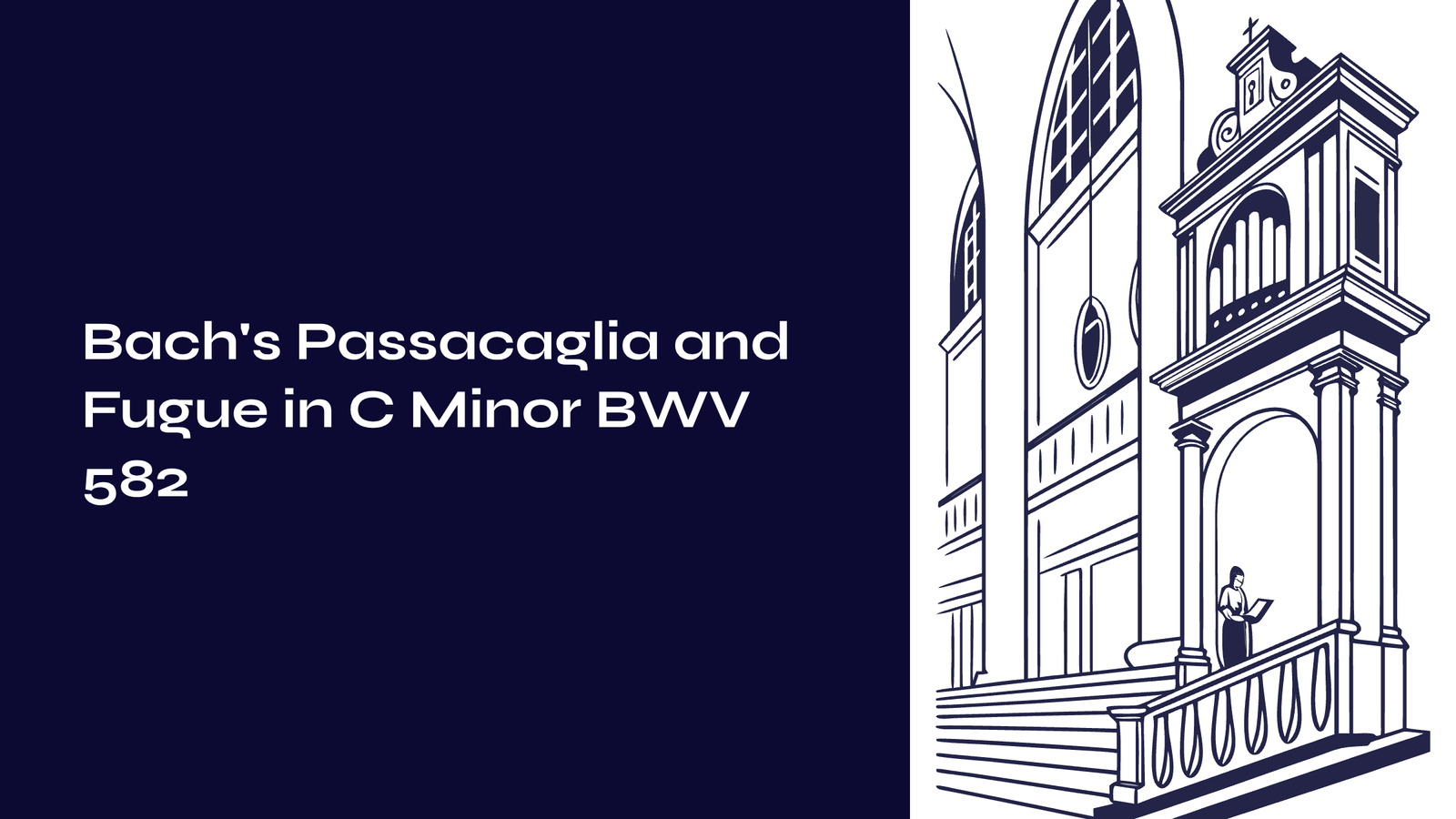
Hello! Today I’m excited to share one of classical music’s eternal masterpieces – Bach’s Passacaglia and Fugue in C Minor, BWV 582. Though composed about 300 years ago, this piece sounds remarkably fresh and powerful even today.

What is Bach’s Passacaglia BWV 582?
Bach’s Passacaglia and Fugue in C Minor, BWV 582, is an organ work composed by Johann Sebastian Bach around 1706, when he was approximately 21 years old. This piece goes beyond beautiful music – it’s so perfectly structured that it’s often called “the textbook of music theory.”
The most fascinating aspect of this piece is how an 8-measure theme repeats for about 20 minutes, yet the upper voices create infinite variations above it. Despite the same bass line, it never gets boring and offers something new with each listening.

The Background Behind This Masterpiece
When Bach composed this piece, he was working as an organist at a small church in Arnstadt. However, between 1705 and 1706, Bach took an unofficial journey to Lübeck for about three months.
There, he met Dietrich Buxtehude, the greatest organist of the time, and learned the secrets of North German organ music from him. The church was furious about Bach’s unauthorized leave, but this trip became a crucial turning point in Bach’s musical life.
Interestingly, the theme of this piece was inspired by French composer André Raison’s work. However, Bach expanded Raison’s short piece into a monumental cosmic creation.

What is a Passacaglia? Simple Explanation
A passacaglia is a musical form originating from 17th-century Spain and Italy. Here’s the essence:
The bass repeats the same melody continuously while the upper voices create various variations above it.
Think of it like this: the foundation of a building stays the same, but you build different houses on top each time. Because the foundation is solid, infinite creativity is possible above it.
Typical passacaglias have about 4-8 variations, but Bach’s piece contains an incredible 20 variations. Moreover, each variation is so intricate and complex that musicologists continue analyzing them to this day.

Structure and Listening Points of Bach’s Passacaglia
The First 8 Measures: Theme Introduction
The piece begins with only the organ pedals – the keys played with your feet. This 8-measure melody becomes the foundation for the next 20 minutes.
The simple melody that starts on C, moves to G, E♭, and returns to C – listen very carefully when you first hear it. This is the beginning of everything.
20 Variations: Infinite Changes
Bach repeated these 8 measures 20 times, adding different upper voice melodies each time. The variations can be divided into roughly 5 sections.
Early Variations (1-4): The bass stays constant while new melodies cautiously emerge in the manual (hand-played keys).
Middle Variations (5-12): The music becomes increasingly complex as it builds toward a climax. Variation 12 is particularly significant – it’s where the entire piece reaches its peak, with all 8 voices creating an overwhelming sonic landscape.
Later Variations (13-15): After the climax, there’s a moment to breathe. These are relatively quiet, meditative variations.
Final Variations (16-20): The volume builds again as the music prepares to transition into the fugue.
The Double Fugue: Another World
Immediately after the 20th variation ends, the fugue begins seamlessly. A fugue is a musical form where multiple themes appear simultaneously, seemingly in conversation with each other.
Bach split the passacaglia theme into two parts to use as fugue subjects, and even added a new theme, creating extraordinarily complex music.
The fugue lasts about 5-7 minutes, with tension building continuously until the final transformation from C minor to C major, ending on a hopeful note.

How to Listen to Bach’s Passacaglia: A Beginner’s Guide
First Listening: Feel the Repetition
Listen very carefully to the first 1-2 minutes. You’ll feel the 8 measures repeating. First just the pedal, then the manual joins in, gradually becoming more complex.
The moment you realize “Oh, it’s the same bass but different melodies keep appearing above” – that’s when the fun begins.
Second Listening: Experience the Climax
Around the 12-minute mark, the music becomes most powerful. Here, all 8 voices resound at maximum volume – it’s truly overwhelming. Don’t miss this moment.
Third Listening: Feel the Fugue Transition
Around the 15-minute mark, the atmosphere suddenly changes. Faster notes appear, multiple themes progress simultaneously, and the music becomes more complex. Notice when you think “Ah, this is the fugue now.”

Recommended Recordings of Bach’s Passacaglia
Listening to the original organ version is best. Search “Bach Passacaglia and Fugue C minor BWV 582” on YouTube to find many performances.
Recommended Performers:
– Karl Richter: Traditional, classical interpretation
– Reitze Smits: 2020 Netherlands Bach Society recording, very clear and precise
– Helmut Walcha: Deep interpretation in the German tradition
Orchestral and piano versions exist, but the original organ version’s mystical quality is most powerful.

Why This Piece is Important in Music History
Bach’s Passacaglia is called “the foundation of all music.” Why?
First, it’s the perfect textbook for counterpoint. It demonstrates how multiple melodies can progress simultaneously while harmonizing perfectly.
Second, it enormously influenced later composers. Composers like Schumann, Brahms, and Shostakovich all studied this Bach piece.
Third, it’s the prototype of modern minimalist music. Repeating the same pattern while gradually changing it is a technique used by minimalists like Steve Reich and Philip Glass – but Bach was doing it 300 years ago.

Hidden Meanings: The Theological Message
Bach hid Lutheran hymn melodies in this piece. Tunes like “Nun komm’ der Heiden Heiland” (Now come, Savior of the nations) and “Von Gott will ich nicht lassen” (From God I will not part) are cleverly concealed within the variations.
For Bach, music wasn’t just art – it was a confession of faith. The repeating bass symbolizes God’s unchanging nature, while the varying melodies above represent changing human life.

Why Should We Still Listen Today?
Despite 300 years passing, this piece remains contemporary. Repetition and variation, complexity within simplicity, freedom within order – these concepts are still relevant.
Also, listening to this piece makes us ask fundamental questions about “what is music?” Why isn’t repetition boring? How can simple 8 measures become 20 minutes of magnificent music?
These questions deepen our understanding of music and, more broadly, of art itself.

Other Bach Organ Works Worth Hearing
If you enjoyed Bach’s Passacaglia, try these pieces:
- Toccata and Fugue in D Minor BWV 565: Bach’s most famous organ work
- Fantasia and Fugue in G Minor BWV 542
- Prelude and Fugue in E-flat Major BWV 552
All these pieces offer the same intricate structure and deep emotion as the Passacaglia.

Tips for Deeper Music Appreciation
Listen with the score: You can download free scores from sites like IMSLP. Seeing how the music is structured visually deepens understanding significantly.
Listen repeatedly: This piece is difficult to grasp in one hearing. You should listen at least 3-5 times.
Compare different performances: The same piece sounds completely different depending on the performer. Comparing multiple versions is fascinating.

Music to Enjoy Alongside This Piece
If you want to explore more Baroque music:
– Vivaldi’s Four Seasons
– Handel’s Messiah
– Bach’s Brandenburg Concertos
If you enjoy complex contrapuntal music:
– Bach’s Well-Tempered Clavier
– Bach’s Goldberg Variations
– Bach’s Musical Offering

Questions to Consider While Listening
While listening to this piece, think about these questions:
Why isn’t repetition boring? Bach constantly changed the upper voices, creating new experiences each time even with the same bass.
Where is the climax? Usually, you’d expect the climax at the end, but Bach placed it in the middle (Variation 12). This creates a more natural, balanced feeling.
Why start in dark C minor and end in bright C major? This is Bach’s theological message – representing the soul’s journey from darkness to light, from despair to hope.

Understanding Bach Opens All of Classical Music
Bach is called “the father of music” because all subsequent classical music was built on his foundation.
Mozart, Beethoven, Chopin, Brahms – they all studied Bach and drew inspiration from him. Understanding Bach opens the door to understanding all classical music.
This Passacaglia especially demonstrates Bach’s compositional techniques brilliantly. Properly understanding just this one piece can completely change how you view classical music.

Realistic Advice for First-Time Listeners
Honestly, this piece might be a bit challenging on first hearing. It’s over 20 minutes long and doesn’t have modern melodies or rhythms.
But that’s okay. The first time, you can just play it as background music while doing other things. The second time, listen a bit more attentively, and from the third time, actively engage with it.
There’s no right answer in music appreciation. Approach it at your own pace, feeling it your own way. Eventually, the moment will come when you think “Ah, this piece is so beautiful.”

Beyond Music: Life Wisdom
We can learn life lessons from this piece too.
Depth in simplicity: Just as 8 simple measures hold infinite possibilities, our lives can unfold in diverse ways based on simple principles.
The power of repetition: Repeating the same thing isn’t boring – you can discover something new each time.
The importance of foundation: The music shows that free creation (upper voices) is only possible on a solid foundation (bass).

Create Your Own Listening Journal
While listening to this piece, jot down some simple notes:
- At what point was the most impressive moment?
- What emotions did you feel?
- Which parts stand out in memory?
- Which parts do you want to listen to carefully next time?
Creating a listening journal like this helps you build your own understanding of music.

Listen Right Now
Enough theory – actually listening is what matters. Search for it on YouTube right away. Sit comfortably, or lie down, and listen with good headphones or speakers.
Experience how those 20 minutes flow, how the same bass feels different each time, what emotions arise at the climax… experience it directly.
Music is good to understand intellectually, but ultimately it’s something you feel with your heart. Discover your own Bach, your own Passacaglia.

Starting Your Classical Journey with Bach
If you’re new to classical music, there’s no better starting point than Bach. Because Bach is the beginning of everything.
Just properly understanding this one Passacaglia teaches you classical music structure, harmony, counterpoint, form… all of it naturally.
And above all, Bach shows us what “real music” that still moves us 300 years later truly is. Beauty that doesn’t follow trends, that transcends time.

Share with Others Who Love Music
Good music is too precious to enjoy alone. Why not listen with family or friends? Discussing what each person felt is really interesting.
“I got goosebumps at the climax around 12 minutes”
“I was moved when it changed to C major at the end”
Sharing experiences like this makes the music approach you more richly.

Your Future Classical Journey
I hope this piece becomes the beginning of your classical journey. Bach’s other works, other Baroque composers, and further into Classical, Romantic, and Modern music…
The world of music is truly vast and deep. But starting on the solid foundation of Bach, any music will be waiting for you.

The Gift Music Gives Us
Ultimately, the greatest gift music gives us is “new sensations.” Something we hear with our ears but feel with our hearts, something words can’t express.
Bach’s Passacaglia especially delivers this experience intensely. Discovering infinity in repetition, feeling depth in simplicity, meeting freedom in order…
These paradoxical experiences enrich our sensibilities.

I’m Waiting for Your Thoughts
For those who read this article and actually listened to the piece – how was it? Was it as you expected, or completely different? Was it moving, or still difficult?
All reactions are valuable and meaningful. There’s no right or wrong in classical music appreciation. What you felt is the right answer.
If this article was helpful, please share it with others interested in classical music. Sharing together makes for a richer musical experience.
Wishing you happy times with good music!