Table of Contents

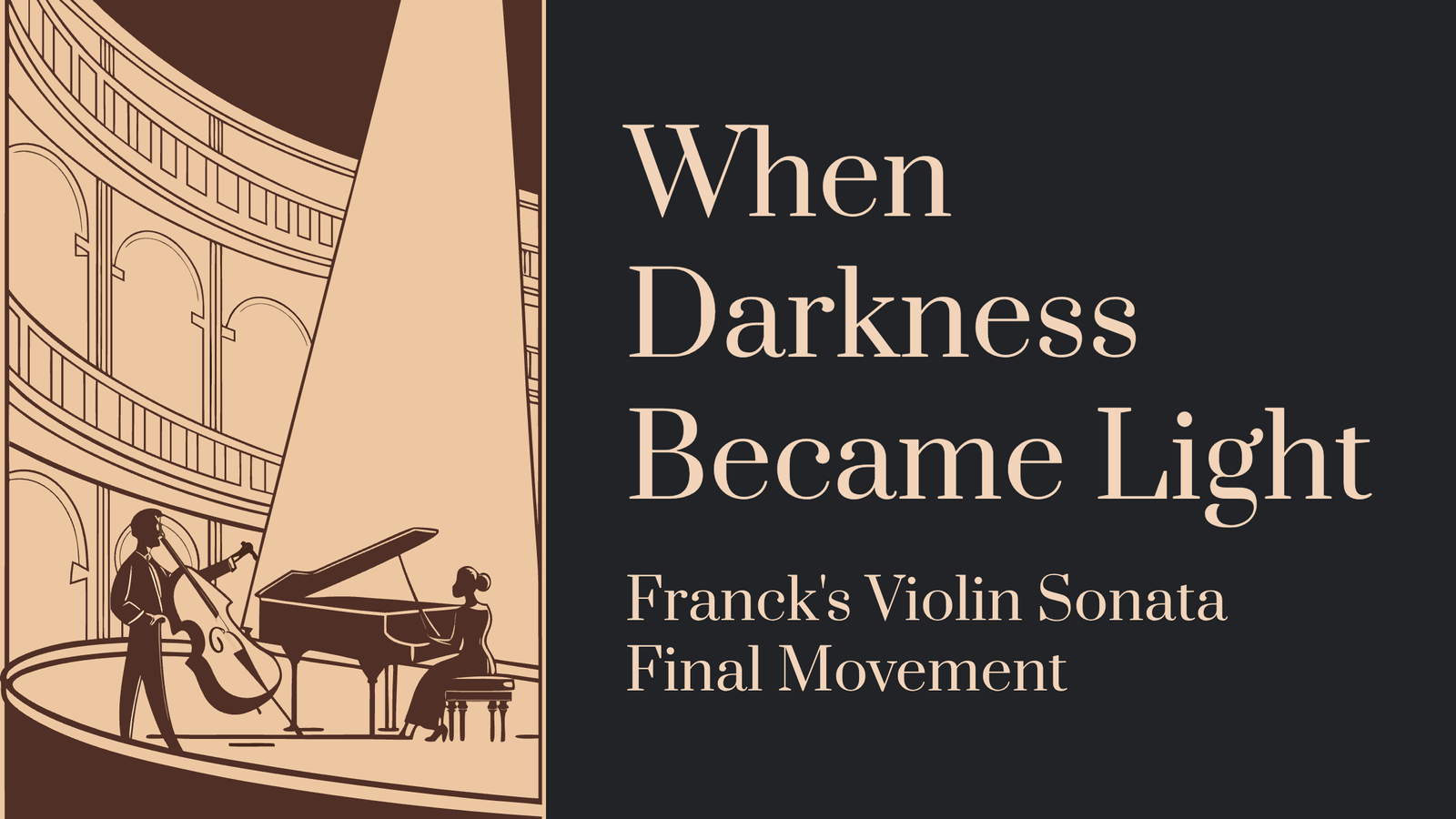
Picture this: December 16, 1886, Brussels. The Modern Art Museum’s concert hall gradually darkens as afternoon light fades through the windows. Two musicians stand at the front—Eugène Ysaÿe with his violin, Marie-Léontine Bordes-Pène at the piano. The sheet music on their stands becomes increasingly difficult to read. Yet they continue playing, the final movement of a brand-new violin sonata unfolding in the gathering darkness, performed entirely from memory.
This wasn’t a planned dramatic effect. It was simply what happened when César Franck’s Violin Sonata received its public premiere. And somehow, that semi-darkness feels perfect for a work that journeys from gentle questioning to blazing revelation.

A Gift Wrapped in Sound
Four months earlier, on September 26, Ysaÿe had married. That morning, the 64-year-old Franck arrived at the young violinist’s door with a wedding present—not silver, not crystal, but something far more precious: the manuscript of a violin sonata, ink barely dry. By afternoon, Ysaÿe and his pianist colleague were sight-reading it for wedding guests, discovering its mysteries in real time.
What kind of person gives a sonata as a wedding gift? Perhaps someone who understands that the truest celebrations aren’t captured in objects but in moments—moments like two instruments learning to speak as one voice.
And that’s exactly what the fourth movement does. It’s titled Allegretto poco mosso—moderately fast, but with gentle motion—yet those Italian words barely hint at what actually happens: a musical ascent so gradual, so inevitable, that you don’t realize you’re climbing until you’ve reached the summit.

The Secret Architecture: When Shadows Dance
The movement opens with something that sounds simple—a graceful melody in A major, the violin singing out clear and confident. But listen closely: eight beats after the violin begins, the piano enters with the exact same melody. Not harmonizing beneath it, not providing accompaniment, but singing the identical tune, like a shadow following its source.
This is what musicians call canon—though that technical term feels too dry for what’s actually happening. Imagine walking past a wall on a sunny day, watching your shadow move alongside you. Now imagine that shadow beginning to speak your thoughts aloud, not after you finish, but while you’re still thinking them. That simultaneous intimacy and separation—that’s what Franck creates here.
The canon technique is ancient, dating back centuries to Bach and beyond. But Franck wields it with a lightness that feels conversational rather than scholarly. The violin and piano aren’t demonstrating compositional prowess; they’re two voices discovering they have the same story to tell, each one’s telling enriching the other’s.
Throughout the movement, this canonic dialogue continues, sometimes obvious, sometimes so subtle you feel it rather than hear it. The two instruments weave around each other like dancers who have rehearsed together so long they no longer need to think about the choreography.

The Ghost of the First Movement
About a minute in, something startles you—a melody you’ve heard before, but transformed. It’s the opening theme from the sonata’s first movement, that gently swaying, almost hesitant phrase that began this entire journey. But now it returns with new confidence, new urgency. The shy question has become a bold statement.
Franck loved this technique, what theorists call “cyclical form”—bringing back earlier themes in later movements. But he didn’t do it for academic reasons. Think of it like meeting an old friend after years apart. They’re the same person, but life has changed them. The experiences between your first meeting and this reunion are written in their face, their voice, their bearing.
That’s what happens to this theme. The innocence of the first movement has passed through the storm of the second, the introspective questioning of the third, and now emerges here radiant, tested, sure of itself. We’re not just hearing a melody repeat; we’re witnessing a transformation, a coming-of-age captured in notes.

The Chromatic Ladder
As the movement unfolds, something subtle begins to happen with the harmonies. Franck was deeply influenced by Wagner, and he inherited from that German master a love of chromatic harmony—those moments when music seems to shimmer between keys, never quite settling, always pulling you forward into the unknown.
If traditional major and minor keys are like walking on solid ground, chromatic harmony is like walking on water—there’s a slight instability, a thrilling sense that anything could happen. The music modulates (shifts between keys) with a frequency that would have shocked Mozart-era listeners. We move from A major to places more distant, more surprising, as if the harmony itself is searching for something.
For a listener new to classical music, this might simply feel like the music is “restless” or “shimmering.” You don’t need to identify the specific keys to feel their effect—that sense of journeying through emotional landscapes, each one with its own color, its own light.

The Impossible Climb
Here’s where the movement reveals its secret structure. If you could graph the emotional and pitch trajectory of this music, you’d see a gradual but persistent ascent. Both instruments move higher and higher in their registers—the violin climbing into its most ethereal range, the piano reaching toward the treble with increasing urgency.
This isn’t just a compositional technique; it’s a metaphor made audible. We’re ascending toward something—enlightenment, transcendence, whatever you want to call that feeling when suddenly everything makes sense. Musicians sometimes describe this as the “transfiguration” section, and that word feels right. Something earthly is becoming luminous.
Around the five-minute mark (timing varies by interpretation), both instruments reach the highest point of their ranges, playing in what one critic called “a region of extraordinary brilliance.” The violin sings out pure and clear above the piano’s cascading figures, and for a moment, all that has come before—the gentle opening, the chromatic searching, the return of old themes—crystallizes into a single, radiant chord.

How to Listen: A Personal Map
When I first encountered this movement, I tried to follow every note, track every theme, name every key. I exhausted myself and missed the forest for the trees. So here’s what I’d suggest instead:
First listening: Close your eyes. Don’t analyze anything. Just let the movement take you on its journey. Notice how your body responds—does your breathing change? Do you find yourself leaning forward at certain moments? Music speaks to us physically before it reaches our intellect.
Second listening: Focus on the conversation between violin and piano. Forget that they’re playing different instruments; imagine they’re two voices, two characters in a dialogue. Sometimes one leads, sometimes the other. Sometimes they speak in perfect unison. What’s the nature of their relationship? Agreement? Friendly debate? Passionate consensus?
Third listening: Try to catch the moment when the music starts its final ascent. You’ll feel it—that subtle shift when gentle becomes urgent, when horizontal becomes vertical. Once you’ve identified that moment (usually around the 4-minute mark), everything that comes before is preparation, and everything after is culmination.
For the truly curious: Listen to at least two different recordings back-to-back. Try Jascha Heifetz with Arthur Rubinstein (1937) for crystalline clarity, then perhaps Renaud Capuçon with Khatia Buniatishvili for a more Romantic, emotionally saturated approach. Notice how different interpretations reveal different facets of the same music—like turning a diamond to catch different angles of light.

What the Darkness Taught Them
Back to that premiere in Brussels, the concert hall growing darker by the minute. Ysaÿe and Bordes-Pène could have stopped, could have postponed until proper lighting arrived. Instead, they played from memory, trusting their preparation, trusting each other, trusting the music itself to guide them.
There’s something profoundly appropriate about that darkness. This fourth movement is about trust—trusting the journey, trusting that ascent will follow descent, trusting that themes which seem lost will return transformed. Perhaps Ysaÿe and Bordes-Pène were unconsciously performing the movement’s deepest message: that sometimes we must proceed without seeing clearly, following the music we’ve internalized, believing in the light we can’t yet see.
Franck died just four years after writing this sonata, in 1890. He was never a fashionable composer, never wealthy or widely celebrated in his lifetime. He spent decades as a church organist, pouring his genius into music that only a handful heard. Yet in this final movement, there’s no bitterness, no resignation—only this steady, radiant climb toward transcendence.
The movement ends not with a dramatic flourish but with quiet certainty—the violin and piano together, in perfect unity, landing on a final A major chord that feels less like an ending and more like an arrival. We’ve reached the summit, and the view is exactly what we hoped it would be.
That’s what I hear in those final measures: not triumph over adversity, not victory after struggle, but something gentler and perhaps more profound—the simple rightness of a journey completed, a gift given and received, two voices that have learned to speak as one.
And maybe that’s why Franck chose this music for a wedding gift. Because marriage, like this sonata, is about two individuals learning to move in canon—singing the same melody, but each bringing their own voice, their own timing, their own irreplaceable color to the shared song.
When the semi-darkness of that Brussels premiere finally gave way to full night, when the last notes faded and applause began, Ysaÿe and Bordes-Pène had accomplished something remarkable: they’d performed a work of genius without seeing the notes, guided only by what they’d internalized, by their trust in each other, and by the music’s inherent logic.
That’s how we should listen too—not by scrutinizing every note, but by trusting the journey, following the ascent, believing that the darkness will give way to light.
And in Franck’s capable hands, it always does.