📑 Table of Contents
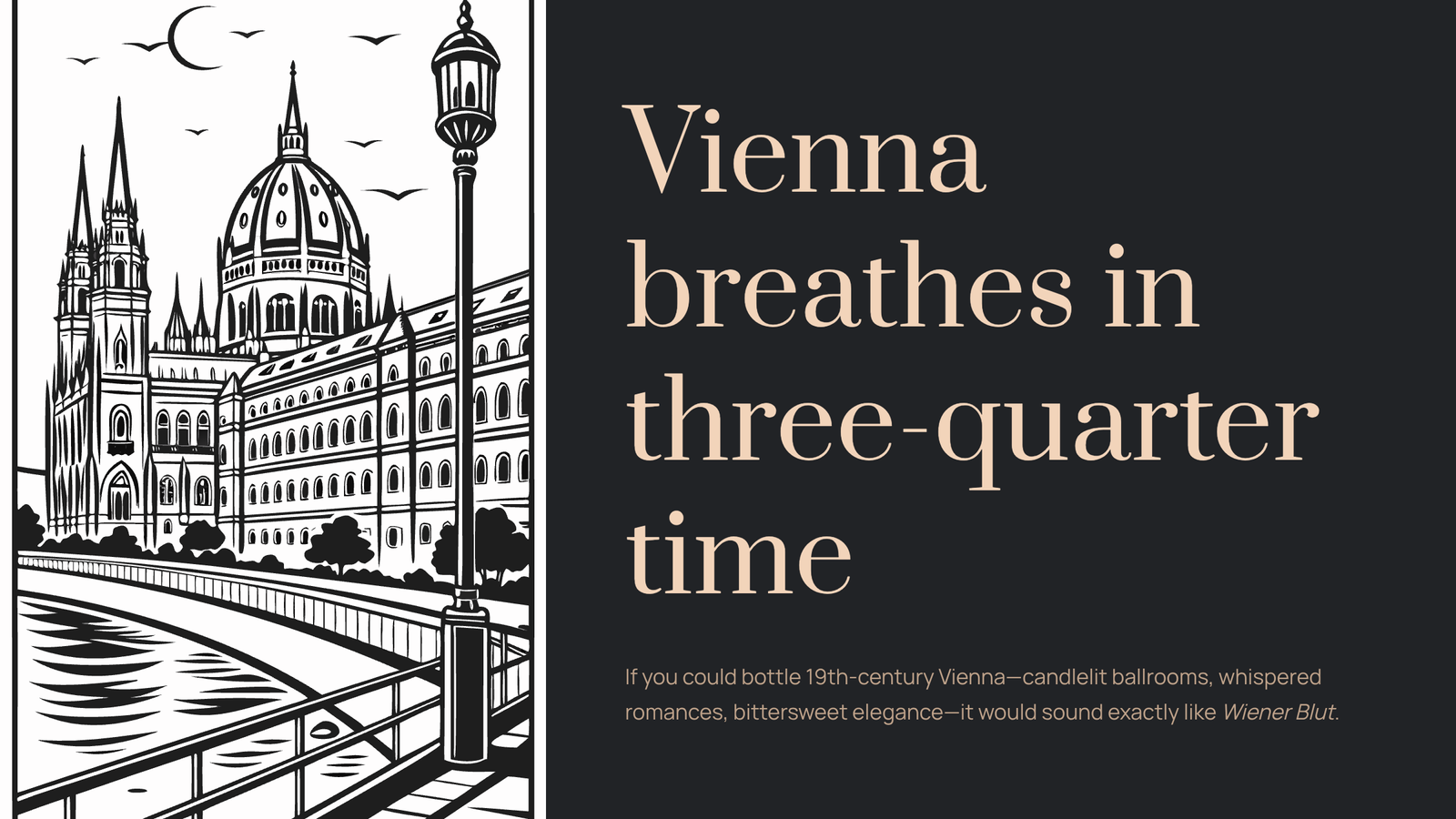
There are cities, and then there are cities that breathe. Vienna breathes in three-quarter time.
If you could bottle the essence of 19th-century Vienna—its candlelit ballrooms, its whispered romances across marble floors, its bittersweet elegance that somehow makes even melancholy feel glamorous—it would sound exactly like Wiener Blut.
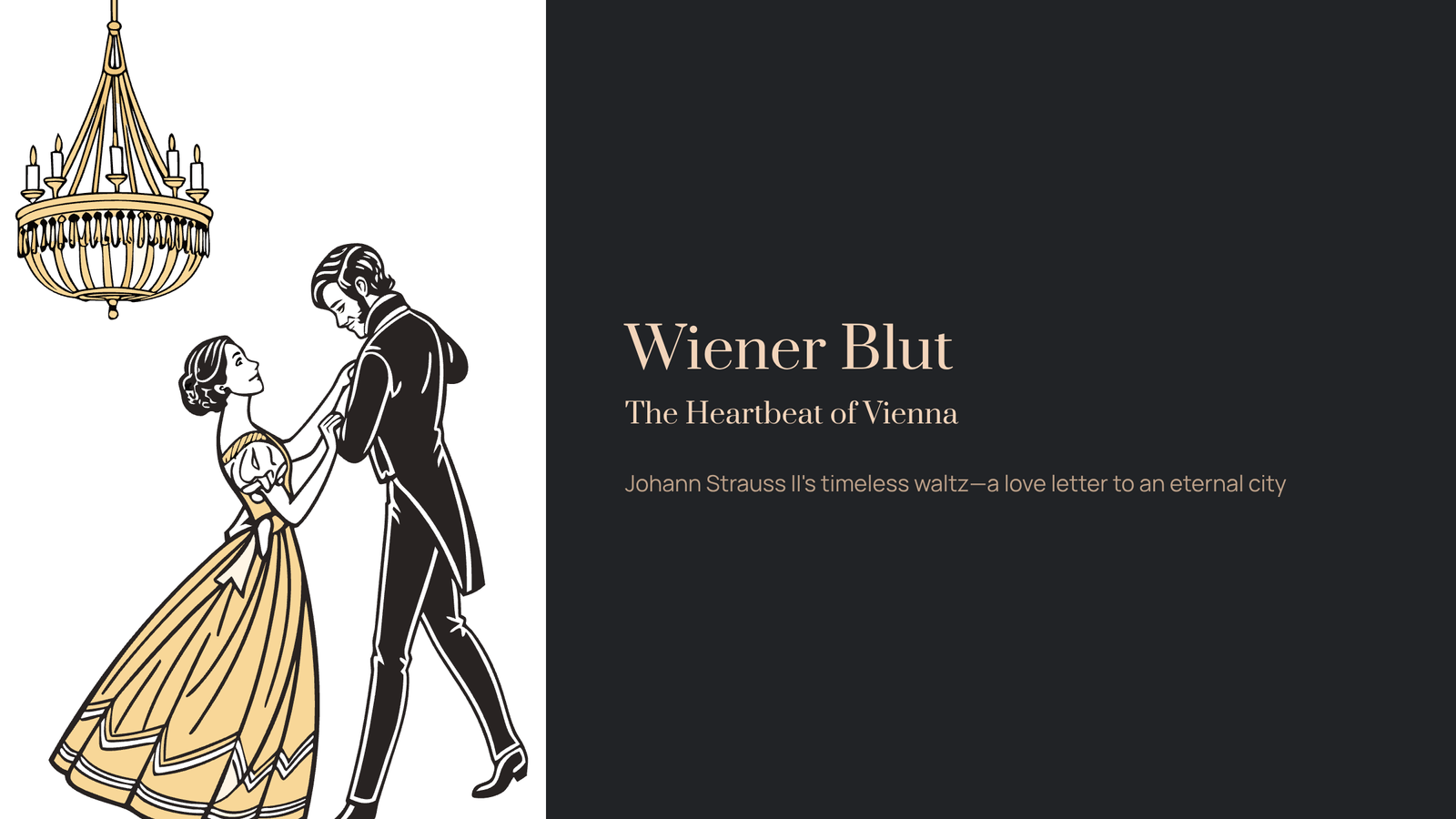
The Waltz King’s Love Letter to His City
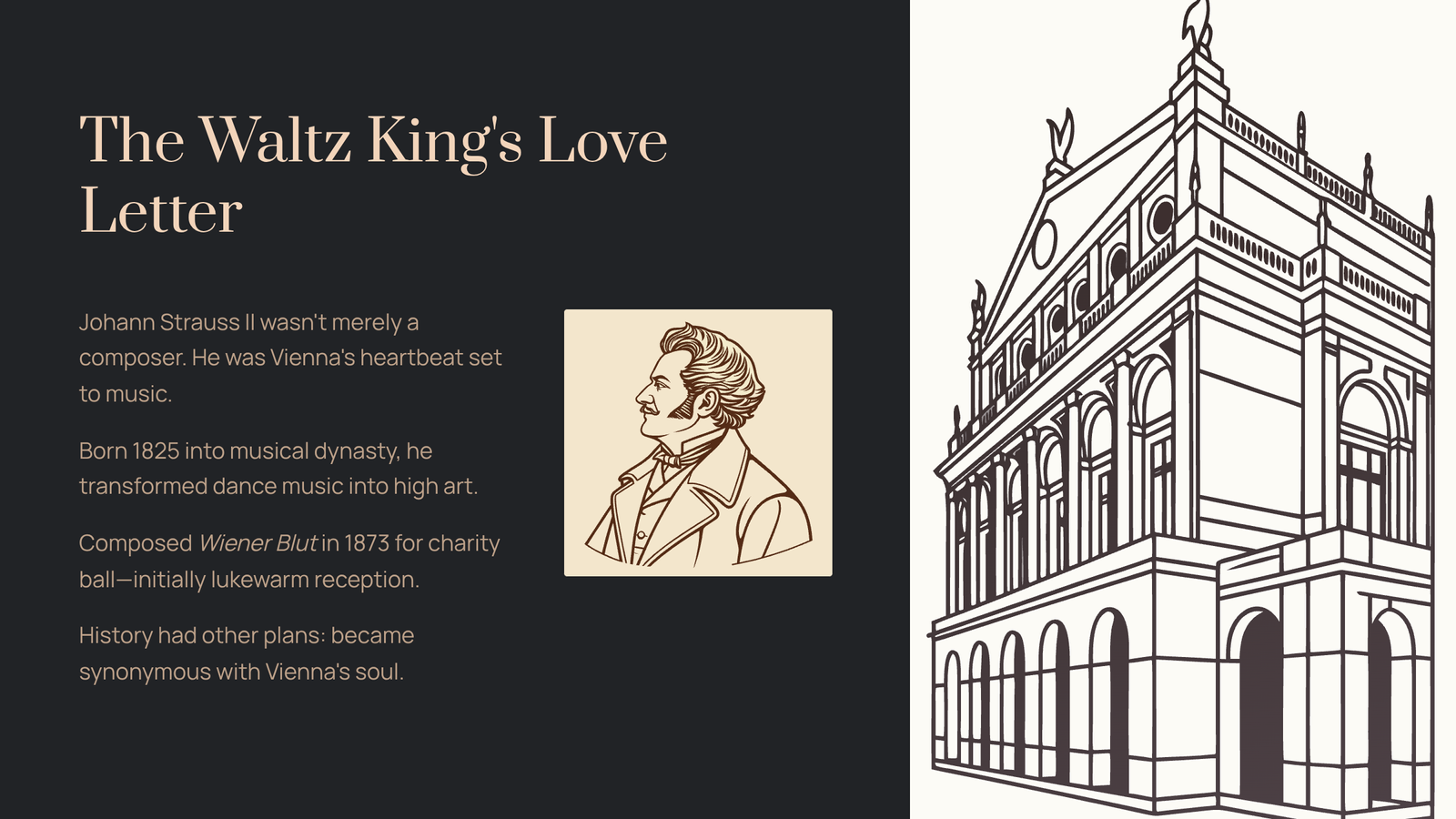
Johann Strauss II wasn’t merely a composer. He was Vienna’s heartbeat set to music. Born in 1825 into a family where waltzes flowed like the Danube, he inherited his father’s musical empire and transformed it into something the world had never heard—dance music elevated to high art.
By 1873, when he composed Wiener Blut (Vienna Blood), Strauss had already conquered Europe’s ballrooms. But this particular waltz wasn’t born from triumph. It premiered at a charity ball and initially received a lukewarm response. The Viennese, perhaps too close to their own reflection, didn’t immediately recognize themselves in the mirror Strauss held up.
History, however, had other plans. Wiener Blut would become synonymous with the very soul of Vienna—so much so that in 1899, it lent its name to an entire operetta compiled from Strauss’s works.
What Exactly Is “Vienna Blood”?
The title itself is untranslatable in the deepest sense. Wiener Blut refers to something more than genetics—it’s that ineffable Viennese character, a particular way of moving through life with grace, charm, and just a touch of theatrical melancholy. It’s knowing how to laugh at tragedy and find sweetness in sorrow.
When you listen to this waltz, you’re not just hearing notes. You’re hearing a philosophy of living.
A Listening Guide: Three Ways to Experience Wiener Blut
First Listen: Let It Carry You
Don’t analyze. Don’t count beats. Simply close your eyes and let the music transport you. Notice how the opening melody feels like an invitation—someone extending their hand across a crowded room. The waltz doesn’t demand; it suggests. Would you care to dance?
Second Listen: Feel the Architecture
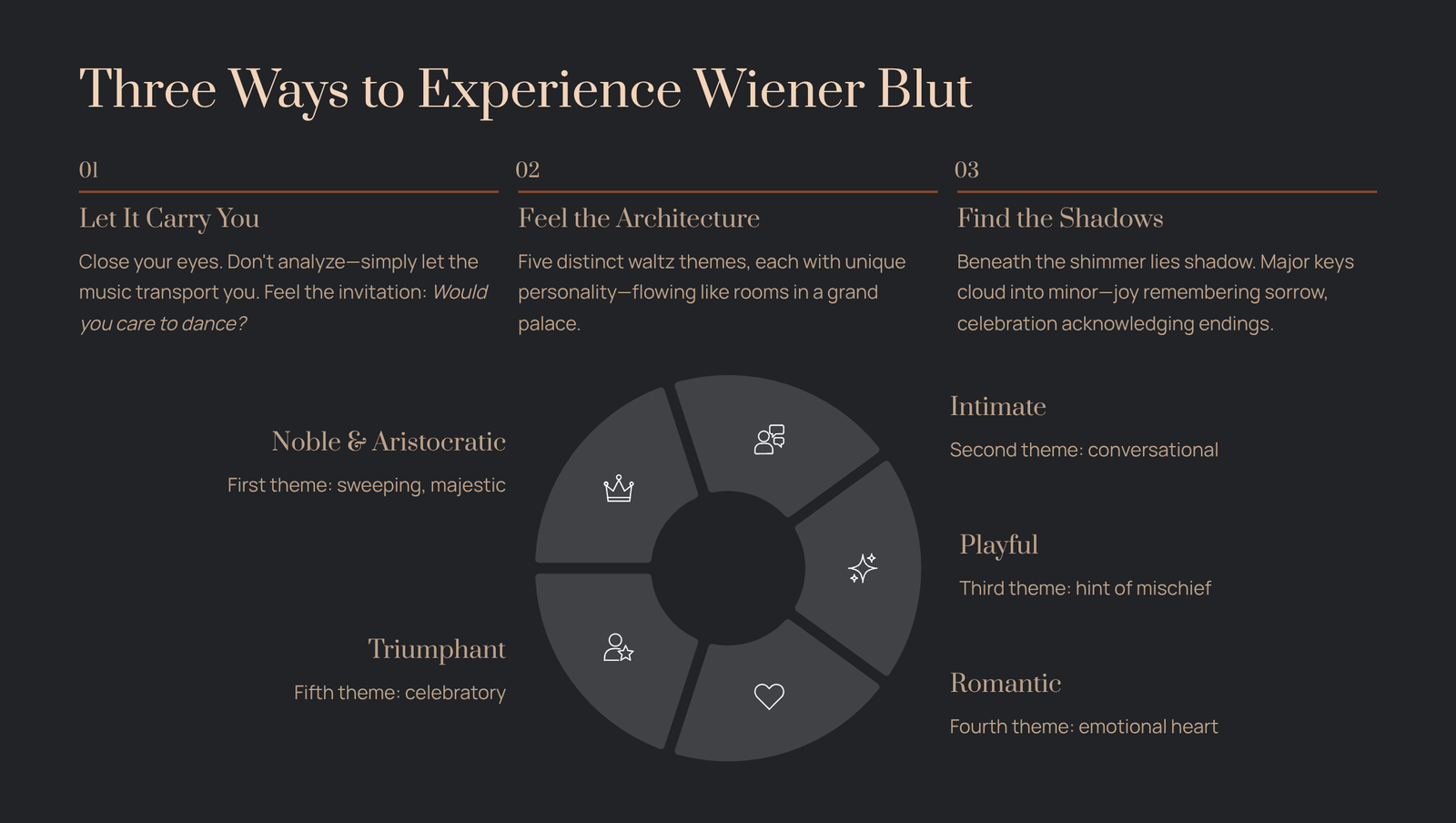
Now pay attention to the structure. Viennese waltzes aren’t single melodies but chains of them, each section flowing into the next like rooms in a grand palace. Wiener Blut contains five distinct waltz themes, each with its own personality:
- The first theme: noble, sweeping, aristocratic
- The second: more intimate, almost conversational
- The third: playful, with a hint of mischief
- The fourth: deeply romantic, the emotional heart
- The fifth: triumphant, celebratory
Notice how Strauss weaves them together, returning to earlier themes like memories resurfacing at a reunion.
Third Listen: Find the Shadows
Here’s what separates Strauss from lesser composers—beneath the shimmer lies shadow. Listen for the moments where the major key briefly clouds into minor, where the melody sighs before it soars. This is the authentic Wiener Blut: joy that remembers sorrow, celebration that acknowledges endings. The Viennese didn’t dance to forget their troubles; they danced to embrace all of life at once.
Recommended Recordings
For Your First Experience:
The Vienna Philharmonic’s New Year’s Concert recordings capture this waltz in its natural habitat. Carlos Kleiber’s legendary 1989 performance remains a gold standard—his conducting seems to breathe with the music, never rushing, never dragging, finding that perfect Viennese rubato (flexible timing) that makes the waltz feel spontaneous rather than metronomic.
For Deeper Appreciation:
Willi Boskovsky’s recordings with the Vienna Philharmonic from the 1960s and 70s offer an older, more traditional interpretation. Boskovsky conducted while playing violin, just as Strauss himself did—there’s an authenticity here that connects directly to the 19th century.
For Modern Ears:
Riccardo Muti’s interpretations bring Italian warmth to Viennese elegance. His tempos tend slightly broader, allowing every phrase to breathe and bloom.

Why This Waltz Still Matters
In our age of instant everything, Wiener Blut offers something radical: the permission to move slowly, to savor, to find beauty in formality. The waltz was once considered scandalous—partners held each other close, spinning in public!—but now it teaches us something we’ve forgotten. There’s intimacy in structure. There’s freedom in form.
When you listen to Wiener Blut, you’re participating in a 150-year-old conversation about what it means to be human, to celebrate, to mourn, to dance through it all with grace.
The Viennese knew something we’re still learning: life is brief and often difficult, but the proper response isn’t cynicism or despair. It’s to put on your finest clothes, take someone’s hand, and waltz—beautifully, defiantly, joyfully—through whatever comes.
That’s Wiener Blut. That’s Vienna Blood. And now, perhaps, it flows a little in you too.
Put on a recording tonight. Pour something you love into a glass. And let Johann Strauss II show you what Vienna knew all along: every evening can be elegant, if you let the music lead.