📑 Table of Contents
There’s a moment — roughly forty seconds into this piece — when the left hand starts leaping across the keyboard like something unhinged while the right hand hammers out octaves with an almost terrifying insistence. The first time I heard it, I didn’t blink. I couldn’t. It felt less like music and more like watching someone set fire to a piano and then play it anyway.
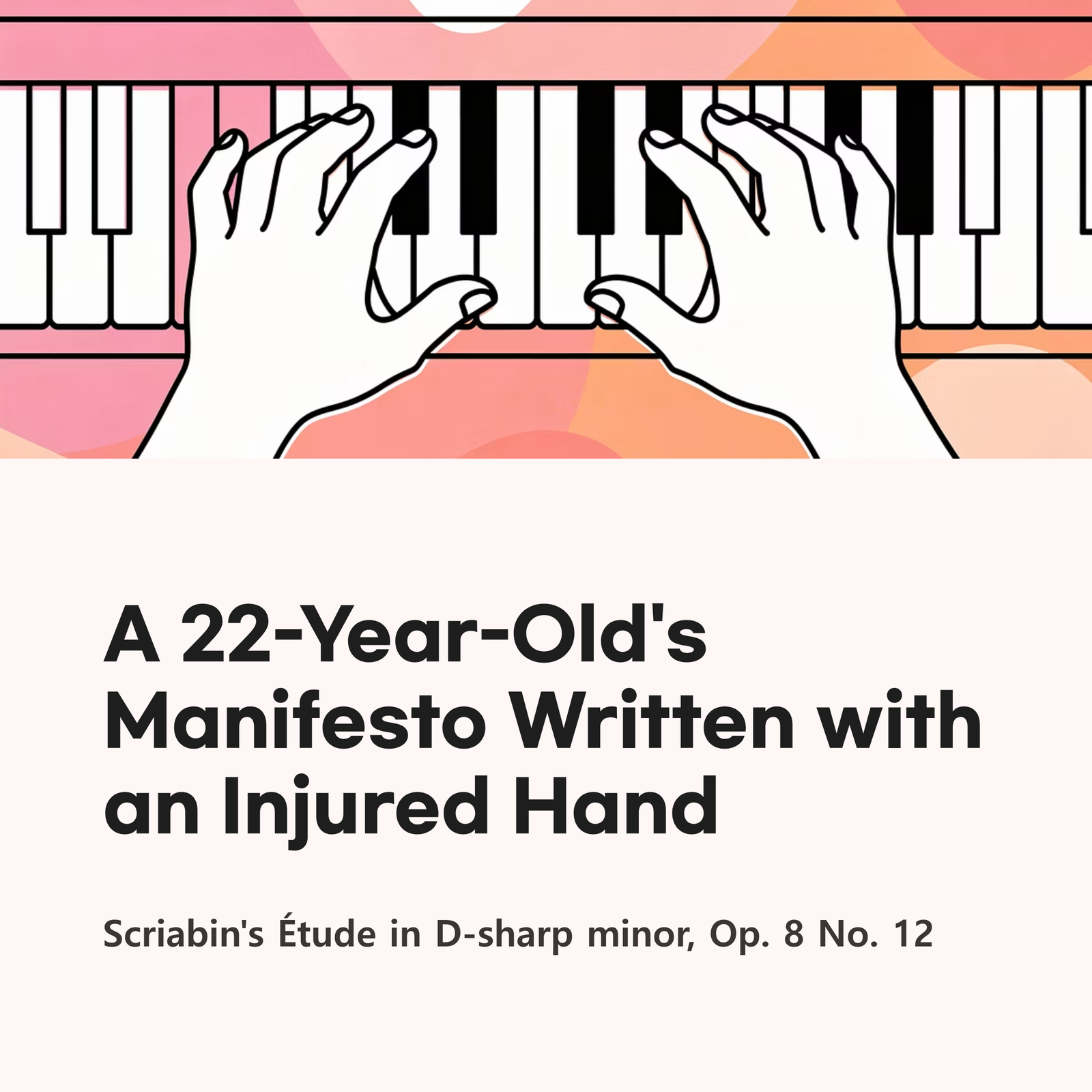
That’s Scriabin’s Étude in D-sharp minor, Op. 8 No. 12. Two minutes. That’s all it takes for this piece to grab you by the collar, shake you, and leave you staring at the wall wondering what just happened.
The Young Mystic Who Broke His Own Hand
Alexander Scriabin was born on Christmas Day, 1871, in Moscow — a city that would shape him, celebrate him, and ultimately bury him far too soon. His mother, a gifted concert pianist, died of tuberculosis when he was barely a year old. Raised by his grandmother and a devoted aunt, the boy found his way to the piano almost instinctively, picking out melodies with a single finger at the age of three.
By sixteen, he had entered the Moscow Conservatory, where he studied alongside a certain Sergei Rachmaninoff. The two couldn’t have been more different: Rachmaninoff with his enormous hands that could swallow the keyboard whole, and Scriabin, whose delicate fingers could barely stretch to a ninth. It was this very inadequacy — or what he perceived as one — that nearly destroyed him.
In the summer of 1891, desperate to match his rival’s technical prowess, Scriabin practiced Liszt’s fiendishly difficult Réminiscences de Don Juan and Balakirev’s Islamey with obsessive intensity. The result was devastating: a serious overuse injury to his right hand. Doctors told him he might never fully recover. He was nineteen years old, and his dream of becoming a touring virtuoso seemed to be over before it had truly begun.
He responded not with silence, but with fury. His Piano Sonata No. 1 in F minor poured out of him — what he called a “cry against God, against fate.” And somewhere in the wreckage of that crisis, something fundamental shifted inside him. If his hands couldn’t make him immortal, his mind would.
Op. 8: A Pianistic Manifesto
The Twelve Études, Op. 8, published in 1894, were Scriabin’s declaration of war — not against anyone else, but against the limitations of what he believed piano music could express. He was in his early twenties, freshly recovered (or at least partially so), and consumed by the desire to place himself in the lineage of Chopin and Liszt, the two composers who had defined what an étude could be.
The first eleven études in the set explore a vast emotional terrain: Chopinesque lyricism, Lisztian bravura, and quiet introspective moments that seem to belong entirely to Scriabin himself. They were, in a sense, his pianistic autobiography — a young composer working through his influences and emerging on the other side with something unmistakably his own.
And then comes No. 12.
Positioned as the final and crowning piece of the set, the D-sharp minor Étude is where Scriabin stops whispering and starts shouting. If the other études are chapters, this one is the exclamation point at the end of the book.
What Makes This Étude So Explosive
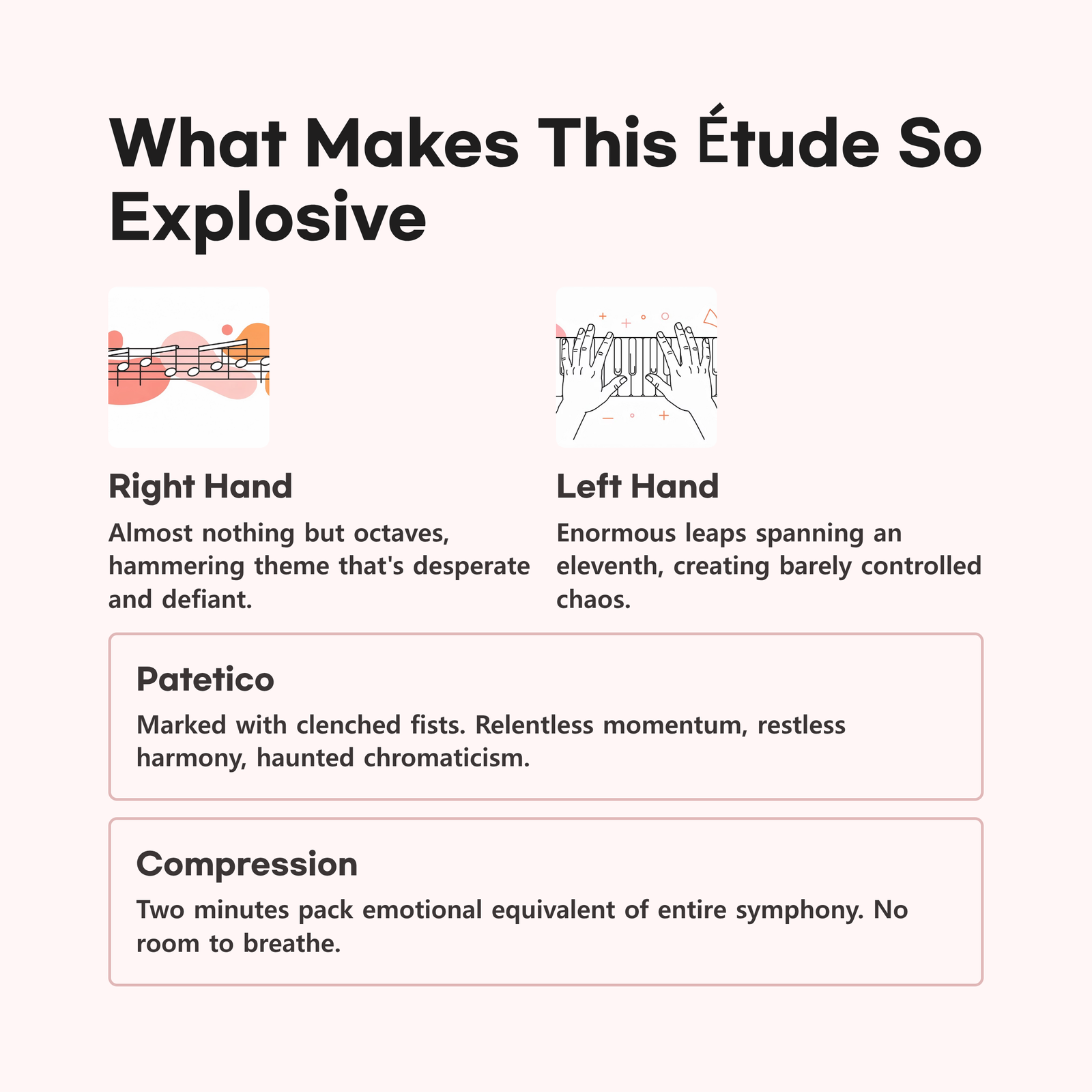
Technically, this is an octave study. The right hand plays almost nothing but octaves from the first measure to nearly the last, hammering out a theme that is equal parts desperate and defiant. The left hand, meanwhile, is tasked with enormous leaps — sometimes spanning an eleventh — creating a sense of barely controlled chaos beneath the melody.
But calling it an “octave study” is like calling a thunderstorm “precipitation.” The technique is merely the vehicle for something far more visceral.
The piece opens with a rising figure that feels like a question being asked with clenched fists. The main theme, marked Patetico, surges forward with relentless momentum, building through waves of intensity that never quite resolve the way you expect. There’s a restlessness in the harmony — Scriabin constantly shifts through tonal centers, creating a sensation of searching, reaching for something just beyond grasp. The chromaticism gives the music a haunted, almost feverish quality.
What makes it so effective is the compression. In roughly two minutes, Scriabin packs in the emotional equivalent of an entire symphony. There’s no room to breathe, no pause for reflection. The intensity simply builds and builds until the final measures, where the octaves in the right hand give way — just briefly — to a different texture, as if the fury has finally exhausted itself.
The Horowitz Effect
This étude might have remained a respected but somewhat obscure piece in the piano repertoire were it not for one man: Vladimir Horowitz.
The legendary Ukrainian-American pianist adopted Op. 8 No. 12 as one of his signature encore pieces, and in doing so, introduced it to audiences around the world. There’s something almost perversely perfect about the pairing: Horowitz, with his demonic technique and theatrical stage presence, playing a piece that sounds like it was written specifically to set a concert hall on fire.
Horowitz’s recordings of this étude — and there are several — remain benchmarks of the piece. His 1942 recording crackles with barely contained violence, while later performances reveal a more controlled but no less intense interpretation. In his hands, the piece becomes less of a technical showpiece and more of a dramatic monologue — a voice raging against something enormous and unnamed.
If you’re coming to this piece for the first time, start with Horowitz. His recording on the Favorite Encores album captures the volcanic energy that makes this étude unforgettable. For a different perspective, seek out recordings by Sviatoslav Richter, who brings a more architectural, almost philosophical approach, or by Evgeny Kissin, whose youthful fire matches Scriabin’s own intensity at the time of composition.
How to Listen: A Practical Guide
Here’s what I’d suggest for your first few encounters with this piece:
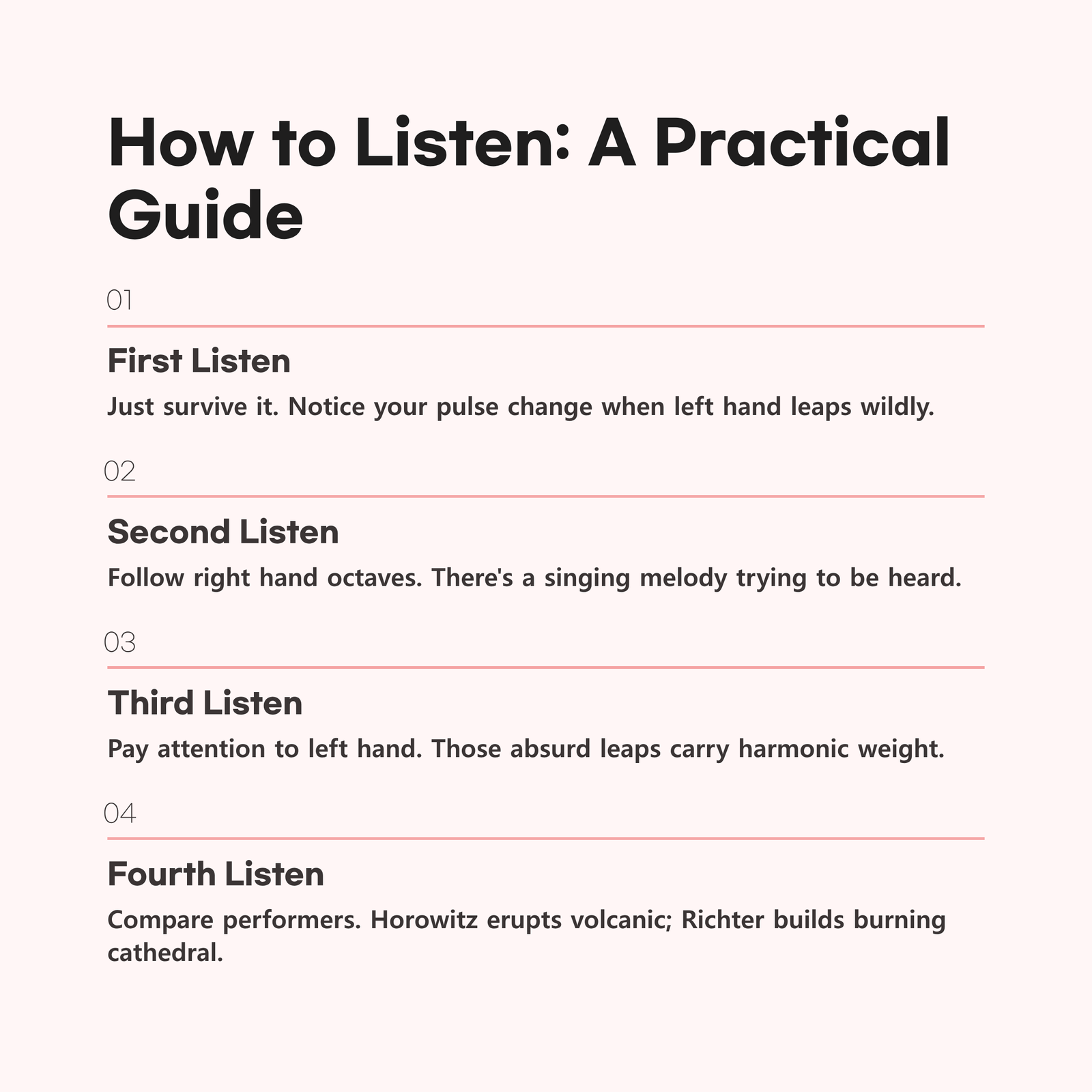
First listen — just survive it. Don’t analyze, don’t think. Just press play and let the two minutes wash over you. Notice how your pulse changes. Notice the moment when the left hand starts those wild leaps and the music seems to break free from gravity. That visceral, physical response is exactly what Scriabin intended.
Second listen — follow the right hand. Those octaves aren’t random pounding. There’s a melody buried in there — a singing line that’s trying to be heard above its own intensity. Listen for the moments when the theme rises, falls, and transforms. Pay attention to the Patetico marking: this is music that wants to move you, not just impress you.
Third listen — pay attention to the left hand. This is where the real drama lives. Those leaps are absurdly difficult — we’re talking about intervals of a tenth or eleventh at breakneck speed — and each one carries a harmonic weight that shifts the emotional color of what the right hand is doing. The left hand is the restless undercurrent beneath a stormy surface.
Fourth listen — compare two performers. Put Horowitz and Richter side by side. Notice how the same notes can produce entirely different emotional landscapes. Horowitz turns it into a volcanic eruption; Richter builds it like a cathedral being consumed by flames. Neither is wrong. Both reveal something different about the music.
The Sound of Someone Refusing to Give Up
I keep coming back to Scriabin’s injured hand. A young man, barely out of his teens, told by doctors that his career might be over. And instead of accepting that verdict, he poured everything — rage, defiance, ambition, heartbreak — into music so intense that audiences over a century later still feel their breath catch when they hear it.
The D-sharp minor Étude isn’t just a technical exercise or a concert showpiece. It’s the sound of someone refusing to be defeated by circumstance. Every hammered octave is an act of rebellion. Every impossible left-hand leap is a dare — to fate, to physical limitation, to anyone who ever said you can’t.
Scriabin would go on to compose far more radical, more philosophically ambitious works. He would dabble in mysticism, dream of a performance in the Himalayas that would end the world and usher in a new age of spiritual enlightenment. He would die, absurdly and tragically, at forty-three from an infected pimple on his lip.
But here, at twenty-two, he was simply a young man with a hurt hand and a burning need to prove that the fire inside him was bigger than any injury could contain. Two minutes. That’s all he needed to make his case. And more than 130 years later, the case still stands.