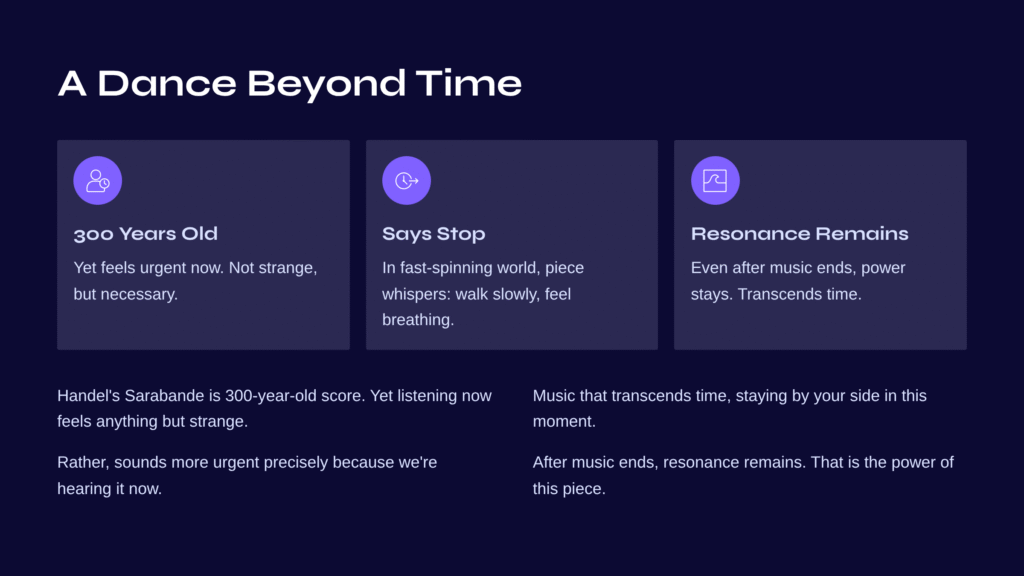
George Frideric Handel wrote the Sarabande from his Keyboard Suite in D minor, HWV 437, probably in the early 1700s. The suite was published in 1733, and the Sarabande is its third movement, a slow dance for harpsichord that later became a recurring theme in Stanley Kubrick’s Barry Lyndon.
The film gives the dance an orchestral scale, but its measured steps are already there in the keyboard music. You can hear them in the first few bars by counting three beats and noticing how much weight the middle beat can carry.
📑 Table of Contents
Why Handel Wrote the D Minor Sarabande
Handel (1685–1759) was a Baroque composer whose work ranged from operas and oratorios to solo keyboard suites. A suite brings several short movements together, often drawing on different dances. In this one, the allemande and courante come first, then the sarabande and its two variations, followed by a gigue.
The exact composition date and any specific occasion for the suite are uncertain. Its place in the suite gives us a clear sense of its musical purpose. After the more flowing courante, the sarabande gives each chord time to register. The lively gigue then changes the pace again. Play the ends and beginnings of those neighboring movements and you can hear how much of the Sarabande’s gravity comes from where Handel put it.
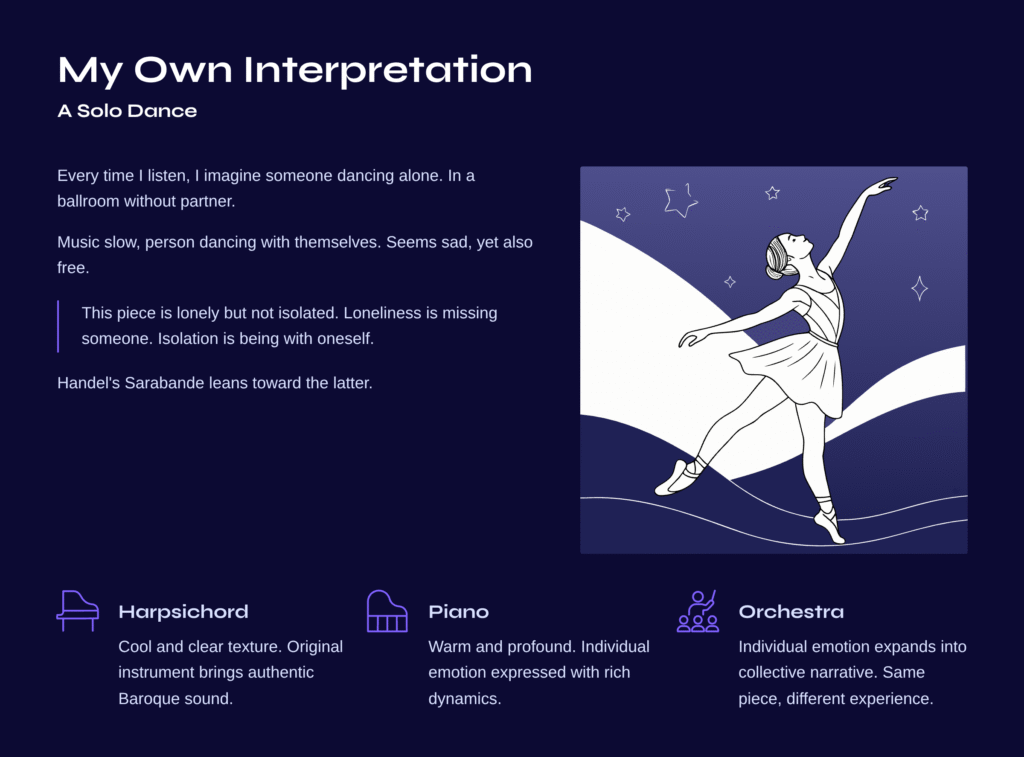
The keyboard setting also helps explain how readily the piece travels between instruments. The upper notes give you a melody to follow, and the lower notes make the changes of harmony easy to hear. On a harpsichord, the notes speak with a clear plucked attack and then decay. On a piano, the player can bring out an inner note by touch or let the chord ring with the pedal. Those choices can shift your attention even when the notes are familiar.
What Is a Sarabande?
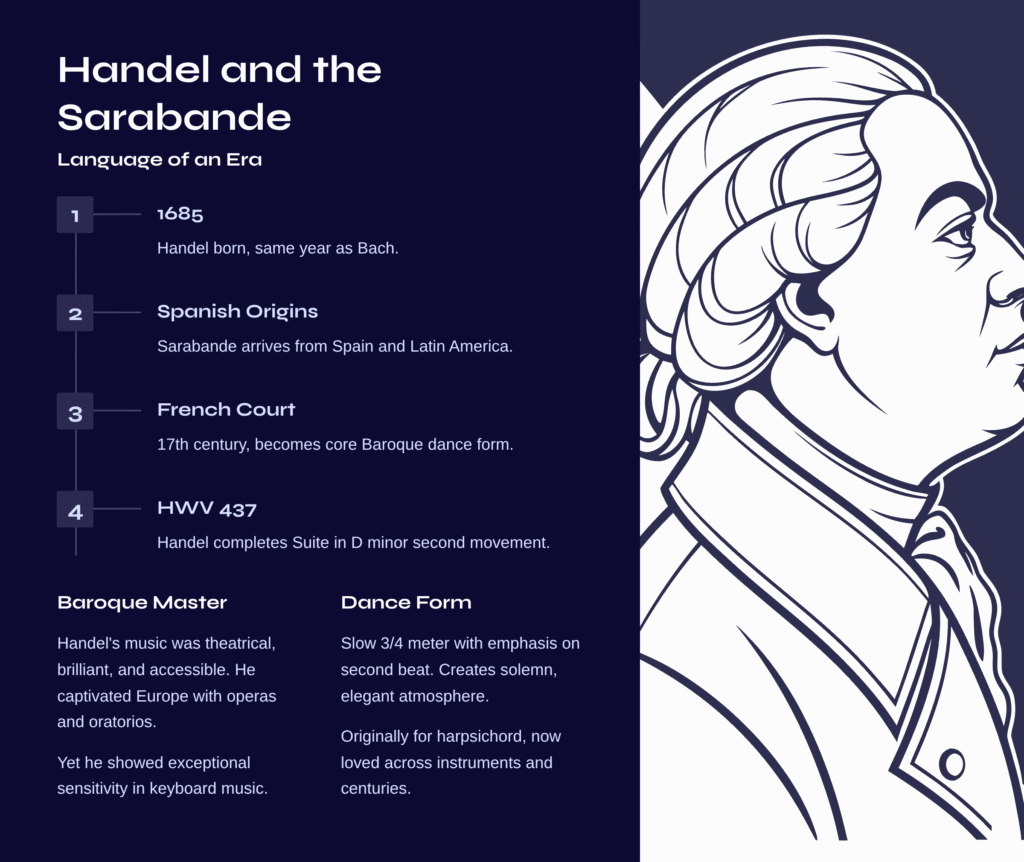
The sarabande has early roots in the Spanish-speaking world, with its history associated with both Spain and Latin America. It took on a slower, more stately character in French court practice and became a regular movement in Baroque suites. That slower tradition is the one you hear in Handel’s D minor piece.
A sarabande moves in groups of three beats. A characteristic feature is the weight it can give the second beat, through the length of a note or the way a phrase settles on it. Count “one, two, three” at an even pace over the opening. Beat one gets the bar moving, and beat two can feel like the point where the music comes to rest for a moment. The next bar arrives on schedule, even if the phrase feels suspended.
You can hear a different use of the same dance in Bach’s Sarabande from Cello Suite No. 5. Start at the opening and follow the single line. With so few notes sounding together, the rhythm and the space between notes do much of the work that Handel gives to chords.
Handel’s Sarabande in Barry Lyndon
Stanley Kubrick used the Sarabande in his 1975 film Barry Lyndon, with music adapted for the film by Leonard Rosenman. It accompanies the opening titles and returns during the climactic duel between Barry and Lord Bullingdon. Handel wrote the underlying music, and Rosenman adapted it for the soundtrack.
The duel gives that steady pulse a dramatic purpose. The formal steps of the encounter take time, and the music lets you feel each interval of waiting. In the film arrangement, the weight of the low instruments and percussion makes a gesture that fits under two hands at a keyboard fill the scene.
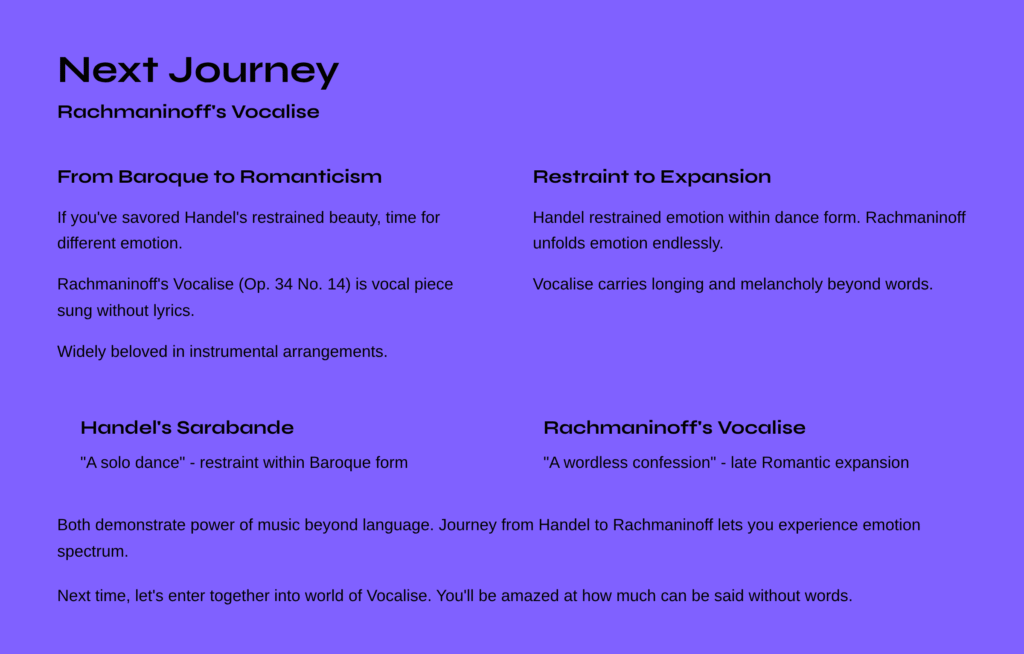
Handel also used the sarabande rhythm in music for the stage. You can hear it at the start of “Lascia ch’io pianga” from Rinaldo, where a singer carries the long phrases over the measured pulse. In the aria, those phrases have words and a dramatic situation. The keyboard Sarabande leaves the same sort of pacing open to whatever a performer or filmmaker brings to it.
What to Listen for in Handel’s Sarabande
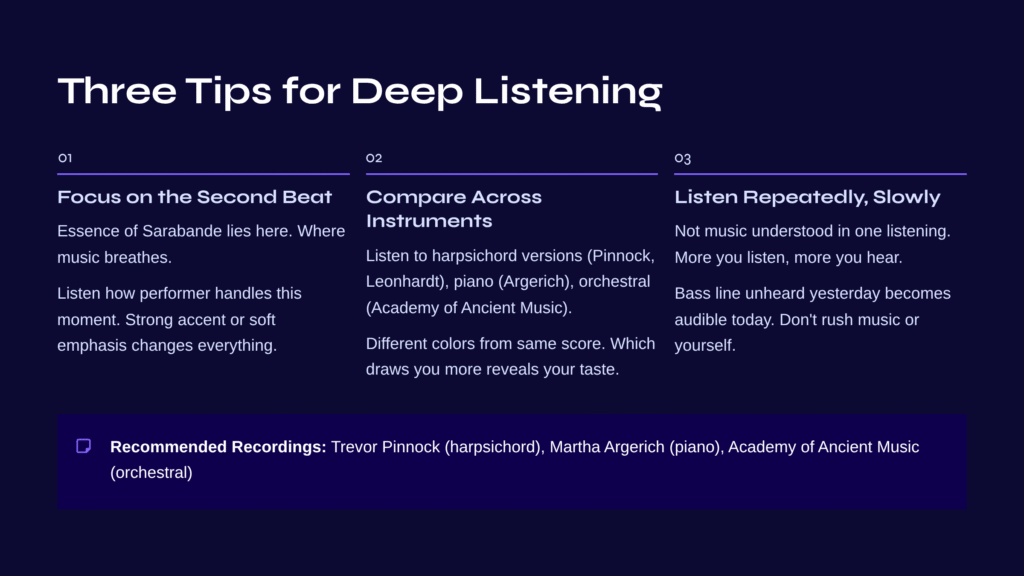
Start with the opening chords. Follow the highest note through the first phrase, then go back and follow the lowest one. The first pass gives you the tune. The second makes it easier to hear where the harmony moves and where it settles. Put the two together and the familiar opening has both a melody and a sense of direction.
Find the first variation. The theme has two sections, each marked to repeat, and two written variations follow it. As the first variation starts, listen for the smaller notes moving around the tune. Keep counting the same slow three beats through the busier surface. The underlying changes still give you a way to follow the phrase, even if you briefly lose track of the melody.
Follow the bass in the second variation. Give the lower part your attention as soon as the variation begins. The movement down there can change your sense of where the music is going, especially if the upper notes held your attention the first time. Then compare the ending on harpsichord with the ending on piano. Notice how long the last chord remains audible and how that shapes the pause before the gigue.
Listen to This Piece
Frequently Asked Questions
Who wrote the Sarabande in Barry Lyndon?
George Frideric Handel wrote it as part of his D minor keyboard suite, HWV 437. Leonard Rosenman adapted the music for Stanley Kubrick’s film, where it is heard in orchestral form.
Was Handel’s Sarabande written for piano?
Handel wrote the suite for harpsichord. Piano performances are common today, and the piano gives players additional control over how softly a note begins and how long it continues to ring.
Is Handel’s Sarabande the same as “Lascia ch’io pianga”?
They are separate works by Handel. The Sarabande in D minor is a keyboard movement, while “Lascia ch’io pianga” is an aria from Rinaldo with its own melody and a related dance rhythm.
Sources
- Keyboard suite in D minor (HWV 437)
- Sarabande — Encyclopaedia Britannica
- Barry Lyndon
- Lascia ch’io pianga
Part of: Heard It Somewhere? · Start Here