Impressionism in classical music is a name for music that emphasizes shifting color and atmosphere, often letting a sound linger instead of driving toward a clear resolution. Associated especially with French music of the late nineteenth and early twentieth centuries, it invites you to notice how a note sounds as much as what melody it belongs to.
Claude Debussy and Maurice Ravel are the names you will hear most often. The label is useful for getting started, but it does not describe every piece they wrote, and the two composers sound different from each other.
📑 Table of Contents
When Was Impressionism in Music?
The term comes from visual art, where it suggests an interest in fleeting light and perception. Applied to music, it points to composers who explored subtle changes of texture, harmony, and tone color around the turn of the twentieth century. It is a loose description rather than a school with membership rules or a single starting date.
Debussy is central to the story, although he did not welcome being labeled an Impressionist. His music often gives you enough melodic shape to follow while leaving the surrounding harmony open to several interpretations. Ravel is frequently placed beside him because both composers could make the piano and orchestra sound remarkably colorful. Ravel’s crisp outlines and carefully controlled patterns, though, can feel quite different from Debussy’s flowing transitions.
You may also hear the phrase “French Impressionism.” It identifies the tradition that made the term familiar, but it should not suggest that every French composer of the period worked in one style. Nor does it mean the music is always quiet or dreamy. A passage can be bright, playful, or forceful while still making color its main attraction.
Impressionism in Music: Characteristics You Can Hear
Start with harmony. In much earlier music, a tense chord often seems to demand a particular next chord. Here, a composer may let the tension remain, move a chord shape up or down without resolving it, or use a scale that softens your sense of a home note. The result is not a lack of direction. It is a different way of creating movement: one color changes into another.
The piano makes this easy to hear. Its sustain pedal lets notes continue sounding after the keys are released, so successive tones can overlap. Debussy and Ravel use that resonance as part of the music, while also writing quick, sharply defined figures that glint through it. An unclear recording or excessive pedal can blur those details; the effect depends on hearing both the individual notes and their combined sound.
Rhythm may feel flexible, but it is rarely casual. A melody can enter between repeated figures, or a small pattern can return just as the harmony beneath it changes. Instead of counting every beat, follow one recurring sound and notice what surrounds it the next time it appears.
Finally, listen for titles without treating them as instructions to imagine an exact picture. Water, moonlight, and other images can suggest a starting point. The music does more than illustrate them: it turns changes in register, spacing, and motion into an experience you can hear even with your eyes closed.
Debussy and Ravel Impressionism: Five Piano Pieces to Start With
Debussy, “Clair de lune.” Start at the opening, where the melody pauses between gentle chords. Follow the spaces as well as the notes: the melody gradually gains momentum, then becomes quiet again. This is a friendly introduction to the way a piece can expand and recede without losing its thread. If you want to stay with it afterward, our guide to Debussy’s “Clair de lune” follows that single work more closely.
Debussy, “Reflets dans l’eau.” Start with its opening rippling figure. Listen for the difference between the small notes in motion and the broader chords that interrupt or redirect them. The title means “Reflections in the Water,” and the shifting layers give you a useful way into its sound. Try following the low notes on a second hearing; they help anchor a surface that can seem to be changing constantly.
Debussy, “The Girl with the Flaxen Hair.” Start with the first melody and notice how plainly it is stated. This short prelude shows that the style does not require a wash of notes. Its interest lies partly in the delicate harmonies around a tune you can remember after one hearing. When the melody returns, ask whether it seems altered by what you have heard in between.
Ravel, Pavane pour une infante défunte. Start with the opening melody, moving at an unhurried pace above its accompaniment. A pavane is an old, stately dance, and this piece lets you hear how a clear tune can sit within richly colored harmony. It also shows the limits of the Impressionist label: its measured shape is as important as its atmosphere.
Ravel, Jeux d’eau. Start with the opening cascade of piano notes, then listen for moments when a melody rises out of the motion. The title means “Water Games,” and the piece makes an illuminating partner to Debussy’s “Reflets dans l’eau.” Both suggest water, but Ravel often gives its movement a brilliant, precise edge. Our closer look at Ravel’s Jeux d’eau offers another way to follow its piano writing.
These five works make a compact starting playlist because they do not all create the same mood. Move from the spacious opening of “Clair de lune” to the busy surface of Jeux d’eau, and the word Impressionism begins to mean more than “soft piano music.”
How to Follow the Music Without a Score
Pick one feature for each hearing. The first time, follow the melody wherever it appears. The second time, pay attention to what happens underneath it: a repeated figure, a low note, or a chord that seems to hang in the air. On a third hearing, notice the transitions. Does a new passage announce itself, or do you realize only afterward that the sound has changed?
Comparing two pieces can sharpen your ears faster than trying to memorize a definition. Put Debussy’s “Reflets dans l’eau” beside Ravel’s Jeux d’eau. Both titles point toward water, yet their patterns and pacing create distinct experiences. Then pair “The Girl with the Flaxen Hair” with Ravel’s Pavane to hear how each composer gives a memorable melody room to breathe.
There is no need to identify every scale or chord to enjoy this music. If you can hear a melody emerge, a texture thicken, or a familiar figure return in a new setting, you are already following some of its most important ideas. “Impressionism” is a helpful doorway; the particular sounds of each piece are what make you want to stay.
Frequently Asked Questions
What are the main characteristics of Impressionism in music?
Listeners often recognize colorful harmonies, overlapping piano sounds, flexible sounding rhythms, and attention to texture. These are tendencies, not a checklist: a clear melody or firm pulse can belong in the same piece.
When was Impressionism in music?
The term is most closely associated with French music from the late nineteenth and early twentieth centuries. There is no exact beginning or ending, because it describes a way of hearing certain works rather than a formally defined period.
Are Debussy and Ravel both Impressionist composers?
Both are commonly discussed under that label, and their music offers excellent examples of color and imaginative piano writing. It is worth hearing their differences too: Debussy often lets phrases flow into one another, while Ravel frequently makes intricate patterns sound sharply defined.
Sources
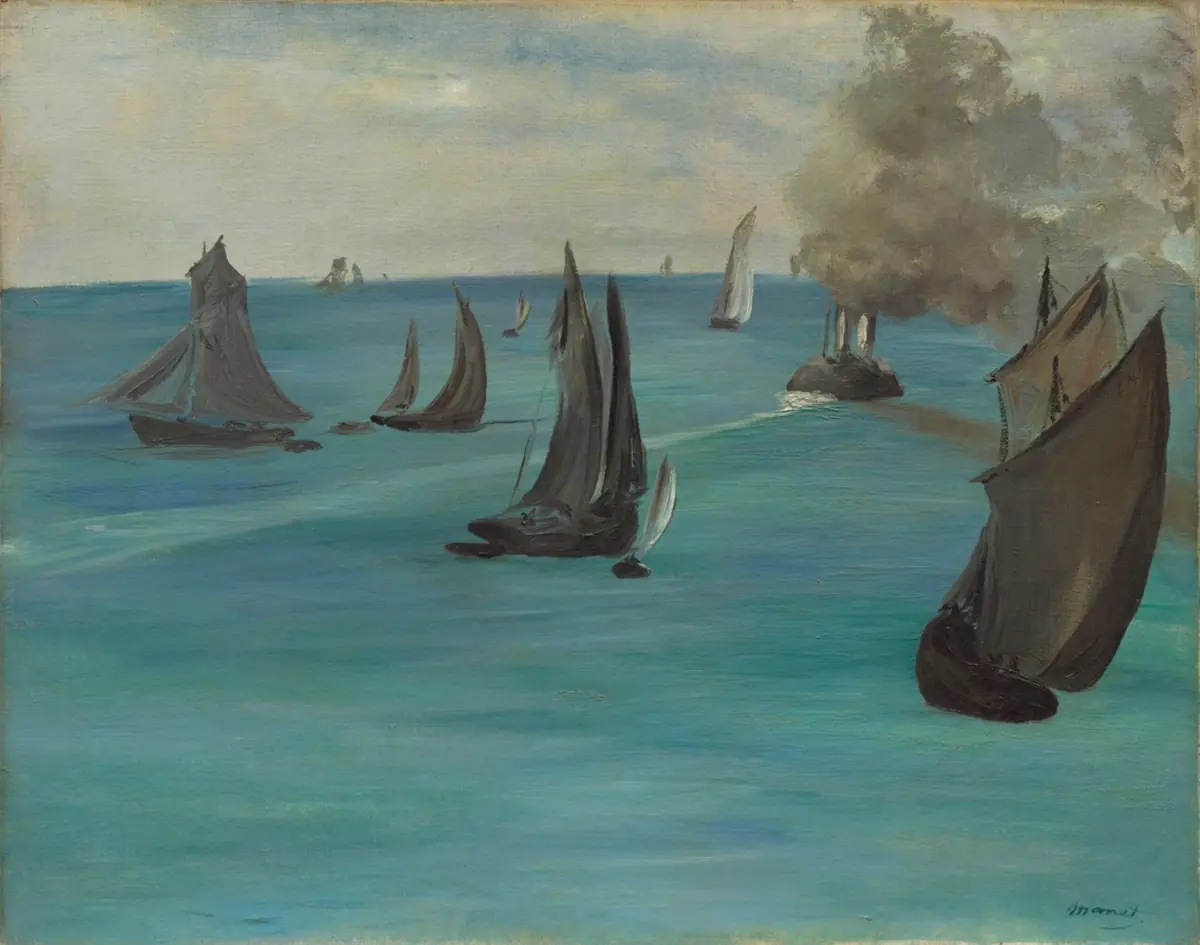
Cover art: Rocks at Port-Goulphar, Belle-Île, Claude Monet, 1886. Art Institute of Chicago (public domain). Image: Sea View, Calm Weather (Vue de mer, temps calme), Édouard Manet, 1864. Art Institute of Chicago (public domain).