📑 Table of Contents
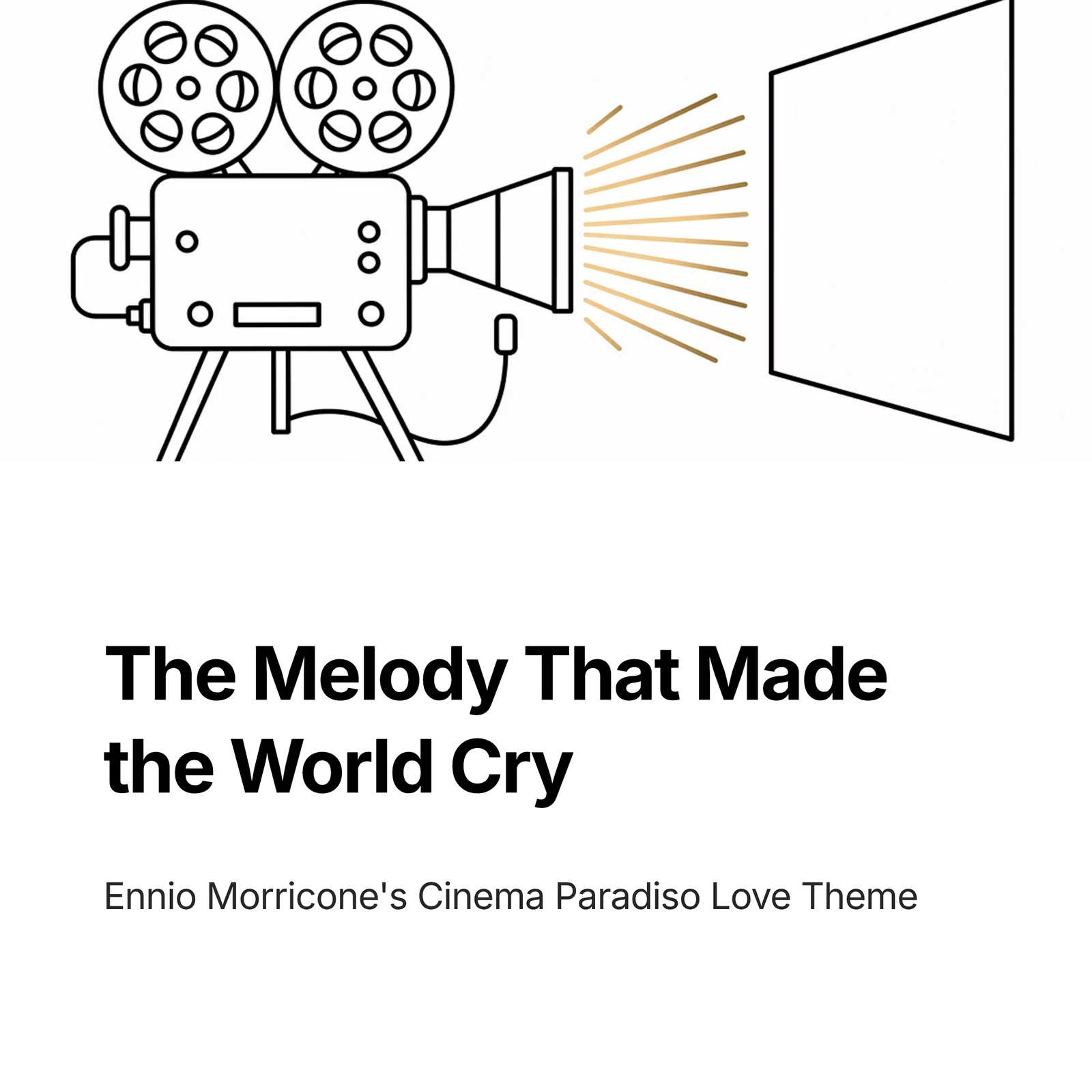
There’s a particular kind of silence that follows a phone call you weren’t expecting. In the 1988 film Cinema Paradiso, Salvatore — a celebrated film director living in Rome — receives exactly that kind of call. Alfredo, the old projectionist who shaped his childhood, has died. And just like that, decades of carefully buried memories come flooding back.
I first encountered the Love Theme from Cinema Paradiso not in a theater, but on a rainy evening when I was scrolling through a playlist, half-distracted. The melody stopped me cold. It was as if someone had distilled the entire ache of remembering — the warm glow of a place you can never return to — into a single stream of notes. I didn’t know the film. I didn’t know the story. But somehow, I already understood everything the music was trying to say.
That’s the strange power of this piece. It doesn’t require context. It simply reaches into your chest and squeezes.
The Man Behind 500 Scores — And the Son Who Wrote This One
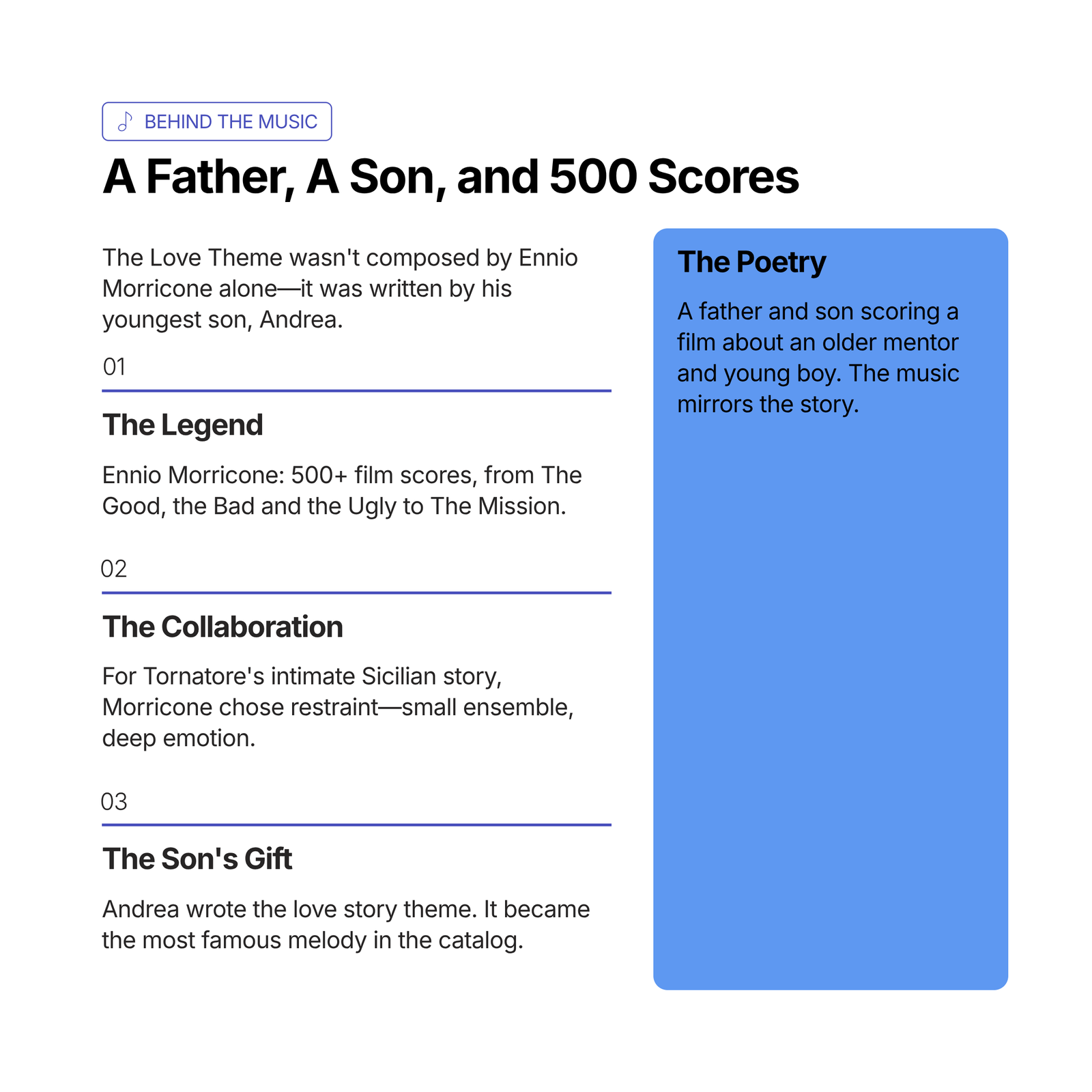
Here’s a detail that surprises most people: the Love Theme wasn’t composed by Ennio Morricone alone. It was written by his youngest son, Andrea Morricone.
Ennio Morricone is, of course, one of the most prolific and revered film composers of the twentieth century. With over 500 film scores to his name — from the iconic whistling of The Good, the Bad and the Ugly to the sweeping grandeur of The Mission — he practically invented what modern film music sounds like. Directors from Sergio Leone to Quentin Tarantino sought him out for his uncanny ability to translate emotion into sound.
When Giuseppe Tornatore approached Morricone to score Cinema Paradiso, Morricone recognized something deeply personal in the story. Tornatore had essentially written a fictionalized version of his own Sicilian childhood, and Morricone understood that such intimacy demanded restraint — a small ensemble rather than a grand orchestra. Solo winds, piano, celeste, strings, and alto saxophone would carry the emotional weight.
But for the love story between young Salvatore and Elena, Morricone turned to Andrea. The result was a theme so tender, so achingly beautiful, that it became the emotional centerpiece of the entire film — and arguably the most famous melody in Morricone’s catalog, even though it wasn’t technically “his.”
There’s something poetic about that. A father collaborating with his son to score a film about the bond between an older mentor and a young boy. The music doesn’t just accompany the story. It mirrors it.
What the Melody Actually Does to You
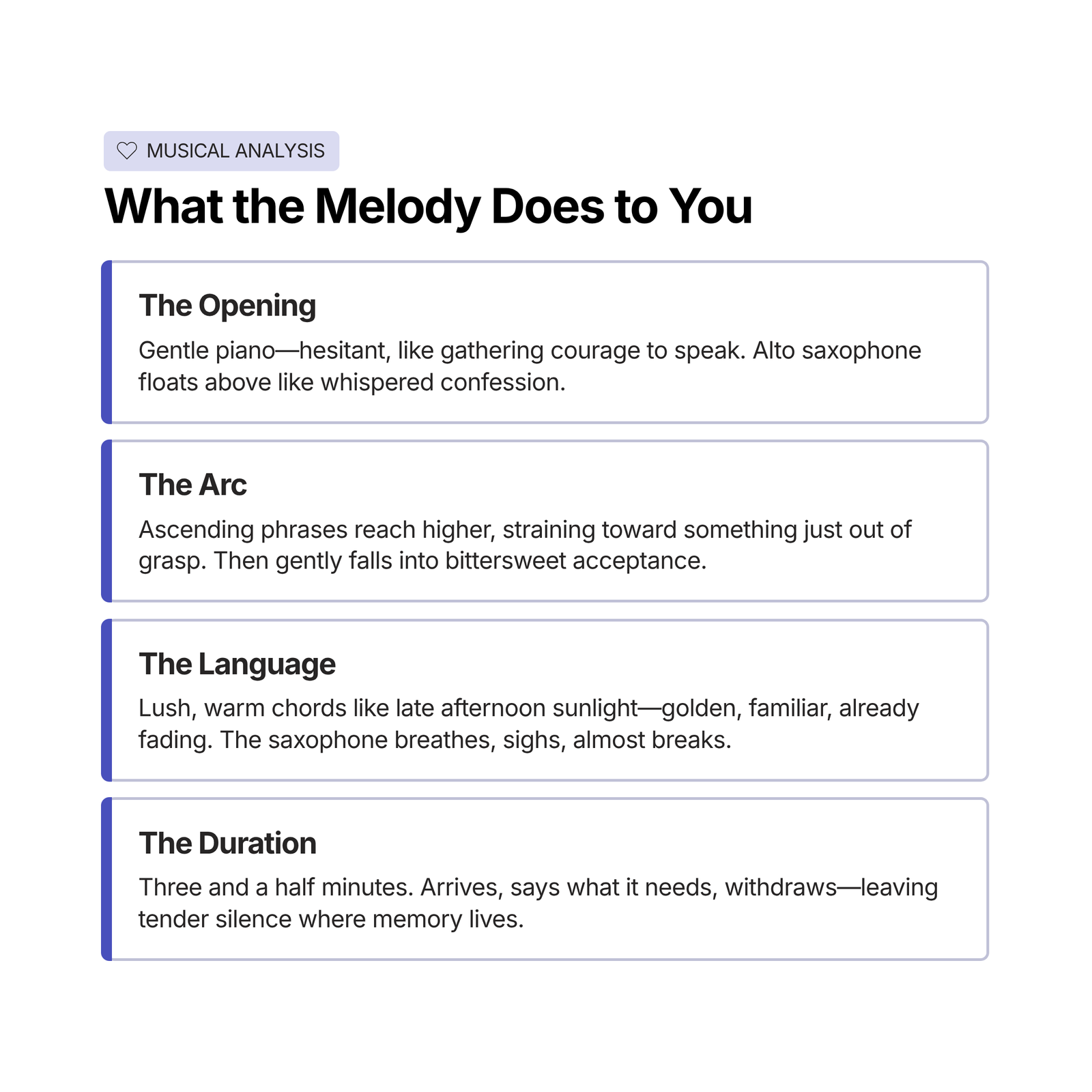
The Love Theme opens with a gentle piano figure — simple, almost hesitant, like someone gathering the courage to speak. Then the melody enters, carried by a warm alto saxophone that floats above the accompaniment like a whispered confession. The strings gradually swell beneath, adding layers of emotional gravity without ever overpowering the intimacy of the moment.
What makes this theme so devastating is its melodic arc. Andrea Morricone builds the melody through a series of ascending phrases, each one reaching slightly higher than the last, as if the music is straining toward something just out of grasp. And then — right when you expect a grand resolution — the melody gently falls back, settling into a bittersweet acceptance. It’s the musical equivalent of reaching for someone’s hand across a crowded room and watching them disappear into the crowd.
The harmonic language is deceptively simple. There are no jarring dissonances, no complex modulations. Instead, Andrea uses lush, warm chord progressions that feel like late afternoon sunlight — golden, familiar, and already fading. The saxophone, in particular, brings a human quality that a violin or oboe might not. It breathes. It sighs. It sounds like a voice trying not to break.
At roughly three and a half minutes, the piece never overstays its welcome. It arrives, says what it needs to say, and withdraws — leaving you in that tender silence where memory lives.

The Scene That Lives Rent-Free in Every Film Lover’s Heart
To fully feel the Love Theme, it helps to understand the moment it inhabits.
Cinema Paradiso is set in a small Sicilian village where a crumbling movie theater serves as the beating heart of the community. Young Totò (Salvatore’s childhood nickname) falls under the wing of Alfredo, the projectionist, who becomes the father figure he never had. Through flickering images on a screen, Totò discovers that life is bigger than his tiny village — and that stories have the power to reshape who you are.
As a teenager, Totò falls in love with Elena, and the Love Theme becomes the sonic expression of that first, overwhelming, all-consuming young love. But their relationship is cut short by circumstance — her family’s disapproval, his departure for military service, the cruel machinery of time and distance. Years later, when a middle-aged Salvatore learns the truth about what happened — that Elena had left a note for him that he never found — the Love Theme returns, now carrying the unbearable weight of thirty lost years.
It’s no longer just a love theme. It’s an elegy for the life that might have been.
How to Listen: Three Ways In
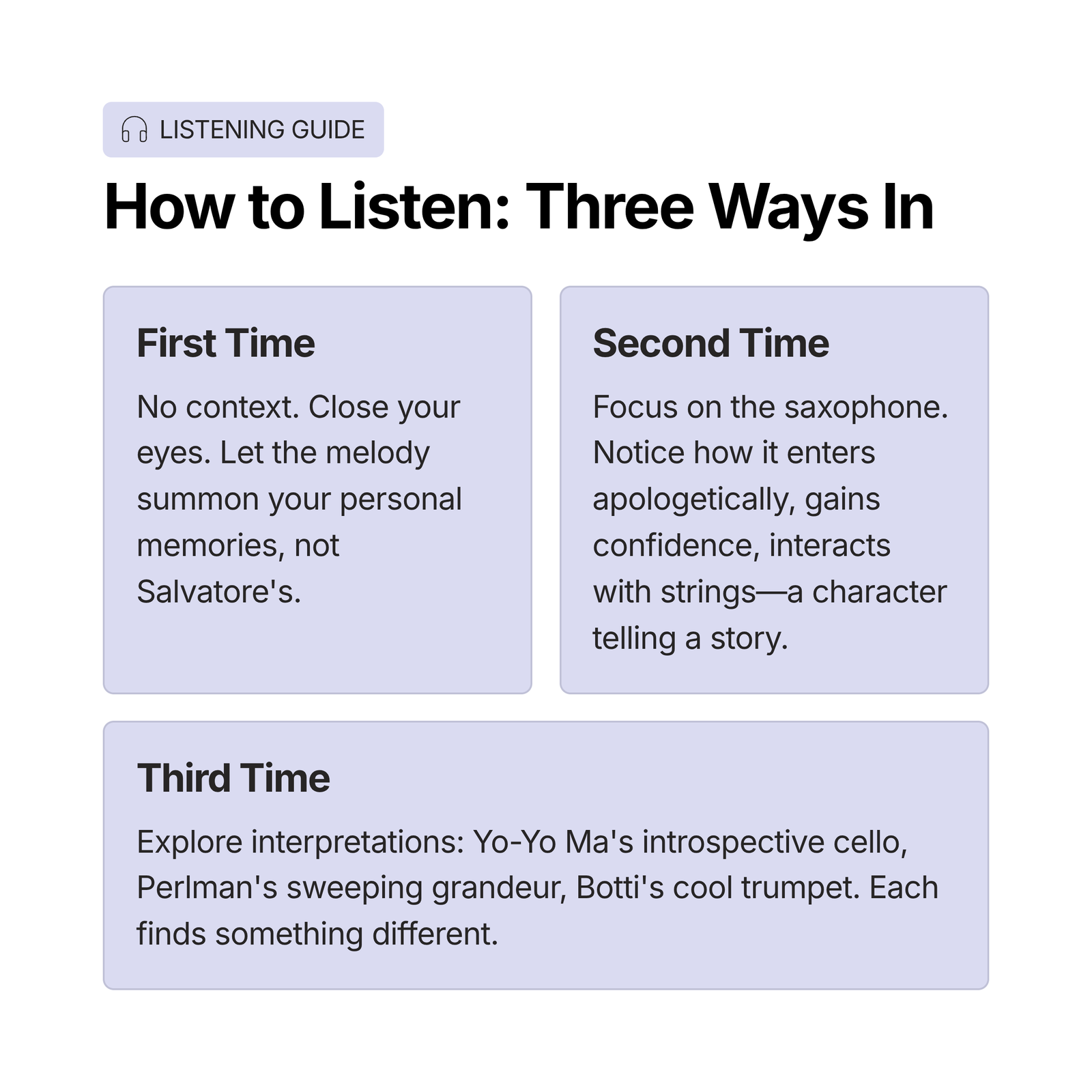
The first time, listen without any context. Don’t watch the film first. Don’t read about the plot. Just put on a good pair of headphones, close your eyes, and let the melody find you. Pay attention to what images arise in your own mind. This piece has a remarkable ability to summon your personal memories rather than Salvatore’s.
The second time, focus on the saxophone. Notice how it enters almost apologetically, then gradually gains confidence and emotional weight. Track the way it interacts with the strings — sometimes leading, sometimes surrendering to them. The saxophone in this piece is essentially a character telling you a story.
The third time, listen to different interpretations. Yo-Yo Ma recorded a cello arrangement that transforms the piece into something more introspective and solitary. Itzhak Perlman, with John Williams conducting the Pittsburgh Symphony Orchestra, gives it a lush, sweeping grandeur that feels like watching the sunset from a hilltop. Chris Botti’s trumpet version adds a cool, late-night melancholy. Each artist finds something different in Andrea Morricone’s melody, which speaks to the universality of what it expresses.
The original soundtrack album remains essential listening, but these reinterpretations prove that a truly great melody is like water — it takes the shape of whatever vessel holds it, yet remains unmistakably itself.
Why Nine Notes Can Still Make You Cry
A writer for The Washington Post once confessed that it takes only nine notes from this score to bring them to the verge of tears, no matter where they are. I understand the feeling completely. There are melodies that are beautiful, melodies that are clever, and then there are melodies that feel like they’ve always existed — as if they were simply waiting in the air for someone to write them down.
The Love Theme from Cinema Paradiso belongs to that last, rarest category. It doesn’t try to impress you with complexity or surprise you with harmonic invention. Instead, it does something far more difficult: it tells the truth about what it feels like to remember someone you loved and lost. Not with drama. Not with spectacle. But with the quiet, devastating honesty of a saxophone playing in an empty room.
Ennio Morricone once described music as “energy, space, and time.” His son Andrea proved, with this single theme, that sometimes the most powerful energy is the gentlest, the most important space is the silence between notes, and the most precious time is the kind that has already slipped away.
If you’ve ever looked at an old photograph and felt something you couldn’t quite name — that warm ache that is equal parts gratitude and grief — then you already know this melody. You just haven’t heard it yet.