
📑 Table of Contents
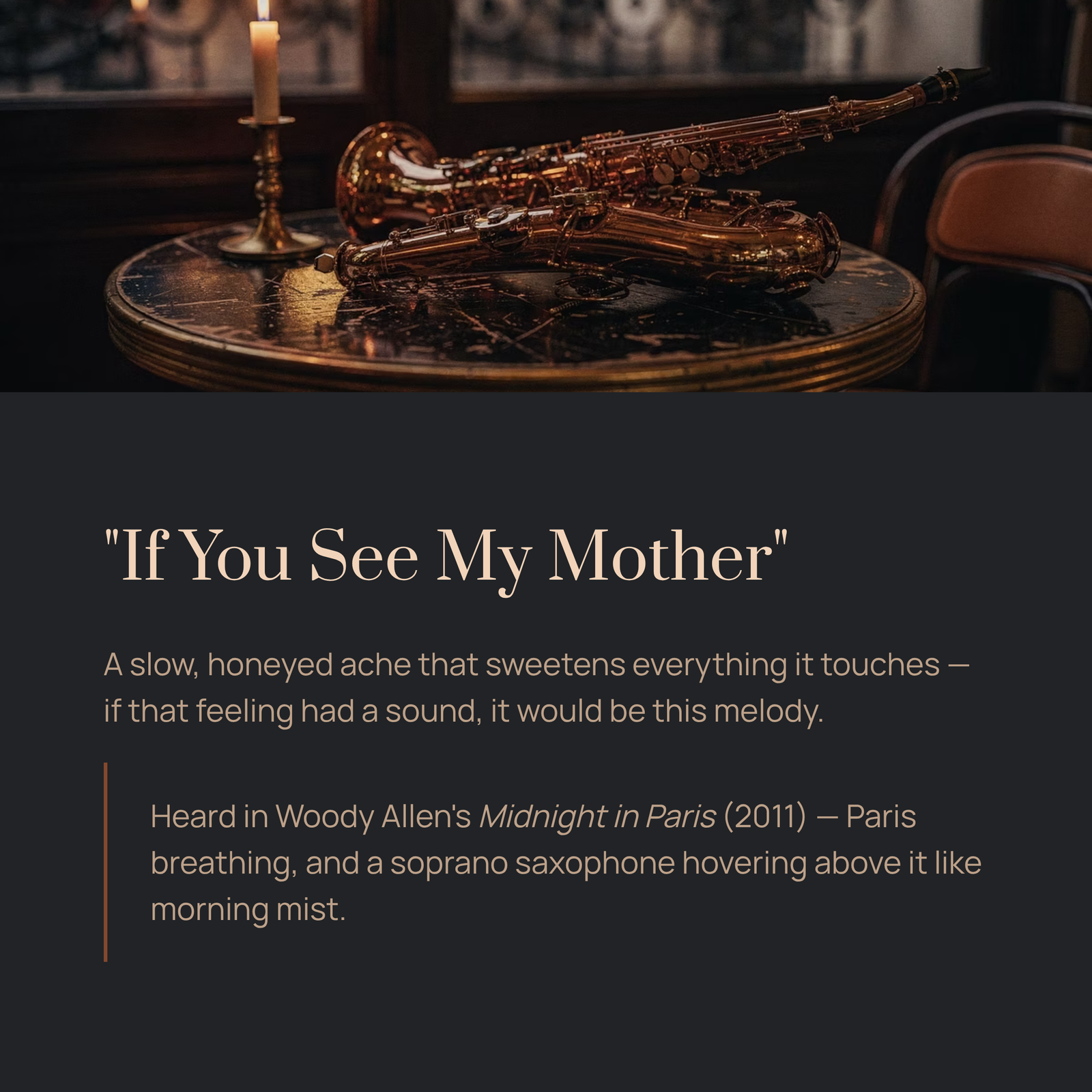
There is a particular kind of longing that only surfaces when you are far from home — not the sharp pang of immediate absence, but a slow, honeyed ache that sweetens everything it touches. If that feeling had a sound, it would be the opening bars of Sidney Bechet’s “Si Tu Vois Ma Mère.”
You may have heard this piece without knowing its name. It floats through the opening sequence of Woody Allen’s Midnight in Paris (2011), accompanying a wordless montage of the city at dawn, noon, dusk, and rain. No dialogue. No characters. Just Paris breathing, and this melody hovering above it like morning mist over the Seine. Those few minutes alone were enough to make audiences around the world fall quietly, irreversibly in love — not just with Paris, but with the aching warmth of a soprano saxophone played by a man born in the back streets of New Orleans over a century ago.
The title translates simply: “If You See My Mother.” And already, before a single note sounds, something in your chest begins to soften.
The Man Who Played Before Armstrong
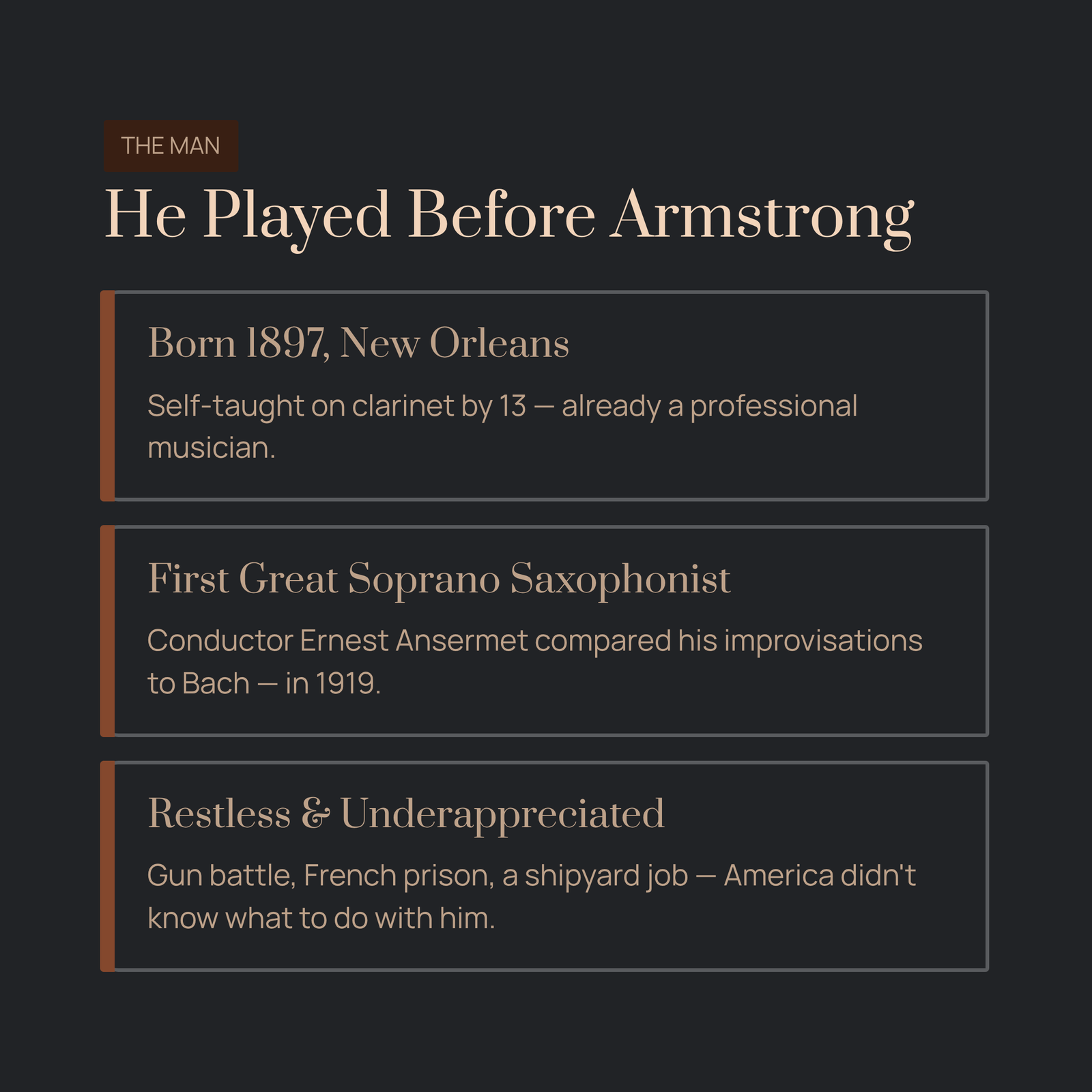
Sidney Bechet was born on May 14, 1897, in New Orleans, into a middle-class Creole family where music was as natural as breathing. His father Omar was a shoemaker who played the flute; all four of his brothers were musicians. Young Sidney was drawn to the clarinet first — not through formal lessons, but by sneaking his older brother Leonard’s instrument and teaching himself to play when no one was listening.
By the age of thirteen, he was already a professional musician. By sixteen, he was touring the Deep South. What set Bechet apart was not merely his precocity but the sheer emotional force of his playing. His tone was enormous, his vibrato wide and trembling, his phrasing bold enough to match — and sometimes overpower — an entire brass ensemble. The Swiss classical conductor Ernest Ansermet heard him in London in 1919 and was so astonished that he wrote what is believed to be one of the earliest critical essays ever devoted to a jazz musician, comparing the young Creole’s improvisations to the inventiveness of Bach.
It was in London that Bechet discovered the soprano saxophone, an instrument most musicians at the time considered a novelty. He made it his voice. His sound on the soprano was unlike anything the jazz world had heard — piercing, nasal, vibrant with an almost operatic intensity. He became the first great soprano saxophonist in jazz history, predating even the recordings of his fellow New Orleanian, Louis Armstrong.
Yet where Armstrong became a global icon, Bechet remained restless, underappreciated, and frequently in trouble. His fiery temperament led to a gun battle on a Parisian street in 1928 and a year in a French prison. He bounced between continents, between bands, between brief flares of recognition and long stretches of obscurity. At one point in the early 1950s, just months before recording “Si Tu Vois Ma Mère,” he was so short on money that he took a job in a shipyard.
America, it seemed, did not quite know what to do with Sidney Bechet.

Paris Knew
Everything changed in 1949, when Bechet was invited to perform at the Salle Pleyel Jazz Festival in Paris. He was fifty-two years old. He had been playing professionally for nearly four decades. And suddenly, in a city an ocean away from where he was born, he was received not as a journeyman or a relic, but as a star.
France embraced Bechet with a devotion that his homeland never offered. He settled there permanently, performing regularly with Claude Luter’s Orchestra, recording prolifically, and achieving the kind of celebrity usually reserved for film actors and football players. The French public adored his full-blooded, melodic style, his warmth, his sense of drama. He was not merely a musician in Paris — he was a cultural figure, an emblem of the romance between jazz and the city that had always welcomed it.
It was in this late chapter of his life, during this unexpected flowering, that Bechet composed “Si Tu Vois Ma Mère.” Recorded in 1952 with Claude Luter et son Orchestre, the piece was adapted from an earlier composition called “Early Jazz Never Will Forget The Blues,” which Bechet had recorded with the Mezzrow-Bechet Quintet in 1947. But the French version feels like a different creature entirely — slower, more tender, draped in the particular melancholy of a man who has finally found peace but cannot forget what he left behind.
Listening to the Longing
What makes “Si Tu Vois Ma Mère” so deeply moving is its simplicity. There are no fireworks here, no acrobatic runs or aggressive improvisations. The melody unfolds gently, almost reluctantly, like someone confessing something they have carried for years.
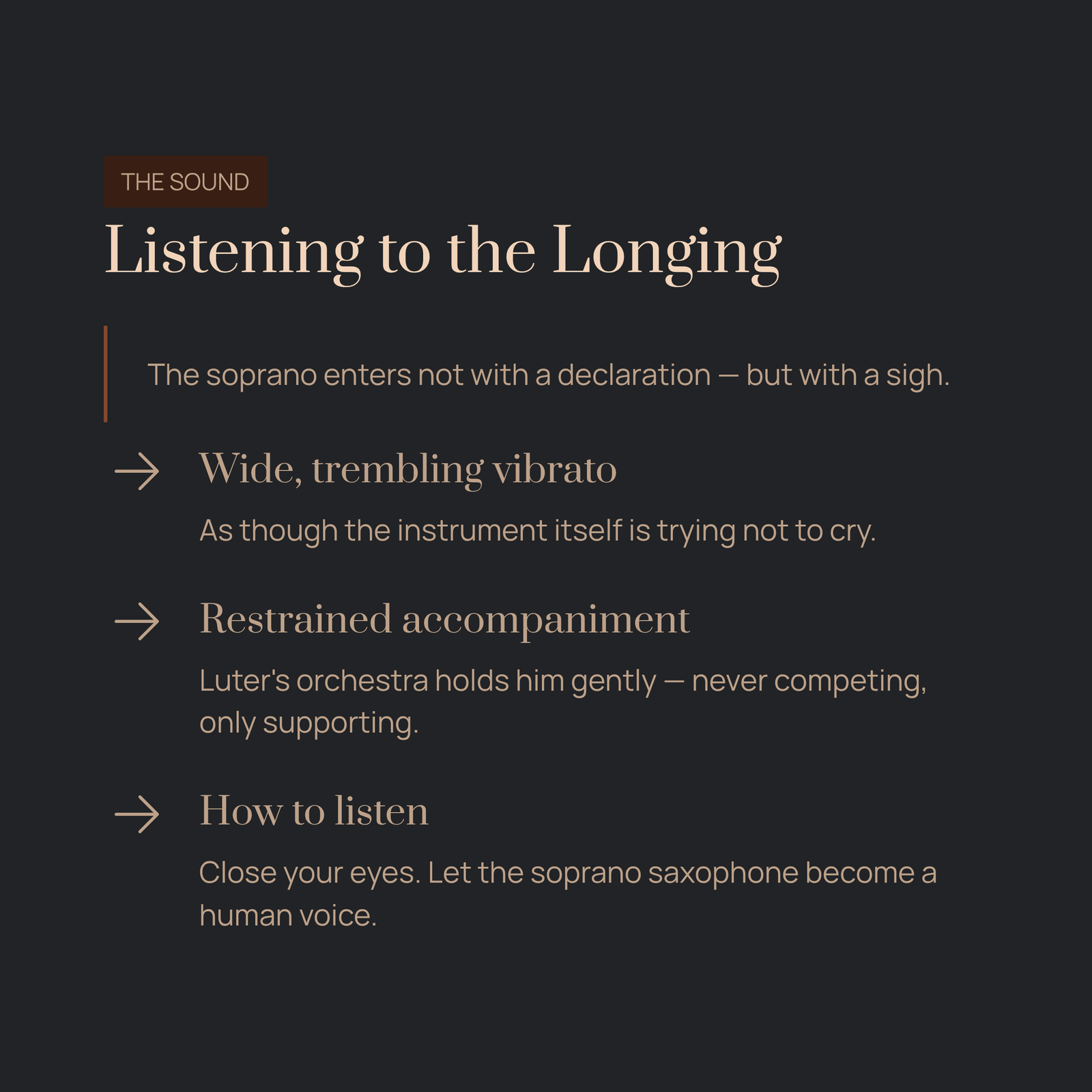
Pay attention to the way Bechet’s soprano saxophone enters — not with a declaration, but with a sigh. The vibrato is wide and trembling, as though the instrument itself is trying not to cry. The melody rises and falls in long, arcing phrases that feel less like musical lines and more like someone slowly walking through the streets of a city they love, looking at everything with the specific tenderness of knowing they may not return.
The accompaniment from Luter’s orchestra is deliberately restrained. A gentle rhythm section, soft clarinet harmonies — they create a warm bed for Bechet’s soprano to rest upon, never competing, only supporting. This is not a performance designed to impress. It is a performance designed to hold you.
If you listen closely, you can hear the entire emotional geography of Bechet’s life in this single piece: the Creole household in New Orleans where he first picked up a clarinet, the decades of wandering through cities that recognized his talent but never quite embraced him, and finally, the unexpected tenderness of finding home in a foreign country. “If you see my mother,” the title whispers, “tell her I am here. Tell her I am all right.”
For a first listen, I recommend simply letting the piece wash over you without analysis. Close your eyes if you can. Let the soprano saxophone become a human voice. On a second listen, notice how Bechet bends certain notes — not sharply, but in slow, graceful curves, as if the melody is made of something flexible and warm, like candlelight reflected in water.
Recommended Recordings and Versions
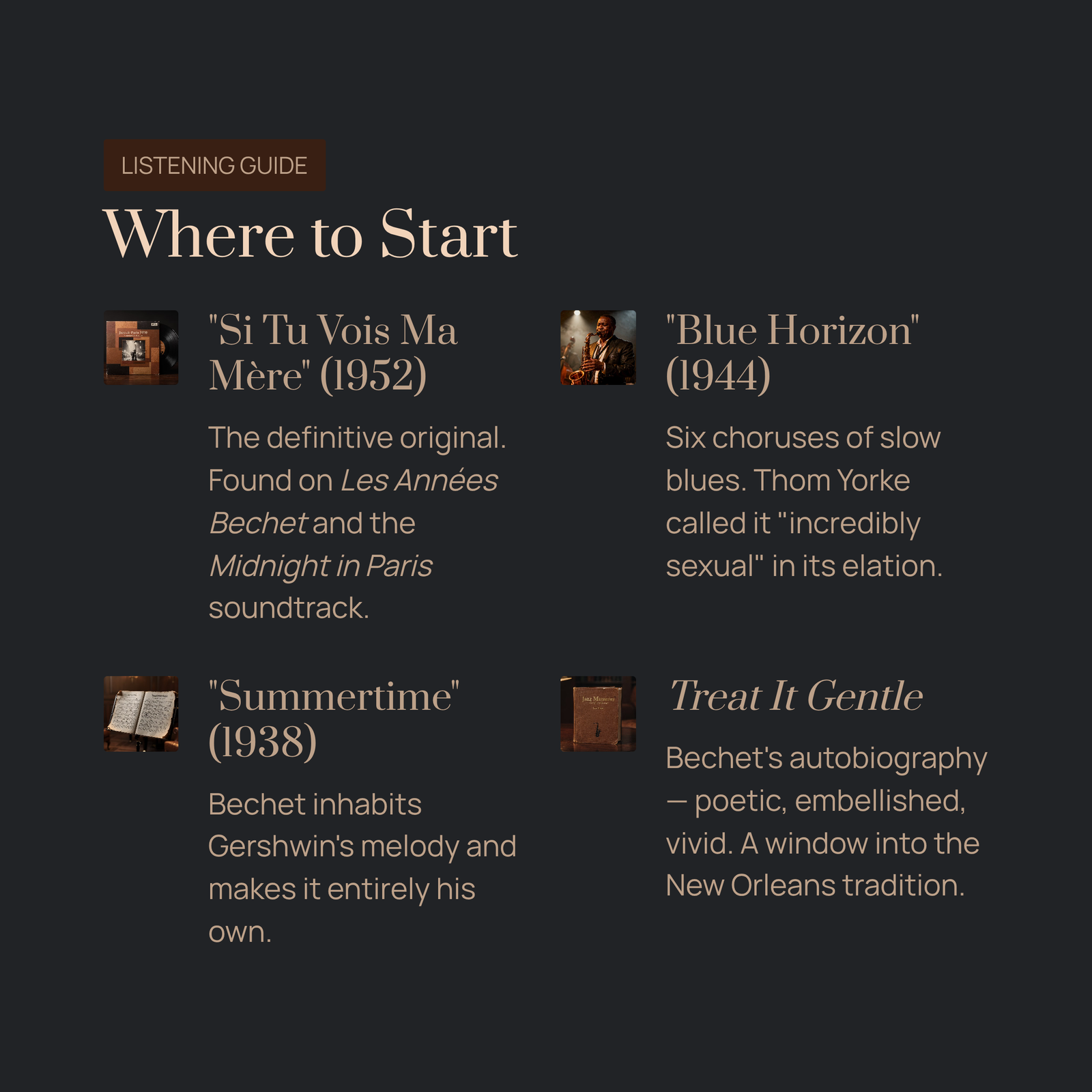
The definitive recording is, of course, Bechet’s 1952 original with Claude Luter et son Orchestre. It appears on various compilations, including Les Années Bechet and the Midnight in Paris film soundtrack. This is the version that captures the full weight of Bechet’s emotional palette — the warmth, the longing, the quiet authority of a man who has lived enough to know exactly what he wants to say and how to say it.
For those who want to explore Bechet’s artistry more broadly, his 1944 recording of “Blue Horizon” is an essential companion piece — six choruses of slow blues so rich in feeling that Radiohead’s Thom Yorke once described the playing as “incredibly sexual” in its elation. His 1938 interpretation of Gershwin’s “Summertime” is another landmark, showcasing his ability to inhabit someone else’s melody and make it entirely his own.
If you enjoy the atmosphere of “Si Tu Vois Ma Mère,” the entire Midnight in Paris soundtrack is worth exploring as a curated introduction to the mood of early jazz intertwined with Parisian romance. And for a deeper understanding of the man himself, Bechet’s autobiography Treat It Gentle — though embellished and sometimes inaccurate — offers a vivid, poetic window into how he understood his own music and the New Orleans tradition that shaped it.
The Music Is the Whole Story
Sidney Bechet died in Garches, near Paris, on May 14, 1959 — his sixty-second birthday. He is buried in a quiet French cemetery, an ocean away from the New Orleans streets where he first learned to play. In the decades since, his influence has quietly permeated jazz like groundwater: Johnny Hodges, John Coltrane, Wayne Shorter, Branford Marsalis — all of them drank from the well that Bechet dug.
But perhaps his most remarkable legacy is the simplest one. A three-minute recording from 1952, a soprano saxophone singing a melody whose title is both a question and a prayer: “If you see my mother.” It asks nothing grand. It promises nothing spectacular. It simply says: I am far from where I started, and I carry everyone I have ever loved inside the sound I make.
That is why “Si Tu Vois Ma Mère” moves you even before you understand it. Not because it is technically brilliant — though it is — but because it is honest in the way that only music can be honest. It speaks in the universal language of someone who has traveled far and felt deeply, and who has learned that the most powerful thing you can do with an instrument is not to show what you can play, but to show who you are.
Put it on some evening when the light is golden and the city outside your window is settling into its quieter self. Let Sidney Bechet walk you through the streets of his adopted Paris, his soprano saxophone cutting through the air like a voice calling out across the years. You do not need to know anything about jazz to understand what he is saying. You only need to have loved someone, or somewhere, from a distance.
That will be more than enough.