📑 Table of Contents
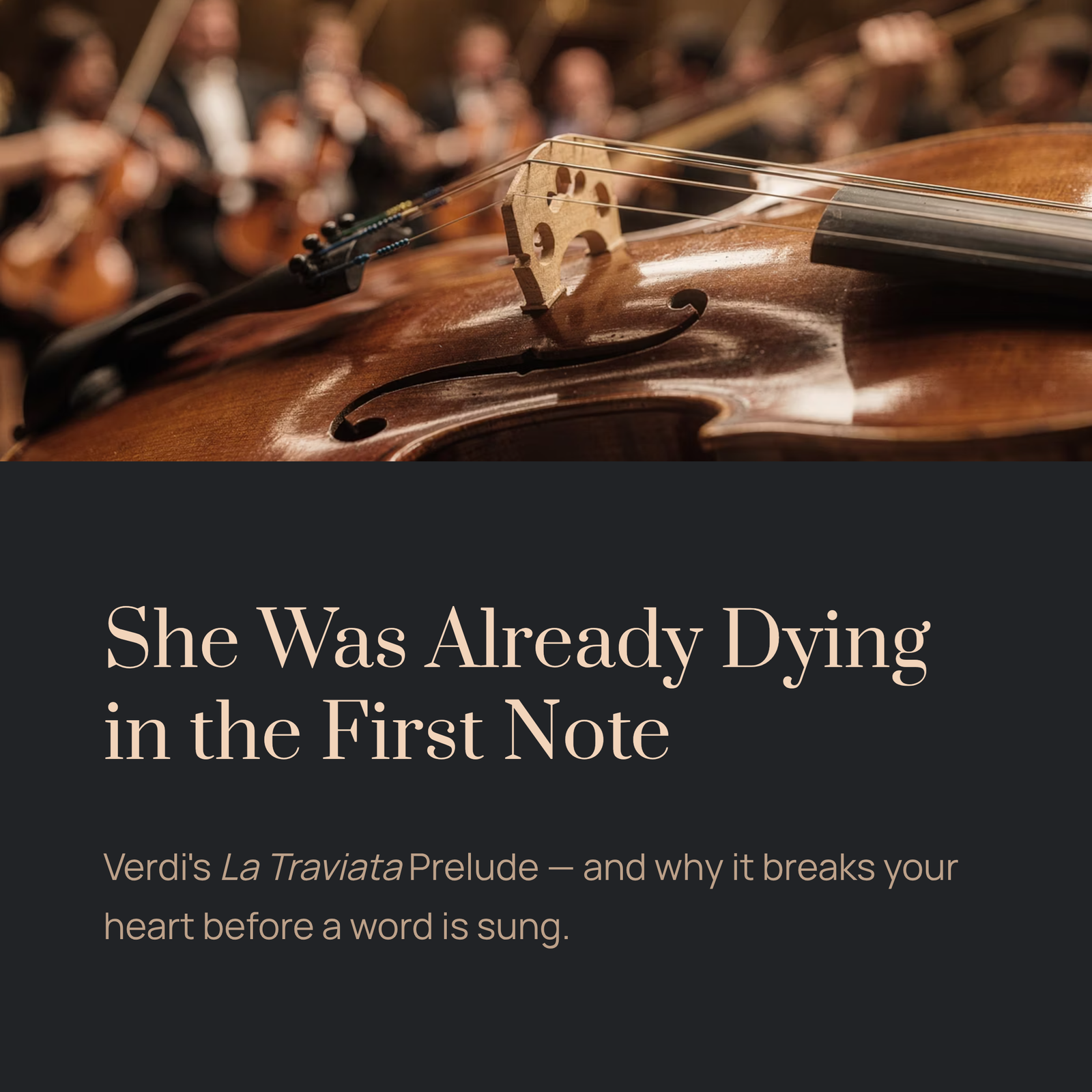
Most stories start at the beginning. Verdi’s La Traviata does not.
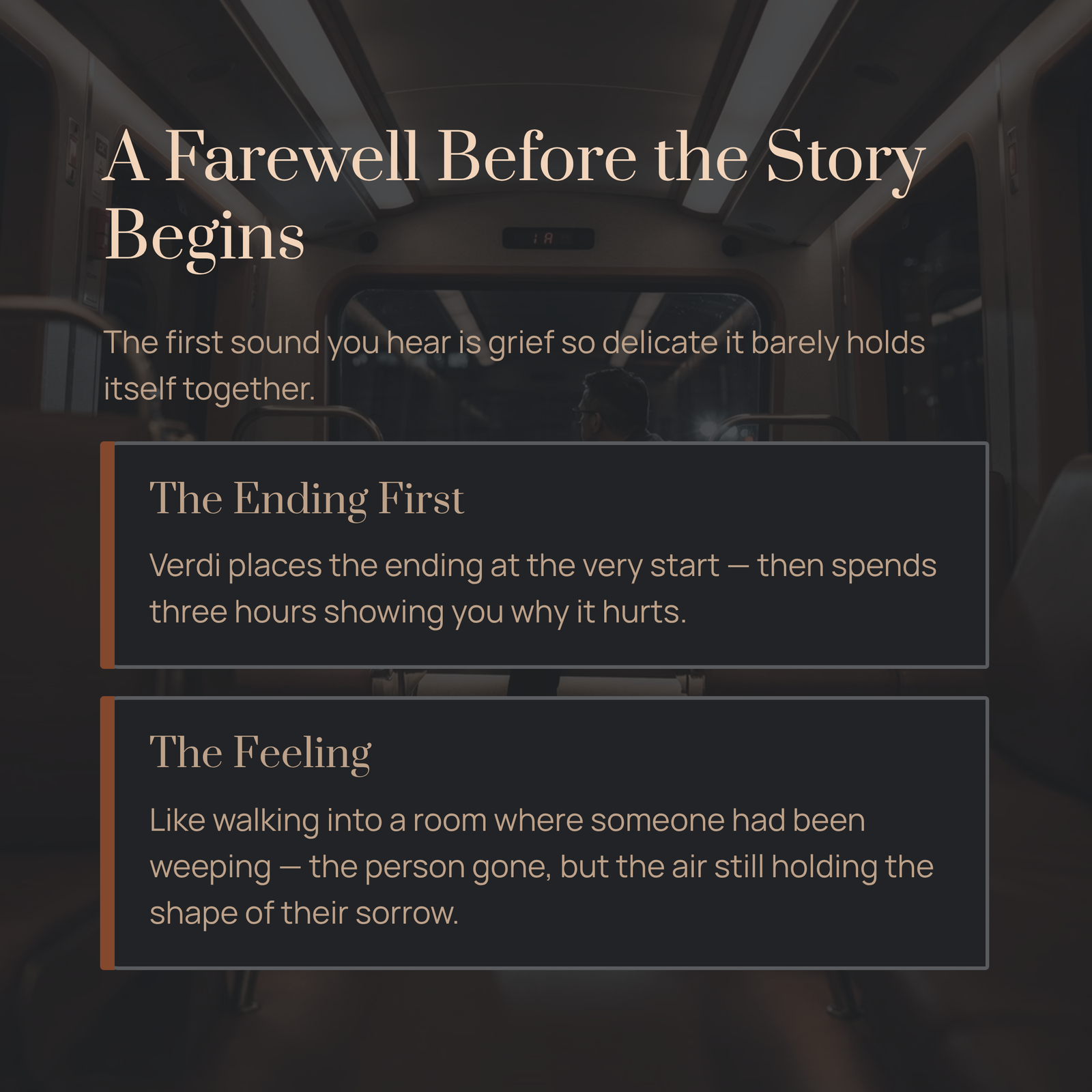
The very first sound you hear — before a single word is sung, before any character steps onto the stage — is a grief so delicate it barely holds itself together. High, trembling strings hover in the air like the last warmth leaving a body. If you didn’t know anything about this opera, you might think: this is beautiful. And it is. But it’s also a farewell. Verdi places the ending at the very start, and then spends the next three hours showing you why it hurts.
I remember the first time I heard this prelude on its own, outside the opera house, through a pair of cheap earbuds on a late train home. I didn’t cry. I just sat very still. Something about those opening measures made me feel like I had walked into a room where someone had been weeping moments ago — the person was gone, but the air still held the shape of their sorrow.
That is the strange, quiet power of this prelude. It asks nothing of you. It simply opens a door.
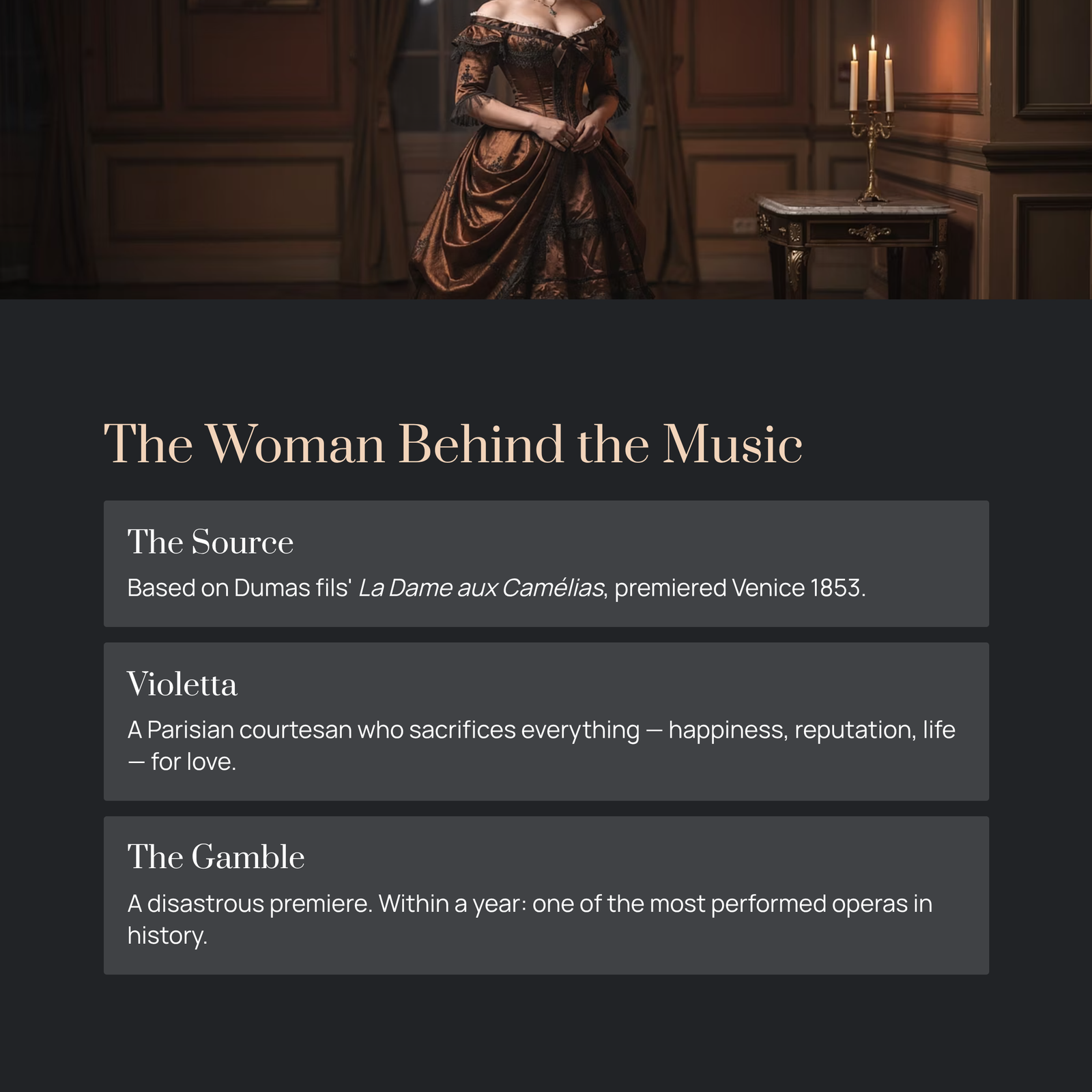
The Woman Behind the Music
To understand this prelude, you need to know who Violetta is — or rather, who she was before Verdi gave her that name.
La Traviata, which premiered in Venice in 1853, is based on Alexandre Dumas fils’ novel and play La Dame aux Camélias. The story follows Violetta Valéry, a Parisian courtesan who falls deeply in love with Alfredo, a young man from a respectable family. Their love is real, but society will not allow it. Violetta sacrifices everything — her happiness, her reputation, and ultimately her life — for the man she loves and the world that refuses to accept her.
Verdi was drawn to this story at a time when opera audiences expected mythological heroes and distant historical drama. Instead, he gave them a contemporary woman, flawed and human, dying of tuberculosis in a rented apartment. The Venice premiere was famously a disaster — the audience couldn’t accept such raw, modern emotion on the operatic stage. Within a year, revised productions turned it into one of the most performed operas in history.
The prelude carries all of this weight. Verdi doesn’t just introduce the music; he compresses an entire life into a few minutes of orchestral sound.
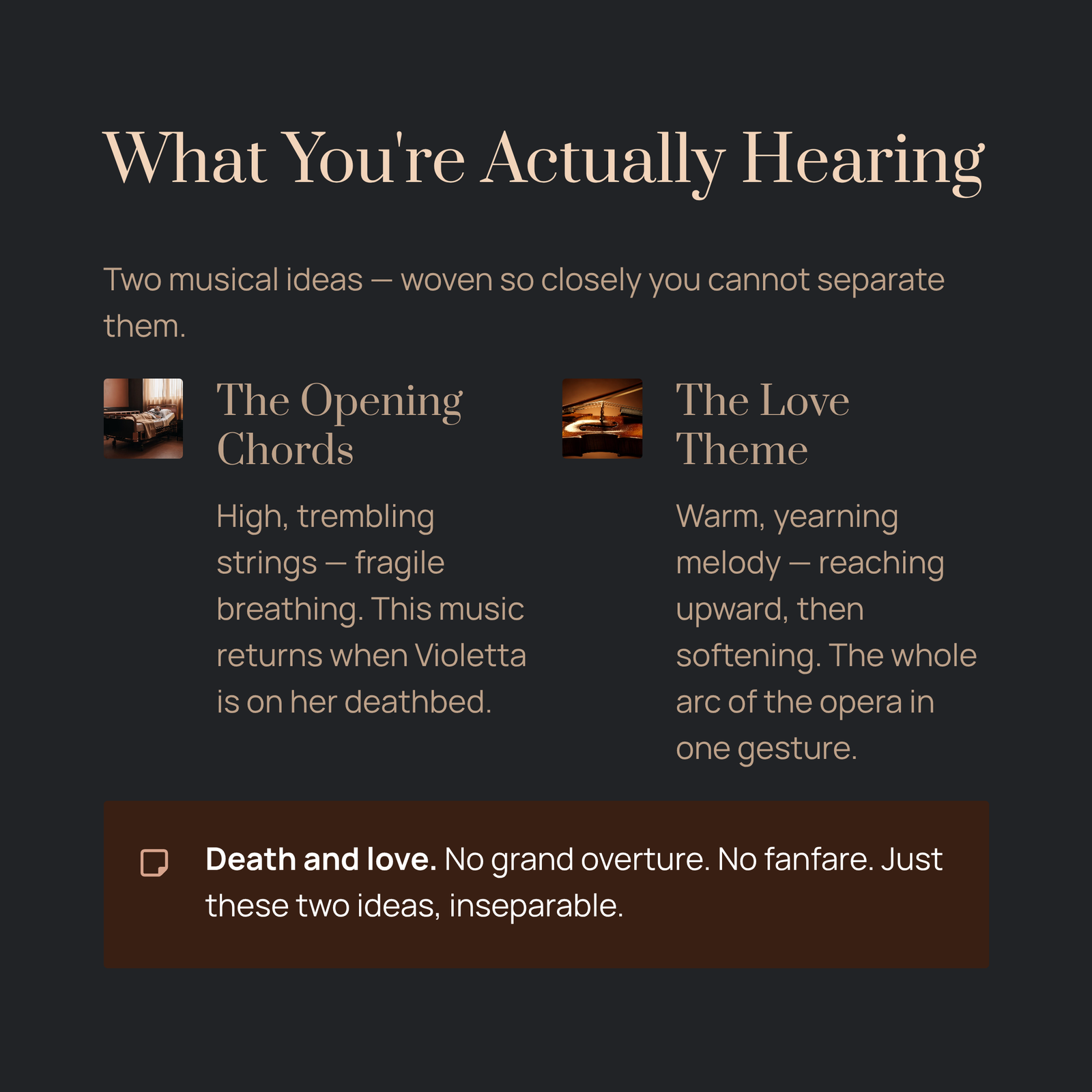
What You’re Actually Hearing
The Prelude to Act 1 is built from two musical ideas, and understanding them transforms the listening experience entirely.
The first idea arrives immediately: divided violins, playing in their highest register, sustain a series of soft, slowly shifting chords. Think of it as breathing — fragile, shallow breathing, the kind you hear in a hospital room when you’re sitting beside someone you love. This music returns at the beginning of Act 3, when Violetta is on her deathbed. Verdi is telling you how the story ends before you even know it has begun.
Then, after this ethereal opening, a melody enters. It’s warm, lyrical, yearning — this is Violetta’s love theme, the music that will later accompany her most intimate confession of feeling. Played by the violins with a gentle orchestral accompaniment, it swells with a passion that feels almost too large for its quiet surroundings. There’s a moment where the melody reaches upward, stretches toward something just out of grasp, and then softens back down. If you listen closely, you can feel the whole arc of the opera in that single gesture: the reaching, the hoping, the letting go.
The genius of this prelude is its economy. No grand overture. No dramatic fanfare. Just two ideas — death and love — woven together so closely that you cannot separate them.
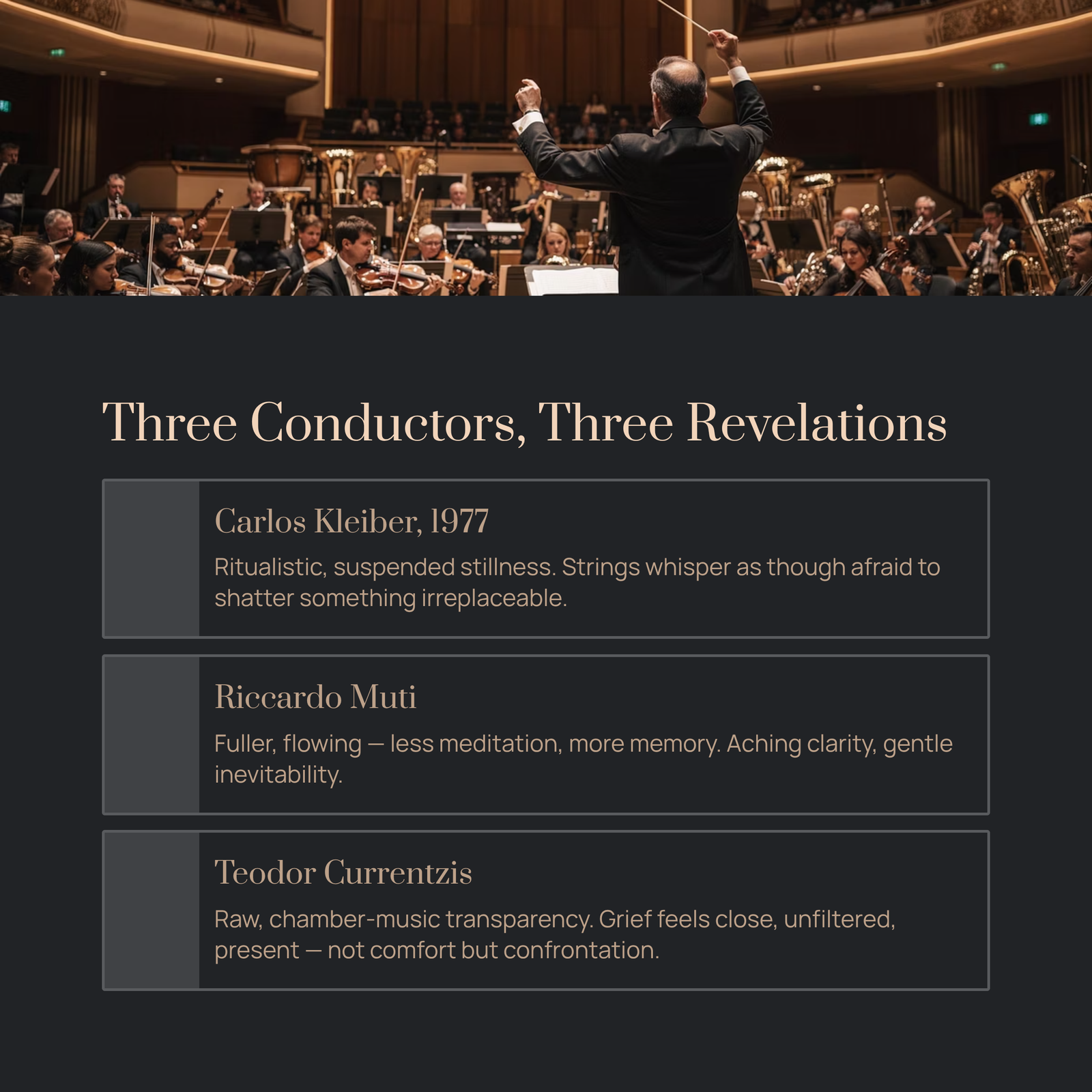
The Performances That Changed How I Hear This Piece
One of the remarkable things about this prelude is how differently conductors approach its emotional temperature.
Carlos Kleiber’s 1977 recording is often considered the definitive version. His pacing is extraordinarily slow and deliberate, almost ritualistic. The opening chords seem to float outside of time. Under his direction, the strings don’t just play softly — they whisper, as though afraid that making too much sound might shatter something irreplaceable. Every phrase breathes with an almost unbearable tenderness.
Then there is Riccardo Muti’s approach, which brings a slightly fuller tone and a more flowing tempo. Where Kleiber creates a sense of suspended stillness, Muti allows the music to move forward with a gentle inevitability, as if the story is already unfolding and cannot be stopped. His version feels less like a meditation and more like a memory — something recalled with aching clarity.
For a more recent interpretation, I’d recommend Teodor Currentzis and MusicAeterna. Their reading is raw and immediate, with an almost chamber-music transparency that strips away any sentimentality. You hear every strand of the string writing with startling clarity, and the effect is not comfort but confrontation — the grief feels close, unfiltered, present.
Each of these conductors finds something different in the same notes, which is precisely what makes this prelude inexhaustible.
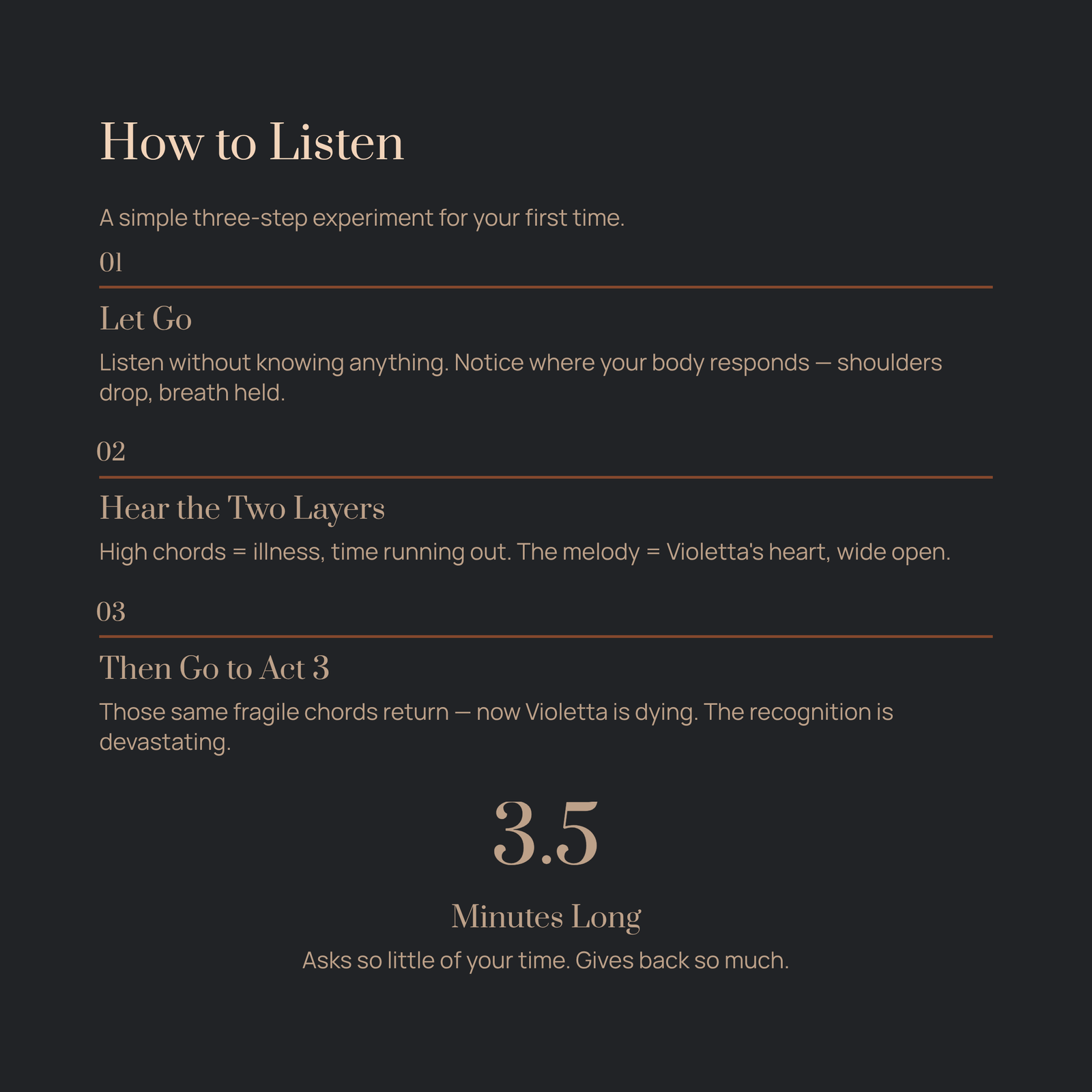
How to Listen: A Gentle Guide
If this is your first time with the La Traviata Prelude, I’d suggest a simple experiment.
Listen to it once without knowing anything — just let the sound wash over you. Notice where your body responds. Maybe your shoulders drop. Maybe you hold your breath without realizing it. That physical response is the prelude doing exactly what Verdi intended.
Then listen again, and this time, pay attention to the two layers. The high, sustained chords at the opening are the frame of illness, of fragility, of time running out. When the melody enters, that is Violetta’s heart — wide open, reckless in its capacity for love, even as everything around it is dissolving.
Finally, if you feel drawn in, listen to the prelude and then immediately skip to the opening of Act 3. You will hear those same fragile chords return, but now Violetta is dying. Now you understand what those sounds meant all along. The recognition is devastating. It’s as though Verdi trusted you to carry that knowledge from the very first bar, knowing it would only reveal its full meaning hours later.
The entire prelude lasts roughly three and a half minutes. It asks so little of your time. It gives back so much.
Why This Music Still Finds Us
There is a reason this prelude survives outside the opera house — in film soundtracks, in concert halls, in the playlists of people who have never sat through a full opera and may never intend to. It survives because it captures something that doesn’t require context or expertise to feel: the weight of loving someone you are going to lose.
Verdi understood that grief and love are not opposites. They are the same melody, heard at different moments. The prelude doesn’t dramatize this idea — it simply presents it, with the quiet confidence of a composer who knew that the deepest truths don’t need to announce themselves.
I keep returning to this piece the way I keep returning to certain photographs — not because I’ve forgotten what they look like, but because each time I look, I notice something I missed before. A harmonic shift I hadn’t registered. A moment where the melody hesitates, just slightly, before continuing. These small discoveries remind me that great music is never finished with us, even when we think we know it well.
If you’re standing at the threshold of classical music, uncertain whether it has anything to say to you, let this be your invitation. Three and a half minutes. A divided string section. Two ideas — one about endings, one about love — folded gently into each other.
Press play. Sit still. And let Violetta tell you her story from the very first note.