📑 Table of Contents
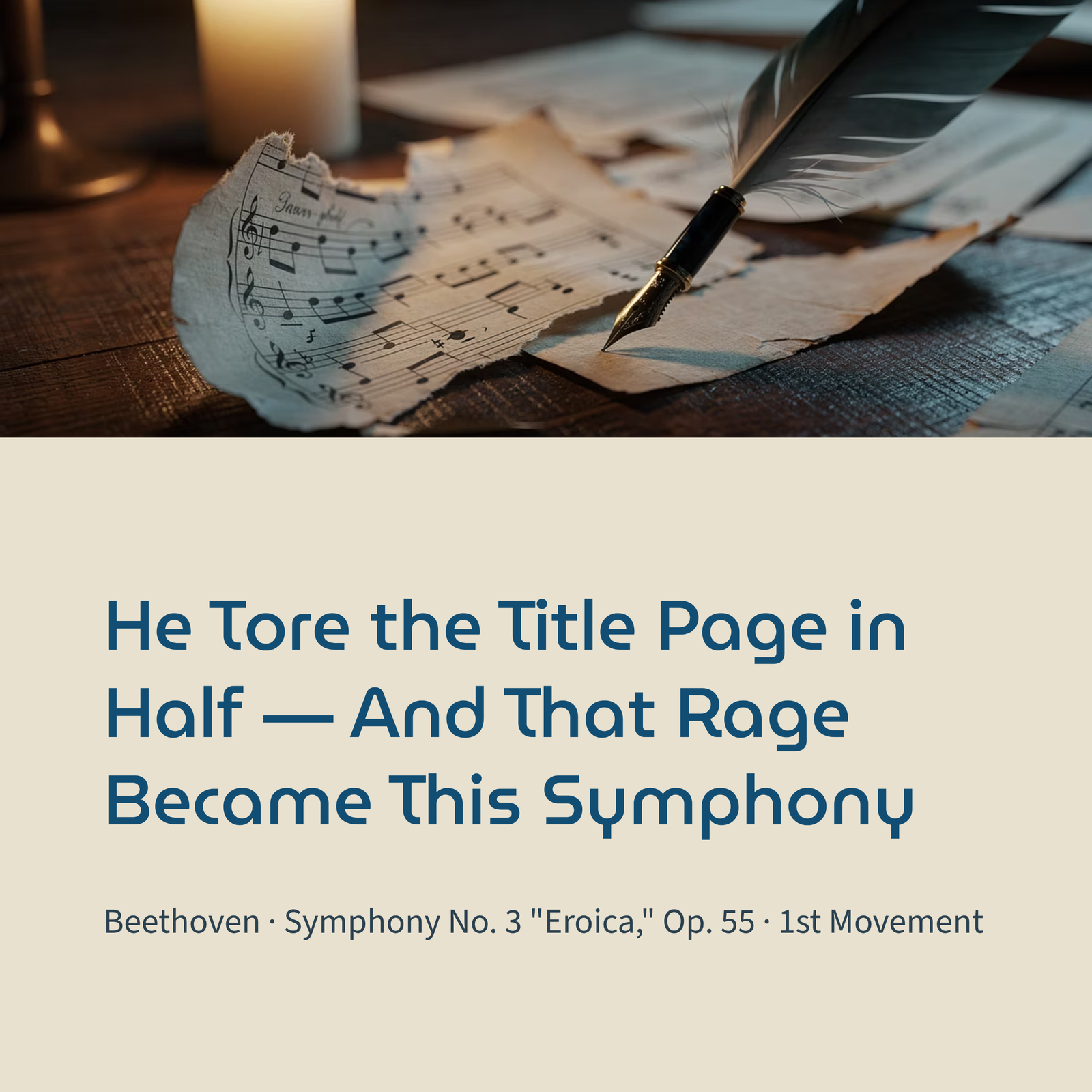
There is a story — perhaps embellished, perhaps not — about Beethoven receiving the news that Napoleon had crowned himself Emperor. The composer, who had dedicated his new symphony to the great liberator of Europe, reportedly seized the title page and ripped it apart. “So he is nothing more than an ordinary man,” he is said to have muttered. “Now he, too, will trample on all the rights of man.”
I think about that torn page every time I press play on the first movement of the Eroica. Because when those two massive E-flat major chords crash open the symphony — like a door kicked in rather than politely opened — you can almost hear the rage. Not petty anger, but something far deeper: the fury of someone who once believed in a hero and then had to bury that belief.
This is where our listening begins. Not with analysis, but with a torn piece of paper and an unshakable sense of betrayal.
The World Before the Eroica — And Why It Mattered
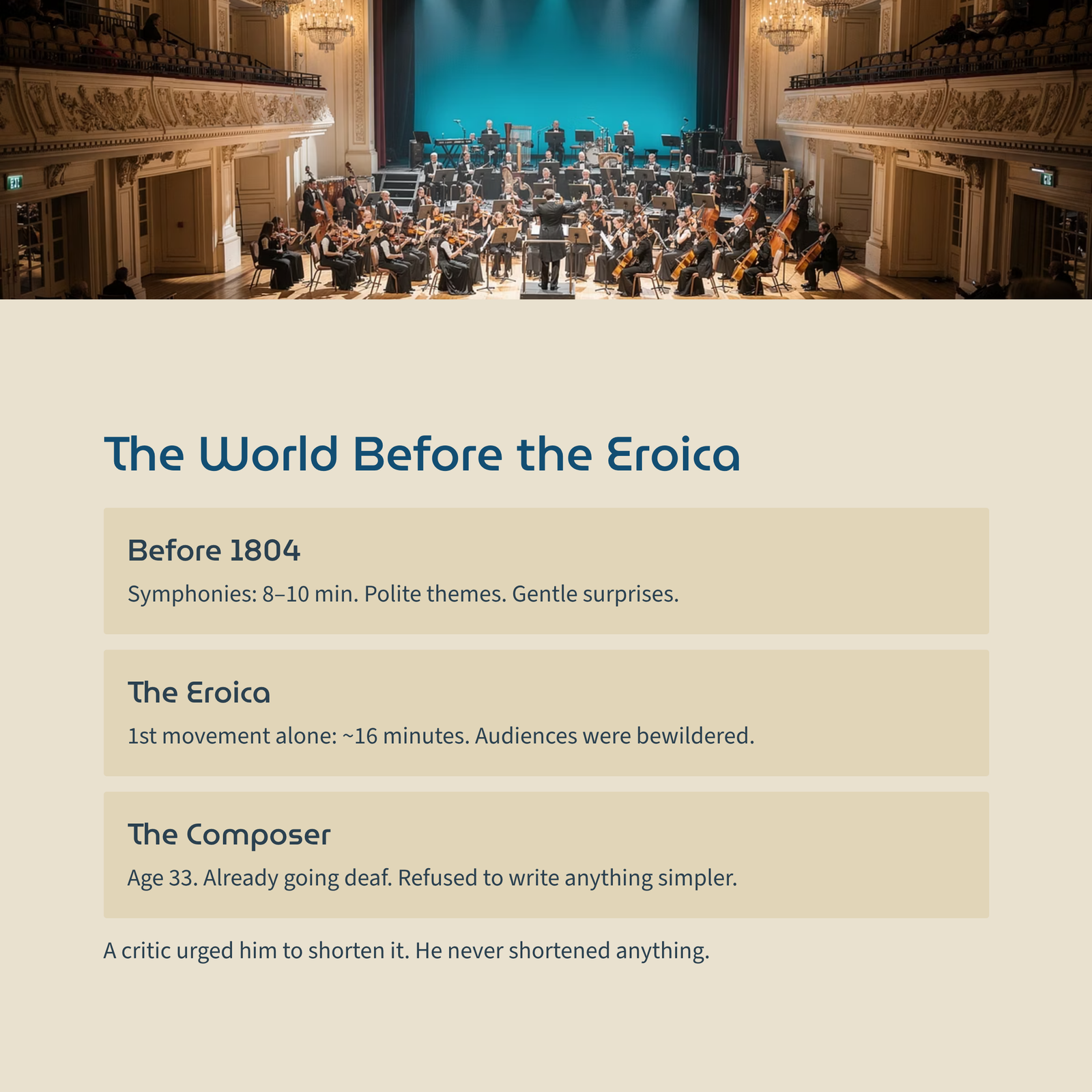
To understand why this symphony changed everything, you need to know what a symphony sounded like before 1804. Think of Haydn and Mozart — elegant, proportioned, like a well-designed room where every piece of furniture sits exactly where you expect it. Symphonies had rules. First movements lasted about eight to ten minutes. Themes were polite. Surprises were gentle.
Then Beethoven wrote this.
The first movement of the Eroica alone runs nearly sixteen minutes — longer than many entire symphonies of the era. When it premiered, audiences were bewildered. Some thought it was too long. Others thought Beethoven had simply lost control. A critic at the time suggested that the symphony “would gain immeasurably if Beethoven would decide to shorten it.”
He did not shorten it. He never shortened anything. And that stubbornness is precisely why we are still talking about this piece more than two centuries later.
Beethoven was thirty-three when he completed the Eroica, and he was already going deaf. Think about that for a moment — a composer losing the very sense that defines his craft, choosing not to retreat into simpler, safer work but instead to write the longest, most complex, most emotionally demanding symphony anyone had ever attempted. The Eroica was not composed in spite of his suffering. It was composed through it.
Hearing the Revolution: What to Listen For
Let me walk you through this movement the way I wish someone had walked me through it the first time I heard it.
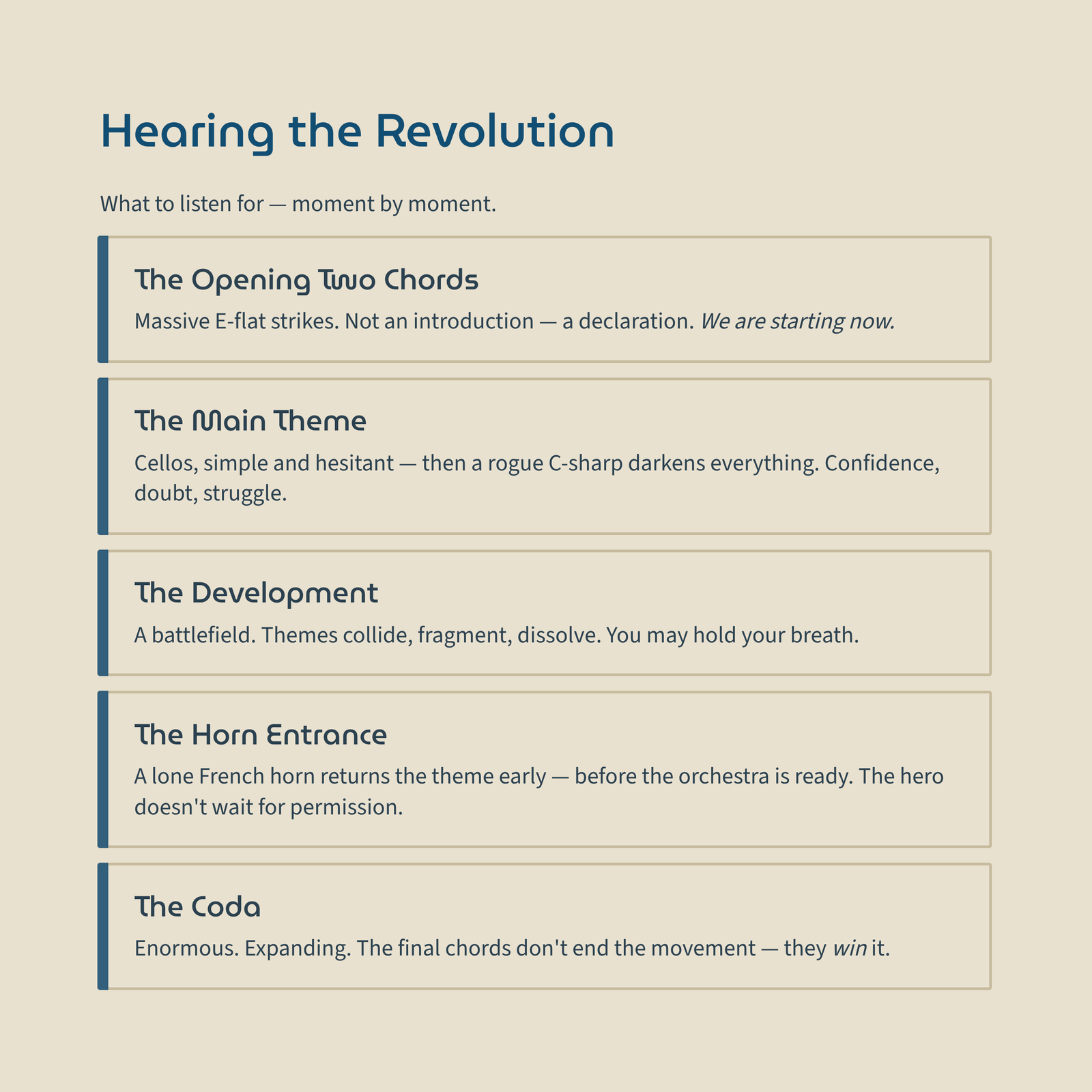
The opening two chords — two quick, massive strikes in E-flat major. They are not a slow introduction. They are a declaration. Beethoven is telling you: sit up, pay attention, we are starting now. Most composers of his era would have eased you in with a gentle prelude. Beethoven refuses.
The main theme enters almost immediately in the cellos — and here is what surprises most first-time listeners. It is not grand or imposing. It is simple, almost hesitant, built on the most basic notes of the E-flat major chord. It sounds like someone beginning to speak, unsure of what they want to say. But listen to what happens next: that tentative melody hits a strange, unexpected note — a C-sharp that does not belong in the key — and suddenly the music stumbles, darkens, reaches for something beyond its grasp. In those first twenty seconds, Beethoven gives you the entire emotional arc of the movement: confidence, doubt, struggle, and the refusal to stop moving forward.
The development section is where the movement truly earns its reputation. In a conventional symphony, the development is a brief middle passage where the composer plays with the themes before bringing them back neatly. Beethoven turns this section into a battlefield. Themes collide, fragment, dissolve into dissonance. There is a passage where the music seems to lose all sense of direction — harmonies pile on top of each other, the orchestra pulls in different directions — and it genuinely feels like everything might fall apart. The first time I heard this section with good headphones, I realized I had been holding my breath.
And then comes the moment that still gives me chills: a lone French horn enters quietly with the main theme, just before the rest of the orchestra is ready. It sounds almost like a mistake — and for years, scholars debated whether it was one. It is not. It is Beethoven’s way of telling you that the hero does not wait for permission to return.
The coda — the ending section — is enormous, almost a second development in itself. Where other composers would have wrapped things up in a tidy bow, Beethoven expands, intensifies, and drives the music toward a conclusion that feels earned rather than inevitable. The final chords do not simply end the movement. They win it.
A Personal Confession
I will be honest: I did not love the Eroica the first time I heard it. I found it long, dense, and exhausting. I was nineteen, listening on cheap earbuds during a train ride, and I kept checking how much time was left.
It was not until years later, during a period when I was dealing with something difficult in my own life — nothing dramatic, just the slow grinding weight of a situation I could not control — that I returned to this movement and finally understood it. The Eroica is not music you enjoy the way you enjoy a pleasant melody. It is music you need during certain chapters of your life. It speaks to the experience of being knocked down and choosing, stubbornly and perhaps irrationally, to stand back up.
That C-sharp in the opening theme — the note that does not belong — I hear it now as the sound of something breaking. And everything that follows is the sound of someone refusing to stay broken.
How to Listen: A Practical Guide
If this is your first time with the Eroica, here are a few suggestions that made a real difference for me.
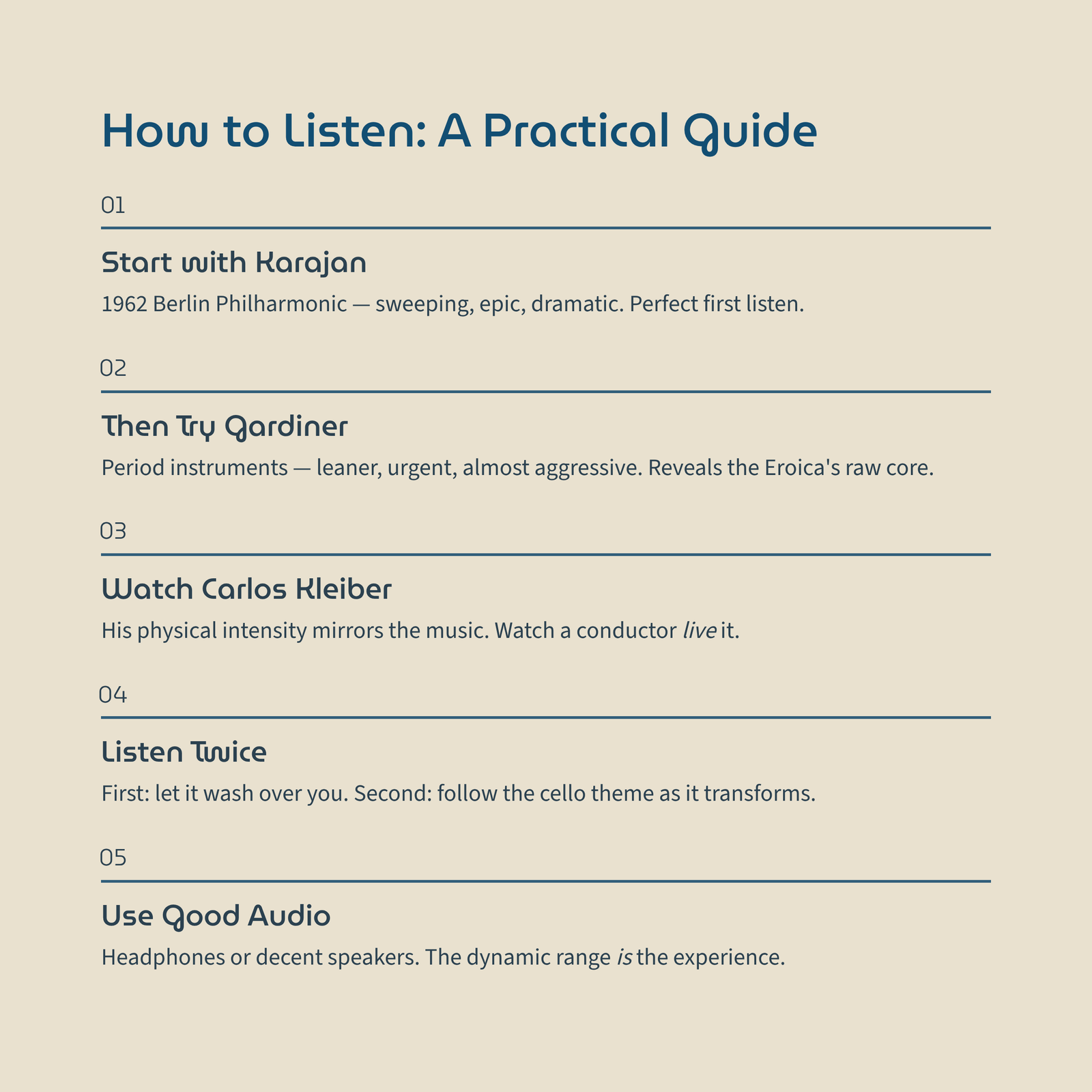
Start with one recording: Herbert von Karajan’s 1962 Berlin Philharmonic recording is a powerful starting point — sweeping, dramatic, and unapologetically romantic. It treats the Eroica as an epic, and for a first listen, that sense of scale helps.
Then try the opposite: John Eliot Gardiner’s period-instrument recording with the Orchestre Révolutionnaire et Romantique strips away the grand orchestral sheen and reveals something leaner, more urgent, almost aggressive. Hearing both versions back to back taught me that the Eroica contains multitudes.
For a live experience on video: Carlos Kleiber’s concert recordings are extraordinary — his physical intensity on the podium mirrors the music’s own restless energy. Watching a conductor live this music rather than simply directing it adds an entirely different dimension.
Listen at least twice. The first time, just let it wash over you. Do not try to follow the structure. The second time, pay attention to that opening cello theme and notice how it transforms — how it appears in different instruments, in different keys, sometimes triumphant, sometimes fractured. The movement is essentially a single idea viewed from every possible angle.
Use the best audio you have. This is not background music. The dynamic range — from near-silence to full orchestral force — is part of the experience. Headphones or a decent speaker setup will reveal details that disappear on a phone speaker.
What the Eroica Leaves Behind
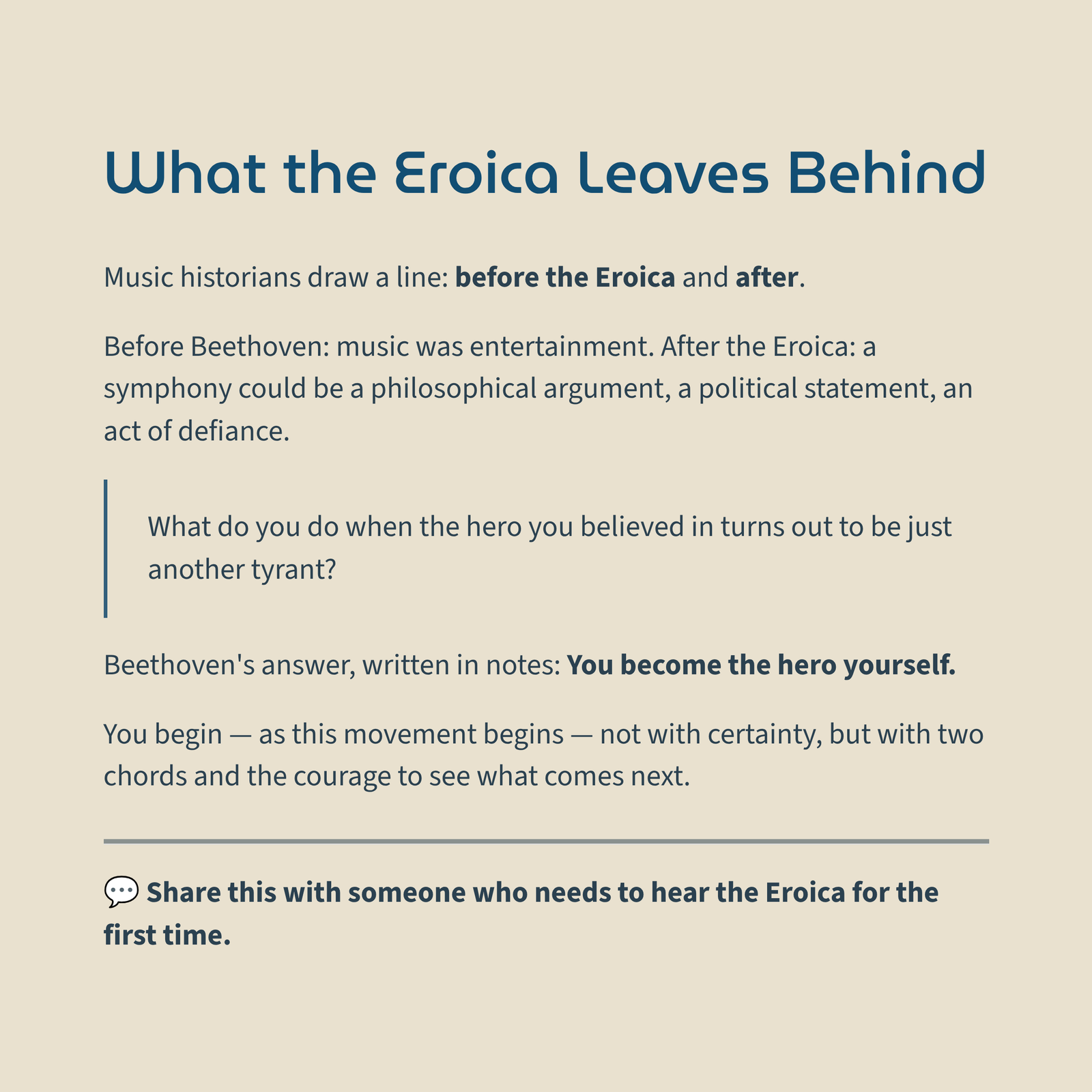
There is a reason music historians draw a line through history and label one side “before the Eroica” and the other “after.” This symphony did not just change what a symphony could be. It changed what music was for. Before Beethoven, instrumental music was largely entertainment — sophisticated, beautiful entertainment, but entertainment nonetheless. After the Eroica, a symphony could be a philosophical argument, a personal confession, a political statement, an act of defiance.
That first movement, with its torn-up dedication and its stubborn, searching theme, asks a question that never gets old: what do you do when the hero you believed in turns out to be just another tyrant? Beethoven’s answer, written in notes rather than words, is breathtaking in its simplicity.
You become the hero yourself.
And you begin — as this movement begins — not with certainty, but with two chords and the courage to see what comes next.