📑 Table of Contents
There is a particular kind of silence that exists only at dawn. Not the silence of absence, but the silence of anticipation — the world holding its breath, waiting for the sun to crest the horizon. If that silence had a sound, it would be the opening notes of Dario Marianelli’s “Dawn.”
I first heard this piece without knowing its name. It drifted out of a speaker in a café one early morning, and I stopped mid-step. A single piano, no orchestra, no embellishment — just a melody so bare and honest that it felt like overhearing someone’s private prayer. That is the peculiar power of this music. It doesn’t announce itself. It simply arrives, the way light does, and changes everything in the room.
The Composer Who Paints With Restraint
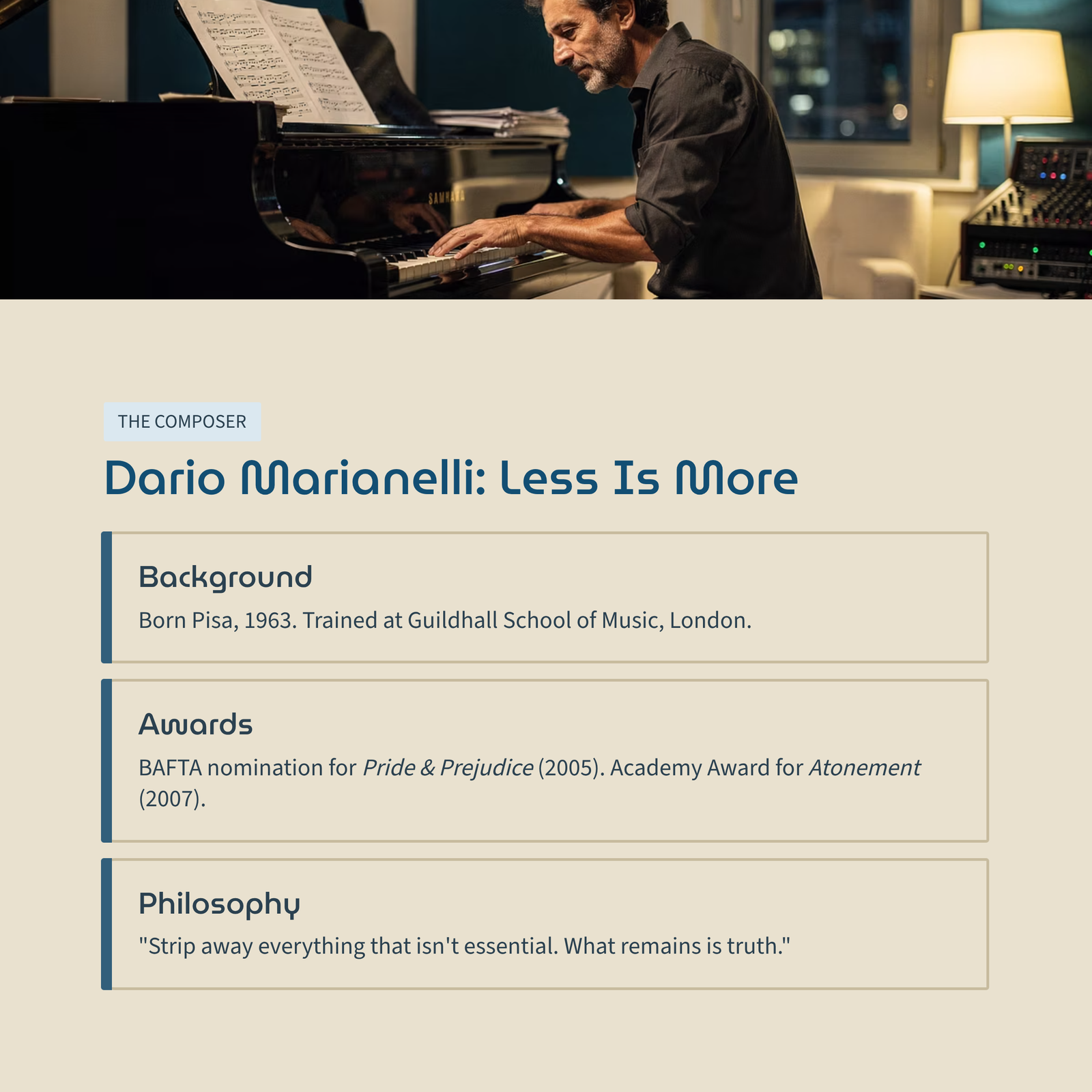
Dario Marianelli is an Italian-born, London-based composer who has spent his career proving that less is almost always more. Born in Pisa in 1963, he studied at the Guildhall School of Music and Drama and the National Film and Television School in London. While many film composers reach for sweeping orchestral gestures to move an audience, Marianelli often chooses the opposite path — a single instrument, a handful of notes, the courage to leave space.
His work on Joe Wright’s 2005 adaptation of Pride & Prejudice earned him a BAFTA nomination, and he later won the Academy Award for Best Original Score for Wright’s Atonement in 2007. But it is arguably “Dawn” — a piece that lasts barely over two minutes — that best represents his artistic philosophy. Strip away everything that isn’t essential. What remains is truth.
Marianelli once described his approach to scoring Pride & Prejudice as an attempt to capture “the interior world of Elizabeth Bennet.” Not the ballrooms, not the grand estates, but the private landscape of a young woman’s mind as she navigates pride, prejudice, and the terrifying possibility of love.
What Happens Inside Those Two Minutes
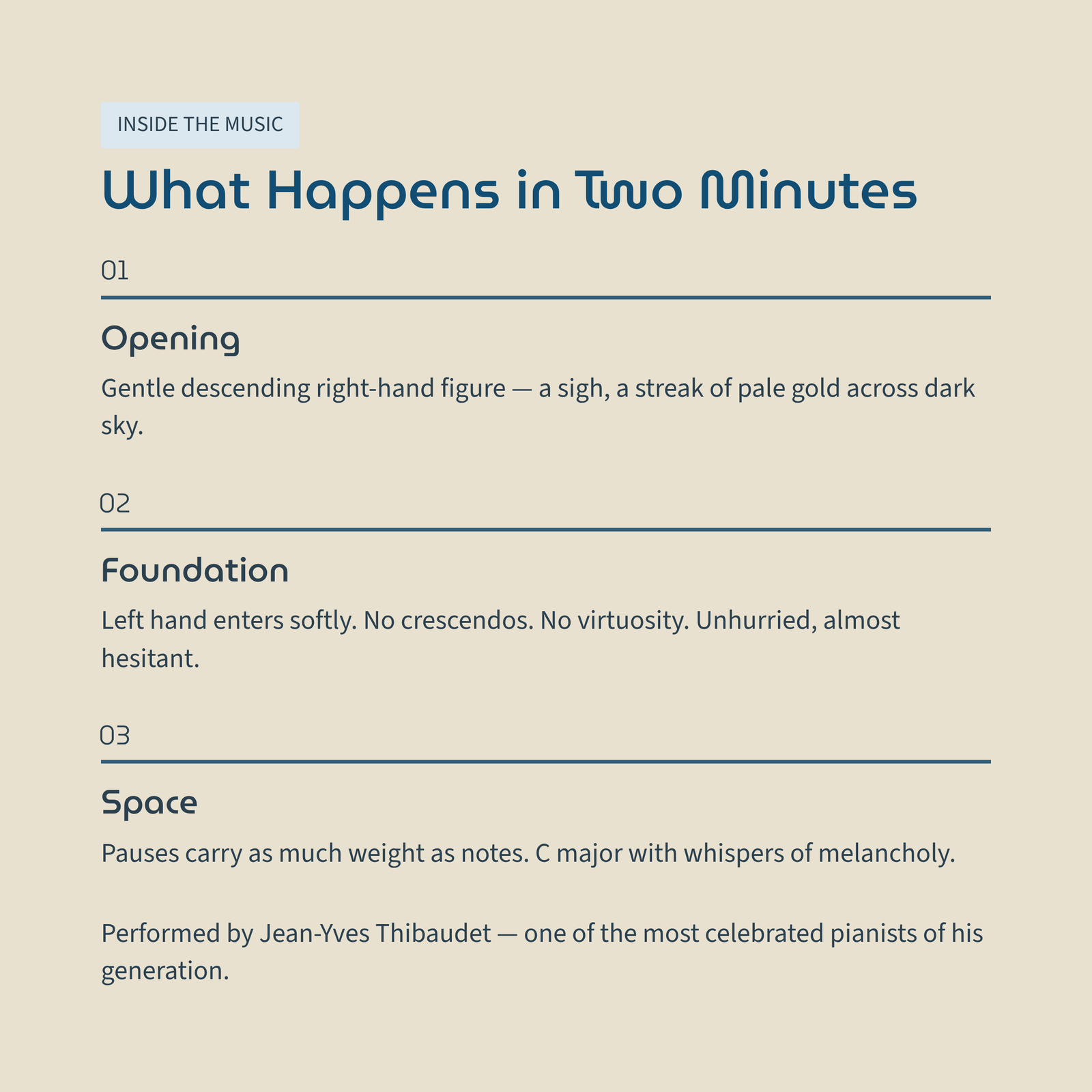
“Dawn” is deceptively simple. The piece is written for solo piano, performed by Jean-Yves Thibaudet, one of the most celebrated pianists of his generation. It opens with a gentle, descending figure in the right hand — a phrase that feels like a sigh, or perhaps like the first streak of pale gold across a dark sky.
The left hand enters softly beneath, providing a quiet harmonic foundation that grounds the melody without ever competing with it. There are no dramatic crescendos, no virtuosic runs, no moments designed to impress. The tempo is unhurried, almost hesitant, as if the music itself is still deciding whether to fully wake.
What makes “Dawn” so quietly devastating is its use of space. The pauses between phrases carry as much emotional weight as the notes themselves. Listen to the way certain notes hang in the air just a moment longer than expected — that slight lingering is where the real feeling lives. It is the musical equivalent of standing at a window, watching fog lift from a field, and feeling something unnamed stir in your chest.
The harmonic language is tonal and warm, rooted in C major but with gentle shifts that introduce a whisper of melancholy. This is not pure joy. It is the complicated tenderness of someone who has been alone with her thoughts for a long time and is only now beginning to sense that something might change.
Why This Piece Feels Like a Secret You Already Knew
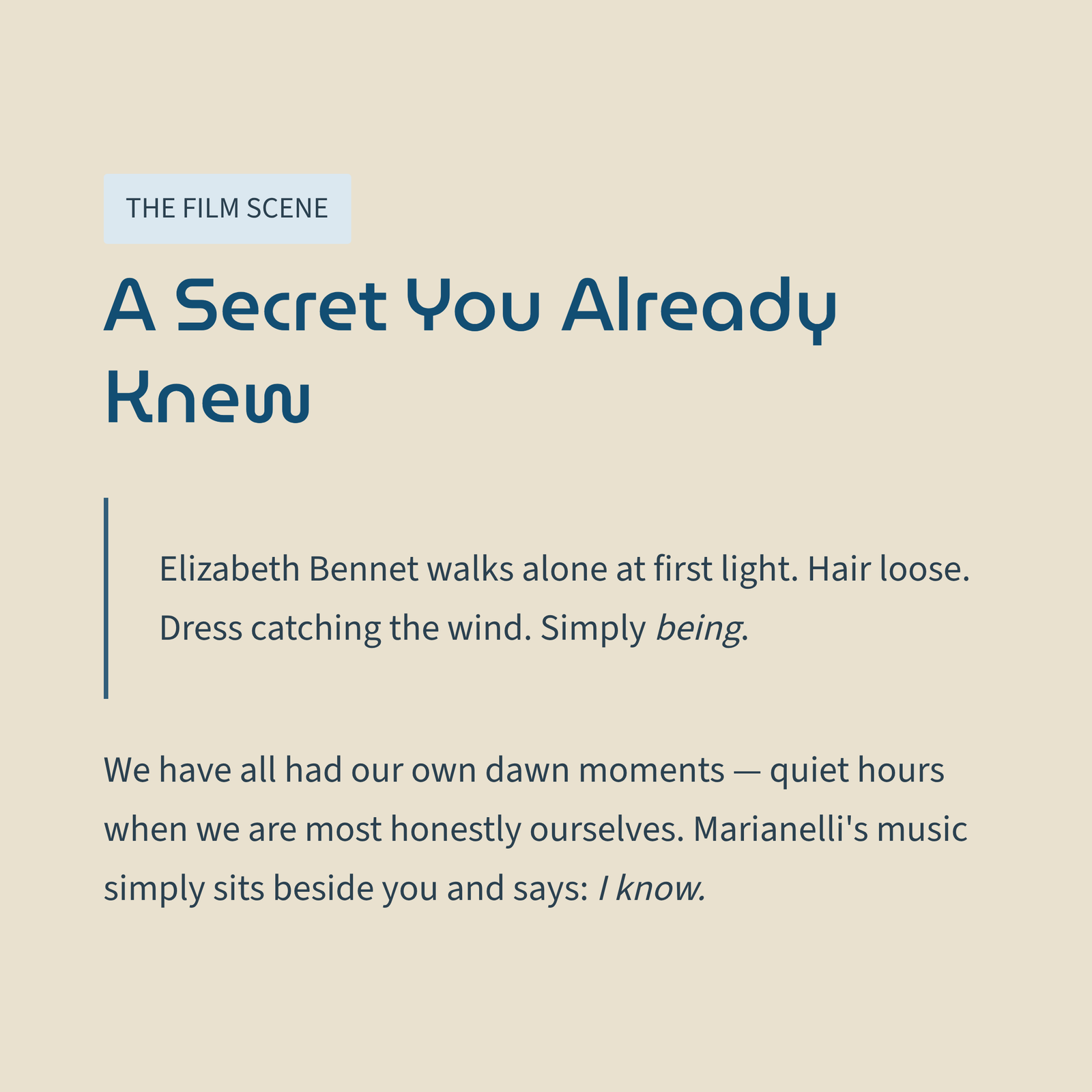
In the film, “Dawn” accompanies one of the most visually stunning sequences: Elizabeth Bennet, played by Keira Knightley, walking alone across the English countryside at first light. Her hair is loose. Her dress catches the wind. She is not going anywhere in particular. She is simply being — present in the landscape, lost in thought, carrying the weight of conversations and glances and unspoken feelings.
This is why the piece resonates so deeply even outside the context of the film. We have all had our own dawn moments — those quiet hours before the world demands our attention, when we are most honestly ourselves. Marianelli’s music does not try to tell you what to feel during those moments. It simply sits beside you and says, I know.
There is a reason this piece has found a second life on study playlists, meditation channels, and late-night listening sessions around the world. It asks nothing of the listener. It offers no narrative arc, no resolution, no dramatic payoff. It is simply a small, perfect window into stillness. And in an age of constant noise, that is a radical gift.
How to Let This Piece In
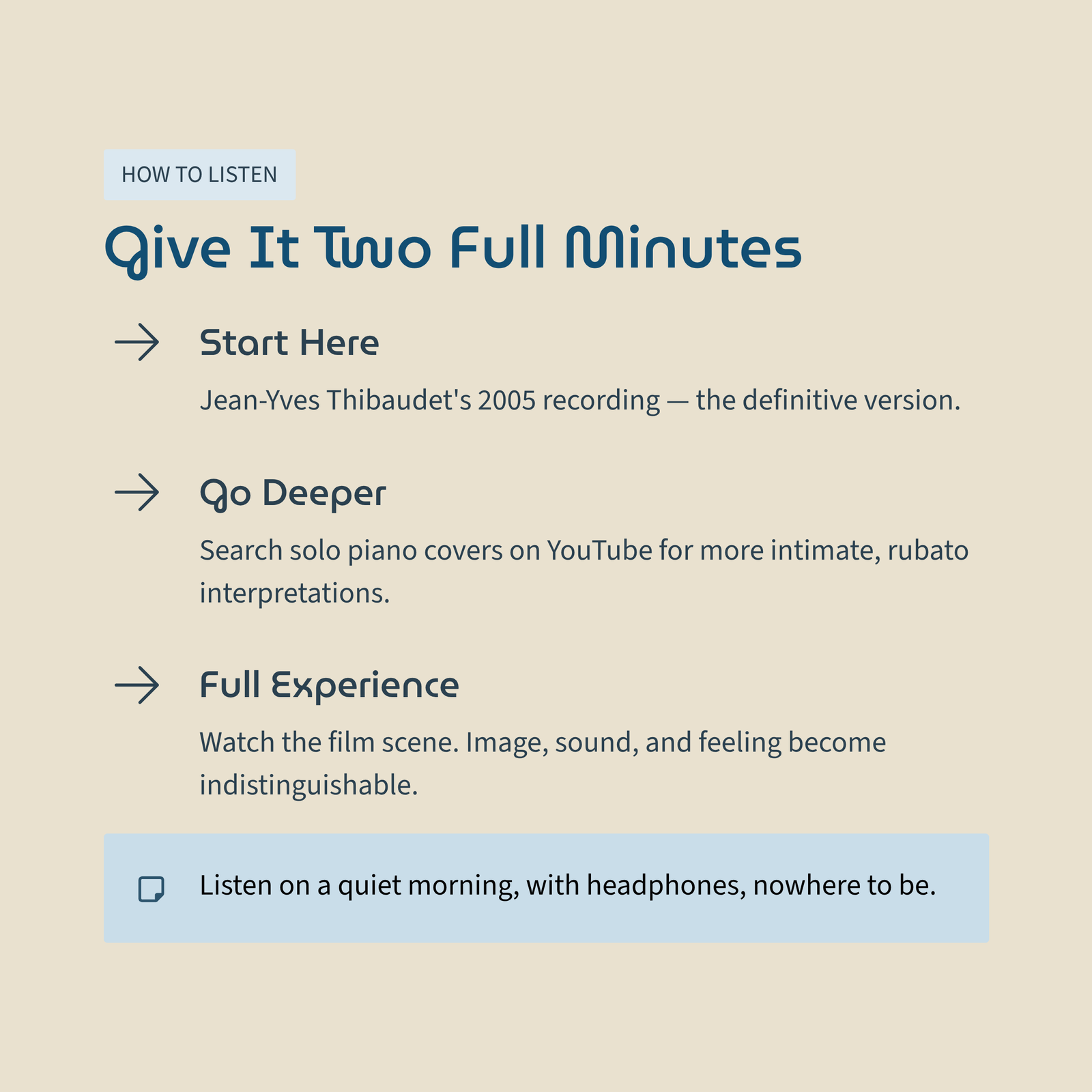
If you are encountering “Dawn” for the first time, here is my suggestion: do not listen to it while doing something else. Give it two minutes of your full attention. That is all it asks.
Jean-Yves Thibaudet’s performance on the original 2005 soundtrack is the definitive recording. Thibaudet brings a warmth and subtlety to the piano that feels effortless — each note placed with the precision of a watercolor brushstroke. The full Pride & Prejudice soundtrack album is worth exploring, as “Dawn” serves as a kind of emotional thesis statement for the entire score.
For a different perspective, search for solo piano covers on YouTube. Many pianists have recorded their own interpretations, and some bring a slightly more rubato-heavy approach, stretching the phrases just a bit further. These versions can feel more intimate, more personal — like hearing the piece through someone else’s emotional lens.
Try listening on a morning when you have nowhere to be. Let the music fill a quiet room. Pay attention to what happens in the silences between phrases. Notice how the melody seems to breathe. If you can, listen with headphones — the subtle dynamics and the resonance of the piano’s lower register reveal themselves more fully in close listening.
And if you want to understand the full emotional arc, watch the film scene itself. The combination of Marianelli’s music, Wright’s cinematography, and Knightley’s silent performance creates something that transcends any single element. It is one of those rare moments in cinema where image, sound, and feeling become indistinguishable.
Two Minutes That Hold an Entire World
There is a Japanese concept called ma — the meaningful pause, the space between things where understanding lives. “Dawn” is a piece built almost entirely of ma. It is not about what the piano plays. It is about what trembles in the silence after each note fades.
Dario Marianelli composed a piece that does what the greatest art always does: it makes the ordinary sacred. A morning. A walk. A window. A breath. These are not dramatic events. But wrapped in the right music, they become the most important moments of a life.
Sometimes I return to “Dawn” when the world feels too loud, too fast, too insistent. I press play, and for two minutes, everything slows to the speed of light crossing a field. The piano speaks, and then it pauses, and in that pause I remember — this is what it sounds like to be quietly, stubbornly alive.
That is enough. That has always been enough.