📑 Table of Contents

There are pieces of music that politely invite you in, offer you a seat, and gently unfold their story. Zigeunerweisen is not one of them.
From its very first notes, this piece grabs you by the collar. A deep orchestral growl, and then — a single violin, wailing like someone who has lived ten lifetimes of love and heartbreak and refuses to keep quiet about any of them. Before you can even settle into that mood, the music erupts into passages so fast your ears scramble to keep up. Then, just when you think it’s all fireworks, the violin starts to sing the most achingly tender melody you’ve ever heard — the kind that makes you hold your breath without realizing it.
This is Zigeunerweisen, Op. 20. And if you’ve never experienced it, you’re about to discover one of the most electrifying nine minutes in all of classical music.
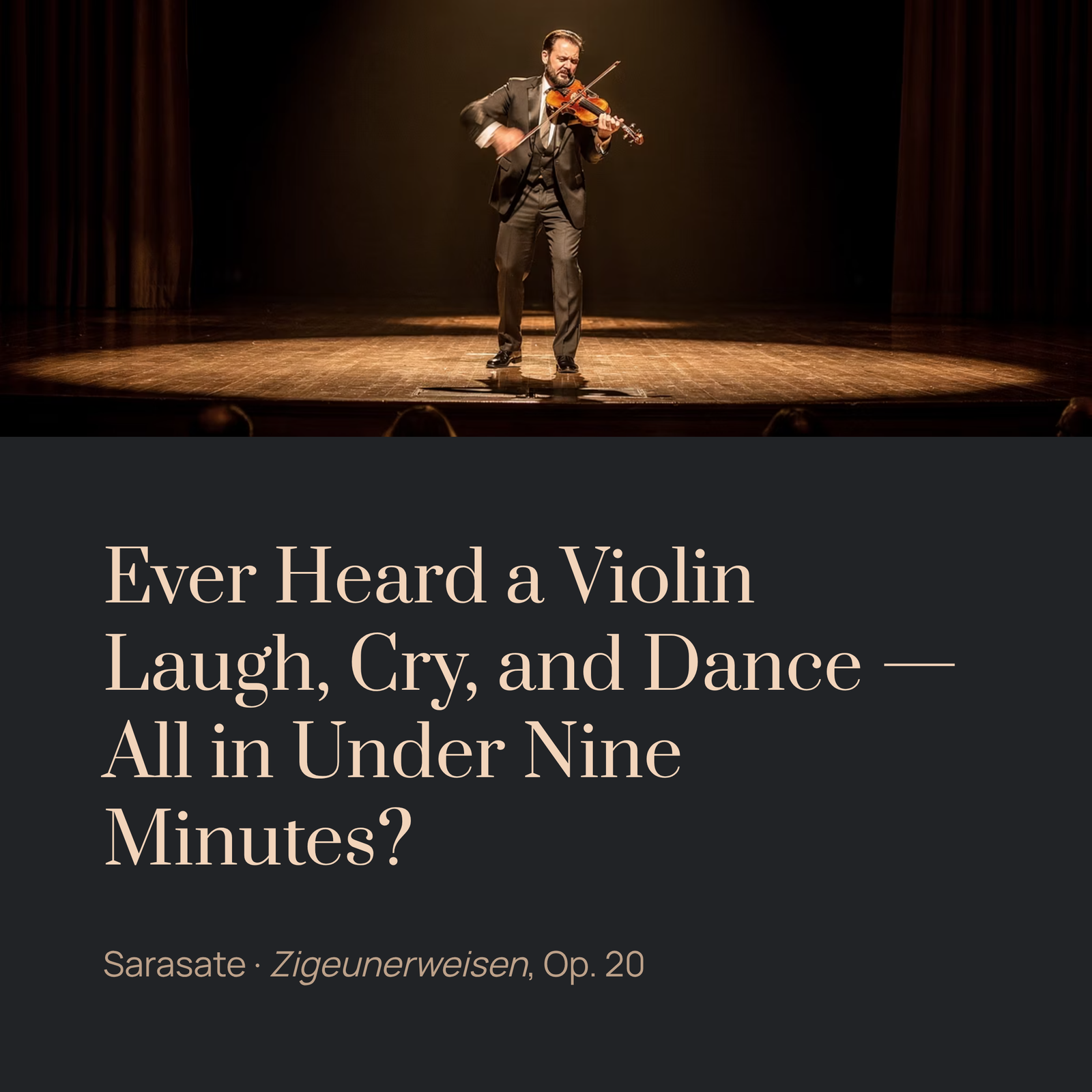
The Man Behind the Magic: Pablo de Sarasate
Pablo de Sarasate (1844–1908) was a Spanish violinist and composer who, in his own time, was nothing short of a rock star. Born in Pamplona, he was a child prodigy who entered the Paris Conservatoire at age twelve and went on to dazzle audiences across Europe and the Americas with a playing style so effortless it seemed almost supernatural. Critics marveled at the purity of his tone and the liquid ease with which he dispatched passages that would leave other violinists in cold sweats.
But Sarasate wasn’t just a technician. He had an ear for melody that bordered on the obsessive, and he was particularly captivated by the folk music traditions of the Romani people — the wandering communities whose fiddling traditions had long electrified the taverns and campfires of Central Europe. In 1878, he distilled that fascination into a single work: Zigeunerweisen, which translates to “Gypsy Airs.” He composed it while visiting Budapest, steeped in the Hungarian musical atmosphere, and premiered it to immediate and thunderous acclaim.
The piece was an instant sensation. It became Sarasate’s calling card, the work audiences most demanded, and it has remained one of the most beloved showpieces in the violin repertoire for nearly a century and a half.

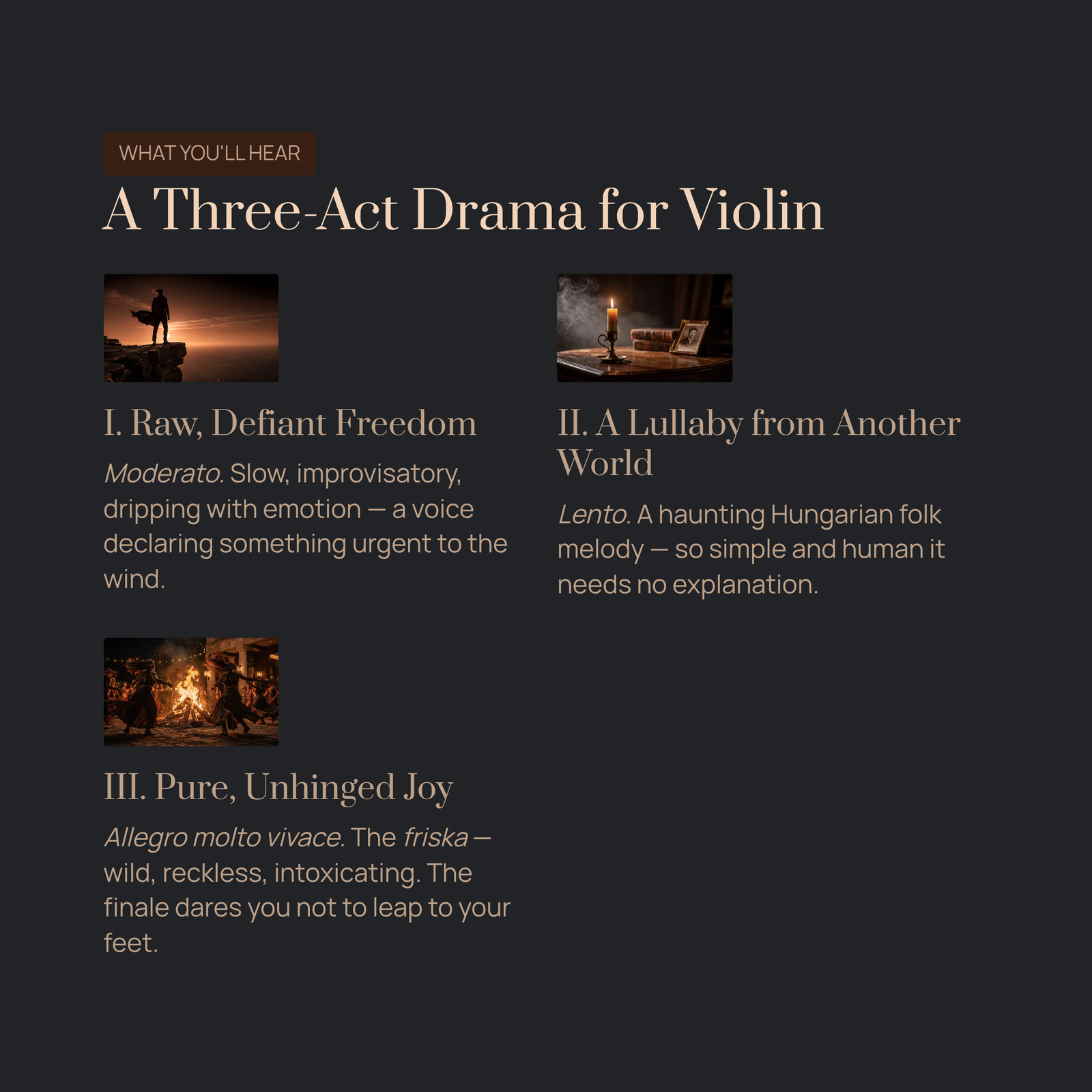
What You’ll Hear: A Three-Act Drama for Violin
You don’t need any musical training to follow Zigeunerweisen. Think of it as a short film in three scenes, each with a completely different emotional temperature.
The Opening — Raw, Defiant Freedom (Moderato)
The orchestra sets a dark, brooding stage. Then the violin enters, and it sounds less like an instrument and more like a human voice — proud, impassioned, a little dangerous. Sarasate draws on the lassan tradition of Hungarian Romani music here: slow, improvisatory, dripping with emotion. The violin swoops and dives, lingers on notes that seem to vibrate with longing, then suddenly unleashes cascades of rapid notes like sparks flying off an anvil. If you close your eyes, you might picture a lone figure standing at the edge of a cliff, declaring something urgent to the wind.
Listen for the moments where the violin seems to be speaking directly to you — those long, drawn-out notes that bend and quiver. That’s Sarasate channeling the Romani fiddling tradition, where the beauty lies not in playing notes perfectly, but in making each note breathe.
The Middle — A Lullaby from Another World (Lento)
And then, everything changes. The frenzy dissolves, and in its place comes one of the most hauntingly beautiful melodies in all of violin music. It floats in, soft and fragile, like a memory you’re not sure is real. This section borrows from a well-known Hungarian folk song, and Sarasate treats it with such tenderness that it feels almost sacred.
This is the moment in the piece where audiences often go still. The violin sings in its most intimate register, and the melody is so simple and so human that it needs no explanation. You don’t analyze it; you just feel it. If the opening was a shout, this is a whisper — the kind that reaches deeper precisely because it’s quiet.
The Finale — Pure, Unhinged Joy (Allegro molto vivace)
Without much warning, the tempo ignites. The violin launches into a whirlwind of rapid-fire notes, leaping from string to string, executing passages that seem physically impossible. This is the friska — the fast, ecstatic dance that traditionally closes Hungarian Romani music. It’s meant to be wild, exhilarating, almost reckless in its energy.
Here, Sarasate pulls out every trick in the virtuoso’s playbook: flying harmonics that shimmer like glass, left-hand pizzicato where the violinist plucks strings while simultaneously bowing, and dizzying runs that spiral upward at breakneck speed. The effect is overwhelming and intoxicating, like being caught in a celebration you never want to end. The piece races to a finish so abrupt and explosive it practically dares the audience not to leap to their feet.
Why This Piece Still Sets Concert Halls on Fire
What makes Zigeunerweisen more than just a showpiece — more than just a vehicle for technical display — is its emotional honesty. Sarasate didn’t write this to prove how fast a violin could be played. He wrote it because the Romani musical tradition moved him deeply, and he wanted to capture its essence: the pride, the sorrow, the wild joy, the sense of a people who carried their entire world in their songs.
There’s a rawness to Zigeunerweisen that classical music doesn’t always allow itself. The opening doesn’t sound rehearsed; it sounds improvised, spontaneous, like a story being told for the first time. The slow section doesn’t just perform sadness; it inhabits it. And the finale doesn’t just display speed; it celebrates the sheer physical thrill of music-making with an abandon that’s almost punk rock in spirit.
For me, this piece is a reminder that music doesn’t have to choose between the head and the heart, between discipline and wildness. Zigeunerweisen is all of these things at once, and that’s why it still makes people gasp almost 150 years after it was written.

Recordings to Start With: Three Doors into the Same Fire
One of the joys of Zigeunerweisen is hearing how different violinists make it their own. Here are three recordings that each offer something distinct.
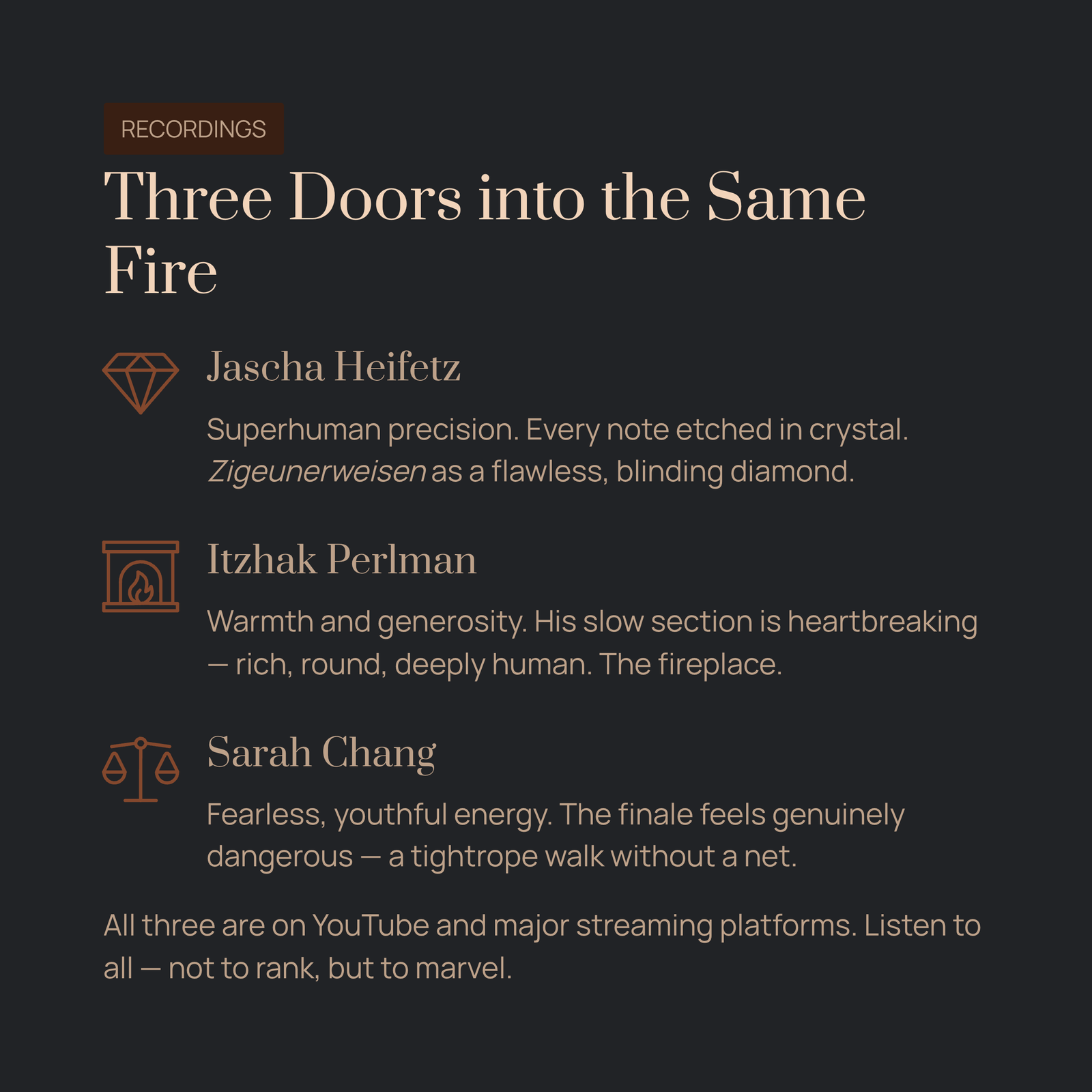
Jascha Heifetz — If you want to hear what superhuman precision sounds like, start here. Heifetz’s legendary recording is almost terrifyingly clean — every note etched in crystal, the fast passages dispatched with an effortlessness that borders on the absurd. Yet there’s a searing intensity underneath that coolness. This is Zigeunerweisen as a flawless diamond: brilliant, hard, and blinding.
Itzhak Perlman — Perlman brings a warmth and generosity to the piece that makes it feel like a conversation rather than a performance. His tone in the slow section is heartbreaking — rich, round, and deeply human. If Heifetz is the diamond, Perlman is the fireplace: you want to draw closer and stay.
Sarah Chang — Her recording, made when she was still remarkably young, crackles with fearless energy. The finale under her fingers feels genuinely dangerous, like a tightrope walk without a net. There’s a youthful daring here that captures the untamed spirit of the piece beautifully.
Each of these recordings is readily available on YouTube and major streaming platforms. I’d suggest listening to all three — not to rank them, but to appreciate how one piece of music can contain so many truths at once.
A Closing Thought: The Freedom in Someone Else’s Song
There’s something quietly profound about what Sarasate did with Zigeunerweisen. A Spaniard, trained in the French conservatory tradition, traveling to Hungary and falling in love with the music of a people who were perpetual outsiders in European society — and then pouring that love into a piece that would outlive them all.
Music, at its best, doesn’t respect borders. It doesn’t care where you were born or what language you speak. Zigeunerweisen is proof of that. It’s a piece born from the collision of cultures, traditions, and temperaments, and the result is something that belongs to everyone.
So the next time you have nine minutes to spare — on a commute, during a late-night walk, or just sitting quietly with a pair of headphones — press play on Zigeunerweisen. Let the violin grab you by the collar. Don’t resist. Some fires are meant to be felt.