📑 Table of Contents

There’s a particular feeling that arrives when a song you’ve hummed a hundred times suddenly slows down, strips away the drum machine, and lets a string section carry the melody instead. The tune is the same. But something has shifted underneath it. You hear the bones of the music — the way one note leans into the next, the small ache in a phrase you never noticed when it was buried under a beat.
That’s the experience waiting for you in an orchestral arrangement of ABBA. Take two of their most beloved songs, “Mamma Mia” and “I Have a Dream,” lift them out of 1970s Stockholm and set them down in a concert hall, and you get something that sits in a strange, lovely place between pop nostalgia and classical warmth. If you’ve ever wondered what the bridge between the two worlds actually sounds like, this is a gentle place to start.

Who Actually Wrote These Songs?
ABBA wasn’t a single composer — it was a Swedish group of four, and the songwriting engine behind it was the duo of Benny Andersson and Björn Ulvaeus. They wrote the music and lyrics for nearly the entire ABBA catalog, including both songs we’re listening to here.
Andersson, in particular, is worth knowing about if you care about the classical side of things. He was trained on accordion and piano from childhood, soaked in Swedish folk music, and his harmonic instincts run deeper than the glossy pop surface suggests. Years after ABBA, he went on to write a full-scale musical (Chess, with lyricist Tim Rice) and even orchestral and folk-rooted concert works. So when these songs translate so naturally to strings and winds, it isn’t an accident. The architecture was always there.
“Mamma Mia” was released in 1975 — the bouncy, marimba-flecked song about being helplessly drawn back to someone you keep trying to leave. “I Have a Dream” came in 1979, a slower, almost hymn-like piece with a children’s choir on the original recording. Pairing them in one orchestral set is clever: one gives you motion and play, the other gives you stillness and hope.

Why These Songs Survive Without the Vocals
Here’s the simple test of whether a pop song has real musical bones: take away the famous voice and see if the melody can stand on its own. Both of these pass easily.
“Mamma Mia” is built on a hook that keeps circling back to the same few notes, like a thought you can’t shake — which is, fittingly, exactly what the lyrics are about. In an orchestral version, that repetition stops feeling like a pop chorus and starts feeling like a motif, the way a classical composer plants a short idea and returns to it again and again. Listen for how the strings pass the tune between sections, the way a single melodic phrase migrates from violins to woodwinds.
“I Have a Dream” works differently. Its melody moves in long, rising lines that feel like they want to be sung by a full choir or carried by a swelling string section. Stripped of words, it becomes almost devotional — closer in spirit to a slow movement of a symphony than to a chart single. This is the song that will likely give you that throat-tightening, eyes-prickling moment.

A Simple Listening Guide
You don’t need any technical background to follow along. Just try noticing a few things:
The melody hand-off. In good orchestral arrangements, no single instrument hogs the tune. Notice each time the main melody moves to a new instrument or section — a flute, a solo cello, the full violin choir. Each version of the same tune carries a slightly different color and emotion.
The bass line as a quiet foundation. Underneath the melody, low strings and basses set the harmonic ground. In “I Have a Dream” especially, that slow-moving foundation is what gives the piece its hymn-like steadiness.
The dynamics — loud and soft. Pop recordings are often compressed to stay at one consistent volume. An orchestra does the opposite: it pulls back to near-silence, then blooms into full sound. Let those swells land. The contrast is where the emotion lives.
The shift between the two songs. When “Mamma Mia”‘s playful energy gives way to “I Have a Dream”‘s open-hearted calm, notice how the whole emotional temperature changes. That contrast is the entire point of the pairing.
Where to Hear It
Because these are arrangements rather than a single fixed classical score, what you find will vary — and that’s part of the fun. A few directions worth exploring:
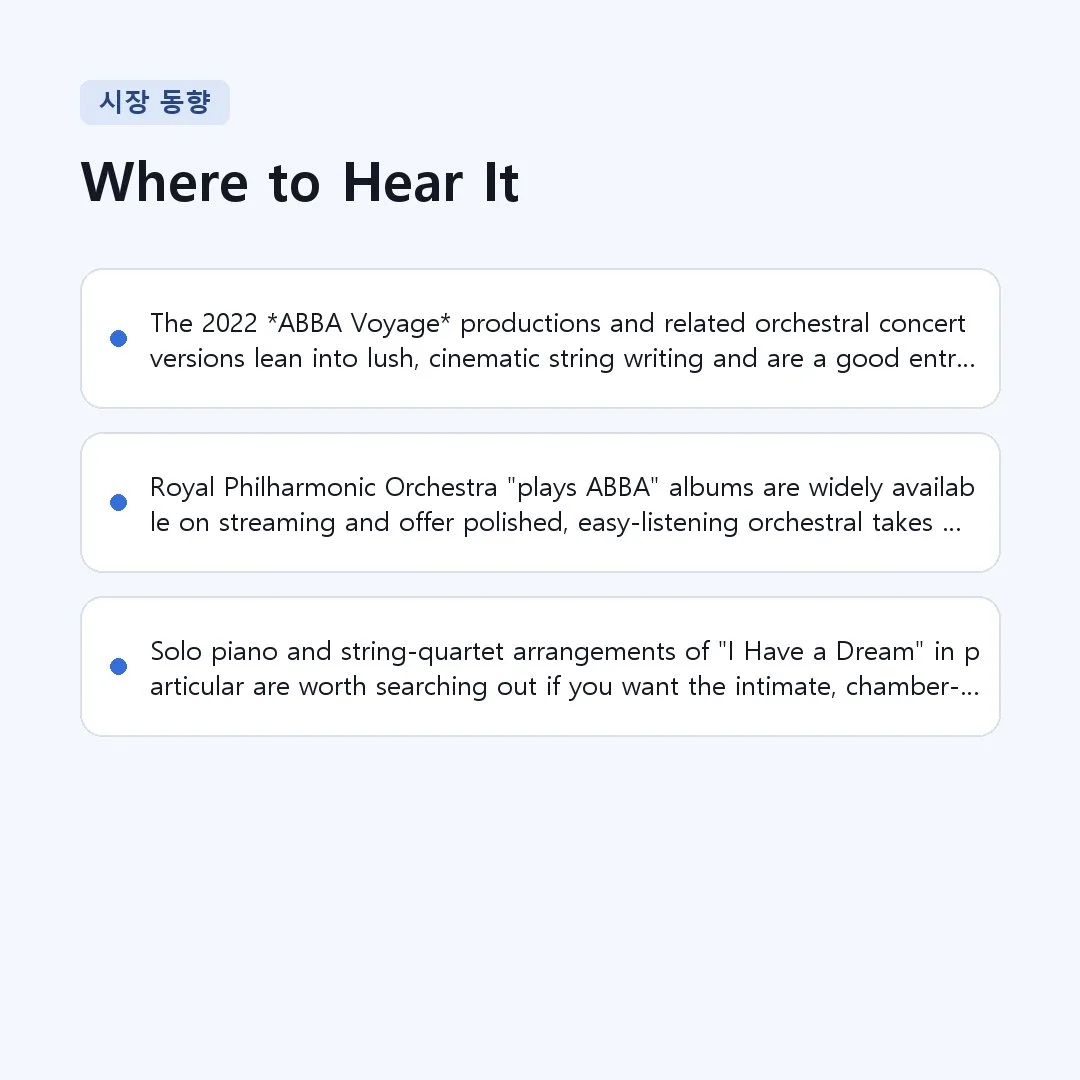
- The 2022 ABBA Voyage productions and related orchestral concert versions lean into lush, cinematic string writing and are a good entry point for the sound at full scale.
- Royal Philharmonic Orchestra “plays ABBA” albums are widely available on streaming and offer polished, easy-listening orchestral takes — ideal background listening that still rewards close attention.
- Solo piano and string-quartet arrangements of “I Have a Dream” in particular are worth searching out if you want the intimate, chamber-music version of that melody. Stripped to four instruments, it becomes surprisingly moving.
Search by song title plus “orchestral,” “string quartet,” or “piano arrangement,” and let your ear pick the version that moves you most. There’s no single definitive recording here — which means you get to choose your own.
Letting a Familiar Song Become New Again
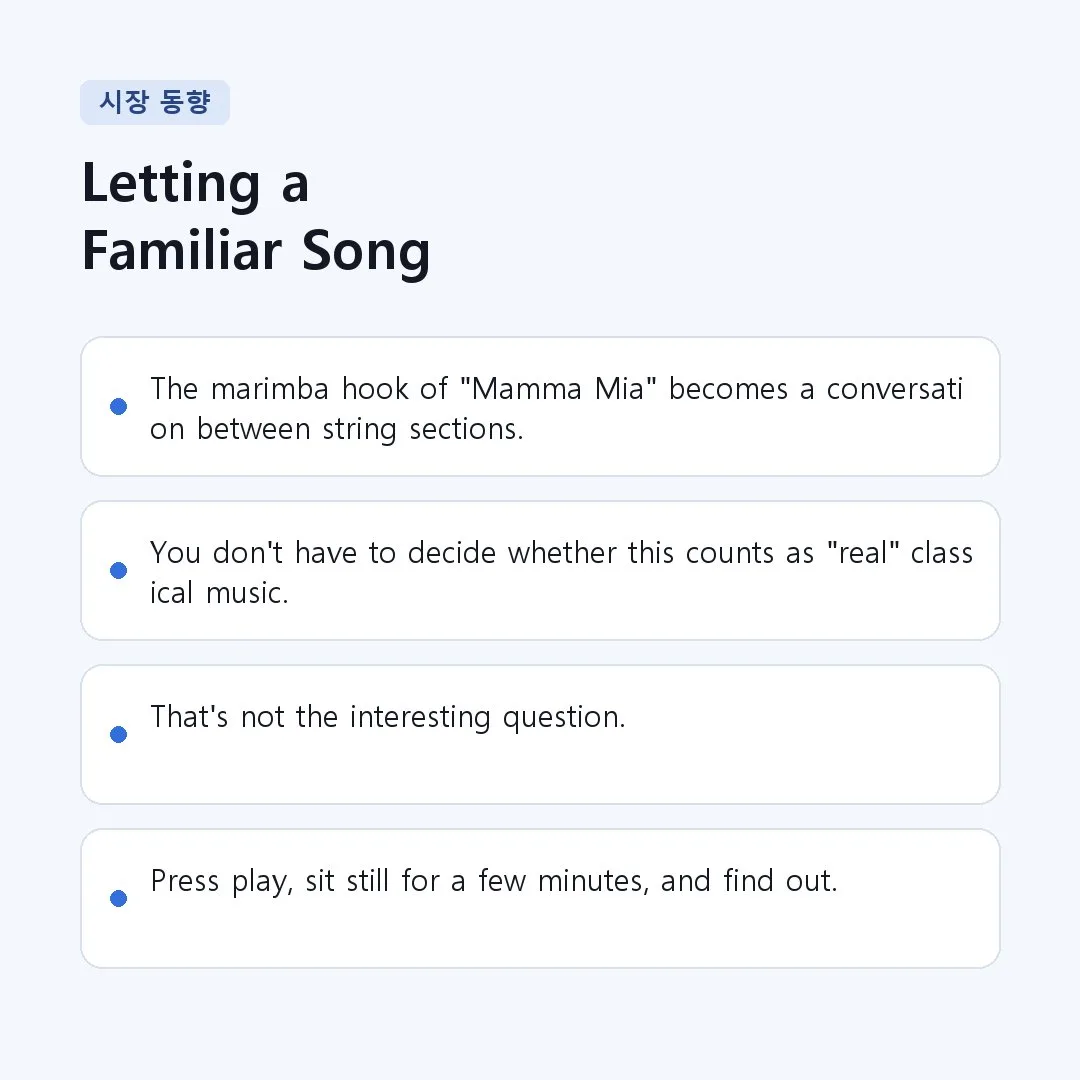
The quiet pleasure of hearing pop reimagined for orchestra is that it returns something to you. A song you thought you’d fully absorbed turns out to have rooms you never entered. The marimba hook of “Mamma Mia” becomes a conversation between string sections. The choir of “I Have a Dream” becomes a wash of warmth with no words at all, just feeling.
You don’t have to decide whether this counts as “real” classical music. That’s not the interesting question. The interesting question is simpler: when the drums fall away and the strings take over, do you hear something you’d been missing all along? Press play, sit still for a few minutes, and find out.