📑 Table of Contents
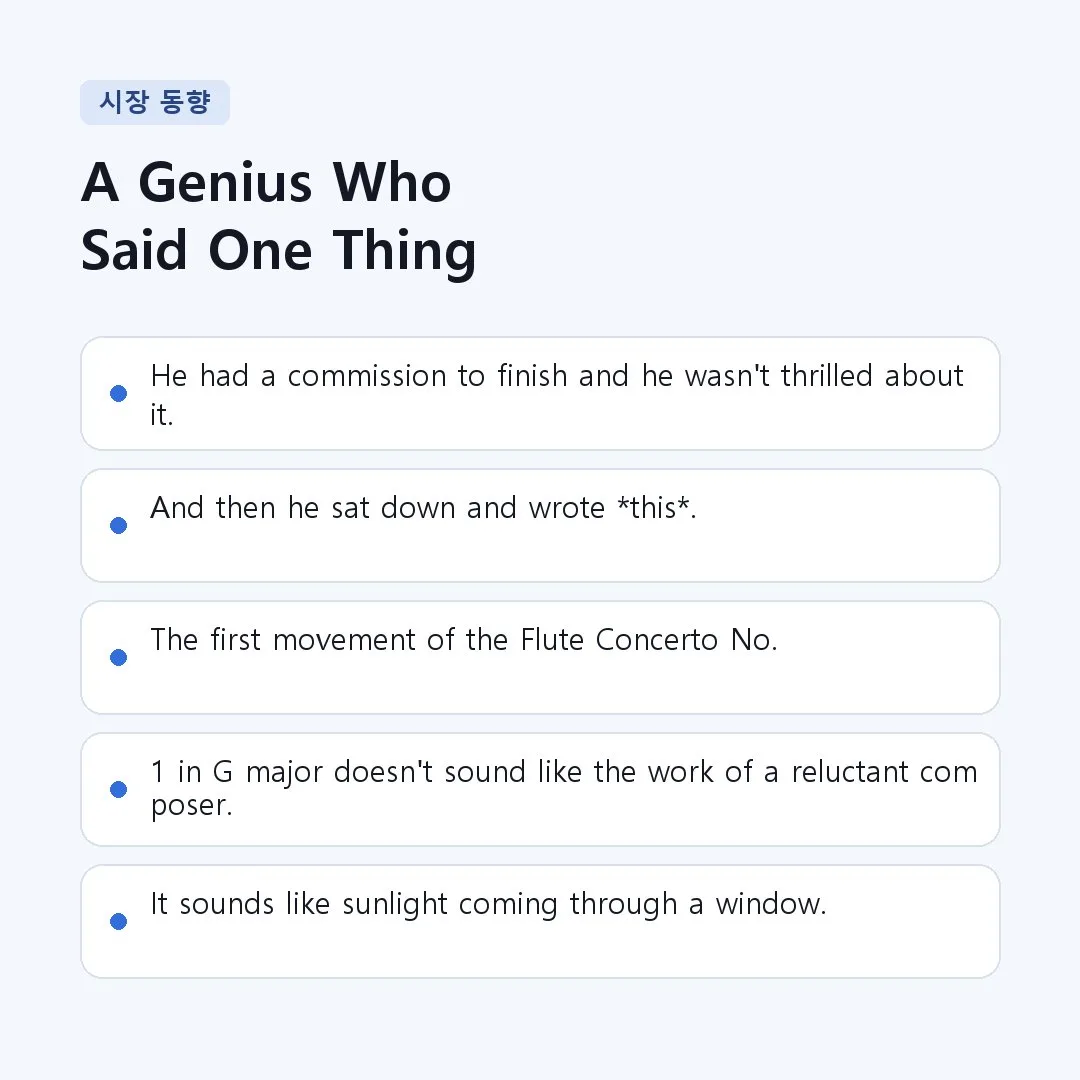
There’s a letter, written by a 22-year-old Mozart to his father in the winter of 1778, in which he grumbles that he can’t stand writing for the flute. He found the instrument tricky to tune, awkward to write for, and—frankly—a bit of a chore. He had a commission to finish and he wasn’t thrilled about it.
And then he sat down and wrote this.
The first movement of the Flute Concerto No. 1 in G major doesn’t sound like the work of a reluctant composer. It sounds like sunlight coming through a window. If you’ve ever wondered what music made by someone in a genuinely good mood feels like, press play and you’ll know within ten seconds. The gap between what Mozart said about the flute and what he actually produced is one of the most charming little contradictions in music history.
Who Was Writing, and Where
Mozart was on the road. He had left Salzburg—the small city where he’d grown up under his father’s strict supervision—and was traveling in search of a better job and, not incidentally, a bit of freedom. In late 1777 he arrived in Mannheim, home to what was widely regarded as the foremost orchestra in all of Europe, famous for its precision and its dramatic swells from soft to loud. For a young composer used to provincial Salzburg, it was intoxicating.
While there he met a wealthy Dutch surgeon and amateur flutist named Ferdinand Dejean, who commissioned what Mozart described as three short, simple concertos and a couple of flute quartets, for a fee of 200 gulden. Mozart, distracted by new friends and possibly by a young singer he’d fallen for, didn’t finish the whole job. He delivered two concertos instead of three and got paid less than half. His father was furious.
But the work he did finish was no rush job. The G major concerto goes far beyond the “small, easy, and short” piece the patron had asked for. Whatever Mozart claimed about disliking the flute, the music tells you he was, at that moment, a happy young man writing freely for the first time in his life.
What You’re Actually Hearing
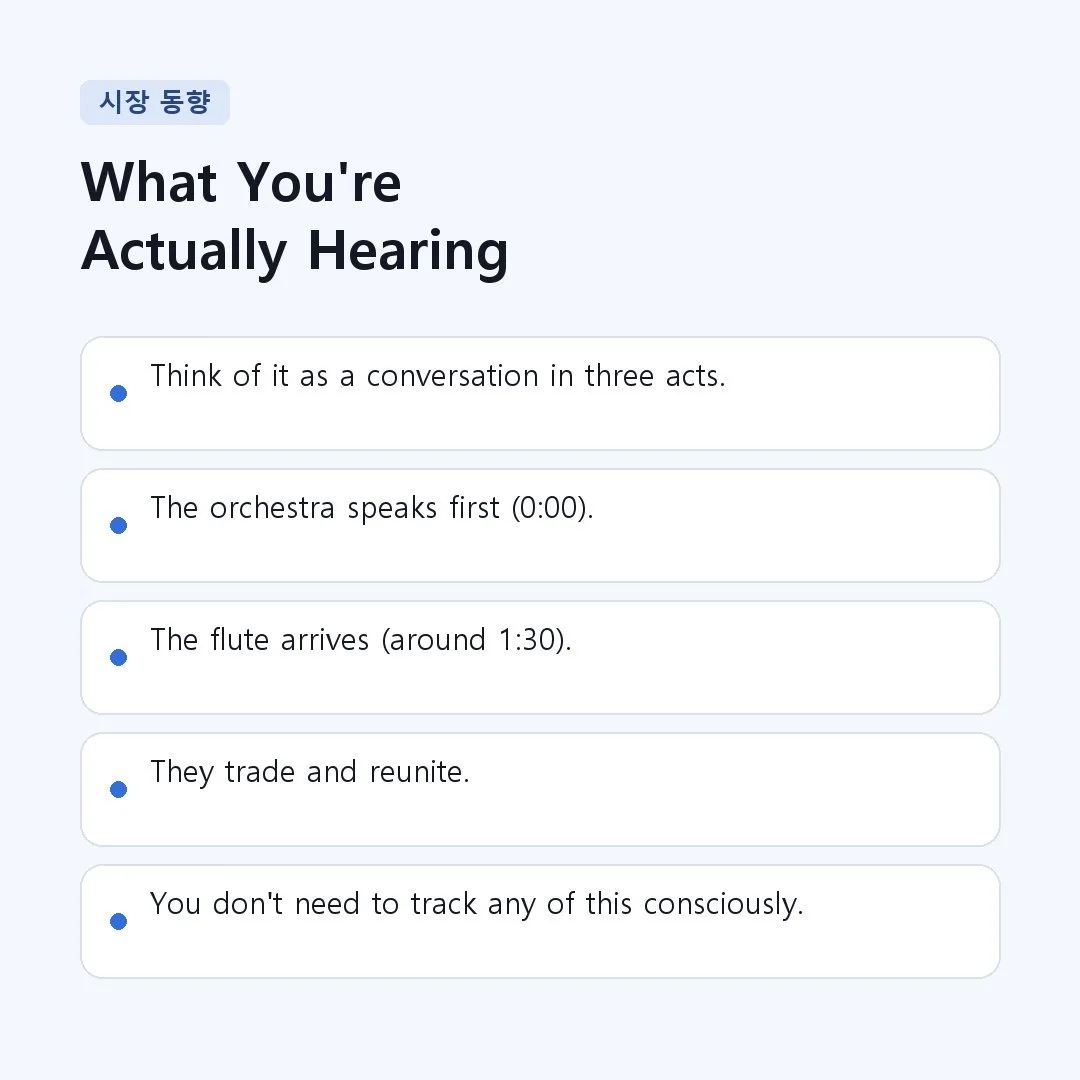
The movement is marked Allegro maestoso—”fast and majestic”—and it follows a pattern common to concertos of the era. Think of it as a conversation in three acts.
The orchestra speaks first (0:00). Before the flute enters, the strings lay out the main tunes with bright, confident energy, punctuated by warm notes from a pair of horns. This is the orchestra setting the scene, introducing the melodies the soloist will soon take up.
The flute arrives (around 1:30). When the solo flute finally enters, it doesn’t just repeat what we heard—it takes those melodies and decorates them, spinning fast runs and graceful turns that show off both the player’s agility and the instrument’s silvery brightness. Listen for the contrast: the orchestra is the steady ground, the flute is the bird flying above it.
They trade and reunite. The rest of the movement is a back-and-forth—the flute leading, the orchestra answering, the two weaving together. Near the end you’ll hear the orchestra pause and the soloist play alone in a flashy passage called a cadenza, a kind of solo spotlight before everyone rejoins for the final flourish.
You don’t need to track any of this consciously. But knowing the flute “answers” the orchestra rather than fighting it can shift the whole experience from pretty background sound to an actual dialogue you can follow.
When to Put This On
This is morning music. It’s the sound of a clear day with nothing yet gone wrong—uncomplicated, generous, a little playful. It works beautifully as the soundtrack to a slow coffee, a tidy desk, or the first hour of a day you want to start on the right foot. There’s no darkness here to wade through, no emotional weather to brace for. Just lift.
Recordings Worth Your Time
A few interpretations to start with, each with a slightly different personality:
Emmanuel Pahud (with the Berlin Philharmonic / Claudio Abbado) — Pahud is one of the great flutists of our era, and his tone is pure liquid silver. If you want the polished, modern reference version, start here.
James Galway — Galway’s playing is warmer and more openly singing, with a golden quality that many listeners find instantly lovable. A wonderful entry point if you’re new to the flute.
Barthold Kuijken or other period-instrument players — For the curious: these recordings use a wooden flute of Mozart’s own time, which sounds softer and breathier than the modern metal instrument. Hearing it this way is like seeing a painting cleaned of old varnish—a different, gentler color entirely.
Any of these will serve you well. If you only have time for one, the Pahud recording is the safest first listen.
The Takeaway
There’s something deeply human about this piece. A young man, frustrated and underpaid, writes that he doesn’t even like the instrument he’s been asked to write for—and then produces eight minutes of pure, unguarded joy that has delighted listeners for nearly 250 years. Sometimes our best work comes out sideways, almost in spite of ourselves. Mozart’s Flute Concerto No. 1 is proof, and all you have to do to receive it is listen.