📑 Table of Contents
- Who Was Liszt, and Why Did Everyone Lose Their Minds Over Him
- The Hungarian Rhapsodies: A Portrait of a Place That Mostly Existed in His Head
- What Actually Happens in the Music (A Listening Guide)
- Why It Sounds Like It Might Fall Apart (And Why That’s the Point)
- Recommended Recordings
- The Cartoon Elephant in the Room
- A Final Note on What Liszt Got Right

If you’ve ever watched a cartoon — especially the old Looney Tunes or Tom and Jerry kind — there’s a good chance you’ve already heard this piece. That frantic, escalating piano music as a cat chases a mouse through a kitchen? That’s Liszt. That’s Hungarian Rhapsody No. 2.
It’s been in commercials, comedy sketches, and movie scenes for over a century. And yet most people have no idea what it actually is, where it came from, or why it feels the way it does — like something just barely held together, like controlled chaos, like a performer daring the audience to look away.
The story behind it is stranger and more interesting than you might expect.
Who Was Liszt, and Why Did Everyone Lose Their Minds Over Him
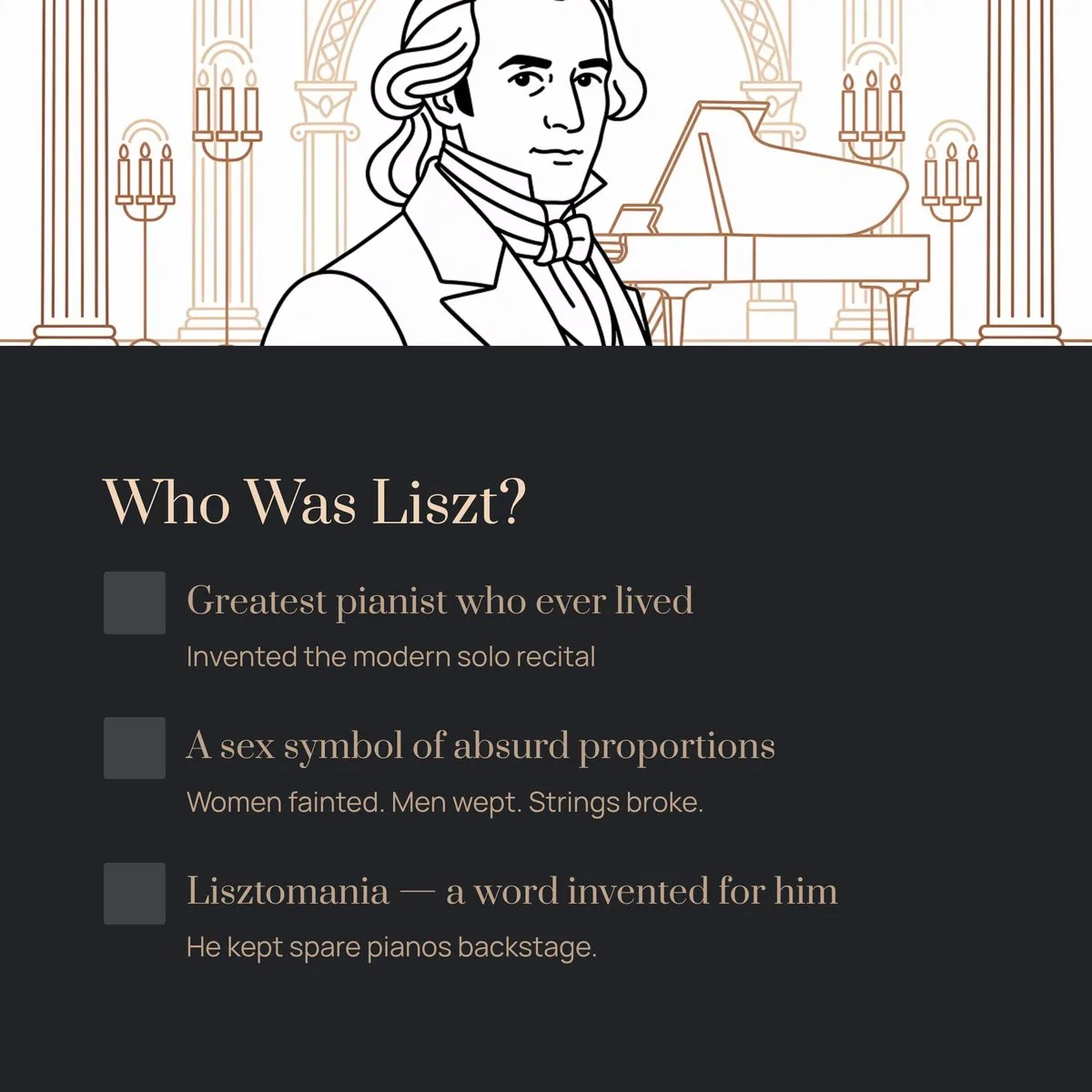
Franz Liszt (1811–1886) was, depending on who you ask, the greatest pianist who ever lived, the inventor of the modern solo recital, a sex symbol of almost absurd proportions, and a man who genuinely believed he was channeling something divine when he played.
He was born in Hungary — in a village called Doborján, now part of Austria — to a father who worked for the Esterházy family and a mother who was Austrian. This detail matters, because Liszt spent much of his life performing as a Hungarian patriot while speaking French and German far better than Magyar. He leaned into the identity. He wore the Hungarian hussar jacket on stage. He collected the verbunkos folk rhythms of Romani musicians he heard in the countryside. He turned those rhythms into something grand, theatrical, and European-palatial.
Was it authentic? It’s complicated. Liszt romanticized and mythologized what he heard. He also transformed it into something that outlasted almost everything composed in the 1840s. Whether you call that appropriation or inspiration probably says something about what year you were born.
What nobody disputes is this: when Liszt sat down at a piano, the room changed. Women fainted. Men wept. He played so forcefully that he regularly broke strings. He had to have extra instruments backstage. He was the first performer in history to be described with a word invented specifically for him: Lisztomania.
The Hungarian Rhapsodies: A Portrait of a Place That Mostly Existed in His Head
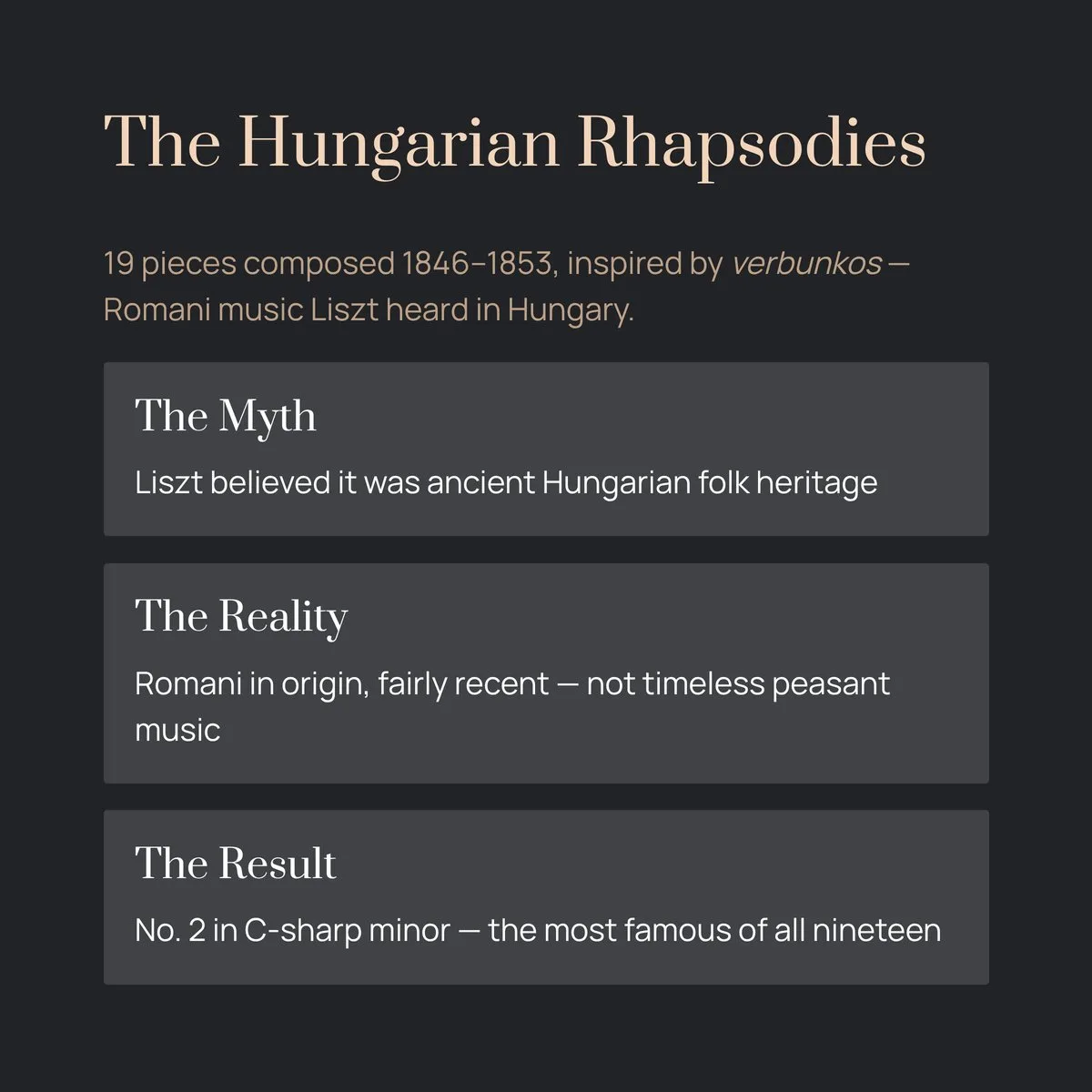
Between 1846 and 1853, Liszt composed a set of nineteen pieces for solo piano that he called the Hungarian Rhapsodies. They were inspired by the verbunkos — a style of music played by Romani musicians in Hungary, associated with military recruiting dances and village celebrations. The music is characterized by sharp rhythmic contrasts, dramatic pauses, ornamentation that sounds almost improvisatory, and a structural arc that moves from slow and brooding to fast and ecstatic.
Liszt believed, somewhat incorrectly, that this music represented ancient Hungarian folk heritage. Ethnomusicologists later pointed out that the verbunkos tradition was itself fairly recent, heavily Romani in origin, and not quite the timeless peasant music Liszt imagined. But what he created from it was entirely his own.
Hungarian Rhapsody No. 2 in C-sharp minor is the most famous of the nineteen — so famous it almost eclipses the others entirely.
What Actually Happens in the Music (A Listening Guide)
The piece has two major sections, and once you know to listen for them, the whole thing clicks into place.
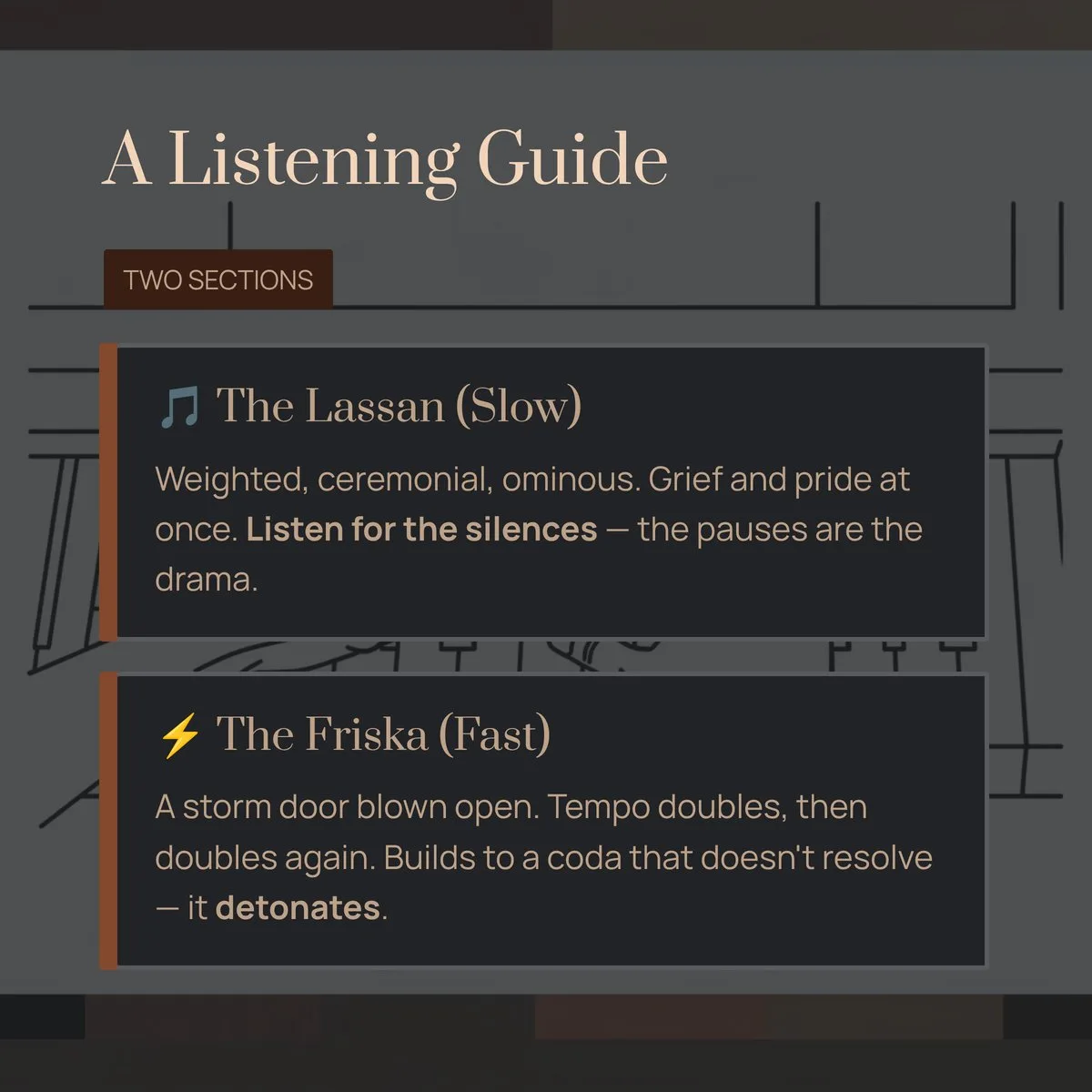
The Lassan (Slow Section)
The piece opens in shadow. The key is C-sharp minor, which in Liszt’s world tends to feel weighted, ceremonial, a little ominous. The opening melody moves in that characteristic verbunkos way — dotted rhythms, sudden silences, ornaments that curl around the notes like smoke.
This section is called the lassan, from a Hungarian word meaning slow. It’s not merely slow in tempo. It’s slow in the way a procession is slow, or the way someone walks when they’re carrying something heavy. There’s grief in it, or something that resembles grief. Some performers play it as mourning. Others play it as pride. The best performances find a way to do both at once.
Listen for the silences. Liszt writes rests that feel like held breath. The pauses aren’t empty — they’re part of the drama.
The Friska (Fast Section)
Then everything changes.
The friska — from a word meaning fresh or lively — arrives like a storm door blown open. The tempo doubles, then doubles again. The left hand sets up a rhythmic pulse like a drumbeat and doesn’t stop. The right hand starts spinning out melodies that move faster than you expect anything played on a piano to move. The dynamic range swings wildly from hushed murmurs to full-orchestra volume.
This is the section that made Liszt famous. This is what he played to make the room go silent and then erupt. If you watch a great pianist perform this live — hands crossing, the body leaning forward, the sound filling a concert hall without amplification — it’s one of the more viscerally exciting things classical music offers.
The piece ends with a coda that builds through repeated acceleration into something nearly unhinged. It doesn’t resolve so much as detonate.
Why It Sounds Like It Might Fall Apart (And Why That’s the Point)
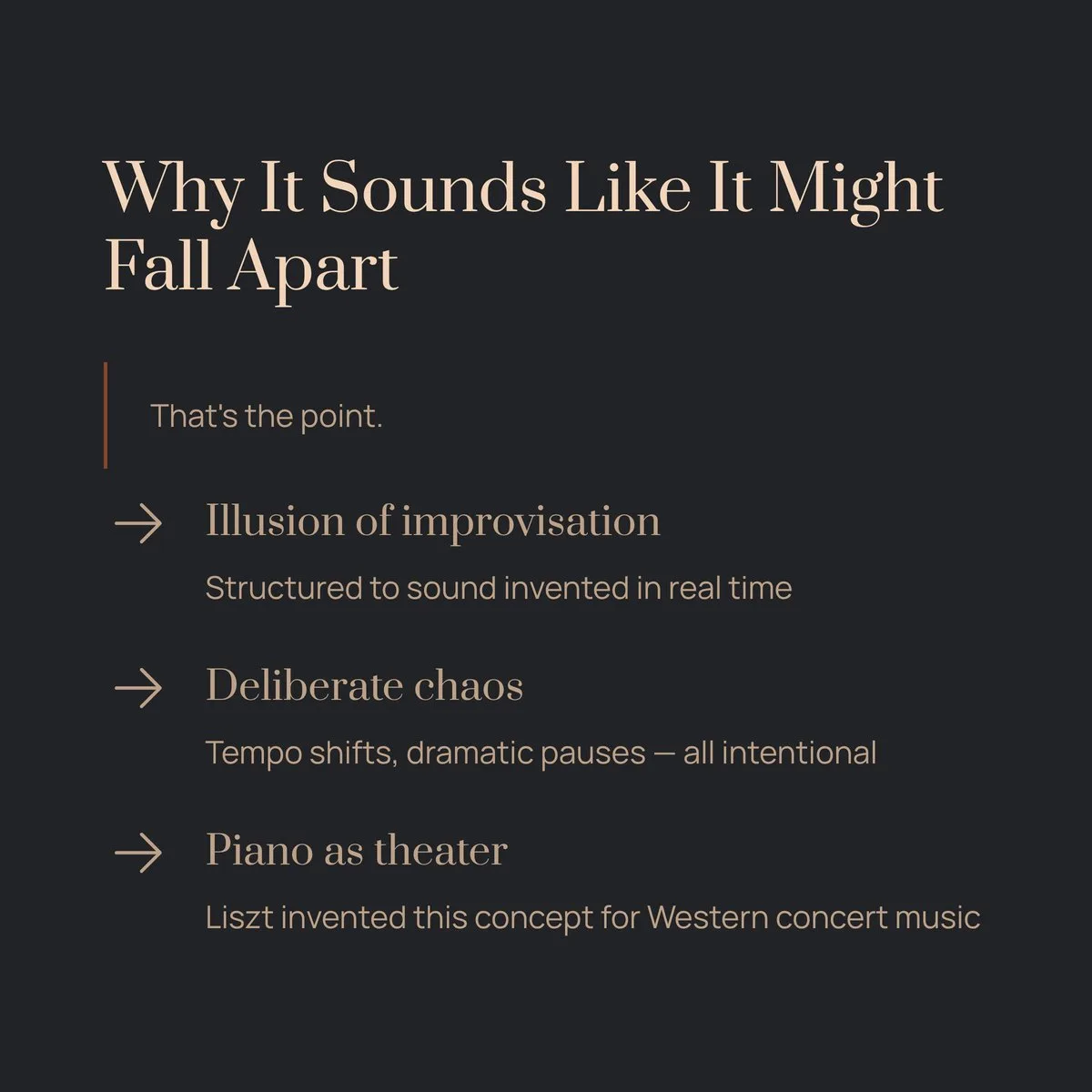
Hungarian Rhapsody No. 2 is structured around the illusion of improvisation. Liszt wanted it to sound like the music is being invented in real time — like a Romani musician at a village celebration, showing off, responding to the crowd, pushing further than is entirely safe.
This is why it can sound almost chaotic to first-time listeners. The tempo changes aren’t accidents. The dramatic pauses aren’t the performer losing their place. The sudden shifts in mood and energy are deliberate — they’re the whole point.
The piece is theater. It’s a piano piece that behaves like a performance with a narrative arc, a central character, and a climax. Liszt essentially invented this concept for Western concert music.
Recommended Recordings
A few performances worth your time, depending on what you’re looking for:
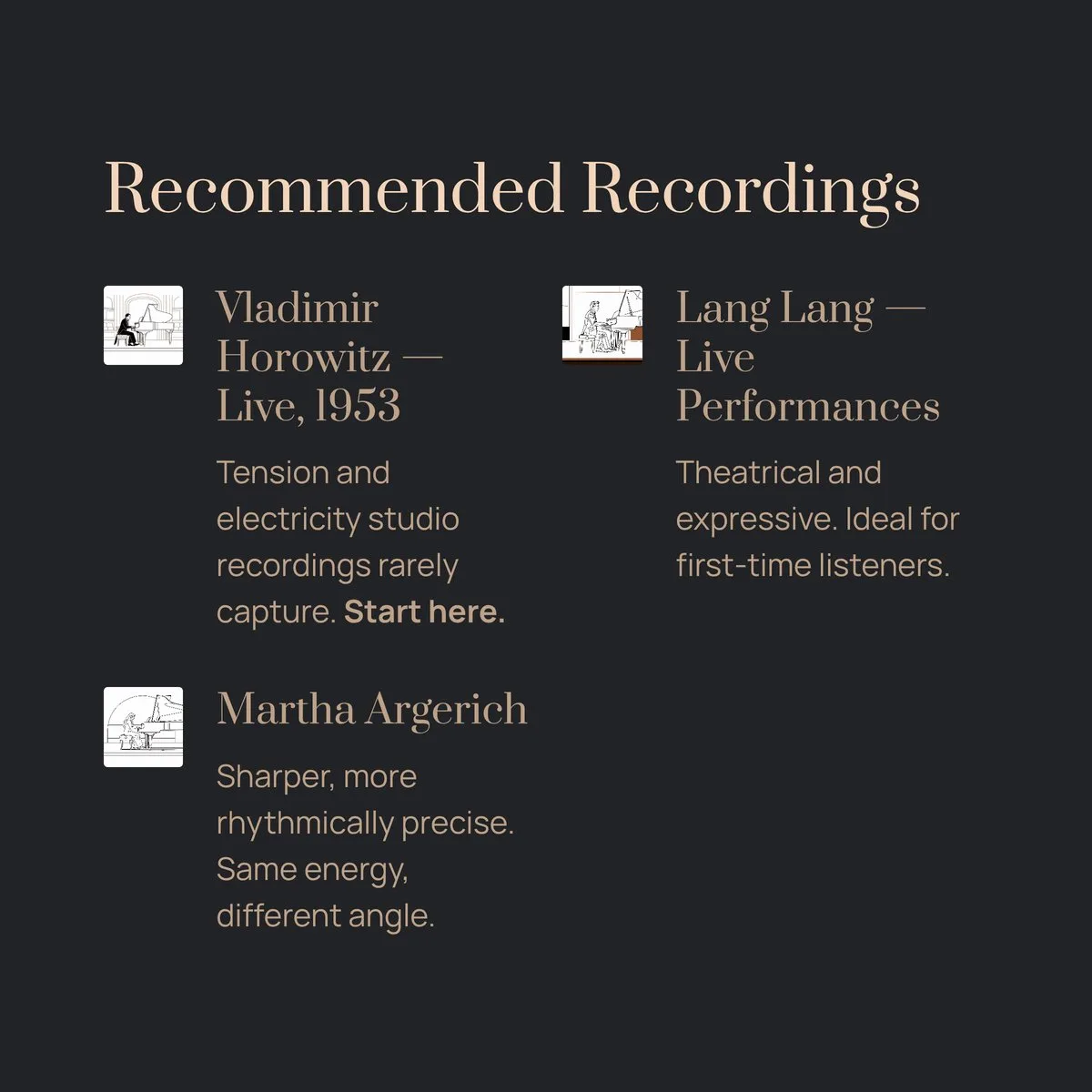
Vladimir Horowitz (live, 1953) — Horowitz plays this like a man possessed. His Carnegie Hall recordings from this era have a tension and electricity that studio recordings rarely capture. If you want to understand what all the fuss was about, start here.
Lang Lang (live performances) — Lang Lang’s Hungarian Rhapsody No. 2 performances are more recent and easier to find on video. He leans into the theatricality, which divides critics and delights audiences. For first-time listeners, the expressiveness actually helps — you can see and hear exactly where the emotional pivots are.
Martha Argerich — If the Horowitz and Lang Lang versions feel too extroverted, Argerich’s approach is sharper and more rhythmically precise. Same energy, different angle.
There are also several well-produced orchestral arrangements worth exploring. The piece has been arranged for full orchestra multiple times, and hearing it with strings and brass adds a different texture — though it loses some of the piano-solo intimacy that makes the quiet sections so striking.
The Cartoon Elephant in the Room
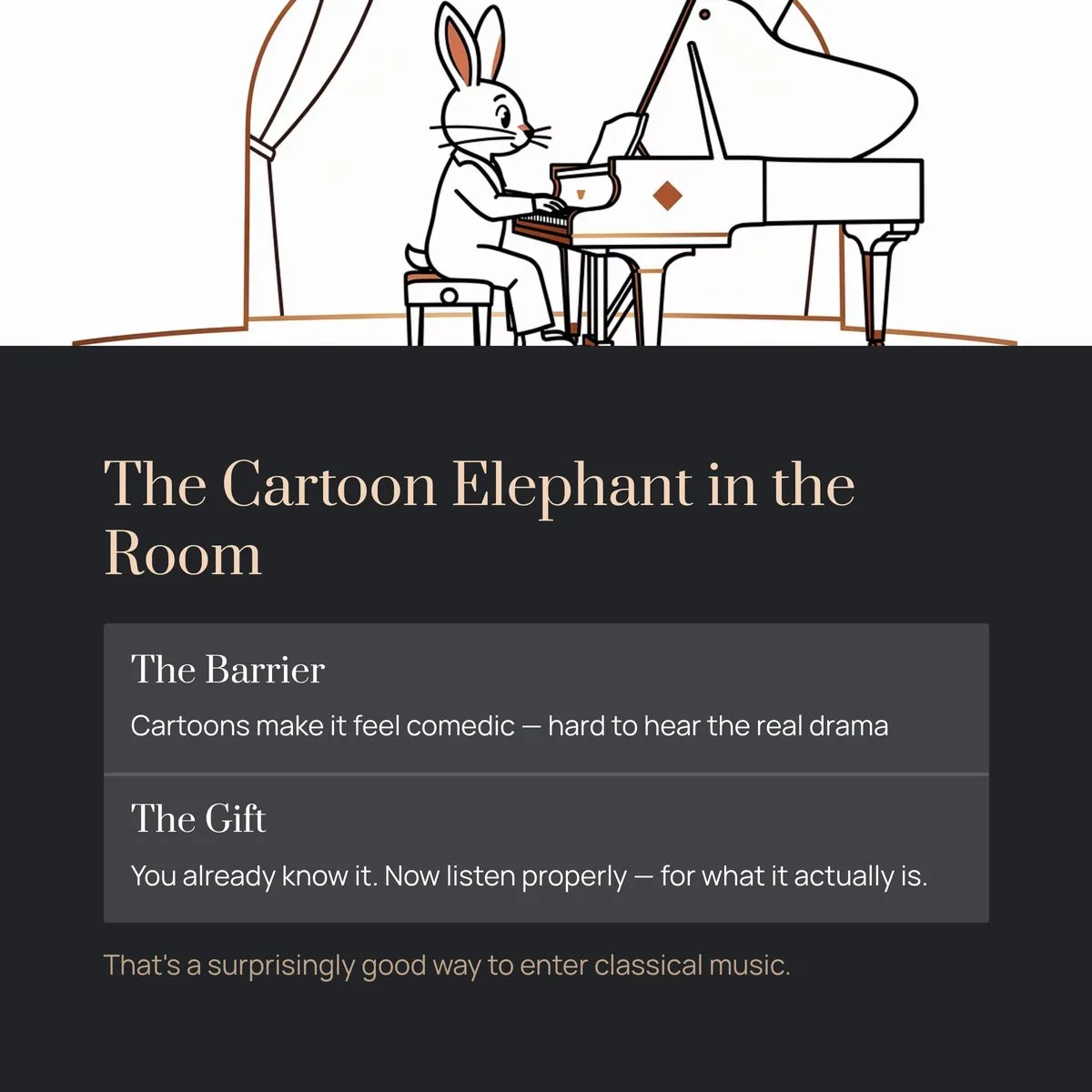
Yes, Bugs Bunny played this. Yes, Tom and Jerry too. Yes, it’s been used in roughly five hundred commercial contexts.
This is either a barrier or a gift, depending on how you think about it.
The barrier: if you grew up watching cartoons, the music might feel inherently comedic, which makes it hard to hear the genuine drama underneath.
The gift: you already know the piece. You’ve already absorbed its structure without realizing it. When you sit down to listen seriously — headphones, lights low, maybe following along with a score if that’s your thing — you’re not learning it from scratch. You’re hearing it again, properly, for what it actually is.
That’s a surprisingly good way to enter classical music.
A Final Note on What Liszt Got Right
The mythology Liszt built around Hungarian folk music was imprecise. The Romani musicians who inspired him didn’t get much credit. The “ancient tradition” he claimed to be documenting was partly invented.
And yet the music he made from those materials is genuinely, undeniably alive in a way that most music simply isn’t. It has drama and structure and surprise. It has a slow section that asks something of you and a fast section that doesn’t wait for you to agree. It builds to an ending that feels earned.
If Liszt was performing a version of Hungary rather than documenting it — well, he was a performer. It was what he did. And this piece, with all its theatrical excess and technical difficulty and sheer noise, might be the best argument that sometimes performance and truth aren’t as far apart as they look.
Put it on. Don’t start with the friska — start from the beginning, with the lassan, with that first weighted chord in C-sharp minor. Let the slow part be slow. Then let the fast part happen to you.
You’ve heard it before. This time, you’ll actually be listening.