📑 Table of Contents

Picture a crowded opera house where, instead of a single dazzling soprano, an entire chorus rises together and sings as one voice. It isn’t a battle cry. It’s something quieter and heavier: the sound of people who have lost their home, remembering it out loud. That is the strange magic of “Va, pensiero.” The melody moves almost entirely in unison, as if the composer wanted the audience to feel that no single person is grieving here. A whole people is.
If you’ve never knowingly heard a note of opera, you may still recognize this tune. It hums along like a lullaby that turns out to be about exile. And by the end of these few minutes, you’ll understand why Italians once treated this short chorus as something close to a national prayer.
Who Was Verdi, and Why Did This Piece Matter So Much?
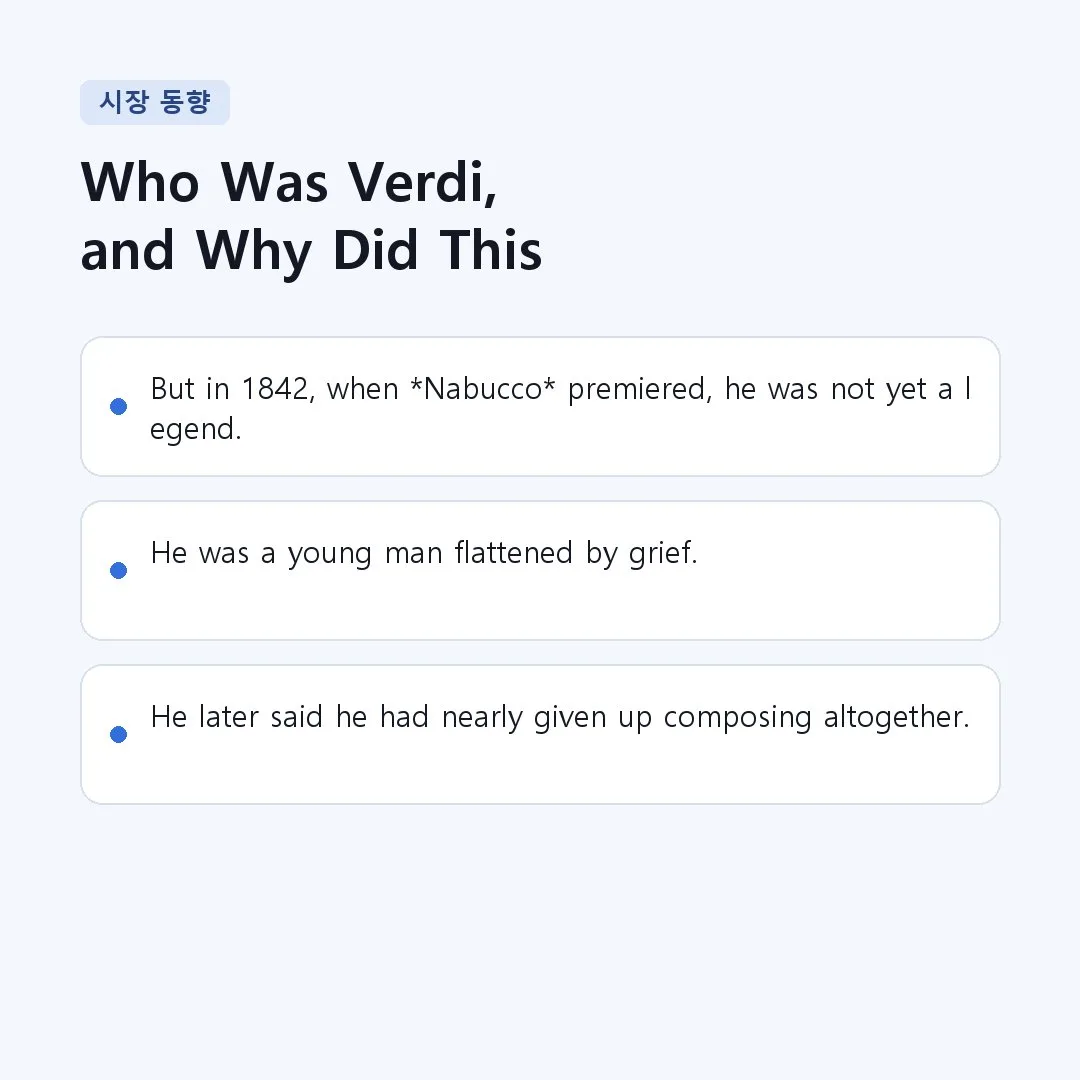
Giuseppe Verdi (1813–1901) is one of the towering figures of Italian opera, the composer behind later masterpieces like Rigoletto, La traviata, and Aida. But in 1842, when Nabucco premiered, he was not yet a legend. He was a young man flattened by grief. In the span of a couple of years he had lost his two young children and then his wife. He later said he had nearly given up composing altogether.
The story goes that a librettist pushed the libretto of Nabucco into his hands, and the page fell open to the words of “Va, pensiero.” Whether or not every detail of that legend is exact, the emotional truth fits: a man who had lost everything found his way back to music through a song about longing for a home you cannot return to.

The Story Behind the Music
Nabucco retells the Biblical account of the Hebrew people exiled in Babylon after the fall of Jerusalem. “Va, pensiero” — literally “Go, thought” — is sung by the captive Hebrews as they labor by the banks of the Euphrates. They send their thoughts flying home on golden wings, toward the hills and rivers of a homeland they may never see again.
Here is where history makes the music even larger. In the 1840s, much of Italy was not a unified country but a patchwork of territories under foreign control. To Italian audiences, a chorus of an oppressed people dreaming of a lost homeland did not feel ancient at all. It felt like them. Over the following decades, “Va, pensiero” became an emotional rallying point for Italian identity and unification. When Verdi died in 1901, crowds in the streets of Milan are said to have spontaneously sung this chorus as his coffin passed. Few pieces of music have ever been so completely adopted by the people who first heard them.
How to Listen: A Few Quiet Signposts
The chorus runs only about four to five minutes, so you can give it your full attention in one sitting. Here’s a gentle map.
The opening. Listen for the orchestra setting a swaying, rocking pulse before the voices enter — almost like water lapping against a riverbank.
The unison entry. When the chorus comes in, notice how everyone sings the same melody together rather than splitting into harmony. This is the heart of the piece’s emotional design: it sounds like one enormous voice, a community speaking as a single soul.
The swell. About midway through, the music opens up and grows fuller and more passionate. This is the moment the longing tips over into something almost defiant — hope refusing to die.
The hush at the end. The chorus draws back into quietness, as if the dream of home gently folds itself away again. Don’t rush off when it finishes; let the silence afterward do its work.
You don’t need to follow the Italian text to feel any of this. The shape of the music carries the meaning on its own.

Recordings Worth Your Time
A few interpretations to start with, depending on what you’re after:
Riccardo Muti (with the chorus and orchestra of La Scala) brings an Italian gravity and architectural clarity to the piece. If you want a performance that feels rooted in the work’s home tradition, this is a natural place to begin.
Claudio Abbado offers readings of notable warmth and balance, with the chorus shaped lovingly rather than pushed for sheer volume. Good for a first, immersive listen.
For something with documentary weight, look for the famous occasion when Muti, conducting in Rome, paused and invited the audience to sing the chorus along with the performers — a moment that captures, better than any description, how this music still belongs to ordinary people. Recordings and footage of such performances are easy to find and deeply moving.

A Thought to Carry With You
What makes “Va, pensiero” endure isn’t technical brilliance or vocal fireworks. It’s that Verdi found a way to make private grief sound like collective hope. A man who had buried his own family wrote a melody that an entire nation would one day sing for itself — and then, in the end, sing for him.
The next time you feel that particular ache of missing a place, or a person, or a version of life that’s gone, you might find this chorus says it more honestly than words can. Let your thoughts go, on golden wings. The music knows the way.