📑 Table of Contents
There are openings in classical music that ease you in gently — a quiet murmur of strings, a lone oboe sketching a melody in the dark. The Carmen Prelude is not one of them.
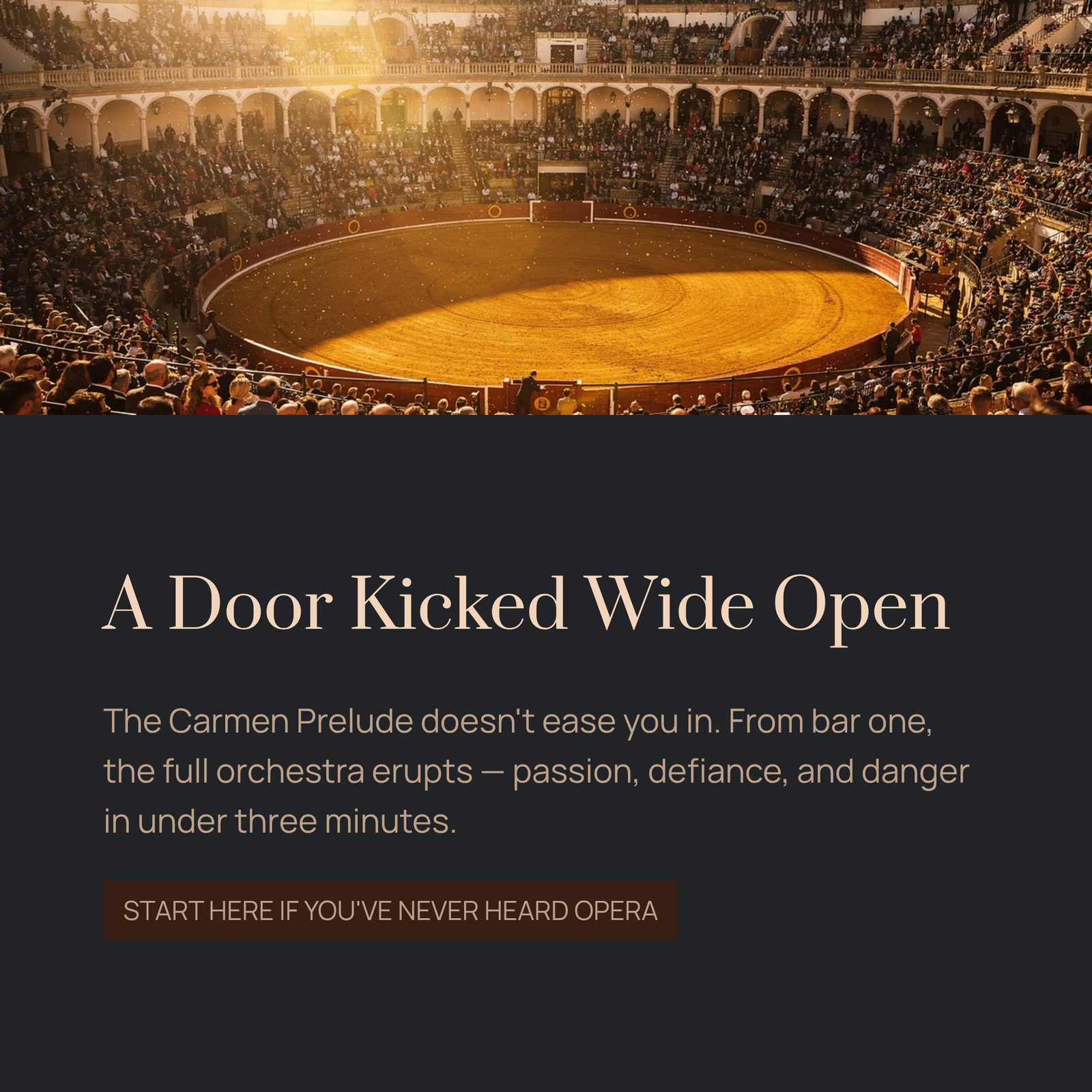
From the very first bar, Bizet grabs you by the collar. The full orchestra erupts in a blaze of color so vivid, so unrelenting, that you don’t just hear it — you feel it land in your chest. It’s the sound of a packed bullfighting arena, the roar of a crowd drunk on spectacle, the scent of dust and sweat and something dangerous hanging in the air. In under three minutes, Bizet lays out everything this opera is about: passion, defiance, jealousy, and a fate that cannot be outrun.
If you’ve never listened to a single opera in your life, start here. This isn’t a gentle invitation. It’s a door kicked wide open.
The Man Who Died Not Knowing He’d Written a Masterpiece
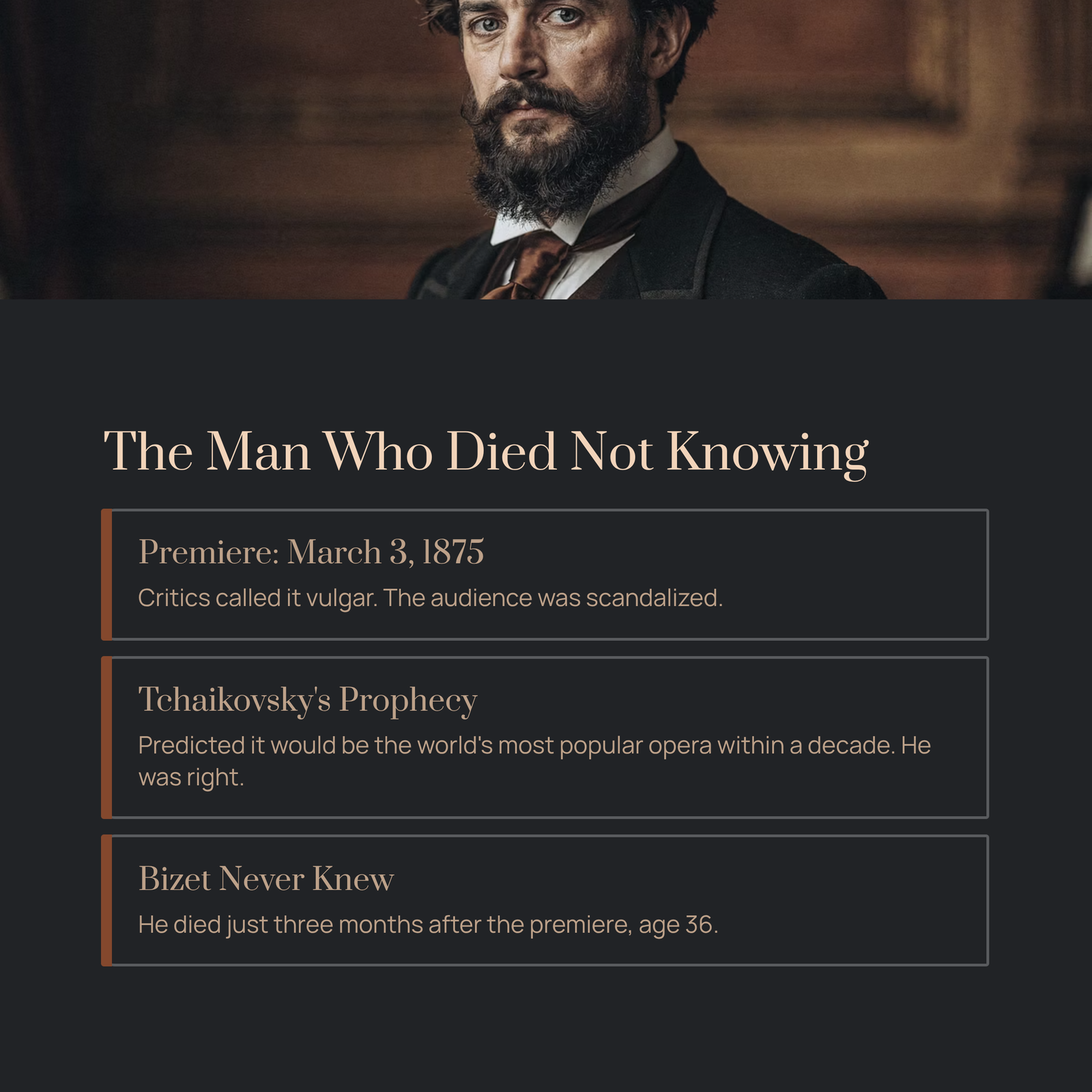
Georges Bizet composed Carmen in 1875, and it premiered at the Opéra-Comique in Paris on March 3rd of that year. He was thirty-six years old, and he had spent most of his career struggling against the expectations of the French musical establishment. They wanted elegance. They wanted restraint. Bizet gave them a story about a Romani cigarette factory worker who seduces a soldier, destroys his life, and gets murdered for it.
The premiere was, by most accounts, a disaster. Critics called it vulgar. The audience was scandalized. Tchaikovsky, who happened to attend a performance shortly after, predicted it would become the most popular opera in the world within a decade — and he was right. But Bizet never lived to see it. He died just three months after the premiere, likely of a heart attack, at the age of thirty-six. The tragedy of Bizet’s life mirrors the tragedy of his opera in a way that feels almost unbearable once you know it.
The Prelude, which Bizet composed as the audience’s very first encounter with his world, carries all of that weight — though it wears it lightly, disguised as pure, irresistible excitement.
What You’re Actually Hearing: A Map of the Entire Opera in Miniature
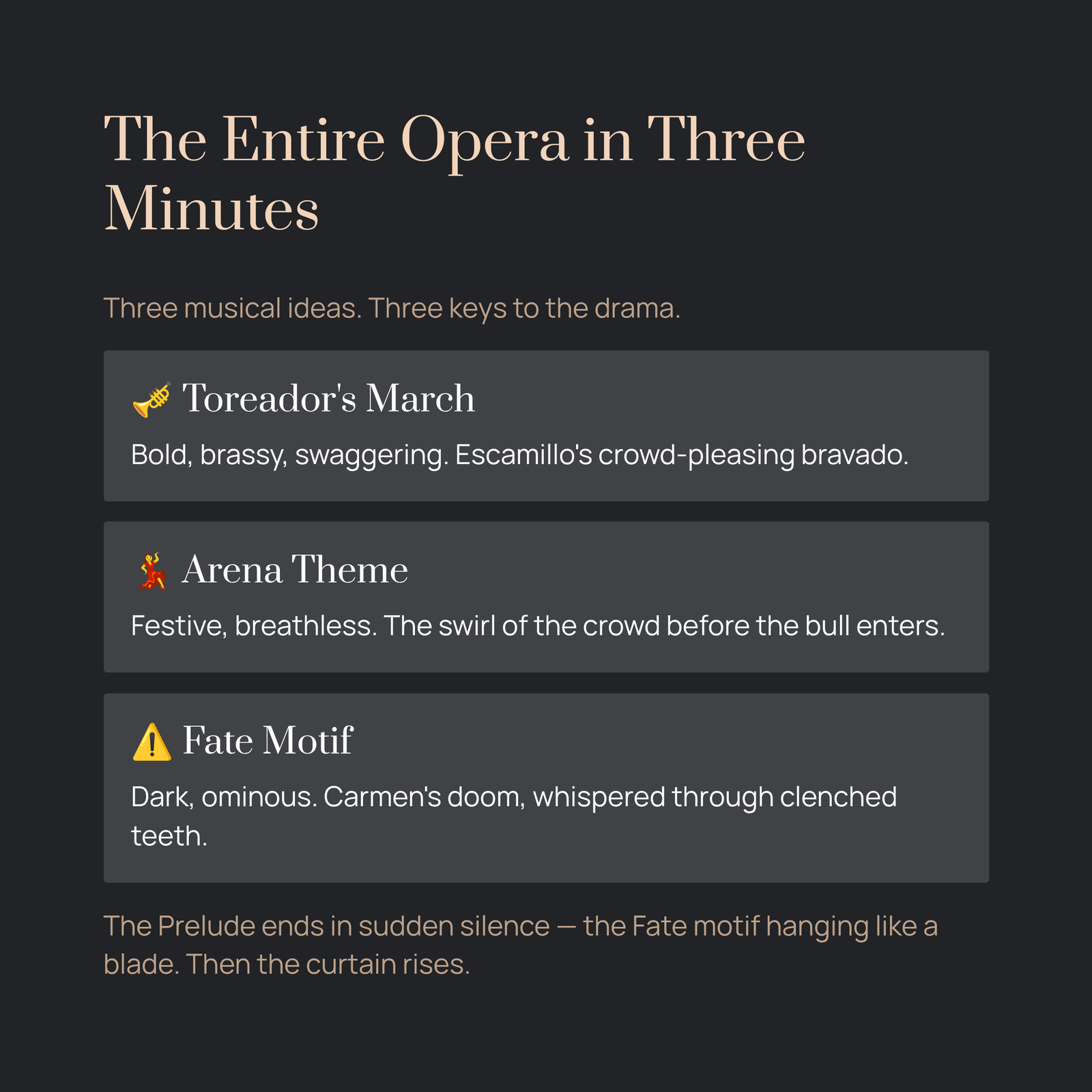
The Carmen Prelude is structured as a brilliantly compressed overture that presents three distinct musical ideas, each one a key to the drama that follows.
The Toreador’s March opens the piece — that famous, swaggering theme you’ve almost certainly heard before, even if you didn’t know its name. It’s bold, brassy, and almost absurdly confident. This is the music of Escamillo, the bullfighter, all chest-puffing bravado and crowd-pleasing charisma. Listen to how the strings and woodwinds toss the melody back and forth like a crowd doing the wave in a stadium. It repeats, builds, and explodes into applause-like orchestral fanfares. This is public spectacle at its finest.
The second theme shifts the energy. A lighter, dance-like passage sweeps in — still festive, but with a slightly different color. This is the atmosphere of the arena itself, the swirl of the crowd, the anticipation before the bull enters the ring. Bizet keeps the momentum almost breathless here, never letting you settle.
Then, without warning, everything changes. The orchestra drops to a whisper, and a dark, ominous melody creeps in on the lower strings. This is the “Fate” motif — the musical signature of Carmen herself, and of the doom that follows her everywhere she goes. It’s built on an augmented second interval, a sound borrowed from Romani and Spanish musical traditions, and it sounds like a warning whispered through clenched teeth. The harmony underneath twists and turns in ways that feel physically unsettling, like the ground shifting beneath your feet.
The Prelude doesn’t resolve this tension. It simply stops — a sudden, dramatic silence that leaves the Fate motif hanging in the air like a blade. Then the curtain rises, and the story begins.
Why It Still Lands Three Minutes Later
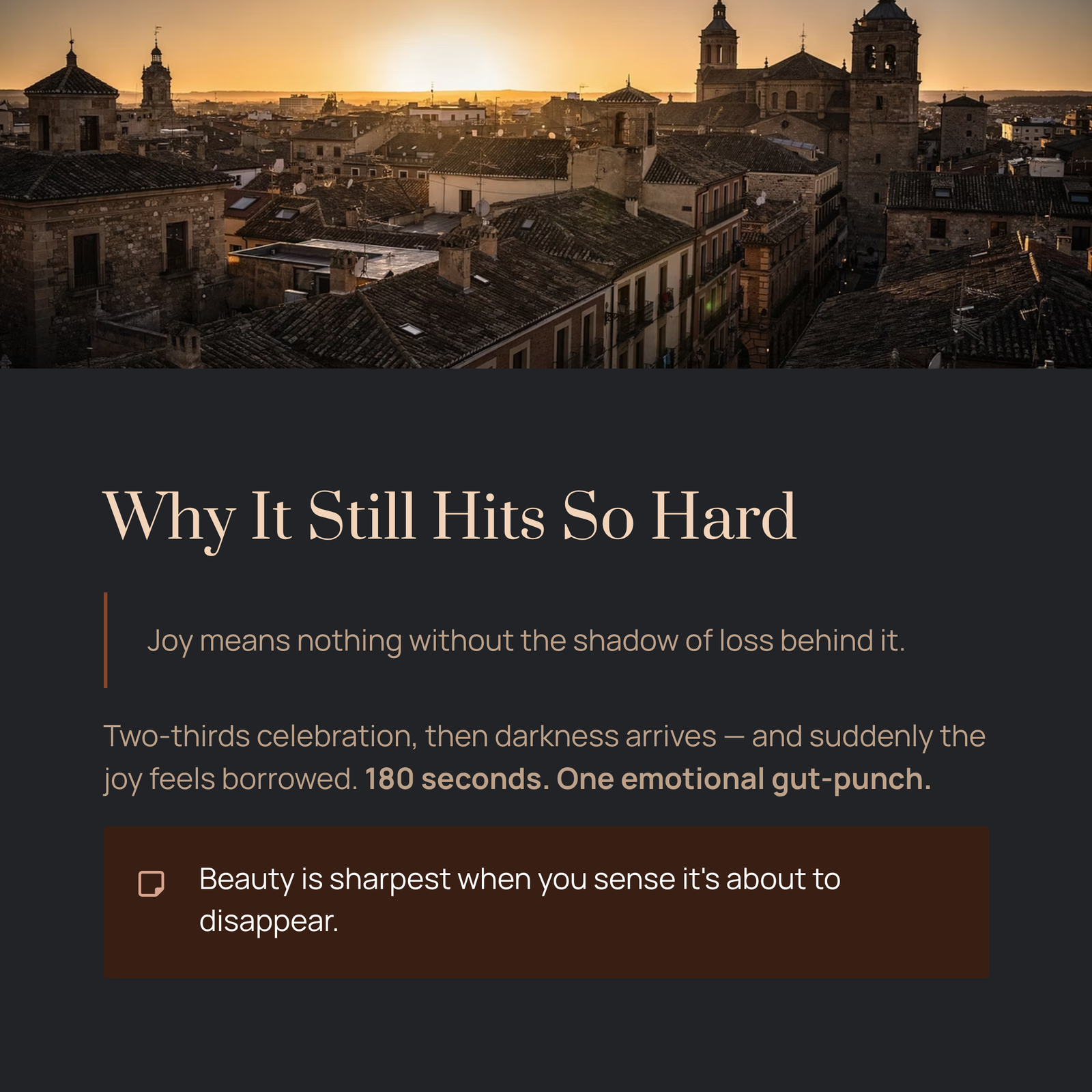
What makes this Prelude so extraordinary isn’t just its melodies — it’s the architecture of contrast. Bizet understood something fundamental about dramatic storytelling: joy means nothing without the shadow of loss behind it.
The first two-thirds of the Prelude are pure celebration. You’re swept up in it. You’re clapping along internally. And then that dark theme arrives, and suddenly the celebration feels fragile. Retrospectively, you realize the joy was never innocent — it was always borrowed time. That emotional whiplash, compressed into roughly 180 seconds, is what makes this piece hit so hard. It’s the same reason a sunset moves us more than a clear blue sky: beauty is sharpest when you sense it’s about to disappear.
I come back to this piece whenever I need reminding that brevity isn’t the enemy of depth. Some composers need forty minutes to build a world. Bizet does it in three, and he does it so thoroughly that by the time the curtain rises, you already know — on some instinctive, pre-verbal level — that this story will not end well.
How to Listen: A Practical Guide for First-Timers
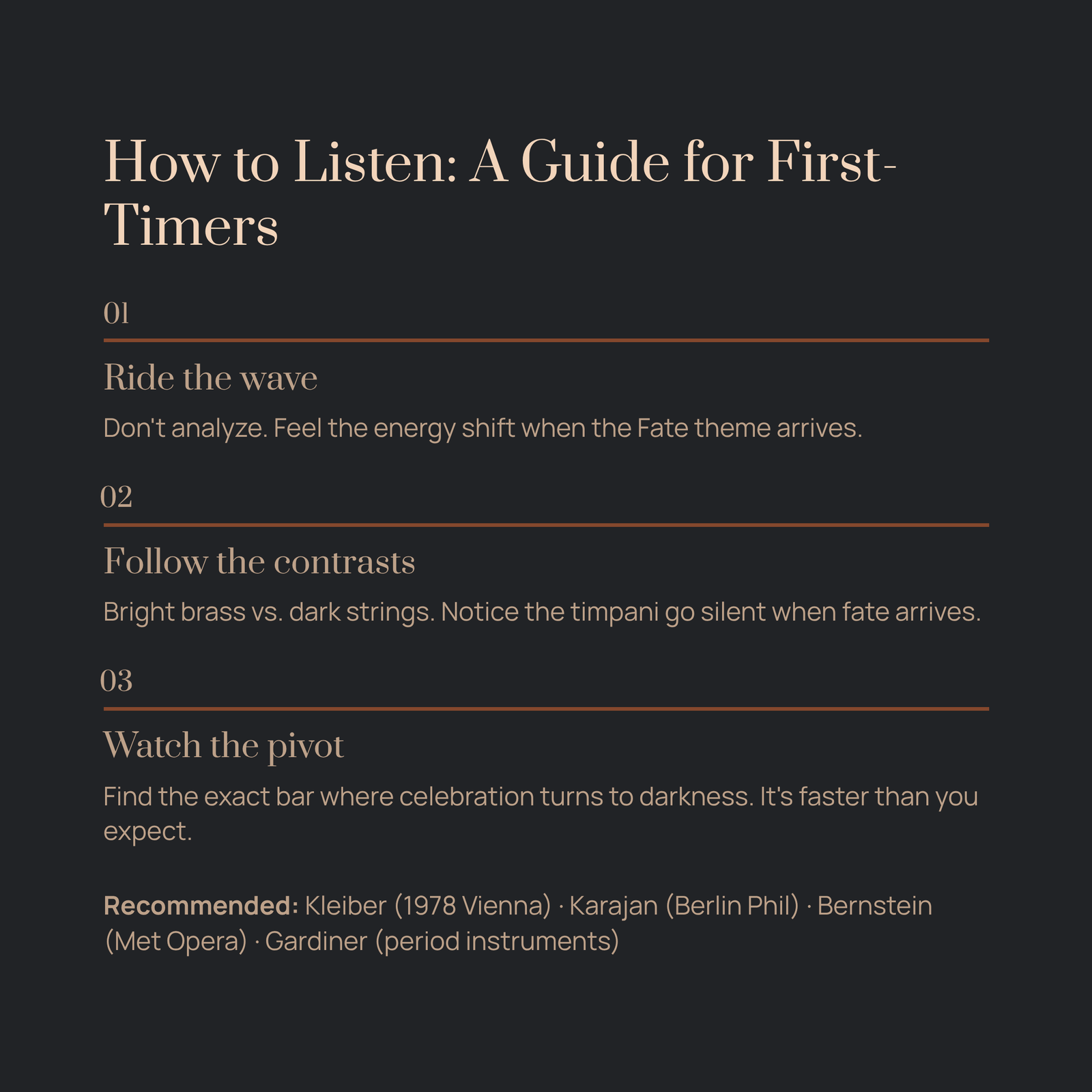
First listen — just ride the wave. Don’t analyze anything. Let the opening hit you. Feel the energy shift when the Fate theme arrives. Notice how the silence at the end feels almost violent after all that noise.
Second listen — follow the contrasts. Pay attention to how Bizet uses orchestral color. The bright, sunlit brass of the Toreador theme versus the dark, coiled menace of the Fate motif. Listen to how the timpani drives the rhythm in the festive sections but goes silent when fate arrives. That absence is as powerful as any note.
Third listen — watch the transition. The moment when the piece pivots from celebration to darkness is one of the most skillful gear-changes in all of opera. Try to identify the exact bar where the mood shifts. It happens faster than you expect, and it never stops being startling.
Recommended recordings to start with:
Carlos Kleiber’s 1978 Vienna recording brings an almost dangerous sense of momentum — the Toreador theme feels like a runaway train, and the Fate motif is genuinely chilling. Herbert von Karajan with the Berlin Philharmonic offers a more polished, cinematic grandeur — every detail gleams like a blade in lamplight. For something with raw, visceral energy, try Leonard Bernstein’s Metropolitan Opera recording, where the orchestra plays as if their lives depend on it. And for a historically informed perspective, Sir John Eliot Gardiner’s period-instrument version strips away the Romantic varnish and reveals a leaner, more dangerous Bizet underneath.
Each of these conductors finds something different in these three minutes. That, perhaps, is the ultimate proof of the piece’s depth.
The Sound of a Story That Refuses to Look Away
There’s a reason the Carmen Prelude has survived a century and a half of overexposure without losing a single volt of its power. It isn’t just music — it’s a declaration of intent from a composer who refused to compromise, who chose truth over comfort, and who paid for it with his reputation and, arguably, his life.
Every time that Fate motif creeps in at the end, I hear something beyond the notes. I hear Bizet himself — a man who knew his opera was extraordinary, who knew it was honest, and who trusted that honesty would eventually be recognized even if the world wasn’t ready for it yet.
He was right. The world caught up. And every time a conductor raises the baton for those opening bars, the proof arrives all over again — loud, unapologetic, and utterly alive.