📑 Table of Contents
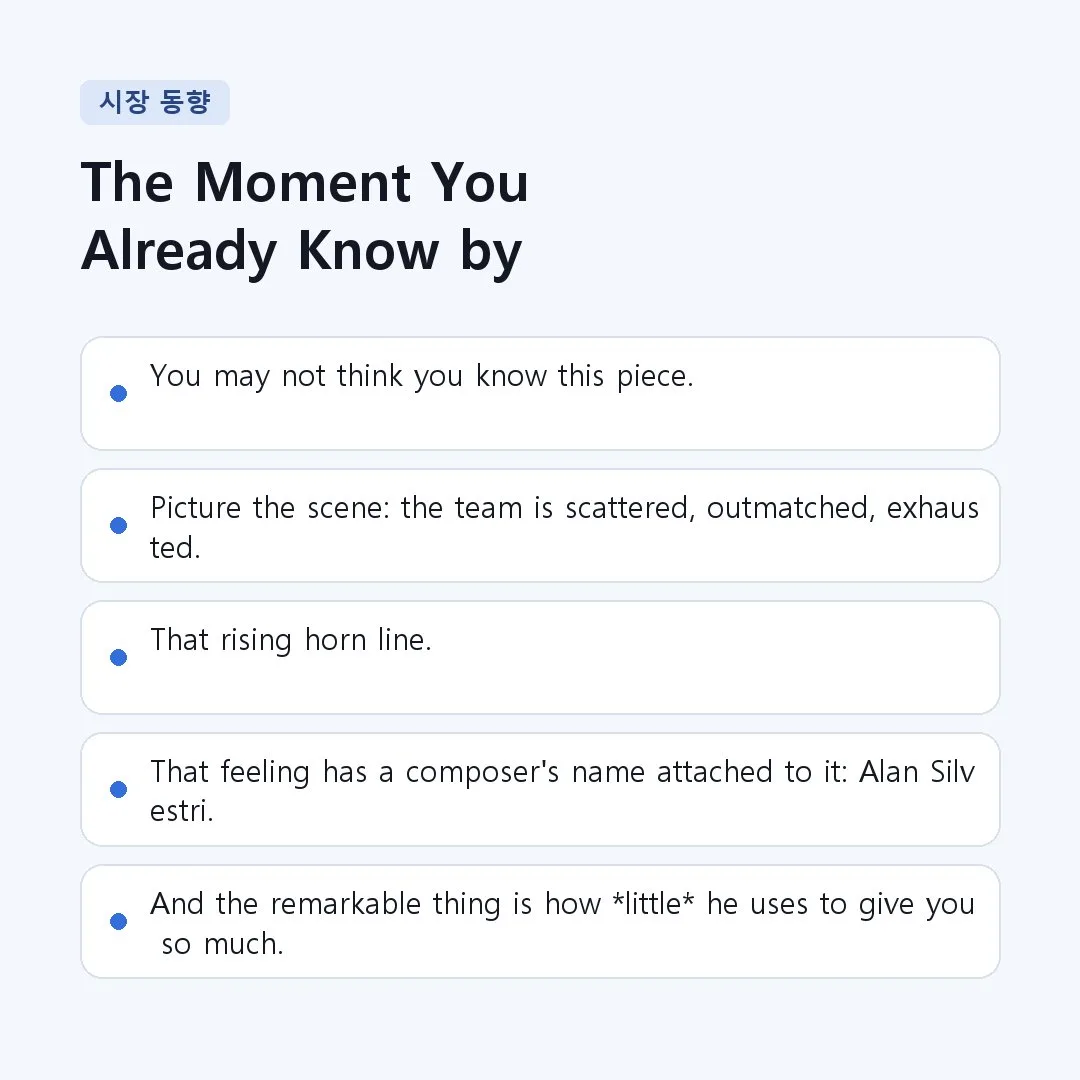
You may not think you know this piece. But you do.
Picture the scene: the team is scattered, outmatched, exhausted. Then the camera pulls back, they stand together in a slow circle, and—there it is. That rising horn line. Five, six notes climbing upward, and suddenly your chest tightens and you believe, against all reason, that everything is going to be okay.
That feeling has a composer’s name attached to it: Alan Silvestri. And the remarkable thing is how little he uses to give you so much. No flood of notes, no wall of sound. Just a melody simple enough to hum after one listen, built to make an entire theater hold its breath at the same instant.
Let’s talk about why it works.

Who Is Alan Silvestri?
If you’ve sat through a movie in the last forty years, Silvestri has probably already gotten under your skin without you realizing it.
Born in New York in 1950, he became one of Hollywood’s most quietly dominant composers through a long partnership with director Robert Zemeckis. That’s his music racing alongside the DeLorean in Back to the Future, his playful whistle following Forrest Gump down the road, his orchestra swelling through Cast Away and The Polar Express. He has a gift that not every composer shares: he writes melodies that ordinary people remember, the kind you find yourself humming in the grocery store.
When Marvel needed a single piece of music to represent its biggest gamble—a film that crammed half a dozen heroes into one story—they turned to Silvestri. The challenge was enormous. How do you write one theme that belongs to everyone and no one, that feels heroic without belonging to a single character?
The Background: A Theme for a Team
Here’s the problem Silvestri had to solve in 2012.
Before The Avengers, each hero arrived with their own musical identity from their own movie. Iron Man had a rock-flavored edge. Captain America had a noble, old-fashioned march. Asking these separate worlds to share a single film meant the music needed something none of them had alone: a sound for togetherness.
Silvestri’s answer was to build a melody that climbs. The theme doesn’t sit still or strut—it ascends, note by note, like people rising to their feet. It’s deliberately uncomplicated, almost like a folk tune or an anthem, because anthems are meant to be shared. A complicated melody belongs to one virtuoso. A simple, rising one belongs to a crowd.
That decision is why the theme can show up quietly on a lone piano in one scene and then explode across a full brass section in another, and feel like the same idea each time. It’s built to grow.
How to Listen: What to Notice
You don’t need to read music to hear what makes this special. Here are a few anchors to listen for.
The climb. The core melody moves mostly upward. In everyday emotional terms, rising pitch tends to feel like hope, effort, lifting off the ground. Silvestri leans on this completely. When the theme reaches its peak, it’s the musical equivalent of a hero finally standing tall.
The brass. The melody lives in the horns and trumpets—instruments we instinctively associate with announcements, fanfares, and arrival. Think of how a trumpet sounds when royalty enters a room. That’s the emotional shorthand Silvestri is borrowing: something important is happening.
The restraint. Notice the silences and the spaces. The theme often holds back, letting a few notes hang in the air before the full orchestra commits. That patience is what makes the eventual payoff land so hard. If the music gave you everything at once, you’d have nothing to wait for.
The build. Listen to how the same melody returns louder, fuller, more layered as a scene escalates. This is a classic film-scoring trick: take a simple idea and keep adding instruments around it, so the music seems to gather strength exactly when the heroes do.
Where to Start Listening
A few entry points, depending on what you’re after.
For the definitive version, find “The Avengers” track from the original 2012 soundtrack album (The Avengers: Original Motion Picture Soundtrack). This is the full statement of the theme as Silvestri intended it, with all its rise and release intact.
For a different flavor, look up live orchestral concert performances of the theme—many symphony orchestras now program film music, and hearing this piece played by a hundred musicians in a hall reveals just how much power lives in that brass section. The energy of a live audience makes the heroism feel almost physical.
And for the curious, compare Silvestri’s quiet, piano-led statements of the melody within the film score against the full-orchestra finale. Hearing the same handful of notes whispered and then shouted is the best way to understand what makes the writing so smart.
Why a Simple Melody Stays With Us
There’s a lesson hiding inside this theme that goes beyond superheroes.
We often assume that powerful music must be complicated—dense, virtuosic, hard to play. But Silvestri proves the opposite. He took a few rising notes, handed them to a section of horns, and built a feeling that millions of people now carry around in their memory, ready to surface the moment that melody returns.
That’s the strange magic of a great theme. It asks almost nothing of you. You don’t need to know the composer’s name or understand a single thing about harmony. You just hear those notes climb, and something in you stands up to meet them.
So the next time that rising line catches you off guard, you’ll know what’s happening. Six notes, a wall of brass, and a composer who understood that the simplest melodies are the ones we never let go of.