📑 Table of Contents
There is a particular kind of feeling that doesn’t have a name. It isn’t quite sadness, and it isn’t quite longing. It’s the ache you feel watching rain slide down a window, or the weight that settles in your chest at the end of a long day when nobody’s around to ask how you are. Most of us don’t have words for it. Rachmaninoff did — except his words were a cello and a piano.
The Andante from his Cello Sonata is roughly six minutes of pure, unguarded emotion. The piano begins alone, laying down a bed of soft, rolling chords, and then the cello enters — not loudly, not dramatically, but the way a close friend might finally speak after sitting with you in silence. If you’ve never listened to chamber music before, start here. You don’t need to understand a single thing about music theory to feel what this movement is doing. It bypasses the brain entirely and goes straight to the place where your unnamed feelings live.
A Man Who Knew What It Meant to Fall, and Rise
To understand why this music sounds the way it does, you have to know one thing about Sergei Rachmaninoff: he had recently come back from the dead, artistically speaking.
A few years earlier, the premiere of his First Symphony had been a catastrophe — savaged by critics, possibly conducted by a drunk, and crushing enough that Rachmaninoff fell into a depression so deep he stopped composing almost entirely. He sought help from a physician named Nikolai Dahl, whose treatment (a mix of hypnosis and steady encouragement) slowly drew him back to the piano. The result of that recovery was his Piano Concerto No. 2, one of the most beloved works ever written for the instrument.
And here is the detail that makes the Cello Sonata so moving: Rachmaninoff wrote it in 1901, the very same year as that triumphant concerto. The Sonata carries the same DNA — the same long, surging melodies, the same emotional honesty of a man who had been to the bottom and climbed back out. The Andante’s central melody is so similar in spirit to the concerto that listening to one will make you hear echoes of the other.
Not Really a “Cello” Sonata at All
Here’s a small surprise that changes how you hear the piece. Rachmaninoff didn’t think of this as a cello solo with piano backup. He was one of the greatest pianists who ever lived, and he gave the piano an equal voice — sometimes even the leading one. Throughout the work, the piano introduces the melodies first, and the cello then takes them up, elaborates on them, and pours emotion into them.
So as you listen to the Andante, don’t just follow the cello. Listen to the conversation. The piano offers a phrase; the cello answers. They overlap, they hand the melody back and forth, they build together toward something larger than either could say alone. It’s less a solo and more a duet between two people who understand each other completely. The work was premiered in Moscow in December 1901, with Rachmaninoff himself at the piano and his close friend, the cellist Anatoliy Brandukov, to whom the piece is dedicated.
How to Listen: A Guide for Your First Time
You don’t need to “do” anything to enjoy this music, but a few landmarks can make the experience richer.
The opening (0:00–1:00): Notice how the piano sets the scene alone before the cello enters. That entrance is the emotional doorway — the moment the movement starts to speak. Let yourself sink into it.
The main melody: This is the heart of the piece, one of the most heartfelt tunes Rachmaninoff ever wrote. It rises and falls like breathing, or like waves. You’ll likely find yourself holding your breath at its peaks.
The middle (the climax): About halfway through, the music swells and intensifies. The piano grows stormier, the cello reaches higher and more urgently. This is the emotional release — the part where the unnamed feeling finally crests and overflows. Don’t resist it.
The return and the close: The opening melody comes back, but now it feels different — softened, resigned, at peace. The movement doesn’t end with a bang. It simply settles, like exhaling after a long cry. You may notice your shoulders drop.
If you’re listening alone at night, with the lights low, you’ll hear it best. This is music made for solitude.
Where to Begin: Recordings Worth Your Time
A few interpretations to guide your first listens, each with its own character:
Yo-Yo Ma and Emanuel Ax — A warm, beautifully balanced recording that’s ideal for newcomers. Ma’s cello tone is rich and singing, and the partnership with pianist Emanuel Ax captures exactly the conversational quality Rachmaninoff intended. If you want one version to start with, this is it.
Mstislav Rostropovich — The legendary Russian cellist brought a grand, deeply Romantic intensity to this music. His interpretations are weightier and more dramatic, perfect once you’ve fallen in love with the piece and want to feel its full emotional scale.
Steven Isserlis and Stephen Hough — For listeners who want detail and nuance, this pairing of a thoughtful cellist with a brilliant pianist brings out the inner conversation between the two instruments with remarkable clarity.
Search for any of these on your streaming service of choice and simply look for “Cello Sonata Op. 19, III. Andante.” Most full recordings of the Sonata place this movement third.
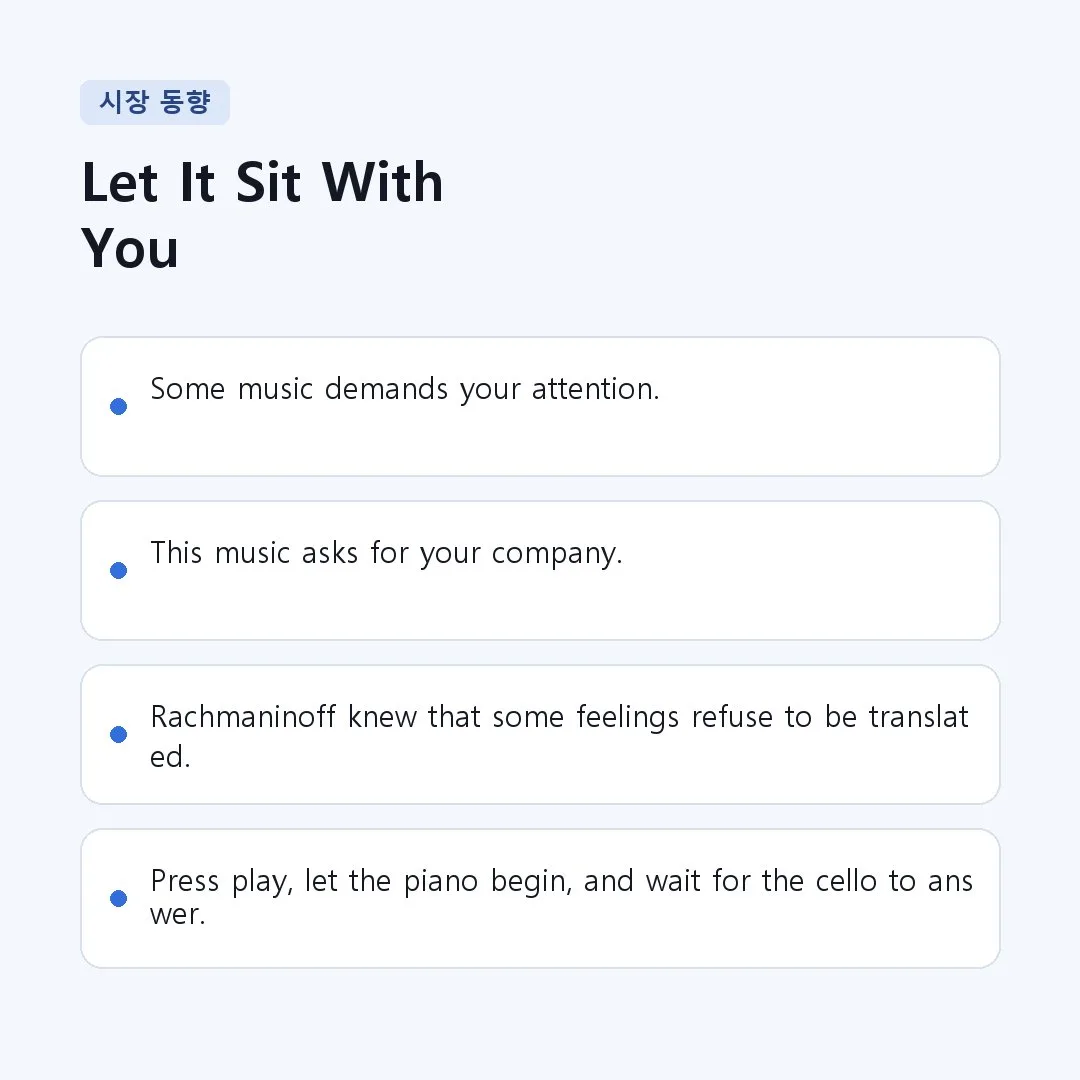
Let It Sit With You
Some music demands your attention. This music asks for your company. The Andante doesn’t try to dazzle you or impress you — it just sits beside you and gives voice to the things you’ve been carrying quietly.
We live in a world that often asks us to explain how we feel, to put it into neat words, to be fine. Rachmaninoff knew that some feelings refuse to be translated. He wrote this movement for those moments — for the ache without a name, for the night when you don’t want to talk but you don’t want to be alone either. Press play, let the piano begin, and wait for the cello to answer. It always does.