📑 Table of Contents
Imagine sitting at a keyboard, your right hand playing one tune and your left hand playing a different one at the same time — yet somehow the two never crash. Instead, they seem to be talking, finishing each other’s thoughts, taking turns leading and following. That conversation is exactly what Bach’s Invention No. 1 sounds like, and it’s over in barely a minute and a half.
If you’ve ever felt that classical music is a locked room with no entrance, this little piece is one of the friendliest doors you’ll find. It asks nothing of you except curiosity, and it rewards you with one of the clearest, most satisfying musical ideas ever written.
Who Was Bach, and Why Did He Write This?
Johann Sebastian Bach (1685–1750) was a German composer and organist who spent most of his life working for churches and aristocratic courts. He was famous in his own time mostly as a brilliant performer, and his reputation as one of the greatest composers in history grew enormously only after his death. He raised a large family, and several of his sons became important musicians themselves.
The Inventions were born out of that family life. Around 1723, Bach assembled a set of fifteen short two-voice keyboard pieces (and fifteen companion three-voice pieces, called Sinfonias) as teaching material for his eldest son, Wilhelm Friedemann, and his other students. In a preface, Bach explained his goal plainly: he wanted students to learn to play cleanly with both hands, to develop good musical ideas, and above all to acquire a “cantabile” — singing — style of playing. In other words, he wasn’t just drilling finger exercises. He was teaching young musicians how to think in music.
That dual purpose is why these pieces still feel alive three hundred years later. They’re educational, but they’re also genuinely beautiful.
The Idea Behind the Music: A Game of Echoes
Here’s the simplest way to understand what’s happening in Invention No. 1. The piece opens with a short, bright phrase in the right hand — just a quick run of notes that feels like a question being asked. Almost immediately, the left hand answers with the very same phrase, a beat later and lower in pitch. This technique, where one voice imitates another, is called imitation, and it’s the engine that drives the entire piece.
Think of it like two people singing a round, such as “Row, Row, Row Your Boat.” One voice starts, the second voice enters with the same melody slightly behind, and the magic comes from how the overlapping lines fit together. Bach takes that basic idea and develops it with astonishing economy: nearly every note in this Invention grows out of that opening figure. He flips it upside down, passes it between the hands, and moves it through different keys, all without ever sounding repetitive.
This is the Baroque era’s love of order and pattern in action — but instead of feeling mechanical, it feels like watching a master juggler who never drops a ball.
How to Listen: A Guide for Your First Time
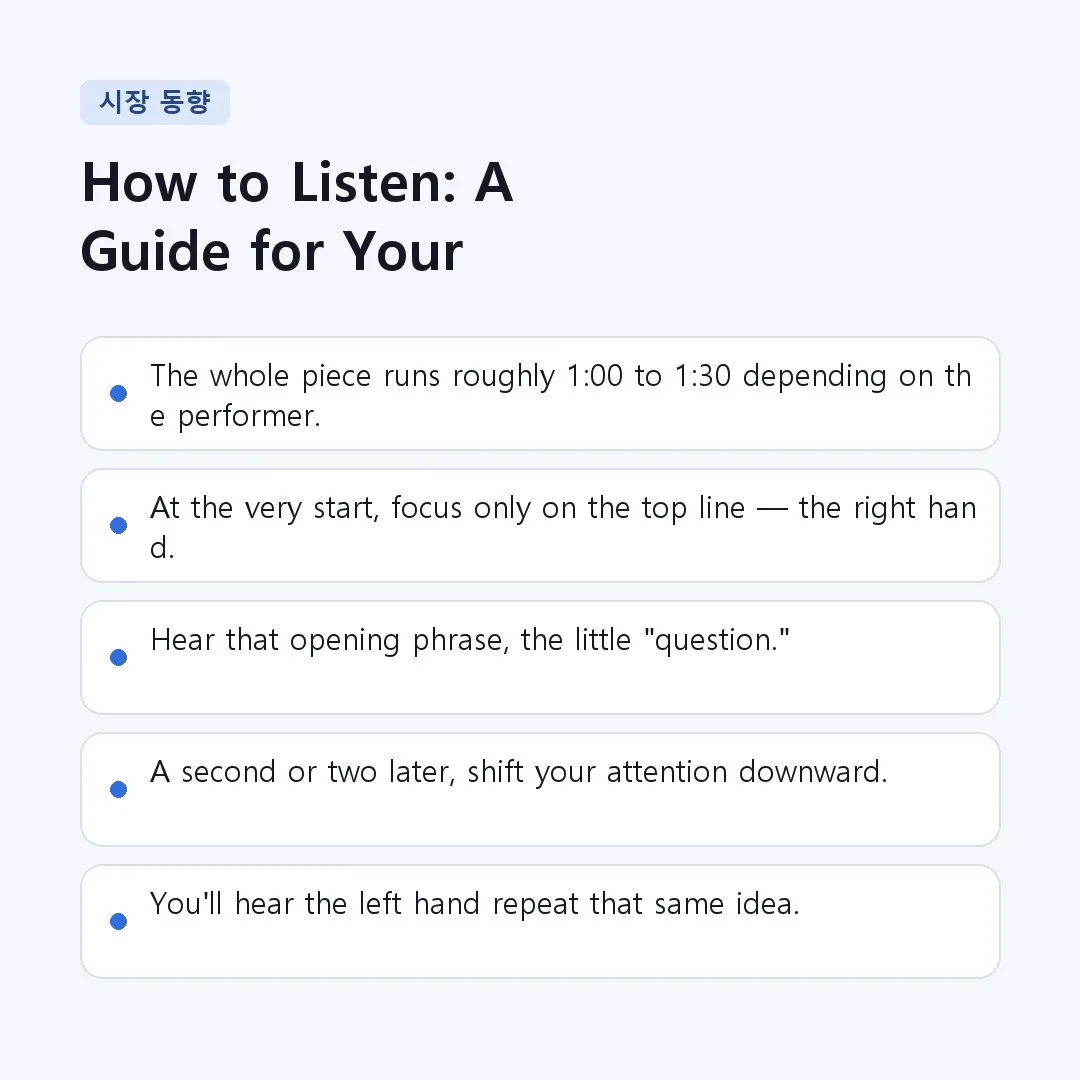
You don’t need any training to enjoy this, but a few anchors will deepen the experience. The whole piece runs roughly 1:00 to 1:30 depending on the performer.
At the very start, focus only on the top line — the right hand. Hear that opening phrase, the little “question.”
A second or two later, shift your attention downward. You’ll hear the left hand repeat that same idea. Once you catch this echo, you’ve understood the heart of the piece.
In the middle section, notice how the music briefly travels into different “moods” or keys — there’s a passage where things feel slightly more shadowed or uncertain before brightening again. This is Bach moving the same material through new harmonic territory.
Toward the end, the two voices draw back together and the piece lands firmly, like a sentence reaching its period.
Try listening twice: once following the right hand, once following the left. The second time, you’ll hear melodies you completely missed before. That shift — from hearing one tune to hearing two independent conversations — is the single most rewarding skill in all of classical listening, and this piece teaches it better than almost anything.
Recordings Worth Your Time
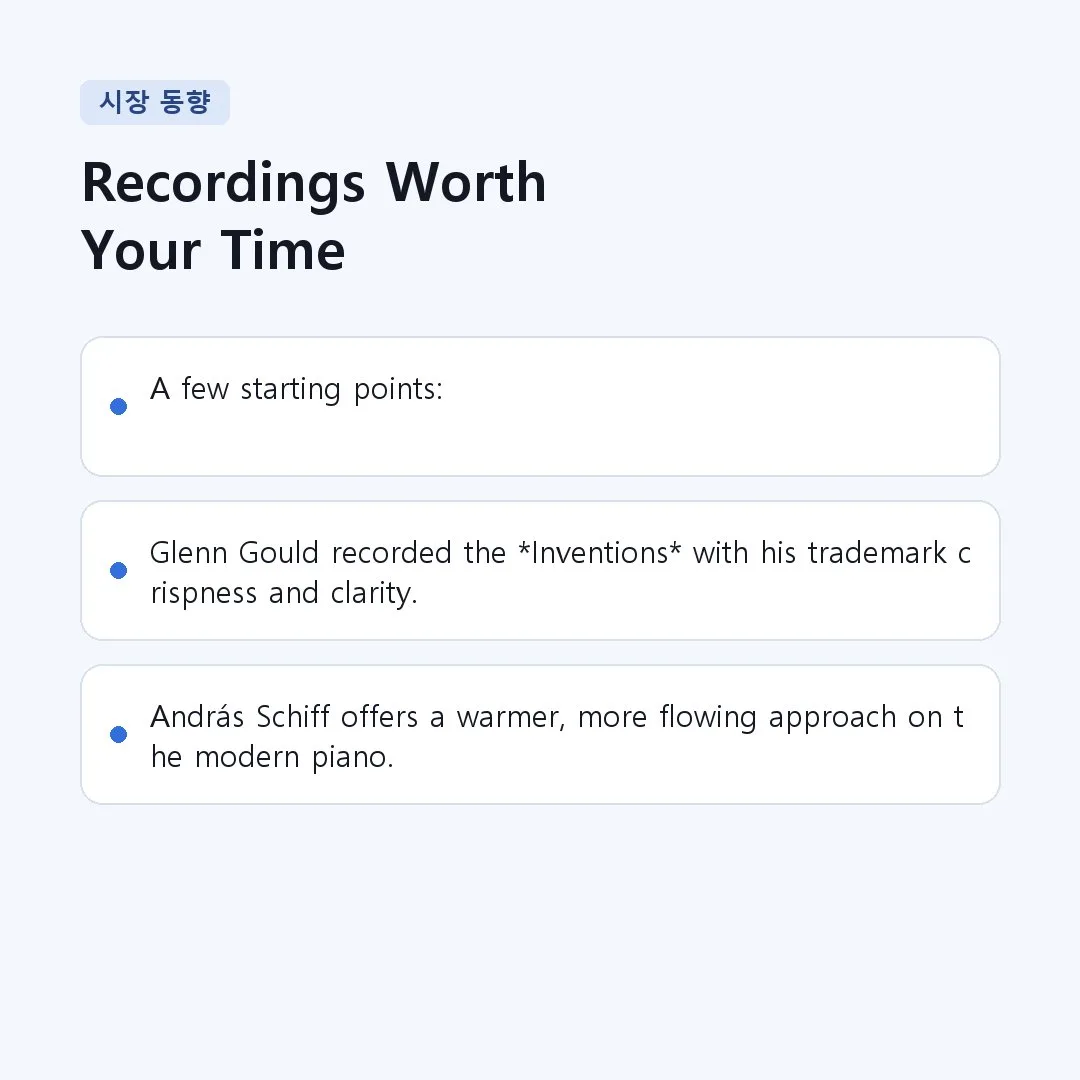
The beauty of this piece is that very different interpretations all work, because the writing is so solid. A few starting points:
Glenn Gould recorded the Inventions with his trademark crispness and clarity. Every voice is razor-sharp and distinct, which makes his version almost like an X-ray of the music — ideal if you want to clearly hear the two-hand conversation. Be aware he sometimes hums along, which listeners either love or find distracting.
András Schiff offers a warmer, more flowing approach on the modern piano. His playing has a gentle, singing quality that fits Bach’s stated goal of a “cantabile” style beautifully, making it a lovely choice for relaxed listening or focused work.
For a period-instrument experience, look for recordings on the harpsichord, the instrument Bach himself likely had in mind. Players like Kenneth Gilbert or Christophe Rousset reveal a brighter, more percussive texture that brings out the music’s dancing energy and historical character.
If you only have time for one listen, search for any clear piano recording and simply enjoy how two hands manage to hold a complete conversation in under two minutes.
Why This Tiny Piece Stays With You
There’s something quietly moving about the fact that one of history’s greatest musical minds poured this much craft into a teaching piece for his children. Invention No. 1 carries no grand drama, no thundering climaxes — just two voices, listening and responding to each other with perfect balance.
Maybe that’s why it works so well as music for focus or for clearing a cluttered mind. It models a kind of attentive, generous dialogue, the sort we all wish we had more of. Three centuries on, Bach’s small lesson still teaches us how to listen — and once you’ve learned, you’ll hear those overlapping voices everywhere.